
GameStop's Transformation Fuels Collectibles Surge and Capital Discipline
The company's strategic shift towards collectibles and disciplined capital management drove a strong profitability rebound despite declines in traditional retail sales.
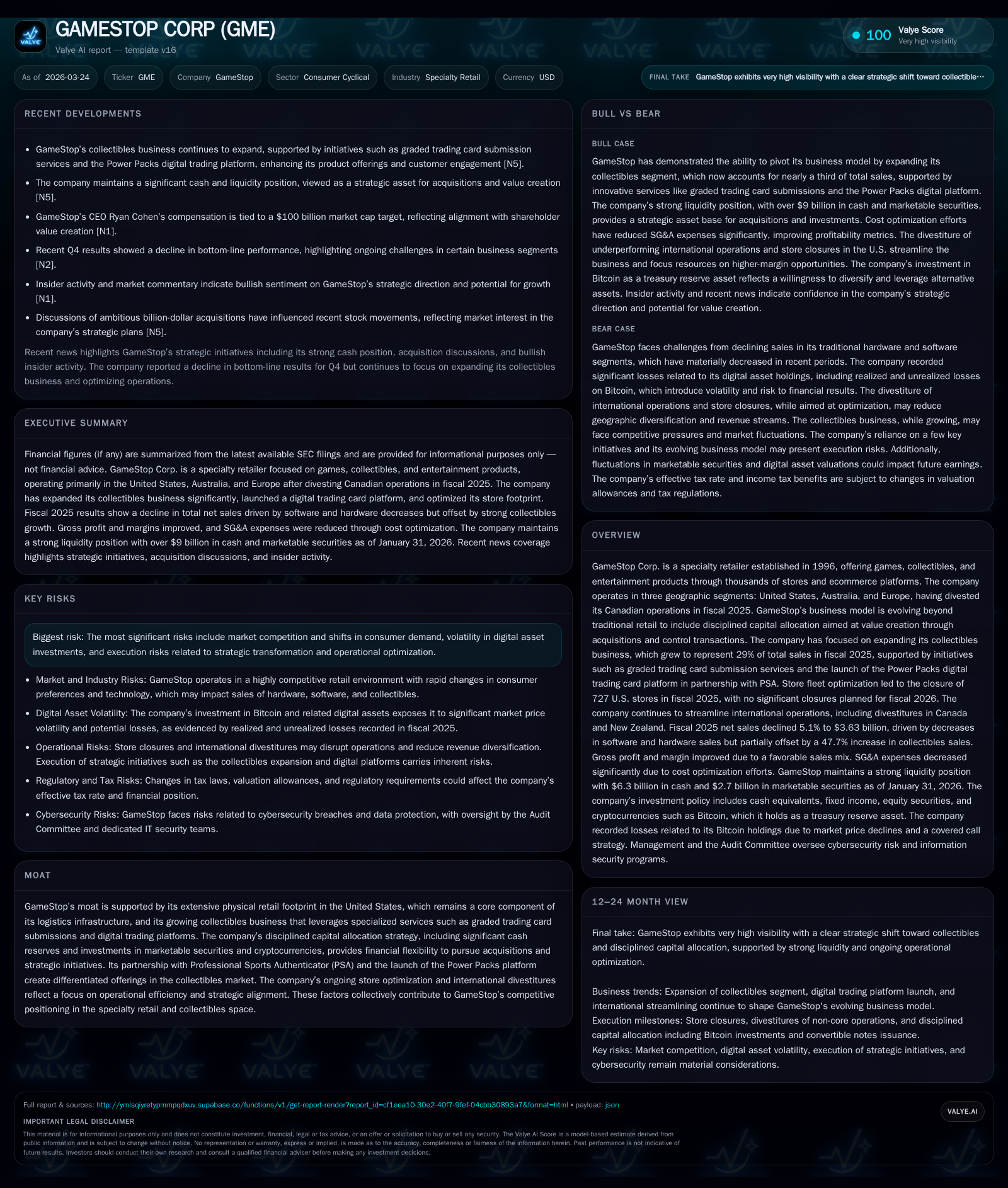
GameStop Corp. experienced a notable transformation in fiscal 2025, highlighted by a 5.1% revenue decline offset by a near tenfold operating income increase and a 219% net income jump. This turnaround was fueled primarily by the expansion of its high-margin collectibles segment, now comprising nearly 30% of sales, alongside aggressive store closures and international portfolio realignment. Supported by over $6.3 billion in cash and disciplined capital allocation—including $4.2 billion raised via zero-coupon convertible notes—GameStop fortified liquidity while maintaining no share repurchases and modest capital expenditure. Moving forward, growth hinges on scaling digital trading platforms like Power Packs amid risks from digital asset volatility and shifting consumer demand.
Historic Revenue Decline Meets Profitability Turnaround in FY2025
GameStop Corp.'s fiscal year ended January 31, 2026 (FY2025) marked a pivotal inflection point: although consolidated net sales declined 5.1% YoY to $3.63 billion [F1][S1], the company swung from operating losses of -$26.2 million in FY2024 to a robust operating income of $232.1 million—a nearly tenfold improvement [F1]. Net income leapt even more dramatically by 218.7%, reaching $418.4 million [F1]. This pronounced financial rebound arose chiefly from stringent cost controls, reduced SG&A expenses by nearly $220 million (a 19.5% cut), asset impairments associated with divestitures, and enhanced profitability stemming from sales mix shifts toward higher-margin collectibles [S1][S16]. Notably, the gross profit margin improved significantly by almost four percentage points to 33%, underscoring these mix effects.
The decline in revenues was reflective of structural headwinds facing GameStop's traditional hardware and software segments—a combined drop exceeding $530 million [S20]—and intensifying competition within specialty retail. However, the company’s decision to expedite closure of underperforming stores mitigated fixed cost burdens; FY2025 saw the shuttering of 727 U.S. locations alone [S16], building on prior years' efforts.
Historical performance (annual)
| FY | Rev ($bn) | Net ($mm) | CFO ($mm) | OpInc ($mm) | Rev YoY | Net YoY |
|---|---|---|---|---|---|---|
| 2025 | 3.6 | 418 | 615 | 232 | -5.1% | +218.7% |
| 2024 | 3.8 | 131 | 146 | -26 | -27.5% | +1859.7% |
| 2023 | 5.3 | 7 | -204 | -34 | -11.0% | +102.1% |
| 2022 | 5.9 | -313 | 108 | -312 |
Source: SEC companyfacts cache [F1].
Capital returns and efficiency (annual)
| FY | FCF ($mm) |
|---|---|
| 2025 | 597 |
| 2024 | 130 |
| 2023 | -239 |
| 2022 | 52 |
Source: SEC companyfacts cache [F1].
- Large declines mainly due to strategic divestitures impacting prior periods [F1].
Collectibles Expansion: The New Engine for Growth and Margin Improvement
The collectibles segment emerged as the centerpiece of GameStop’s operational turnaround strategy during FY2025, expanding its contribution from approximately 19% to nearly 29% of total company sales [S1][S16]. This expansion translated into a nearly $342 million increase year-over-year—a remarkable gain amid overall revenue pressure [S20]. Crucially, collectibles comprise trading cards that are graded for authenticity and preservation state—a category boasting significantly higher gross margins than hardware or software.
GameStop leveraged several specialized initiatives to capture this upside:
- The nationwide rollout of graded trading card submission services at all U.S. stores enabled customers to easily submit premium cards for authentication through PSA (Professional Sports Authenticator), creating stickier consumer engagement.
- Expansion of store floor space dedicated exclusively to collectibles facilitated richer inventory displays aligned with collector preferences.
- Launching the Power Packs platform in partnership with PSA introduced a first-of-its-kind digital trading card ecosystem where authenticated cards are securely vaulted digitally yet remain actively tradable or shippable on demand [N1][S1].
These service lines reflect sector-native strategies typical of premium collectible marketplaces aiming for recurring revenue streams beyond one-off physical goods sales.
Retail Store Optimization and Geographic Portfolio Realignment
A core pillar underpinning GameStop’s operational efficiency has been aggressive store fleet optimization coupled with selective international portfolio trimming [S16]. In FY2025 alone, management took the significant step of closing nearly one-third (727) of its U.S.-based stores amid ongoing reviews factoring market conditions and individual location performance [S1][S16]. These closures yielded meaningful rent savings and related occupancy overhead reductions.
Internationally, GameStop divested its Canadian operations entirely during Q2 FY2025 after initiating exit plans earlier in the year; it also ceased New Zealand operations over this timeframe [S1][S16]. Europe likewise saw net store count decline due to prior-year exits including Italy and Germany closures impacting revenues notably [S20].
Despite these contractions, GameStop emphasized maintaining its U.S. retail footprint strategically as it remains integral not just as direct sales points but also as logistics hubs supporting omnichannel fulfillment — a moat fostering competitive advantage through physical-digital integration [S16].
Capital Allocation Strategy: Convertible Notes, Cash Reserves, and No Buybacks
Fiscal year 2025 reflected transformative capital structure developments for GameStop highlighting disciplined capital deployment aligned with strategic priorities:
- The company completed private placements totaling approximately $4.2 billion through zero-coupon convertible senior notes issued at zero interest due between 2030–2032 [S4][S21]. These convertibles provide long-duration funding without conventional coupon cash flow burdens.
- Concurrently, GameStop generated over $319 million in net interest income on elevated cash balances invested across money market funds, government securities, commercial paper, and short-term instruments per its Board-approved Investment Policy which includes selective Bitcoin treasury reserve positioning totaling ~4,710 BTC purchased for ~$500 million during FY2025 [S6][S19].
- As of January 31, 2026, unrestricted cash plus marketable securities summed to slightly over $9 billion, yielding an extraordinarily healthy current ratio around 15x—an indicator of robust short-term liquidity capacity [F1][S18].
- Notably absent were any share repurchases despite an existing authorization permitting up to $101 million in buybacks remaining unused [S8][F1]. Capital returned directly via dividends remains nil historically [F1], consistent with reinvestment emphasis.
- Capital expenditures were tightly controlled at only $17.5 million (up marginally vs prior year), suggesting prioritization of free cash flow generation over reinvestment into physical infrastructure given ongoing retail contraction trends [F1][S24].
This conservative financial stewardship reflects risk-aware investment while preserving flexibility for acquisitions or other opportunistic corporate actions outlined as objectives by management [S8].
Liquidity and Balance Sheet Strength: Safeguarding Flexibility Amid Uncertainty
Beyond record-level cash reserves, GameStop exhibits prudent oversight over its balance sheet risks particularly surrounding digital asset exposure:
- The company reported losses on digital assets totaling $131.6 million during FY2025 arising from unrealized markdowns on Bitcoin valuations plus realized impacts from covered call option strategies involving pledged Bitcoin collateral positions at Coinbase Credit Inc., consistent with their treasury management approach designed to monetize some upside while retaining underlying crypto exposure [S6][S11].
- Governance structures around cybersecurity risks were strengthened with dedicated IT security leadership averaging over a decade of specialist experience reporting directly to Audit Committee oversight—critical given evolving e-commerce transactional data volumes inherent in collectibles marketplaces [S10][S1].
Collectively these factors contribute to safeguarding financial flexibility amidst external uncertainties including volatile crypto markets and fast-changing consumer tastes.
Forward-Looking Considerations: Innovation in Digital Platforms and Market Risks
While explicit company guidance is absent for upcoming fiscal periods beyond descriptions of strategic intent [N3][S1], key milestones center around scaling their innovative Power Packs beta platform—which introduces a novel intersection between physical collectible authentication/storing and instant secondary marketplace liquidity—for potentially driving deeper collectible segment penetration.
However, growth drivers face simultaneous constraints:
- Digital asset investment volatility poses earnings variability risk especially should cryptocurrency valuations substantially deteriorate further affecting valuation marks or collateral arrangements [S10].
- Competitive pressures remain intense not only from online pure-play retailers but also evolving gamer preferences towards subscription-based or fully digital entertainment content potentially diminishing physical game purchases [N3][N8].
- Operational discipline must continue as previous store closure impacts subsist; resumption or acceleration thereof may affect revenue base even if improving margins structurally.
What to Watch: Future Earnings Drivers and Execution Risks
Investors should monitor the balance management strikes between expanding collectibles—which currently exhibit margin accretive characteristics—and sustaining or evolving its traditional retail business model that still contributes significant revenues primarily from the U.S.[N3][N8][S10]. Key indicators include:
- Rate of adoption & monetization scale within the Power Packs ecosystem alongside measurable acceptance among PSA-authenticated collectors.
- Potential re-entry into share repurchases or dividend distributions signaling confidence in sustainable cash flow generation versus ongoing capitalization for acquisitions or investments.
- Management responses to competitive dynamics including pricing strategies across hardware/software segments as well as collectible categories.
- Developments around digital asset holdings including recognition of losses or gains depending on cryptocurrency market conditions affecting treasury valuations.
Execution risk will remain elevated due mainly to this multi-faceted transformation trajectory spanning retail contraction mitigation balanced against modern collectibles innovation platforms reliant on technical infrastructure maturity and consumer engagement latency.
This analysis is based solely on publicly available SEC filings ([F1], [S#]) and recent news reports ([N#]) without extrapolation beyond documented figures or investor guidance disclosures provided therein. It aims to provide comprehensive insight into GameStop Corp.'s recent operational evolution and outlook from a fundamental perspective rather than investment advice.
Disclaimer: This is research-only, informational analysis and not investment advice. It may include AI-generated interpretation and general industry context. Always verify important details using primary sources.

Comments