
Bionano Genomics Confronts Liquidity Constraints Despite Optical Genome Mapping Adoption Growth
Revenue growth moderates as the company struggles with liquidity challenges while expanding its genome analysis platform.
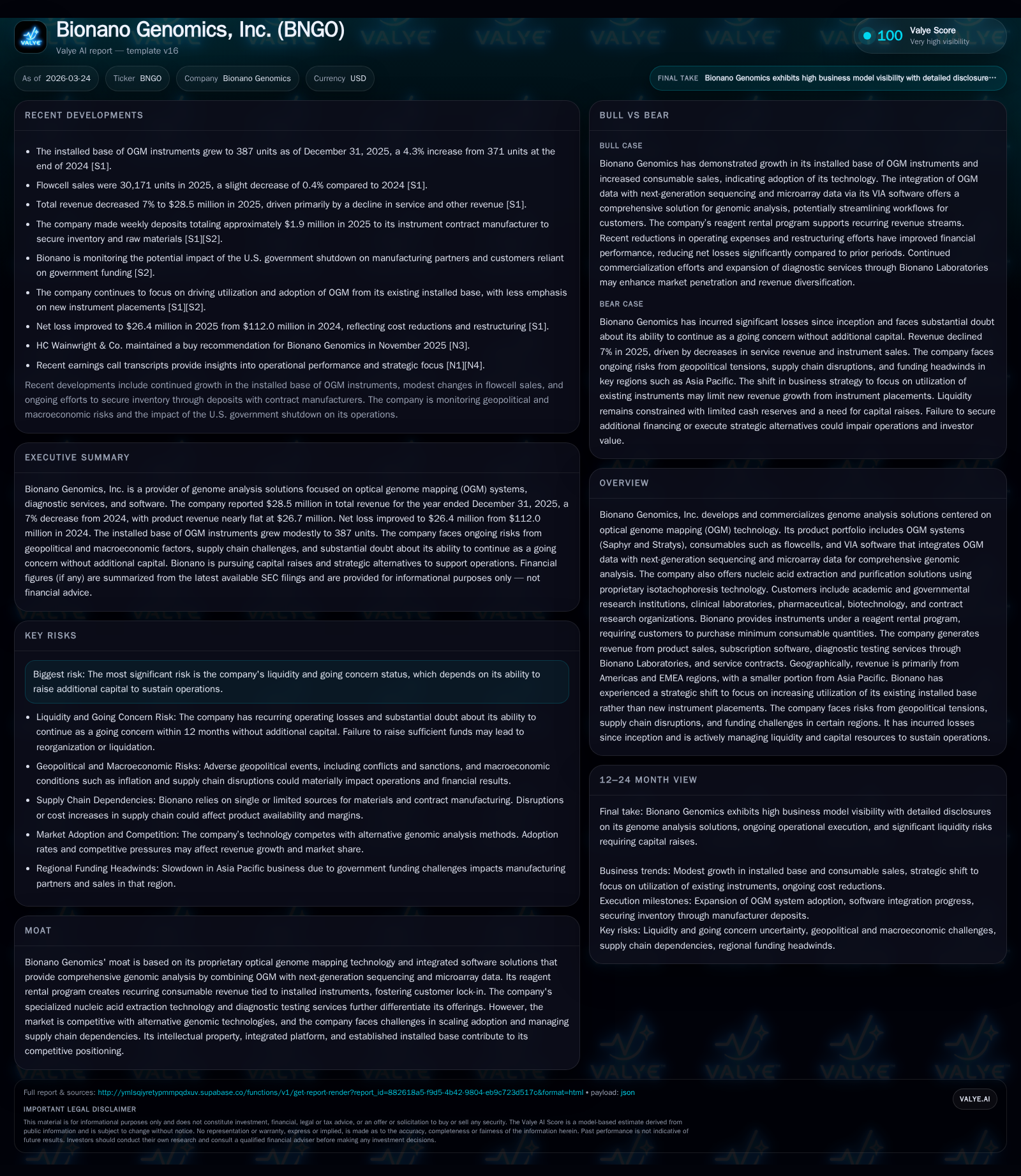
Bionano Genomics has incrementally expanded its installed base of optical genome mapping systems and sustained stable consumable sales, underpinned by a reagent rental model fostering recurring revenues. However, overall revenue contracted year-over-year for 2025 while operating losses narrowed significantly from prior years amid restructuring efforts. The company faces substantial liquidity risks, with cash reserves insufficient beyond early 2027 under current plans and ongoing operational deficits. Bionano’s competitive moat is built on proprietary OGM technology and integrated software but scaling adoption in a competitive genomics market and navigating capital needs remain material challenges.
Company Overview
Bionano Genomics, Inc. operates in the genomics technology sector, focusing on optical genome mapping (OGM) solutions for comprehensive genome analysis. Its platform includes the Saphyr and Stratys OGM systems, consumables such as flowcells for DNA linearization, the VIA software that integrates sequencing and microarray data into consolidated genomic views, proprietary nucleic acid extraction technology based on isotachophoresis (ITP), and diagnostic testing services delivered via Bionano Laboratories [S1]. Customers span academic/government research institutions, clinical labs, pharmaceutical and biotech firms along with contract research organizations.
Bionano's commercial model comprises direct instrument sales plus a reagent rental system where customers commit to minimum consumable purchases fostering recurring revenue streams attached to its installed instrument base.
Past Growth and Historical Performance
Revenue and Adoption Trends
In the year ended December 31, 2025, Bionano generated total revenues of approximately $28.5 million, down about 7.4% compared to roughly $30.8 million in 2024 [S5][S20][F1]. Product revenues constituted $26.7 million of this total (vs. $27 million in prior year), with service revenues also declining to around $1.8 million from $3.8 million [S5][S20]. These declines reflect macroeconomic impacts including geopolitical tensions affecting Asia Pacific markets causing headwinds [S1][S2].
The installed base of OGM instruments rose modestly by about 4.3% from 371 at the end of 2024 to 387 units at the end of 2025 [S1]. Concurrently, annual sales of flowcells, essential consumables that enable genome mapping analyses per sample, remained essentially flat decreasing just slightly by 0.4% from about 30,307 units sold in 2024 to roughly 30,171 units in 2025 [S1]. Within partial periods during 2025 there were increases quarter-over-quarter reflecting gradual uptake.
This pattern indicates growing customer adoption but tempered by macroeconomic headwinds limiting broader expansion.
Profitability and Cash Flow
Historically a company investing heavily in R&D and commercialization efforts since inception, Bionano posted an operating loss of approximately -$33.3 million for fiscal year (FY) 2025—a significant improvement from the -$104 million operating loss recorded the prior year—and net losses declined similarly from about -$112 million in FY24 down to -$26.4 million in FY25 [F1].
Operating cash flow remained negative at roughly -$16.3 million but improved markedly versus -$68.9 million in FY24 [F1]. Such improvement aligns with cost-cutting restructuring measures executed starting early-2024 including workforce reductions totaling over two hundred employees as well as discontinuing some lower-margin diagnostic services within Bionano Laboratories [S18]. Capital expenditures have been minimal or zero recently reflecting tight financial discipline [F1].
The substantial narrowing in losses indicates progress toward managing overheads but consistent negative cash flow sustains liquidity concerns.
Historical performance (annual)
| FY | Net ($mm) | CFO ($mm) | OpInc ($mm) | Net YoY |
|---|---|---|---|---|
| 2025 | -26 | -16 | -33 | +76.4% |
| 2024 | -112 | -69 | -104 | +51.8% |
| 2023 | -232 | -125 | -215 | -75.3% |
| 2022 | -133 | -125 | -132 |
Source: SEC companyfacts cache [F1].
Capital returns and efficiency (annual)
| FY | ROE% |
|---|---|
| 2025 | -59.4 |
| 2024 | -316.7 |
| 2023 | -241.8 |
| 2022 | -53.2 |
Source: SEC companyfacts cache [F1].
Note: Revenue YoY computed between FY24-FY25 only; other YoY changes approximate.
Future Growth Prospects
Bionano identifies its primary growth markets as cytogenetics laboratories globally (approximately 10,000 labs analyzing ~10 million samples annually excluding developing regions) and cell and gene therapy research sectors encompassing about 1,400 pharmaceutical/biotech companies [S1]. The economic potential for OGM-based solutions is estimated near $10 billion annually across these domains with around $3 billion attributed specifically to cell/gene therapy applications.
Additional growth could stem from expansion into broader pathology segments such as newborn screening and neurological/cardiological risk assessment where OGM could streamline workflows by reducing reliance on multiple technologies [S1]. Furthermore, VIA software integration enhances value through consolidated genomic interpretation underpinning next generation sequencing (NGS) analysis workflows.
Despite these opportunities, challenges include limited commercial scale adoption particularly beyond research-use-only applications currently targeted by Bionano’s products [S6], competition from alternative genomic technologies offering different capabilities or cost structures, supply chain dependencies especially for components in consumables [S13], plus macroeconomic uncertainties impacting global sales.
Forecasts and Milestones
No explicit quarterly or annual revenue or profitability guidance was provided in the most recent earnings release or filings [N1][S3].
However, management highlights ongoing efforts to ramp instrument placements via reagent rental programs requiring minimum consumables purchase commitments encouraging stable recurring revenue streams [S1]. Investment continues toward research enhancing existing products alongside potential future collaborations targeting expanded use cases.
Analysts should monitor Bionano’s quarterly reported installed base growth rates post-387 units exit-2025 levels, consumable flowcell sales trends with particular attention to Asia Pacific recovery or further slowdowns given past sluggishness [S2], adoption velocity outside current academic/government clients into commercial clinical lab markets as well as updates on any regulatory clearances permitting diagnostic labeling beyond RUO status.
Returns and Capital Allocation
Bionano exhibits an approximate negative return on equity near -59% based on latest annual net loss relative to equity recorded at fiscal year-end of about $44 million [F1], underscoring lack of profitability thus far.
Free cash flow remains negative given no capital expenditure outlays recently but ongoing operational cash usage limiting internal funding capacity [F1][S10]. The company has not declared dividends nor engaged significantly in buyback activity given capital preservation priorities amidst balance sheet constraints.
Capital raising efforts historically relied upon equity issuance via at-the-market offerings yielding gross proceeds of several tens of millions across recent years plus convertible debenture funding ($20M senior secured convertible debentures raised mid-2024 redeemed old debt instruments) enabling continued operations but dilutive effects persist for shareholders with no certainty around timing or terms for future financings if needed [S8][S9][S22][S26].
Liquidity Risks
Cash including equivalents plus short-term investments ended December 31, 2025 at approximately $29 million combined (accounting for restricted amounts related to debt issuance conditions). Management projects the current capital suffices only into first quarter of calendar year 2027 absent additional funding or meaningful operating improvements; otherwise substantial doubt exists about going concern status over next twelve months [S16][S17][S26].
The firm continues evaluating equity or debt financing options alongside stringent cost reduction initiatives addressing manufacturing scaling challenges amid geopolitical disruptions notably affecting Asia Pacific performance segments [S1][S2][S19]. Any failure securing timely capital infusions risks forcing curtailment or cessation of operations including potential bankruptcy proceedings with uncertain stakeholder recoveries [S18][S26].
Industry Context Analysis (Not company-specific)
OGM represents an innovative approach to structural variation detection surpassing limits inherent in short-read NGS techniques especially regarding large deletions/duplications and complex rearrangements common in cytogenetics diagnostics related to hematologic malignancies or constitutional disorders alike. A reagent rental model locking customers into purchasing consumables creates an annuity-like revenue stream while encouraging higher productivity through bundled pricing schemes—common practice among genomics instrumentation vendors seeking predictable revenue ahead of volume scalability.
Integration software like VIA addresses a key bottleneck: disparate data types complicate comprehensive variant interpretation requiring multi-layered analyses often performed manually or with suboptimal tools causing downstream delays impacting healthcare decisions or research conclusions.
However established players deploying sequencing platforms profitably dominate clinical genomics largely due to entrenched workflows validated over decades; thus achieving replacement disruptive technologies adoption is arduous without clear-cut clinical utility augmentations paired with cost efficiencies.
Conclusion Summary
Bionano Genomics has matured its optical genome mapping platform presence among research clients reflected by steady instrument placements and stable consumable unit sales yet encountered headwinds translated into revenue contraction during fiscal year ending December 31, 2025 compared with prior year levels. Despite operational loss improvements attributed partly to restructuring headcount reductions and elimination of certain service offerings beginning in early-to-mid-2024 periods, negative cash flows persist revealing sustained liquidity constraints placing material uncertainty on ongoing viability beyond early-2027 horizon absent additional financings or strategic interventions.
Its proprietary OGM technology coupled with integrated analytical software underpinning multi-data type consolidation represents distinctive differentiation supporting an estimated multibillion-dollar total addressable market aligned primarily around cytogenetics labs and growing cell/gene therapy R&D activity spheres; however conversion of this opportunity into scalable commercial returns remains unproven amid intensifying competition.
Monitoring future installed base expansion rates, consumables volume trajectory especially outside currently challenged geographic regions like Asia Pacific plus financings developments will be key indicators shaping medium-term outlook.
This document does not constitute investment advice but provides an analytical overview grounded solely on reported facts and filings available as of March 24, 2026.
Disclaimer: This is research-only, informational analysis and not investment advice. It may include AI-generated interpretation and general industry context. Always verify important details using primary sources.

Comments