
SUNation Energy's Growth Strategy and Financial Strains Amid Industry Consolidation
An analysis of SUNation Energy’s historical performance, growth prospects, financial health, and competitive positioning highlights key operational and regulatory tradeoffs.
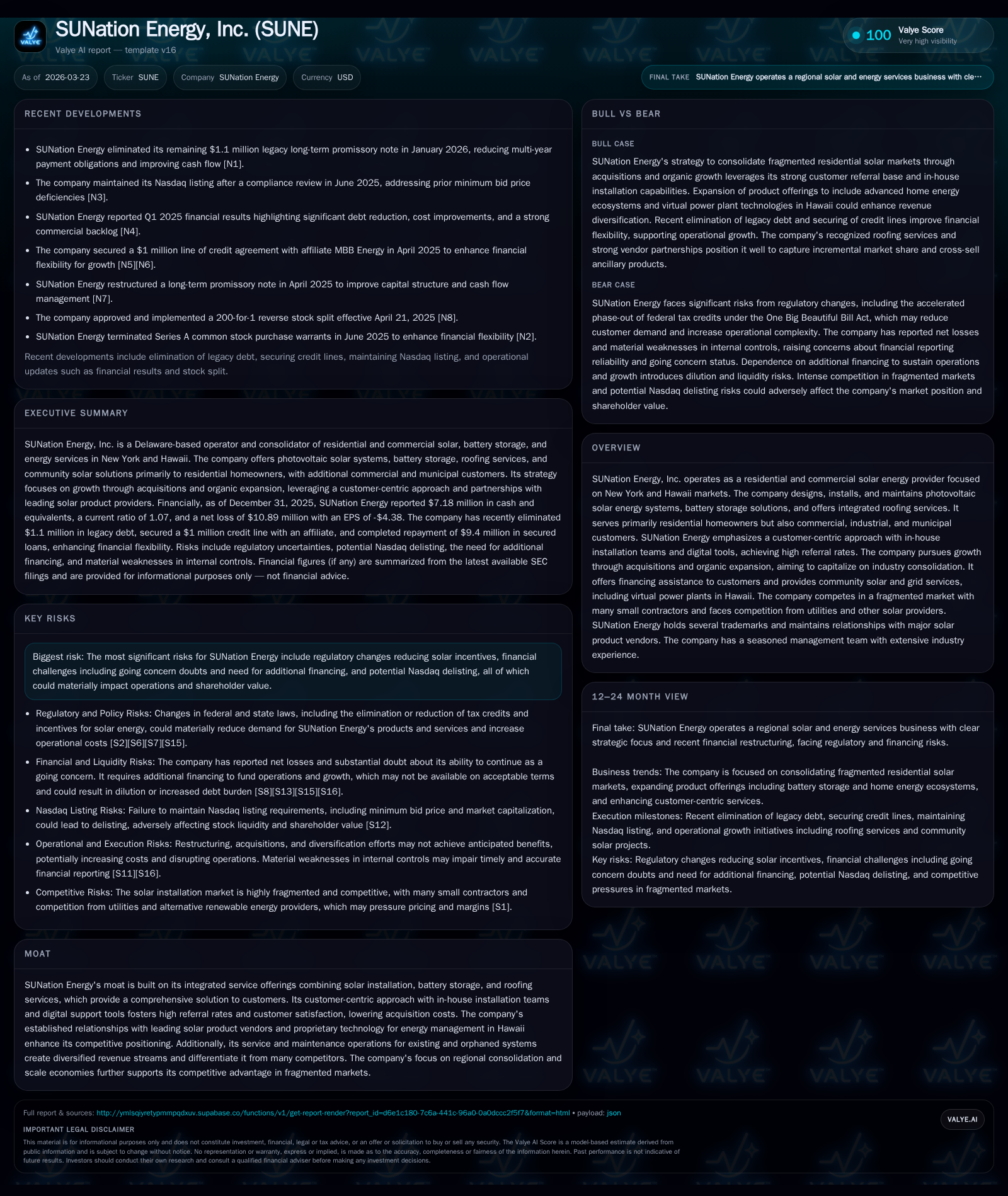
SUNation Energy, Inc. operates primarily in the New York and Hawaii residential solar markets with integrated solar, battery storage, and roofing services. The company has pursued growth via organic expansion and acquisitions within fragmented regional markets, leveraging a customer-centric model with in-house teams to foster referrals. However, SUNation faces notable financial challenges including persistent losses, cash flow volatility, and liquidity constraints compounded by industry regulatory changes and Nasdaq listing risks. Its future growth potential depends on successful scale economies, continued consolidation, and adaptation to evolving solar incentives.
Company Overview
SUNation Energy, Inc. operates as a residential and commercial solar energy provider focused predominantly on two U.S. states — New York (specifically Long Island) and Hawaii [S4][S10]. It designs, installs, and maintains photovoltaic (PV) solar systems combined with lithium-ion battery storage solutions and integrates residential roofing services into its offerings [S5][S6]. The company primarily serves homeowners but also extends services to commercial, industrial, municipal customers alongside community solar programs that enable collective renewable energy access [S11]. SUNation also operates a grid services platform including virtual power plants in Hawaii.
The company positions itself as a consolidator of local/regional solar service businesses nationwide, aiming to harness scale advantages in an otherwise fragmented residential solar market characterized by over 4,000 contractors [S5]. This strategy includes both organic growth initiatives and targeted acquisitions designed to capture economies within equipment supply chains such as modules, inverters, wiring components while lowering customer acquisition costs through high referral rates driven by its customer-centric approach [S4][S5].
Historical Performance
Available financials present a mixed picture of declining revenue over earlier years with persistent losses impacting profitability metrics:
Historical performance (annual)
| FY | Net ($mm) | CFO ($mm) | OpInc ($mm) | Net YoY |
|---|---|---|---|---|
| 2025 | -11 | 1 | -2 | +31.3% |
| 2024 | -16 | -6 | -12 | -94.9% |
| 2023 | -8 | -1 | -7 | +21.4% |
| 2022 | -10 | -8 | -10 |
Source: SEC companyfacts cache [F1].
Capital returns and efficiency (annual)
| FY | Buybacks ($) | ROE% |
|---|---|---|
| 2025 | 6098 | -44.7 |
| 2024 | 6098 | -185.4 |
| 2023 | 38403 | -39.8 |
| 2022 | -38.0 |
Source: SEC companyfacts cache [F1].
Note: Latest comprehensive revenue figure for FY2025 is not publicly stated; operating income and net income are available for FY2025 [F1].
From FY2015 through FY2017 revenue declined markedly (approximately a 31% drop from $27.7 million to $19 million), reflecting structural challenges or contraction phases possibly linked to market pressures or business realignments [F1]. Operating income remained negative across periods where data exists — e.g., operating loss narrowed significantly from about $12 million loss in FY2024 to $1.67 million loss in FY2025 reflecting improved operations [F1]. Similarly, net income remains materially negative with an estimated net loss of nearly $10.9 million in FY2025 though improved compared to prior years’ larger deficits (e.g., ~$15.8 million loss in FY2024) [F1].
Operating cash flows have recovered positively in FY2025 at near $950 thousand after several years of negative cash flow, indicating some progress on working capital or operational efficiencies [F1]. Capital expenditures have decreased sharply year-over-year based on sparse historic data but are generally low relative to revenue.
Returns reflect acute profitability pressures — the approximate return on equity sits near minus 45% as of FY2025 given net losses relative to shareholder equity base [$24.3 million] [F1]. The company historically paid dividends sporadically at low levels before ceasing payments amid financial uncertainties.
Business Model & Competitive Positioning
SUNation’s core offering centers on residential PV installations coupled increasingly with battery energy storage systems—a combination becoming essential for tapping grid resiliency value especially in Hawaii’s island systems where grid instability incentivizes behind-the-meter storage [S10]. Its New York operations add vertically integrated roofing as a complementary service which simultaneously addresses structural installation needs improving system durability and customer convenience [S6][S11]. This reinforces cross-selling potential while diversifying revenue streams.
The company operates an in-house installation workforce which it credits for delivering superior customer experiences compared to competitors who rely heavily on subcontractors [S4][S7]. Such control fosters transparency and reliability supporting referral acquisition channels—approximately 35% of installed jobs come from repeat or referral customers according to recent disclosures [S5]. This customer-centric philosophy purportedly yields lower acquisition costs versus industry peers.
Technologically, SUNation partners with leading product manufacturers such as Enphase, Tesla Energy, FranklinWH and plans expansion into Generac’s full ecosystem (power electronics through smart thermostats), indicating efforts to maintain advanced equipment portfolios attractive to tech-conscious consumers [S9].
Commercial project expertise is managed via a dedicated team handling complex commercial/institutional deployments (schools, warehouses etc.) which have distinct permitting and labor intensity compared to residential projects [S11]. Community solar offerings extend SUNation’s footprint beyond premise ownership models enabling residents or organizations unable or unwilling to install onsite solar participate financially.
A notable differentiator is SUNation’s service offerings maintaining existing or orphaned systems abandoned when other contractors withdrew from local markets – allowing recurring maintenance revenues uncommon among direct competitors who often exit post-installation phases [S11].
Despite these strengths, the company confronts intense competition:
- Fragmented residential markets with thousands of installers nationally,
- Established utilities increasingly integrating renewables,
- Utility-affiliated community choice aggregators presenting alternative clean energy portfolios,
- Competitors ranging from sales-only entities outsourcing installation to large construction firms or electrical contractors [S17][S20].
Within its New York geographic focus area SUNation claims top ranking by installed capacity for residential solar contractors on Long Island correlating with an impressive ~29% YoY capacity growth per utility interconnection records in 2025 illustrating local competitive success though no single entity commands >25% market share broadly [S17][S20].
Growth Prospects & Strategic Drivers
The company's central growth thesis banks on accelerating consolidation within fragmented regional markets to exploit scale economies particularly regarding equipment sourcing costs (modules/inverters/etc.), leverage shared corporate services (finance/IT/legal/HR), and optimize go-to-market efficiency through enhanced digital tools supporting sales pipelines and install journey management [S4][S5].
SUNation openly cites favorable precedent consolidation drivers post Tesla-SolarCity (2016) and Sunrun-Vivint mergers (2020) setting consolidation trends proving scale benefits across residential solar installer base nationally [S5]. Wood Mackenzie data notes over three quarters of the residential market served by local/regional installers reinforcing acquisition rationales.
Another growth lever resides in expanding ancillary market products including enhanced battery storage sales plus increased service contracts particularly on orphaned systems left underserved as smaller competitors exit markets offering one-stop-shop solutions aligning better with homeowner preferences while attempting geographic expansion beyond core states [S4][S6].
Financing facilitation remains pivotal for many customers preferring loan options over upfront purchases; SUNation assists clients through relationships with financing companies minimizing upfront cost burdens thus broadening addressable client pools further supporting volume increases albeit with exposure to third-party financing terms remaining intact [S6].
Community solar participation enables access to customers unable or unwilling to own systems physically expanding penetrable market segments aligned also with evolving state regulatory supports promoting group renewables adoption models particularly relevant given tightening traditional net metering policies [S11][S22].
However growth may be capped or pressured by:
- Increased regulatory headwinds reducing government incentives such as accelerated tax credit phase-outs enshrined in the July 2025 "One Big Beautiful Bill Act," ending legacy Inflation Reduction Act incentives faster than expected thereby dampening demand elasticities tied closely to such subsidies [S2][S8][S15];
- Tariffs imposed on certain Chinese-origin solar components creating cost inflation risks potentially reducing pricing flexibility across competing vendors affecting margin profiles negatively [S19];
- Labor shortages impacting installer availability limiting project throughput as competition for skilled electricians/installers tightens nationally leading potentially to higher wage inflations or project delays limiting growth velocity [S21];
- Real estate disruptions relying heavily on localized demand (NY Long Island & Hawaii) so adverse regional economic or regulatory developments could disproportionately affect results creating geographic concentration risk despite limited national spread currently [S21];
- Increasingly stringent Nasdaq exchange rules narrowing compliance leeway raising risk of delisting which undermines capital raising abilities needed for expansion [S1][S16];
- Capital allocation puzzles where current operations generate insufficient free cash flow for aggressive roll-ups necessitating dilutive fundraising subjecting shareholders to dilution compromises both financially and strategically compelling execution discipline going forward.
Returns & Capital Allocation
SUNation continues generating negative returns evidenced by persistently negative net income figures culminating most recently in about $10.9 million net loss during FY2025 despite incremental operating improvements (operating loss narrowed substantially vs prior years) suggesting early cost containment benefits underlying operations yet unresolved fixed overhead burdens remain material detractors from profitability metrics inclusive of an approximate ROE near minus 45% reflective of these deficits relative to equity base size seen at period end circa $24.3 million excluding non-operating effects yet consistent red ink persists at the bottom line [F1].
Free cash flow generation turned positive ($920k estimated) driven largely by recovering operating cash flow ($950k positive) after consecutive years spent burning cash indicating improved working capital management or project execution timing but still modest given company scale underscoring fragile liquidity status requiring sustained momentum across multiple quarters for meaningful runway extensions absent external funding injections [F1].
Capital expenditures remain comparatively low historically hinting at relatively asset-light installations yet subtle increases planned likely under new technology ecosystem expansions expected with partnerships like Generac showing longer-term capex gradients might rise slightly depending on product mix changes ultimo mid-decade horizon [F1][S9].
Dividend payments have been negligible recently reflecting emphasis on preserving internal liquidity; buybacks minimal suggest absence of surplus capital deployment opportunities under current financial constraints emphasizing capital recycling towards operational stabilization rather than shareholder remuneration presently evident [F1].
The company’s balance sheet creditors remain concerned about short-term liquidity sufficiency due both to working capital tightness (current ratio approximating only ~1.07) plus substantial liabilities proximate to current assets resulting in limited cushion against adverse shocks necessitating recurrent capital raises evidenced recently but substantially uncertain about continuing viability absent new funding sources creating elevated going concern risks explicitly disclosed within filings [F1][S18][S22][S24].
Regulatory & Legal Risks
A salient risk theme revolves around regulatory turbulence detailed extensively including the rapid sunset of critical subsidies essential for solar system affordability driven largely by legislative shifts culminating mid-2025 legislation modifying key Inflation Reduction Act tax credits curtailing consumer financial incentives thereby challenging curtailed demand underscores basis risk for customer acquisition forecasts integral under prevailing business assumptions [S8][S15][S25].
Additionally tariffs levied on Asian imports notably polysilicon wafers have raised component price hurdles combining with market scarcity elevating supplier cost bases contracting gross profit margins unless offset partially by scale procurement reflected prominently within strategic acquisition motivations though outcome uncertainty remains high due to potential countermeasures or supply chain instability induced by geopolitical trade disputes complicating forecasting consistency further revealed historically prevalent within this sector affecting contingent planning prudence frameworks applied herein[S19].
Binding legal proceedings appear limited but ongoing routine business litigation remains monitoring points including resolved lease insurance disputes plus isolated defective equipment replacement matters indicative of nominal contingent liabilities though procedural overheads insist continual assessment confirming absence respectively minimal materiality impacting substantive financial outcomes documented openly per filings alleviating extraordinary impairment expectations unchanged currently but prudently noted against backdrop inception integration risks around acquired entities[S12][S13] . Nasdaq compliance features prominently as spotlighted risk factor with historical minimum bid price non-compliance triggering panel hearings successfully ended June 2025 though further rule tightening removing cure periods plus increasing minimum valuation thresholds portend fresh hurdles encumbering stock price stabilization imperatives critical also for continuity accessing capital markets freely referenced explicitly highlighting existential listing retention challenge[S1][S16] .
Looking Ahead: What To Watch Next (Analysis)
Given absence of explicit forward guidance yet detailed commentary reveals several future developments warrant close observation:
- Progression along announced acquisition/integration pipeline evidencing tangible revenue/income lift externally verified amid continuing fragmented market consolidation narratives;
- Ability sustainably improve margin profiles leveraging purchasing power gains alongside streamlined operations driving underlying cash flow resilience supportive for internal reinvestment;
- Capital raise success critically modulating liquidity runway facilitating business continuity absent distress fire sales;
- Regulatory developments post One Big Beautiful Bill Act implementation examining impact magnitude regarding consumer uptake changes plus local/state incentive adaptations importantly;
- Market strength signals derived from subscription uptake trends toward battery storage upgrades enhancing system value propositions;
- Pricing pressure impacts emanating from tariff-induced cost inflation possibly pressured competitively tolerable thresholds ultimately translating into contract win/loss ratios observable via unique utility interconnection disclosures;
- Management's flexibility adjusting strategies including possible diversification outside core solar offerings foreshadowing broader home energy integration models representative reactionary tactics amid shifting policy landscapes;
Sector experts know the residential solar industry thrives on regulatory feedback loops influencing unit economics profoundly hence projecting cautious optimism realizing pathway depends largely on policy stability plus financing availability jointly sustaining investment attractiveness among growing environmentally conscious consumer cohorts typical within SUNE's target regions.
Conclusion
SUNation Energy occupies a compelling niche combining regional specialization with integrated product/service bundles aimed at advancing grassroots renewable adoption within structurally fragmented US markets notable for pronounced competition yet offering visible consolidation pathways validated historically sectorwide. Nevertheless lasting profitability challenges marked by persistent net losses together with constrained liquidity loom large necessitating prudent execution while navigating complex regulatory headwinds amplified recently undermining some favorable tailwinds from technology advancements or customer loyalty programs nurturing repeat business streams. Ultimately SUNE exemplifies smaller emerging actors wrestling systemic industry shifts amplifying capitalization importance accompanying aggressive regional roll-ups intended delivering scalable sustainable clean energy solutions enhancing household resilience now shaping future power grids fundamentally.
This memorandum is prepared solely for informational purposes regarding SUNation Energy’s current position within the renewable energy sector based exclusively upon publicly available filings dated through March 23, 2026. It does not constitute investment advice.
Disclaimer: This is research-only, informational analysis and not investment advice. It may include AI-generated interpretation and general industry context. Always verify important details using primary sources.

Comments