
Bitwise Solana Staking ETF's Early Performance and Stakeholder Returns under Market Pressure
The Trust delivers direct Solana exposure combined with staking rewards but faces market volatility and regulatory uncertainty in its inaugural period.
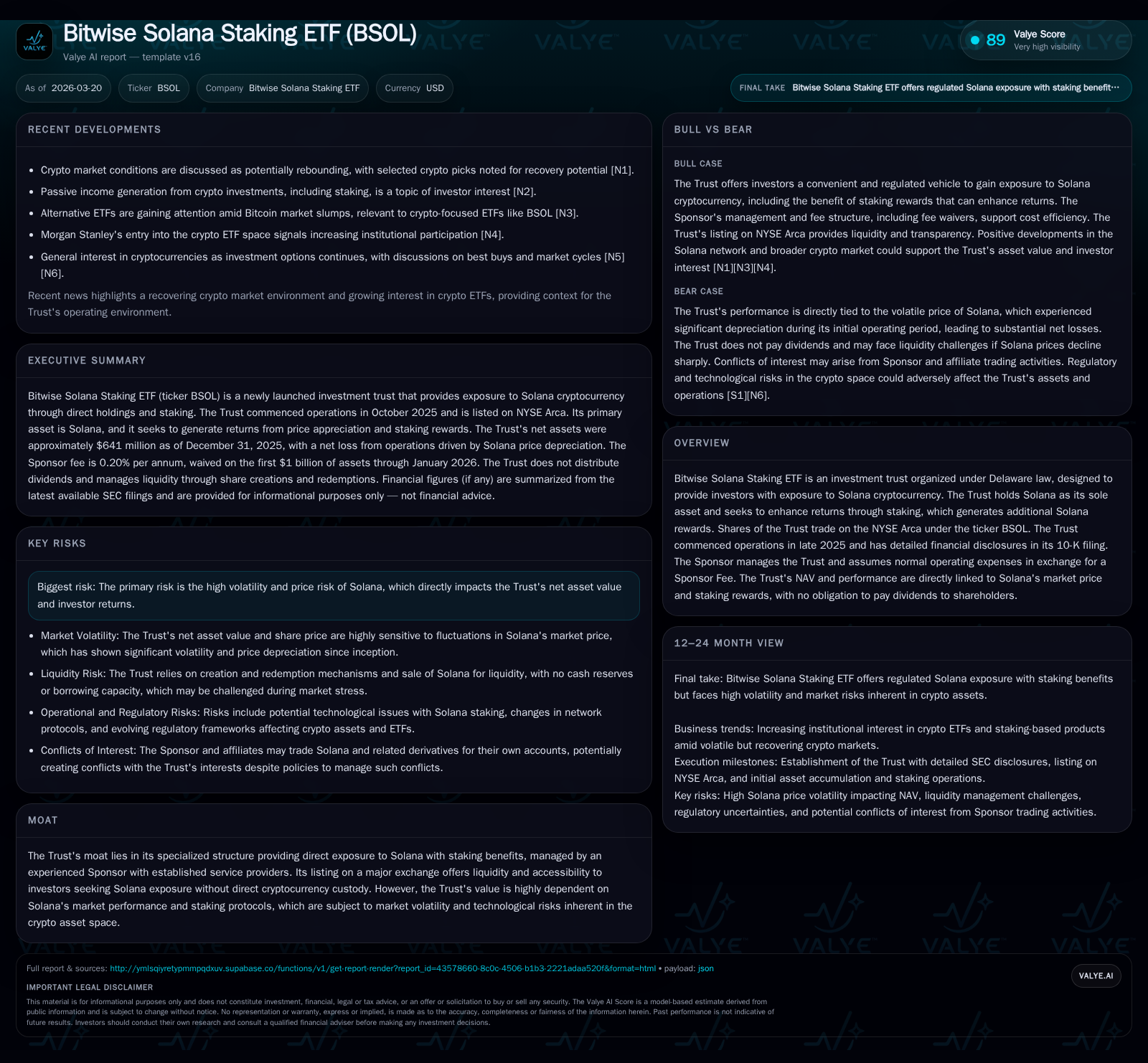
Bitwise Solana Staking ETF (BSOL) launched operations in late 2025 as a novel vehicle offering investors direct Solana cryptocurrency ownership enhanced by staking income. The Trust raised approximately $1.04 billion within its first months, yet endured a net operating loss of about $206.5 million driven largely by falling Solana prices and crypto market turbulence. Its listing on NYSE Arca provides liquidity advantages, while staking rewards offer a yield premium uncommon among crypto ETFs. However, BSOL contends with evolving regulatory frameworks that could reshape digital asset classifications and operational protocols. Key risks include Solana price swings, custody dependencies, and banking partner stability, which investors should monitor alongside potential milestones such as regulatory clarity and NAV stabilization.
Overview: Bitwise Solana Staking ETF’s Structure and Market Entry
Bitwise Solana Staking ETF (ticker: BSOL) operates as a Delaware statutory trust structured to provide investors direct exposure to the cryptocurrency Solana (SOL). Launched in late October 2025, BSOL distinguishes itself by combining physical holdings of SOL tokens with staking mechanisms intended to generate supplementary income through network participation [S1]. This setup offers investors an accessible vehicle listed on the NYSE Arca exchange, eliminating individual custody challenges typically associated with direct crypto investments while enabling liquidity through established equity market trading [S1]. Managed by Bitwise Investment Advisers LLC (the Sponsor), the Trust assumes normal operating expenses against a fixed percentage fee tied to SOL holdings.
Year One Financial Snapshot: Growth Drivers and Operating Outcomes
Over its inaugural period ending December 31, 2025, BSOL successfully raised approximate gross proceeds of $1.04 billion from share issuances at $25 per share [S1][F1]. Despite substantial capital inflows reflective of investor enthusiasm for blockchain-based investment products, the Trust reported a net loss of roughly $206.5 million for the initial partial fiscal year [F1]. This loss is chiefly attributable to declining SOL market values amid turbulent cryptocurrency markets during Q4 2025 [S5]. Net assets increased modestly owing mainly to capital raises but were offset by operation-related deficits and asset depreciation reflecting extreme nascent stage volatility common to digital assets.
Historical performance (annual)
| FY |
|---|
| 2025 |
Source: SEC companyfacts cache [F1].
Table: Year-end 2025 Financial Summary for Bitwise Solana Staking ETF [F1][S5]
Staking Rewards as a Differentiator: Mechanisms and Impact on Returns
Unlike straightforward crypto ETFs holding spot assets alone, BSOL actively integrates staking strategies whereby held SOL tokens are delegated to validators within the Solana network to earn protocol-level rewards [S1][N2]. These rewards provide a steady secondary income stream enhancing total shareholder returns over time relative to price-only exposure. Staking income accrues daily with periodic consolidation into the Trust’s asset base after deducting fees and operating costs [S1]. This structure not only anchors investors’ potential yield beyond pure capital appreciation but also requires effective operational coordination between custodians and staking service providers such as Attestant Ltd., entrusted for managing stake delegation logistics [S1]. Such mechanisms position BSOL competitively within the growing crypto ETF landscape dominated mostly by non-staking alternatives.
Navigating Regulatory Ambiguity: Security Classification and Risk Factors
One of BSOL’s foremost challenges arises from ongoing U.S. regulatory scrutiny over digital assets' classification—particularly whether Solana constitutes a "security" under federal laws—a determination bearing material impacts on valuation and compliance burden [S1][S7][N3]. Historical SEC enforcement actions implicated major trading platforms alleging unlawful securities activities involving SOL; however, recent case dismissals have paused definitive outcomes though uncertainty lingers [S1]. The Trust acknowledges this gray zone significantly influences investment risk profiles due to potential administrative actions or reclassifications that could require structural adjustments or induce extraordinary costs [S1][S10]. Moreover, evolving legislative initiatives directed at clarifying digital asset regulation remain pending.
Liquidity Management and Operational Framework
BSOL employs an 'Agent Execution Model' whereby Coinbase Credit Inc. serves as the Prime Execution Agent responsible for facilitating trades in SOL necessary for creation/redemption cycles [S3][S4][S6]. Leveraging trade credits—short-term secured loans backed by the Trust’s assets—enables smoother transaction settlement though dependency on Coinbase’s banking relationships has been cited as a vulnerability given recent sector-wide banking stresses exemplified by historical failures like Silicon Valley Bank [S8][S16]. Custody segregation is maintained via agreements with BNY Mellon (cash custodian) and specialized blockchain custodians safeguarding SOL tokens under rigorous protocols designed to mitigate theft or operational interruptions [S4][S15]. The absence of dividend obligations further underscores liquidity considerations focusing solely on share price NAV dynamics coupled with staking yields.
Capital Deployment, Expense Structure, and Sponsor Incentives
The Sponsor levies an annual fee of approximately 0.20% on the Trust’s net SOL holdings value to cover all normal operating expenses including audit, custody services, exchange listing fees, and administration costs [S1][S9][S12]. A critical early-stage incentive involved waiving this fee for assets up to $1 billion until January 27, 2026 — assisting capital retention and cost efficiency during formative scaling phases [S5][S12]. Extraordinary expenses unrelated to regular operations such as legal actions or network forks fall outside Sponsor coverage potentially impacting cash flows should such events arise [S6]. The structure aligns sponsor interests with investor outcomes while ensuring predictable ordinary expense levels.
Forward Indicators: What to Watch for BSOL’s Market Trajectory
Absent explicit forward guidance from management, several milestones merit close observation as indicators of future health: stabilization of NAV trajectories following initial volatility; progress toward finalized regulatory guidelines affecting crypto asset classifications especially relevant for SOL; expanded participation rates in staking mechanisms that can enhance yield profiles; frequency and terms of trade credit utilization signaling liquidity robustness; and the adaptability of custody providers amidst shifting industry norms [N1][N3]. Observing these variables will illuminate resilience or vulnerabilities in BSOL's core value proposition moving into 2026.
Investment Risks: Price Volatility, Custody Dependencies, and Banking Relationships
Primary investment risks derive from pronounced fluctuations in Solana’s price impacting NAV directly—cyclical crypto market swings can erode shareholder returns abruptly [S24]. Dependence on third-party custodians exposes the Trust to counterparty risks including limited liability caps on custodian indemnification except in cases of fraud or gross negligence [S15]. Furthermore, reliance on Prime Execution Agent’s banking partners introduces systemic financial institution risks illustrated by prior bank liquidations affecting affiliated crypto platforms; failure or disruption in these relationships could constrain timely share creations/redemptions thereby impairing liquidity or incurring transaction slippage costs passed through economically to secondary market traders [S8][S16]. Lastly, unresolved legal determinations regarding securities law applicability could provoke sudden operational restructuring or litigation expenses reducing net returns [S1][S7].
Disclaimer: This report is prepared solely for informational purposes reflecting data available through March 20, 2026. It does not constitute investment advice or solicitation.
Disclaimer: This is research-only, informational analysis and not investment advice. It may include AI-generated interpretation and general industry context. Always verify important details using primary sources.

Comments