
Pyxis Oncology’s Clinical Advances Counterbalance Persistent Operating Losses and Liquidity Pressures
A clinical-stage biotech innovating in ADCs with promising Phase 1 data but facing significant financial headwinds.
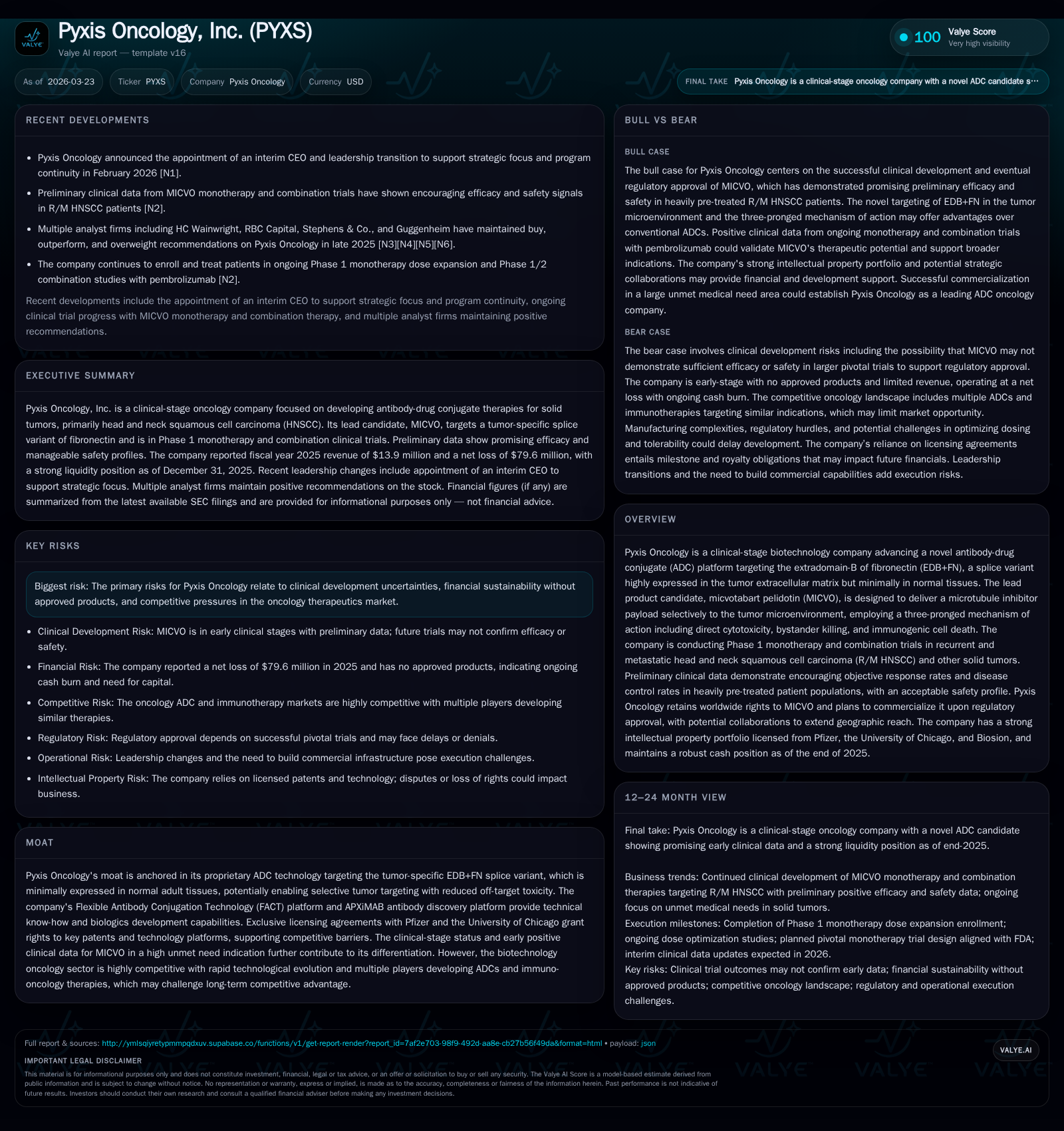
Pyxis Oncology is advancing an innovative antibody-drug conjugate (ADC) platform targeting the tumor-specific EDB+FN splice variant, with its lead candidate MICVO showing encouraging early clinical activity, especially in recurrent/metastatic head and neck squamous cell carcinoma. Despite a steady decline in annual revenue and persistent large operating losses over recent years, the company maintains a solid liquidity cushion with a strong current ratio and minimal capital expenditures. Key growth drivers hinge on successful clinical development, regulatory milestones, and eventual commercialization, while risks include clinical trial uncertainties, financial sustainability, and intense market competition.
Company Overview and Technology Platform
Pyxis Oncology is a clinical-stage biotechnology company focused on pioneering antibody-drug conjugates (ADCs) that uniquely exploit the extradomain-B splice variant of fibronectin (EDB+FN), which is highly expressed within the tumor extracellular matrix (ECM) but minimally present in normal adult tissue [S1]. This targeting strategy differs from conventional ADCs that primarily recognize cell surface antigens on malignant cells.
Their lead candidate, micvotabart pelidotin (MICVO), combines a fully human IgG1 monoclonal antibody with an optimized auristatin microtubule inhibitor payload via a cleavable linker sensitive to acidic conditions in the tumor microenvironment (TME). This design enables localized payload release through three mechanisms: direct cytotoxicity to cancer cells near the ECM target; bystander killing via diffusion into adjacent tumor cells; and induction of immunogenic cell death (ICD), potentially enhancing anti-tumor immune responses [S1].
Historical Financial Performance
As expected for a clinical-stage biotech focused on drug development without commercial products, Pyxis Oncology remains unprofitable [F1]. Revenue totaled $13.9 million in FY2025 compared to $16.1 million in FY2024—a year-over-year decline of approximately 14%, likely reflecting limited income sources such as licensing fees rather than product sales [F1].
Operating losses were significant but showed slight improvement from -$89.5 million in FY2024 to -$84.4 million in FY2025. Net losses remained elevated at -$79.6 million for FY2025 [F1]. The company’s operating cash flow continued to be deeply negative at -$63.5 million during FY2025, consistent with ongoing research and development expenditures [F1]. Capital expenditures were minimal at $9,000 for FY2025 compared to $237,000 the prior year, indicating reliance on outsourced manufacturing or leased infrastructure [F1].
Equity decreased from $160.8 million at end-FY2022 to $53.4 million at end-FY2025 due largely to accumulated losses without offsetting profitability or financing shown through these filings [F1]. This results in an approximate return on equity (ROE) near -149% for FY2025.
Historical performance (annual)
| FY | Rev ($mm) | Net ($mm) | CFO ($mm) | OpInc ($mm) | Rev YoY | Net YoY |
|---|---|---|---|---|---|---|
| 2025 | 14 | -80 | -64 | -84 | -14.2% | -3.0% |
| 2024 | 16 | -77 | -58 | -89 | -4.8% | |
| 2023 | -74 | -71 | -82 | +38.9% | ||
| 2022 | -121 | -89 | -123 |
Source: SEC companyfacts cache [F1].
Capital returns and efficiency (annual)
| FY | FCF ($mm) | ROE% |
|---|---|---|
| 2025 | -64 | -149.1 |
| 2024 | -58 | -64.0 |
| 2023 | -77 | -58.7 |
| 2022 | -96 | -75.1 |
Source: SEC companyfacts cache [F1].
(Note: Revenue represents total reported figures without segmentation.)
Growth Outlook
Near-term growth largely depends on advancing MICVO through clinical development across multiple indications including recurrent/metastatic head and neck squamous cell carcinoma (R/M HNSCC), where preliminary Phase 1 data demonstrated an encouraging ~50% confirmed objective response rate among evaluable patients at active dose ranges [S1]. Trials combining MICVO with KEYTRUDA® (pembrolizumab) aim to expand treatment options into first- or second-line settings for solid tumors.
The ECM-targeting approach could differentiate MICVO by limiting off-target toxicities common with traditional ADCs targeting cellular antigens and may improve durability of response via immunogenic mechanisms.
Challenges include:
- Clinical trial uncertainties including timelines and outcomes,
- Competitive pressures from other ADC developers,
- Manufacturing scale-up complexities,
- Pricing and reimbursement challenges influenced by U.S. healthcare reforms such as the Inflation Reduction Act,
- Intellectual property risks related to licensed technologies.
Milestones & Monitoring Points
As of March 23, 2026 no formal guidance or detailed milestone schedules have been publicly disclosed [N/A]. Key areas for monitoring include:
- Advancement into later-phase clinical trials,
- Broader patient enrollment,
- Interim efficacy and safety data releases,
- Regulatory interactions concerning Biologics License Applications (BLA),
- Strategic partnerships or collaborations that could enhance commercialization reach.
Capital Allocation & Financial Returns
Pyxis continues to invest heavily in R&D without generating positive operating income or free cash flow [F1]. The company’s liquidity position is supported by cash & equivalents of approximately $15.4 million against current liabilities of about $21.1 million at fiscal year-end 2025—yielding a strong current ratio near 3.41 indicating short-term liquidity adequacy despite significant cash burn [F1].
Capital expenditures have been minimal recently ($9K in FY2025), consistent with reliance on contract manufacturing organizations rather than owned facilities [S20]. No dividends or share repurchases are reported as typical for pre-commercial biotechs [F1]. Future capital will likely be allocated toward late-stage development costs and potential commercialization investments.
Intellectual Property & Competitive Positioning
The company holds exclusive licenses from Pfizer granting rights to Flexible Antibody Conjugation Technology (FACT) platforms alongside antibody discovery technologies licensed from the University of Chicago [S11][S24]. These agreements provide proprietary protection for their ADC compositions and underpin the uniqueness of their therapeutic approach.
Despite these protections, the oncology ADC landscape remains highly competitive with rapid innovation across linker-payload chemistries and bispecific targeting strategies.
Risk Factors Summary
Primary risks include:
- Clinical development failures or delays,
- Sustained negative cash flows requiring ongoing financing,
- Intense competition requiring continual innovation,
- Potential patent disputes involving licensed technologies,
- Regulatory hurdles including post-approval requirements,
- Pricing pressures amid evolving healthcare policies,
- Cybersecurity vulnerabilities affecting sensitive proprietary data overseen by senior management and board committees [S28].
Conclusion
Pyxis Oncology exemplifies an early-stage biotech navigating complex clinical validation while managing material financial challenges inherent to its developmental phase. Its differentiated ECM-targeting ADC platform offers promise warranting close observation of upcoming clinical progressions and regulatory milestones.
This analysis is based exclusively on publicly available SEC filings through March 23, 2026 ([F1], [S#]) without incorporation of forward-looking statements beyond explicit disclosures or investment recommendations.
Disclaimer: This is research-only, informational analysis and not investment advice. It may include AI-generated interpretation and general industry context. Always verify important details using primary sources.

Comments