
Avalo Therapeutics Advances IL-1β Antibody Amid Heavy Clinical and Financial Investment
Avalo is pushing forward with its lead candidate abdakibart targeting inflammatory disease but faces financial and regulatory hurdles.
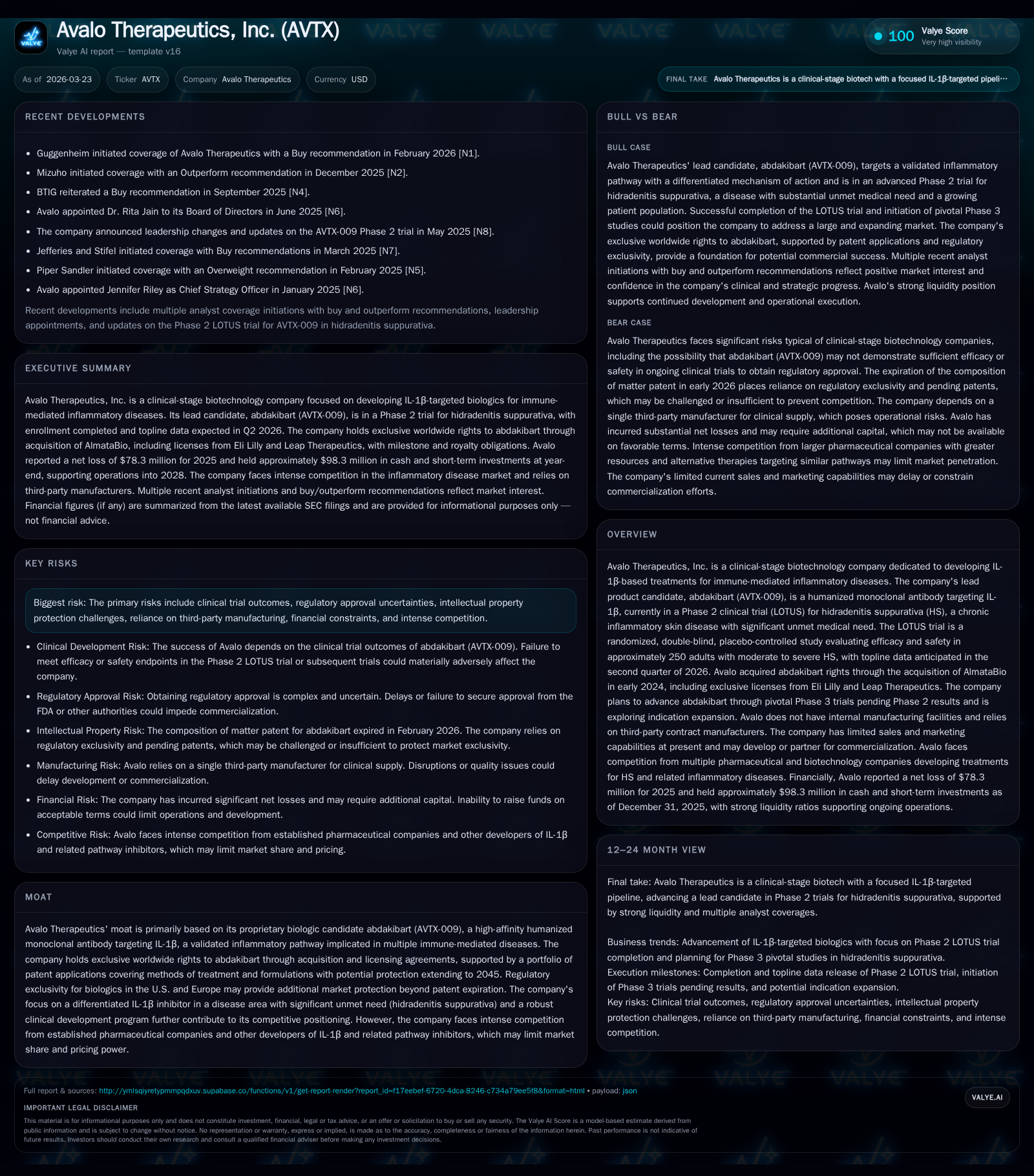
Avalo Therapeutics, focused on developing IL-1β-targeting biologics for immune-mediated inflammatory diseases, currently centers its growth hopes on the Phase 2 LOTUS trial of abdakibart in hidradenitis suppurativa. Despite completing enrollment in 2025 and expecting topline results in Q2 2026, the company has yet to generate meaningful revenue and reports mounting losses, with operating income deteriorating to -$72.9 million in 2025 [F1]. While it holds an exclusive patent portfolio and market rights extending potentially to 2045, Avalo's cash burn and clinical outcome dependence pose ongoing risks. The timeline for pivotal Phase 3 studies hinges on Phase 2 data readout with commercialization prospects sensitive to payor reimbursement dynamics and regulatory scrutiny [S1][S4][S17].
Company Overview and Historical Context
Avalo Therapeutics operates as a clinical-stage biopharmaceutical company dedicated to developing treatments that inhibit interleukin-1 beta (IL-1β), an inflammatory cytokine implicated in various immune-mediated disease processes. The company's flagship asset is abdakibart (AVTX-009), a humanized IgG4 monoclonal antibody designed to selectively neutralize IL-1β activity.
This biologic candidate was acquired through Avalo’s purchase of AlmataBio in early 2024, which included exclusive licensing arrangements from Eli Lilly and Leap Therapeutics, positioning Avalo with proprietary rights worldwide for this anti-inflammatory mechanism of action [S1]. Historically referred to by other designations such as FL-101 and LY2189102 before its acquisition by Avalo, abdakibart reflects established proof-of-concept evidence for IL-1β inhibition but remains unapproved.
The company has targeted hidradenitis suppurativa (HS), a chronic dermatological condition marked by debilitating inflammation and scarring, as its leading indication. This choice aligns with significant unmet clinical needs given the paucity of efficacious treatments available today.
Past Growth & Financial Performance
Avalo remains pre-commercialization with no product revenue since inception besides limited upfronts or milestone receipts typical to early-stage biotechs. The last recorded top-line revenue figure available dates back to FY2017 at approximately $27.8 million, which likely reflects non-recurring licensing or collaborative income rather than sales from marketed products [F1].
Operating losses have expanded substantially over recent years due primarily to increased R&D investments related to clinical trial progression:
Historical performance (annual)
| FY | Net ($mm) | CFO ($mm) | OpInc ($mm) | Net YoY |
|---|---|---|---|---|
| 2025 | -78 | -51 | -73 | -122.8% |
| 2024 | -35 | -49 | -69 | -11.4% |
| 2023 | -32 | -31 | -27 | +24.3% |
| 2022 | -42 | -27 | -37 |
Source: SEC companyfacts cache [F1].
Capital returns and efficiency (annual)
| FY | ROE% |
|---|---|
| 2025 | -94.2 |
| 2024 | -26.4 |
| 2023 | -431.9 |
| 2022 | 381.7 |
Source: SEC companyfacts cache [F1].
(Data from [F1])
This pattern shows accelerating expenditures consistent with the company focusing heavily on clinical development activities — expending roughly twofold more cash each passing year between 2023–25 on operational execution. Net losses nearly doubled year-over-year from approximately $35 million in FY2024 to over $78 million in FY2025.
Avalo maintains a robust liquidity position as reflected by a strong current ratio (~8.14), sustained primarily by accumulated cash equivalents alongside receivables or short-term investments totaling over $105 million against modest current liabilities just under $13 million at FY-end 2025 [F1][S17]. This liquidity should underpin planned developmental milestones over the medium term barring unforeseen events.
Capital expenditure historically is minimal reflecting limited fixed asset demands typical of asset-light biotech models during clinical phases — recorded capex stood below $100k annually recently [F1].
Core Pipeline: Abdakibart and Clinical Development
Abdakibart targets IL-1β with high affinity binding designed to block its downstream inflammatory cascades thought causative in autoimmune pathologies such as HS. The concept of targeting IL-1β builds on immunological insights demonstrating this cytokine's central role in triggering pro-inflammatory cells producing other effectors like IL-6 and TNF-alpha.
A pivotal development effort is the Phase 2 "LOTUS" trial — a randomized double-blind placebo-controlled study evaluating safety and efficacy signals across two dosing regimens in ~250 patients suffering moderate-to-severe HS ([S1]). Enrollment completion was announced October 2025 with topline data anticipated mid-2026 (Q2) — this data readout represents a critical inflection point determining next steps into late-stage pivotal trials.
The clear binary milestone of successful LOTUS outcomes will dictate whether Avalo proceeds rapidly into Phase 3 registration studies or recalibrates strategy including potential out-licensing or program discontinuation depending on efficacy/safety performance.
Regulatory strategy focuses initially within the U.S. framework governed by FDA biological product licensing standards but contemplates parallel European Market Authorization pathways leveraging biologic exclusivities which typically last beyond patent expiry timelines.
Future Growth Prospects & Catalysts
Success hinges predominantly on positive readouts from the LOTUS trial; should abdakibart demonstrate robust efficacy coupled with favorable tolerability profiles it could capture a niche yet meaningful share addressing symptom relief where current therapeutic options are limited or inadequate.
Post-phase 2 milestones include initiating one or more Phase 3 pivotal trials that will be necessary for full marketing approval applications (e.g., Biologics License Application submission).
Beyond HS indications exist possibilities for expanding abdakibart’s application across other immune-mediated diseases where IL-1β plays pathogenic roles; however such expansions remain speculative until core program validation unfolds.
Financially sustainability depends on prudent capital management amid ongoing R&D costs; additional funding rounds or partnership collaborations may be required especially if clinical timelines extend or unexpected setbacks arise [S17].
Other growth constraints include intense competition from established biologics against various inflammatory targets such as TNF inhibitors or IL-23 blockers already approved for HS or related conditions. Moreover regulatory landscapes surrounding pricing pressures from government payors—amplified by recent legislation like the Inflation Reduction Act—may compress anticipated commercialization returns despite clinical value propositions [S11][S13][S21].
Capital Allocation and Returns Profile
Avalo has not generated earnings since inception nor distributed dividends given its developmental stage.
Its negative net income margin (-94% approx ROE based on net loss relative to equity) sharply illustrates absence of profitability at present [F1]. Operating cash flows are running deeply negative (~-$51M annually), reflecting heavy research spending far exceeding any internal cash generation capacity.
Equity rose significantly between FY2023 ($7.3M) and FY2024 ($133M), likely attributable to financing activities following AlmataBio acquisition transactions but declined again leading into FY2025 ($83M), possibly due to combined net loss absorption and investment activities without offsetting capital influxes disclosed at that date [F1].
No share repurchases or dividend payments have been noted; instead resources are allocated primarily towards advancing clinical development programs. The company's ability to maintain operations into late-decade is dependent on accessing further funding via equity issuance or partnerships considering no committed external financing facilities currently exist [S17].
Risks Overview
Clinical Risk: Efficacy/safety outcomes from LOTUS trial remain uncertain; failure would impede development timelines severely.
Regulatory Risk: Complex FDA regulatory requirements plus evolving compliance landscape including healthcare fraud/abuse statutes intensify operational burdens. Financial Risk: Cash burn demands continual access to capital markets; failure raises existential threats. IP Risk: While patents extend potentially through mid-century supported by method-of-use/protection layers there remains inherent uncertainty around enforceability or challenge outcomes [S19]. Competitive Risk: Existing therapies in inflammatory disease niches pose commercialization hurdles necessitating clear differentiation to achieve uptake. Pricing/Reimbursement Risk: Outcomes depend heavily on third-party payor willingness amid rising cost containment pressures nationally and globally impacting realized market value. Operational Risk: Dependence on third-party contract manufacturing introduces supply chain vulnerabilities Critical regulatory inspections further amplify operational risks if deficiencies emerge. Legal/Compliance Risk: Exposure under false claims acts or off-label promotion-related penalties presents potential material litigation exposures requiring stringent internal controls. Volatility Risk: As a small-cap biotech entity stock price subject to outsized swings driven by newsflow unrelated directly to fundamentals impacting investor confidence dramatically. Algorithmic/AI Regulatory Risk: Emerging AI ethics/regulation frameworks may introduce additional reporting/compliance complexities as technology use increases internally.[S25]
What To Watch Next (Analysis)
Topline data release from LOTUS trial scheduled Q2 2026 is quintessential catalyst defining Avalo’s developmental trajectory – this readout will determine go/no-go decisions for embarking upon Phase 3 pivotal studies essential for eventual regulatory submissions. Subsequent corporate communications around strategic partnerships or financing round announcements may provide insight regarding funding sufficiency and risk appetite amidst evolving market conditions. Ongoing monitoring of payor landscape reforms affecting orphan drug pricing/exclusivity policies could influence commercial viability assumptions despite scientific success. Industry competitive developments involving rival IL pathway inhibitors could shift Avalo’s positioning either positively due to synergistic validation of target biology or negatively due to superior profiles demonstrated elsewhere. In summary Avalo is firmly positioned as a high-risk/high-reward biotechnology innovator pursuing an important immune target within an underserved patient population balancing substantial clinical promise against notable financial endurance challenges.
Disclaimer: This is research-only, informational analysis and not investment advice. It may include AI-generated interpretation and general industry context. Always verify important details using primary sources.

Comments