
ParkerVision Inc's Patent Licensing Model Faces Growth and Liquidity Constraints
The company relies on patent enforcement and licensing amid ongoing litigation and continued losses.
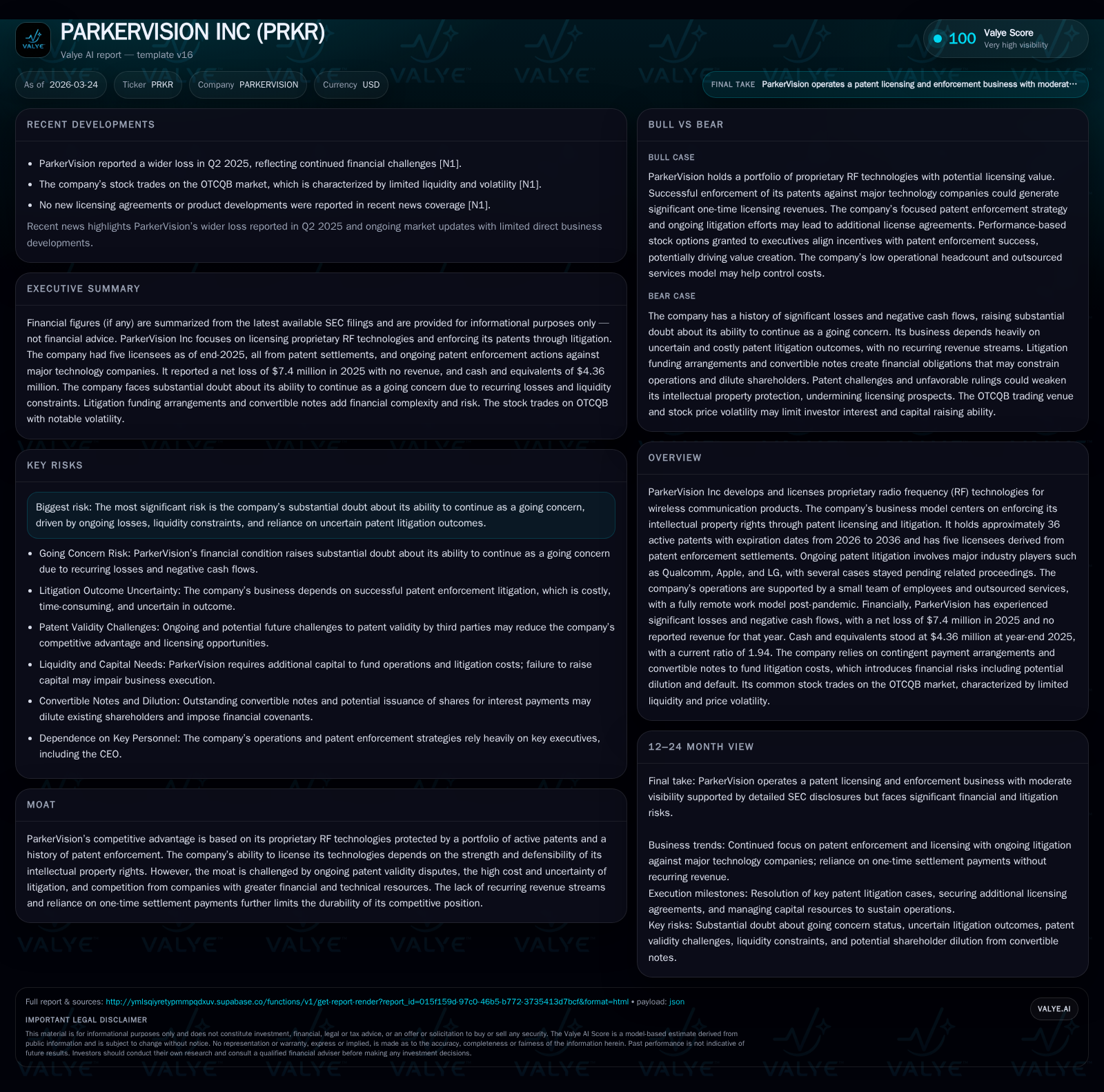
ParkerVision Inc operates primarily as a technology licensor of proprietary RF patents, focusing on enforcing intellectual property rights through litigation and settlements. After a peak in revenue during 2023 from patent settlements, the company reported zero revenue for 2024 and 2025, alongside continued net losses and negative cash flows, raising substantial doubt about its ability to continue as a going concern. Future growth depends heavily on the outcome of pending patent enforcement actions and the company’s ability to monetize its IP portfolio, but ongoing litigation risks and liquidity challenges cast uncertainty on sustaining operations without new capital injections.
Company Overview
ParkerVision Inc focuses on developing proprietary radio frequency (RF) technologies used in wireless communication products. The company has invested significant resources into research and securing patent protection for its inventions domestically and internationally. Its business strategy centers on leveraging this intellectual property portfolio through licensing agreements enforced by litigation when necessary [S1]. ParkerVision currently holds approximately 36 active patents with expiration dates spanning from 2026 to 2036.
The company operates with a lean structure relying on outsourced support and remote work arrangements post-pandemic [S1]. Its core business is monetizing patented technologies rather than producing hardware or generating recurring licensing revenues.
Historical Financial Performance
ParkerVision’s financial performance reflects volatility driven by milestone legal settlements rather than steady operational income. Revenue was negligible prior to a surge to $25 million in fiscal year (FY) 2023, primarily due to one-time licensing settlements arising from patent enforcement actions. Revenues reverted to zero for FY 2024 and FY 2025 with no new significant licensing payments recorded [F1].
Profitability followed a similar pattern: net income swung from deeply negative figures pre-2023 (-$9.8M in FY 2022) to a positive $9.5 million gain in FY 2023 thanks to settlements but returned to losses totaling $7.4 million in FY 2025 [F1]. Operating cash flow mirrored this trajectory with positive inflows in FY 2023 ($10.8M), shifting back to outflows of $5.14 million by FY 2025, reflecting ongoing legal expenses [F1]. Capital expenditures have been immaterial throughout.
Historical performance (annual)
| FY | Rev ($mm) | Net ($mm) | CFO ($mm) | Capex ($) | Rev YoY | Net YoY |
|---|---|---|---|---|---|---|
| 2025 | 0 | -7 | -5 | 2000 | +48.7% | |
| 2024 | 0 | -14 | -3 | 0 | -100.0% | -252.1% |
| 2023 | 25 | 10 | 11 | 2000 | +2602.7% | +197.0% |
| 2022 | 1 | -10 | -3 | 4000 |
Source: SEC companyfacts cache [F1].
Capital returns and efficiency (annual)
| FY | FCF ($mm) | ROE% |
|---|---|---|
| 2025 | -5 | 16.5 |
| 2024 | -3 | 31.2 |
| 2023 | 11 | -24.1 |
| 2022 | -3 | 19.4 |
Source: SEC companyfacts cache [F1].
Cash and cash equivalents were approximately $4.36 million at December 31, 2025 with a current ratio of about 1.94 [F1].
Business Model and Competitive Positioning
ParkerVision’s value proposition lies in its portfolio of patented RF technologies that can be licensed or enforced via litigation against infringers within semiconductor and wireless device markets [S1]. The company has secured five licensees resulting exclusively from settlements linked to patent enforcement rather than broad product adoption or mass licensing.
This creates a competitive moat reliant heavily on the strength and defensibility of its patent claims amid intense challenges from well-capitalized competitors such as Qualcomm and Apple, who are defendants in ongoing litigation [S1]. However, multiple Inter Partes Review (IPR) proceedings contest the validity of key patents, complicating prospects for sustainable licensing income.
Litigation Landscape
Litigation remains central both as an opportunity and risk for ParkerVision’s future growth potential. As of early 2026, nine patent enforcement lawsuits are pending involving defendants ranging from mobile handset makers to semiconductor suppliers [S1]. Key cases involve Qualcomm—with appeals at the Federal Circuit—Apple, LG, among others:
- Two trials initially scheduled for early-2026 were postponed or stayed due to procedural developments.
- Six actions remain stayed pending outcomes of related IPR proceedings challenging patent claims.
- A favorable Federal Circuit opinion remanded some Qualcomm cases back to district court.
These disputes underscore the episodic nature of ParkerVision’s revenue model based on successful patent assertions rather than volume sales or subscription revenues.
Financial Position and Going Concern Risks
With cumulative net losses exceeding $455 million as of end-2025 alongside negative free cash flows near $5 million annually despite minimal capital spending, ParkerVision faces acute liquidity challenges [F1][S1]. Independent auditors have expressed substantial doubt regarding the company’s ability to continue as a going concern absent positive legal outcomes or capital raises [S1].
At year-end 2025, cash resources totaled approximately $4.36 million against current liabilities of $2.41 million, insufficient alone to cover operating costs beyond twelve months without additional financing or unforeseen settlements [F1][S1]. Historically, funding has come primarily via debt or equity issuances rather than self-sustaining earnings [S1].
Failure to secure adequate capital could lead to restructuring or liquidation scenarios where asset realizations may fall short given the intangible-heavy balance sheet dominated by patents dependent on enforceability.
Future Outlook and Considerations
Looking ahead, growth prospects hinge principally on favorable resolution of ongoing patent litigations enabling further licensing income streams or lump-sum settlements [S1]. Additional factors include:
- Expiry of certain patents starting in the late-2020s potentially reducing royalty bases.
- Challenges posed by IPR proceedings which may weaken enforceability.
- Potential joint ventures involving licensing rights remain exploratory without materialization yet [S1].
- Market conditions within semiconductor IP landscapes may constrain new partnerships.
Absent successful monetization events or fresh capital infusions, recurring revenue remains elusive; external financing will likely remain essential for sustaining operations near term.
Returns and Capital Allocation
ParkerVision’s returns have been sporadic due largely to transactional revenue sources coupled with sustained operating losses resulting in shareholders’ equity nearing negative $45 million at end-2025 [F1]. Approximate return-on-equity based on latest annual net loss relative to equity is volatile but negative given loss dynamics [F1].
Capital expenditures remain minimal—roughly $2 thousand annually—reflecting maintenance-focused investment primarily aimed at preserving intellectual property assets while management emphasizes cost control given limited resources [F1][S1].
No dividends or share repurchases have been reported consistent with longstanding financial constraints.
Key Milestones To Monitor
Market participants should watch developments including:
- Outcomes and rulings in postponed trials against Qualcomm, Apple, LG including appellate decisions.
- Progression of IPR proceedings affecting core patents’ validity.
- Announcements regarding new licensing agreements or strategic partnerships beyond existing licensees.
- Updates on fundraising efforts or alternative capital sources enabling continued litigation financing.
- Possible shifts in management strategy responding to viability challenges.
Conclusion
ParkerVision Inc exemplifies a niche intellectual property-driven entity contending with inherent industry risks tied closely to success within complex high-stakes litigation battles against well-capitalized incumbents controlling wireless technology ecosystems. The company's record underscores episodic top-line gains linked heavily to legal outcomes rather than organic revenues while persistent losses highlight systemic challenges maintaining solvency absent consistent favorable verdicts or alternative financing influxes. Investors should carefully consider these dynamics when evaluating operational viability prospects going forward.
This report compiles publicly available SEC filings alongside validated financial data without offering investment advice or recommendations.
Disclaimer: This is research-only, informational analysis and not investment advice. It may include AI-generated interpretation and general industry context. Always verify important details using primary sources.

Comments