
Context Therapeutics Advances T Cell Bispecifics with Expanding Clinical Pipeline and Capital Discipline
Context Therapeutics pursues clinical validation of novel solid tumor therapies while managing rising R&D costs and patent risk.
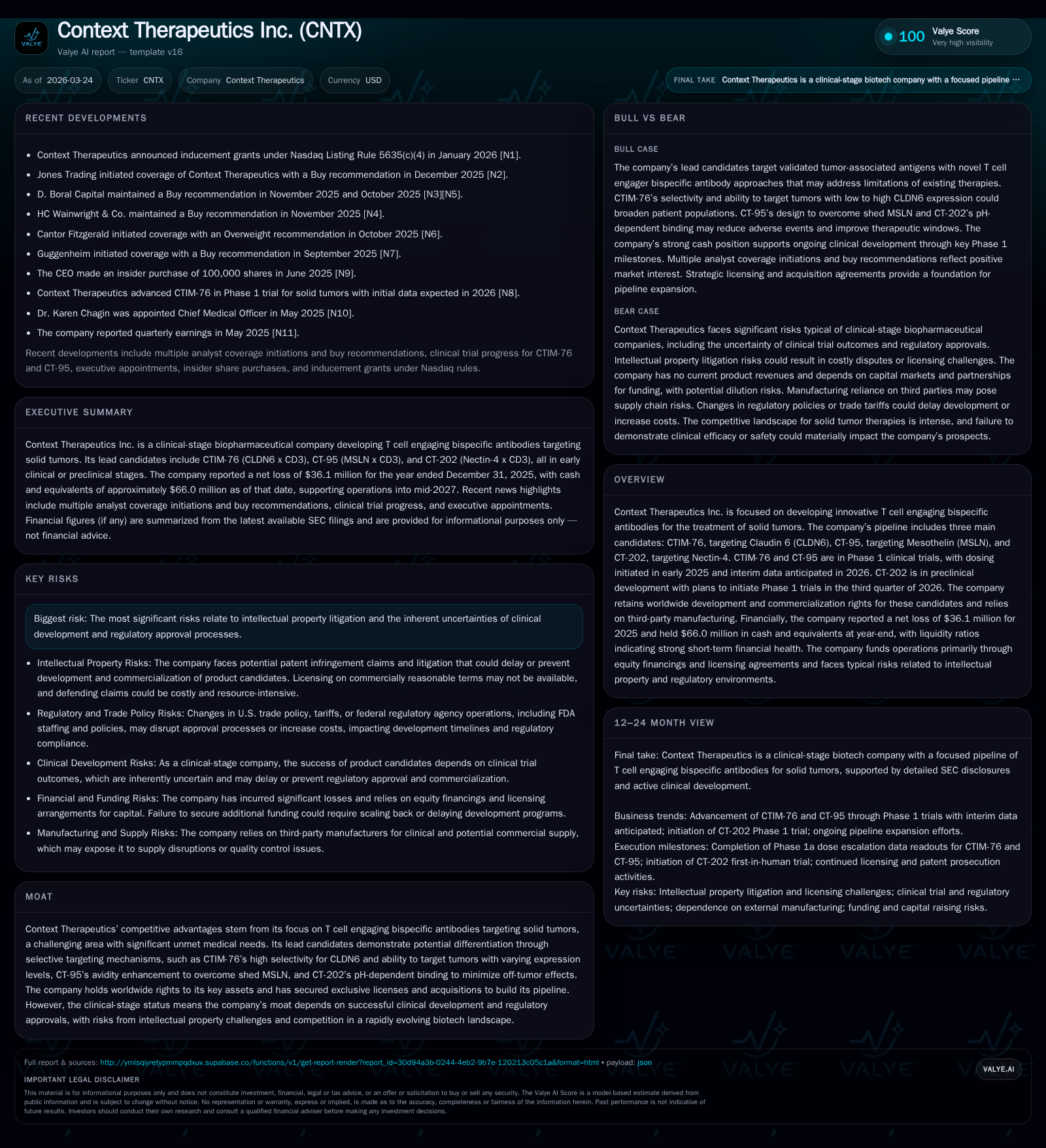
Context Therapeutics Inc. is focused on pioneering T cell engaging bispecific antibodies targeting difficult-to-treat solid tumors, with active Phase 1 trials for CTIM-76 and CT-95 and preclinical progress on CT-202. The company’s operating losses intensified through 2025 reflecting aggressive R&D spending, yet its strong liquidity positions it to advance key clinical milestones anticipated in 2026. Notable intellectual property risks around CTIM-76 patents introduce uncertainty but have been partially mitigated through revised licensing agreements. Governance was recently updated following a Delaware court ruling shaping board dynamics for the upcoming annual meeting.
Rising Operating Losses Reflect Intensifying R&D Investment
Context Therapeutics has experienced a notable increase in operating losses as it ramps up its investment in early-stage clinical development of its pipeline bispecific antibodies. According to SEC-filed company facts, operating income declined from -$15.4 million in 2022 to -$39.7 million by the end of 2025, marking a significant intensification of research and development expenditures consistent with initiation and continued progression of multiple Phase 1 trials [F1]. Over the same period, net income followed a similar trajectory deteriorating from -$14.8 million to -$36.1 million. These losses translate into a negative return on equity approaching -60% given accumulated deficits now above $130 million.
Operating cash flow followed the loss trend amorphously with outflows exceeding $26 million in 2025, reflecting expenditures exceeding capital expenditures which remain modest relative to R&D spend (capex at roughly $34 thousand in 2025) [F1]. This pattern underscores Context's commitment to developing its T-cell engager assets rather than capital-heavy infrastructure investments.
Historical performance (annual)
| FY | Net ($mm) | CFO ($mm) | OpInc ($mm) | Capex ($) | Net YoY |
|---|---|---|---|---|---|
| 2025 | -36 | -26 | -40 | 33948 | -35.2% |
| 2024 | -27 | -15 | -30 | 7316 | -11.5% |
| 2023 | -24 | -21 | -25 | 0 | -61.5% |
| 2022 | -15 | -14 | -15 | 36836 |
Source: SEC companyfacts cache [F1].
Capital returns and efficiency (annual)
| FY | FCF ($mm) | ROE% |
|---|---|---|
| 2025 | -26 | -59.7 |
| 2024 | -15 | -28.1 |
| 2023 | -21 | -201.9 |
| 2022 | -14 | -42.7 |
Source: SEC companyfacts cache [F1].
Note: ROE is approximated as net income divided by equity for each fiscal year [F1].
Clinical Pipeline: Phase 1 Pioneers and Upcoming Trials
Context Therapeutics centers its pipeline around three T cell engaging bispecific antibodies aimed at distinct solid tumor antigens: Claudin 6 (CLDN6) via CTIM-76; Mesothelin (MSLN) through CT-95; and Nectin-4 targeted by CT-202 [S1].
CTIM-76 was the first candidate entering human studies with FDA clearance obtained in early May 2024 for an IND enabling Phase 1 dose escalation and expansion trial targeting gynecologic and testicular cancers expressing CLDN6 [S1]. Patient dosing commenced January 2025 with expectations set to release Phase 1a interim data by June 2026.
Following this progression timeline closely is CT-95 targeting MSLN—a membrane protein prevalent in approximately one-third of cancers—where dosing began April 2025 [S1]. Its analogous Phase 1a interim readout is scheduled for September of the same year.
The third asset CT-202 addresses tumors overexpressing Nectin-4 including bladder and colorectal cancers; however unlike traditional antibody-drug conjugates that carry toxicity concerns such as neuropathy and rash seen with Nectin-4 ADCs, this program employs a pH-dependent mechanism designed to preferentially activate within the acidic tumor microenvironment [S1]. The company filed an application seeking ethics approval in March 2026 aiming to start patient dosing in Q3 of that year.
Collectively these steps constitute critical validation efforts for Context’s TCE bispecific approach targeting diverse yet challenging solid tumor indications.
Innovative Targeting Mechanisms Underpin Differentiation
Context’s scientific edge rests on molecular design innovations that enhance selectivity while reducing potential off-tumor toxicities—key hurdles for bispecific antibody therapies in solid tumors where antigen expression patterns can be heterogeneous.
CTIM-76 selectively targets CLDN6 expressed predominantly on malignant cells but rarely on healthy adult tissues; this tight junction protein has been historically underexploited due to lack of safe targeting modalities [S1]. The candidate directs T-cell-mediated cytotoxicity via CD3 engagement creating potent immune redirection.
For CT-95 targeting MSLN—a glycoprotein overexpressed on mesothelioma and other solid tumors—the company implements avidity enhancement technology designed to overcome shed MSLN fragments which can interfere with binding efficacy. This approach maximizes therapeutic binding strength specifically at tumor sites while sparing normal tissue expressing lower antigen densities .
CT-202 innovates by leveraging tumor microenvironmental acidity through pH-dependent binding; this characteristic minimizes activation outside acidic niches thereby potentially mitigating common adverse events linked to non-selective Nectin-4 targeting seen with conventional ADCs [S1]. This pharmacodynamic selectivity represents a novel refinement among T-cell engager bispecific therapies.
Such differentiated mechanisms are instrumental for building a competitive moat but hinge ultimately on successful safety and efficacy outcomes from ongoing clinical investigations.
Intellectual Property Challenges Temper Growth Outlook
The company’s flagship asset CTIM-76 faces patent-related commercial uncertainties stemming from overlapping intellectual property claims held by third parties under patents expiring initially in January 2034 but more recently an additional U.S. patent expiring March 2042 was identified [S1][S2]. These discoveries emerged after amending an existing license agreement governing technology rights acquired from Integral Molecular.
In February 2024 amendments substantially reduced milestone payments from $55 million down to $15 million development/regulatory milestones and $130 million sales milestones trimmed sharply to $12.5 million alongside royalty reduction from tiered rates between eight to twelve percent to a flat six percent commencing no earlier than February 2034 [S1]. Furthermore obligations related to reimbursing Integral Molecular for certain research fundings were removed.
While Context believes it maintains reasonable defenses against infringement claims and retains worldwide rights necessary for development/commercialization of CTIM-76 within the field of bispecific antibodies targeting CLDN6-positive tumors—litigation risk remains inherent given crowded biotech IP landscapes especially when pursuing transformative therapeutics [S2].
Reduced financial liabilities help balance risks but highlight the indispensable need for robust patent strategy execution as part of long-term commercialization planning.
Capital Structure and Cash Flow: Liquidity Enables Pipeline Progress
Despite growing operating losses and negative free cash flow estimated at approximately $26.4 million (operating cash flow minus capex) during fiscal year 2025 [F1], Context Therapeutics maintains strong liquidity foundations appropriate for advancing its clinical programs.
Cash and equivalents totaled roughly $66 million as of December-end opposed by current liabilities near $8 million yielding a current ratio close to an ample 8.5 times [F1][S1]. This substantial buffer facilitates operational flexibility amid ongoing negative cash flows typical for early clinical-stage biotech where product revenues are absent.
History indicates funding has primarily come through equity issuance—including convertible preferred stock—and convertible debt instruments without distributions such as dividends or share repurchase programs that would otherwise deplete resources [S1]. Capital expenditures remained minimal relative to R&D costs underscoring focus on drug development activities over fixed asset investment.
The company’s cash runway should sustain near-term milestones like planned interim trial readouts and next phase initiations barring unforeseen expenses or delays.
Governance Update Following Delaware Court Resolution
A notable governance event occurred early in calendar year 2026 addressing legal challenges regarding provisions within Context’s corporate charter relating to director terms and removal conditions [S3]. A stockholder class action filed questioned whether certain provisions violated Delaware General Corporation Law concerning fixed three-year board member terms and cause-only removal clauses.
On March 11th the Delaware Court approved a stipulated judgment invalidating those contested sections rendering them unenforceable thus aligning Context’s governance framework with statutory requirements ahead of the forthcoming shareholder annual meeting [S3]. The company filed corrective documentation accordingly adjusting director term expirations so that all current directors serve until successors are duly elected or other termination events arise.
This resolution settles lingering uncertainties over board oversight provisions clarifying shareholders’ rights consistent with best practices prioritizing accountability.
What Investors Should Watch: Interim Trial Data and Pipeline Expansion
Looking forward throughout remainder of calendar year and beyond two pivotal clinical data points remain focal: the anticipated receipt of Phase 1a interim results from CTIM-76 scheduled June 2026 followed by analogous interim data from CT-95 due September same year [S1][S3]. These readouts will offer early insights into safety profiles as well as any signals of therapeutic efficacy crucial for validating Context’s differentiated TCE bispecific approach across multiple antigens widely expressed among solid tumors.
Additionally dosing initiation planned for CT-202 in Q3 sets another developmental milestone potentially confirming feasibility translating unique pH-dependent pharmacology safely into patients.
Beyond these quantified trial timelines we note management’s stated intent to expand its pipeline opportunistically allowing diversification contingent upon available resources emphasizing continuous innovation within solid tumor immunotherapy space [S1].
Disclaimer
This analysis is based exclusively on publicly disclosed filings from Context Therapeutics Inc., including SEC documents up through March 23rd, 2026 and Valye News proprietary excerpts filed on March 24th 2026. It intends to provide an objective synthesis grounded strictly on cited information without speculative forecasts or investment recommendations.
Disclaimer: This is research-only, informational analysis and not investment advice. It may include AI-generated interpretation and general industry context. Always verify important details using primary sources.

Comments