
Nuvera Communications’ Capital-Intensive FTTP Expansion Tests Competitive Resilience
Nuvera Communications balances steady service revenue and federal subsidies against significant debt and execution risks in broadband growth.
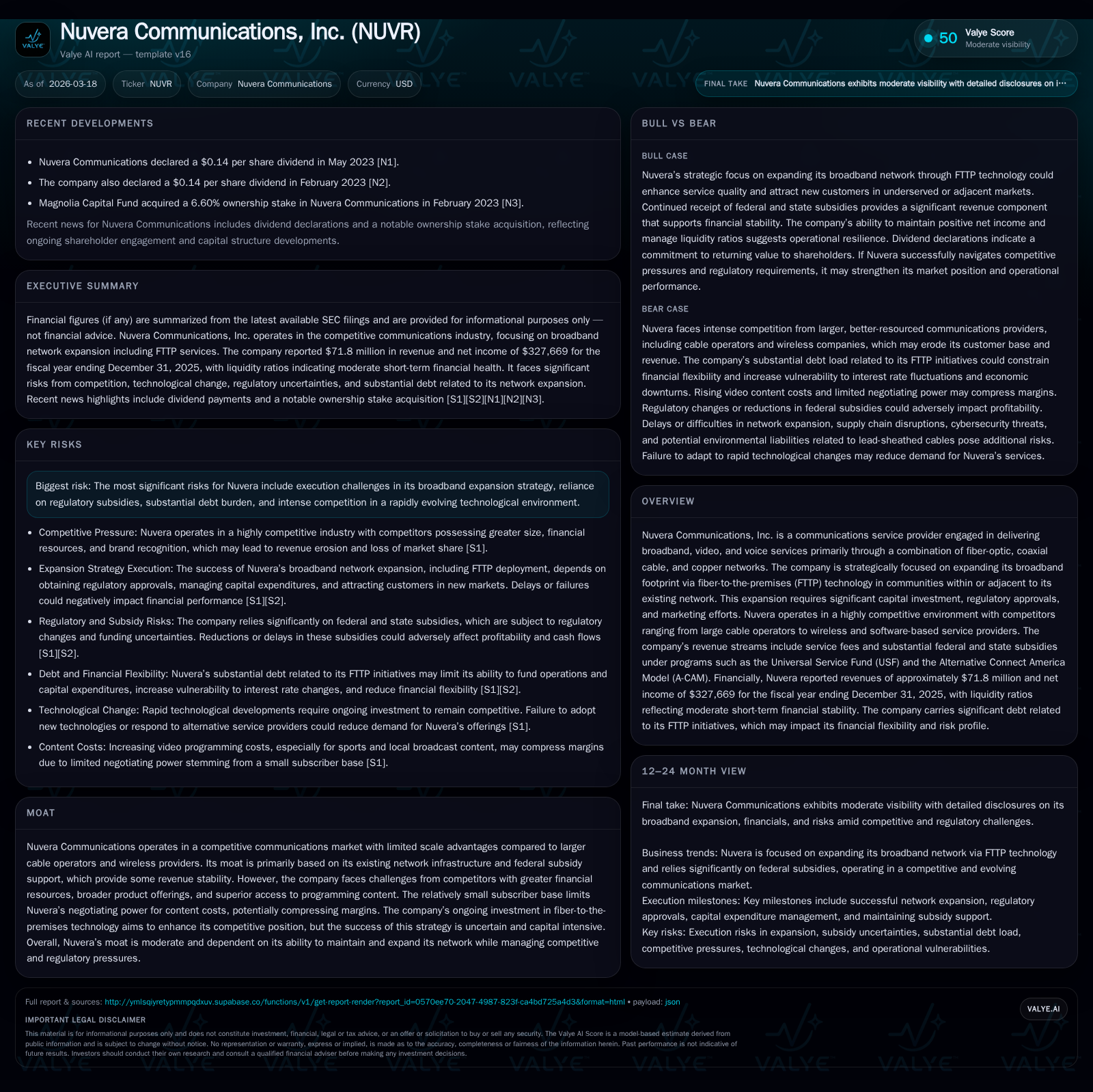
Nuvera Communications has shown consistent revenue growth driven by its broadband, video, and voice services delivered through fiber-optic, coaxial cable, and copper networks. Its strategic pivot toward fiber-to-the-premises (FTTP) broadband expansion requires substantial capital investment, exposing the company to execution risks amid fierce competition and regulatory uncertainties. Despite stable operating income, Nuvera's profitability remains constrained by rising programming costs, increasing debt levels from FTTP spending, and reliance on federal subsidies that face potential volatility. Monitoring capital expenditure trends, subsidy policies, and competitive market dynamics will be critical for assessing Nuvera’s financial trajectory.
Historical Performance Overview
Nuvera Communications’ financials reflect a steady top-line increase over recent years, with revenues rising from approximately $65.7 million in FY2023 to about $71.8 million in FY2025, marking a compounded growth trajectory of roughly 3.7% year-over-year [F1]. This growth aligns with their strategic emphasis on broadband service expansion including FTTP offerings alongside legacy voice and video services. Operating income has been broadly stable around $9.9 million in FY2025 after some fluctuation with a peak at $11.5 million in FY2022; however, net income volatility is notable — recovering from significant losses in FY2023 (-$3.2 million) and FY2024 (-$4.4 million) to a slim positive number ($0.3 million) in FY2025 [F1].
Operating cash flow has held relatively steady near $19 million annually post-FY2022, easing downward pressure on liquidity compared to the prior elevated level of ~$26.5 million [F1]. Nevertheless, capital expenditures remain elevated due primarily to the ongoing build-out of fiber infrastructure — capex fell significantly from over $55 million in FY2023–FY2024 down to about $33 million in FY2025 but still constitutes an outsized portion of cash outflows [F1]. This results in negative free cash flow (operating cash flow minus capex), demonstrating that Nuvera is still funding growth investments aggressively without generating excess cash.
Historical performance (annual)
| FY | Rev ($mm) | Net ($mm) | CFO ($mm) | OpInc ($mm) | Rev YoY | Net YoY |
|---|---|---|---|---|---|---|
| 2025 | 72 | 0 | 19 | 10 | +3.7% | +107.4% |
| 2024 | 69 | -4 | 19 | 10 | +5.2% | -37.7% |
| 2023 | 66 | -3 | 19 | 9 | +0.1% | -144.7% |
| 2022 | 66 | 7 | 27 | 12 |
Source: SEC companyfacts cache [F1].
Capital returns and efficiency (annual)
| FY | Div ($mm) | Buybacks ($mm) | FCF ($mm) |
|---|---|---|---|
| 2025 | -14 | ||
| 2024 | 0 | -35 | |
| 2023 | 1 | 3 | -37 |
| 2022 | 3 | 3 | -11 |
Source: SEC companyfacts cache [F1].
Note: Revenue values are in millions USD; Dividends and Buybacks are amounts paid/repurchased in thousands USD [F1].
Industry Dynamics and Competitive Environment
Nuvera operates mainly as a regional communications service provider offering broadband internet, voice telephone services, and video programming primarily via hybrid network infrastructures comprising fiber optics, coaxial cable, and legacy copper lines . The competitive landscape is intensely challenging: it includes giant cable operators leveraging scale advantage for content acquisition and marketing; wireless carriers aggressively expanding fixed wireless access with next-gen data speeds; satellite providers addressing underserved areas; plus software-driven OTT platforms disrupting traditional video consumption models [S1][S11][S22].
The market demands continuous innovation not only in speed enhancements but also in bundles incorporating voice, data, video, and ancillary services alongside competitive pricing strategies designed by larger peers with deeper pockets [S1][S11]. Smaller players like Nuvera often grapple with negotiating power deficiencies which exacerbate rising content costs — one of their largest operating expenses — especially for sports programming and local retransmissions that attract subscribers but relentlessly inflate margin compression risk [S10]. Moreover, the accelerating consumer shift toward mobile internet service threatens traditional landline telephone revenues prompting carriers to diversify through FTTP deployments or face subscriber attrition [S1][S22].
Technological advances enable competitors to bypass traditional wired architectures through extensive fixed wireless solutions or OTT apps that undermine pay-TV subscriptions altogether [S22]. These dynamics underscore the urgency behind Nuvera’s thrust into FTTP as a necessary but capital-heavy strategy.
Future Growth Prospects
Central to Nuvera’s future revenue growth is its aggressive expansion of fiber-to-the-premises broadband coverage targeting communities within or proximate to its existing footprint [S2][S13][S23]. The company’s blueprint involves securing franchises and permits while upgrading its physical plant — an endeavor requiring multi-year commitments of management focus and capital resources estimated historically at tens of millions annually [F1][S10]. Such buildouts aim both to attract new subscribers with ultra-high-speed offerings and defend against churn amidst intensifying competition.
However, this approach carries considerable execution risk: delays or difficulties obtaining regulatory approvals could stall market entry timelines; supply chain constraints could hamper construction progress; insufficient customer uptake relative to projections may depress returns on invested capital; competition’s reaction might involve price-cutting or service bundling designed specifically to defend contested regions [S2][S13][S23]. Furthermore, Nuvera faces risks tied to escalating tariffs on imported network hardware which amplify buildout expenses potentially pressuring gross margins if costs cannot be recouped through pricing adjustments [S9][S12][S18].
Crucially, reliance on federal subsidies under the Universal Service Fund frameworks such as A-CAM currently contributes materially to cash inflows supporting network economics—over $4 million received in early 2025 alone—but these programs face reform pressures that inject uncertainty regarding future levels or eligibility criteria impacting profitability continuity [S2][S14][S15][S18]. Any reduction would force recalibration of growth investments or service pricing.
Financial Capital Allocation and Leverage Considerations
From a capital allocation perspective, Nuvera remains heavily invested into infrastructure — deploying approximately $33 million in capex during FY2025 even after marked reductions from prior two years exceeding $50 million annually reflecting initial build surge phases now partially tapering off [F1]. This sustains negative free cash flow near -$14 million due to ongoing refurbishment expenses outstripping operating cash inflows by a wide margin.
The company’s balance sheet carries substantial debt related largely to these FTTP initiatives: as of mid-2025 outstanding borrowings approximated $144 million primarily under variable-rate instruments exposing Nuvera to interest rate fluctuations influencing interest burdens negatively if borrowing costs rise further without hedging full exposure effectively [S5][S6][S8][S19]. The consequent leverage impairs flexibility constraining capacity for opportunistic investments or buffering downturns.
Notably the return on equity remains minimal at approximately 0.3% as net profits hover near breakeven despite respectable operating incomes suggesting significant interest expense drag coupled with non-cash items affect bottom line positively only marginally at present [F1]. Dividend distributions have ceased since FY2024 reflecting prudent preservation of internal funds amid capex demands and leverage management efforts while share buybacks have been inactive post-2023 indicating limited scope for capital returns given liquidity priorities.
Operational Risks & Regulatory Environment
Nuvera’s operational continuity hinges on maintaining reliable network infrastructure subject to physical damage risks from weather events or vandalism alongside cybersecurity threats increasingly targeting telecom operators potentially exposing confidential data breaches with reputational repercussions [S24][S16]. Additionally environmental scrutiny regarding legacy elements such as lead-sheathed copper cables found within parts of its network creates latent liabilities uncertain at this stage yet warranting monitoring due diligence investment given potential remediation costs or regulatory actions that could arise unexpectedly [S24]
Furthermore the regulatory environment adds layers of complexity: Nuvera must navigate evolving FCC mandates on universal service funding reforms shifting support towards broadband over voice [S2]; contend with local franchise agreements crucial for municipal market access; comply with state-level public utility regulations imposing cost structures differentially onerous versus less regulated OTT providers creating uneven playing fields competitively; all while engaging stakeholders increasingly attentive to ESG practices raising compliance costs albeit voluntary today but likely intensifying over time across capital markets participants’ expectations frameworks [S7][S16]
What To Watch Next: Analysis Perspective
Absent explicit forward guidance beyond intentions expressed within risk disclosures regarding FTTP expansion timelines or subsidy dependencies ([N#] unavailable), readers should monitor Nuvera’s quarterly filings for capital expenditure pacing changes signaling build progress or slowdowns potentially attributable to external factors such as permitting delays or supply chain bottlenecks impacting network rollouts.
Additionally tracking federal subsidy program reform debates will prove essential given their outsized role supporting economics underpinning rural broadband extensions core to Nuvera’s strategy.
Market share evolution vis-à-vis competing fixed wireless entrants or bundled offerings by large cable incumbents will also shed light on subscriber traction gains or erosion.
Lastly liquidity metrics such as current ratio stability near current ~1.47 mark along with debt maturity profile updates may determine financial resilience horizon historically pressured by leverage servicing needs amid constrained free cash flows [F1].[N#] absence prevents granular expected milestone disclosure.
This analysis reflects information extracted strictly from publicly filed disclosures up through early-2026 without projecting outcomes beyond stated facts nor offering investment recommendations.
Disclaimer: This is research-only, informational analysis and not investment advice. It may include AI-generated interpretation and general industry context. Always verify important details using primary sources.

Comments