
Candel Therapeutics' Viral Immunotherapy Journey: From Clinical Breakthroughs to Capital Strategies
Candel Therapeutics advances proprietary viral immunotherapies, leveraging pivotal trial successes to fuel growth while managing capital demands and regulatory complexities.
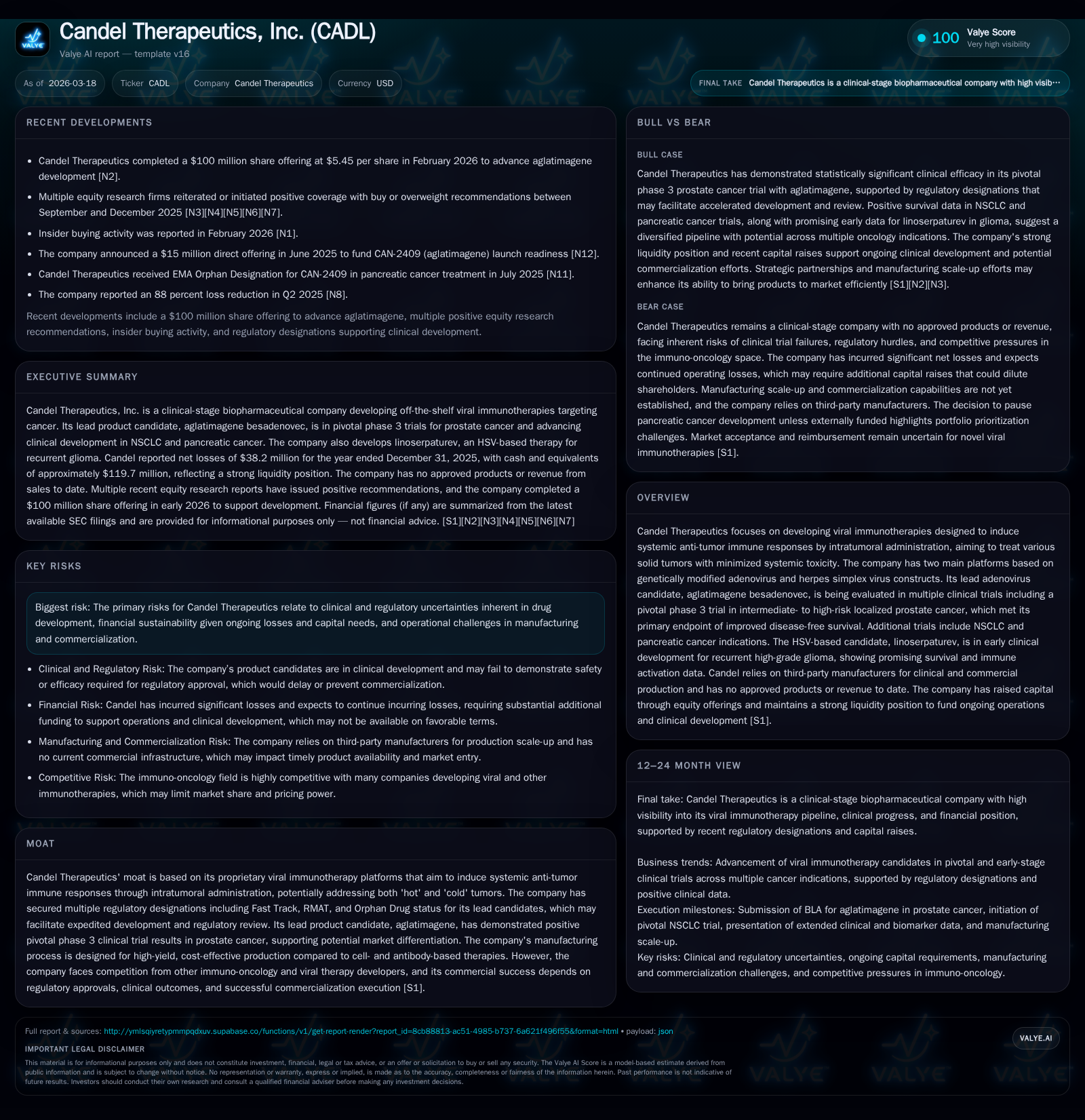
Candel Therapeutics specializes in off-the-shelf viral immunotherapies designed to trigger systemic anti-tumor immunity via intratumoral delivery. The company’s lead adenovirus candidate, aglatimagene besadenovec, has shown promising clinical activity in localized prostate cancer under an FDA Special Protocol Assessment. Despite encouraging clinical progress, Candel continues to operate at a significant net loss with increasing operating expenses tied to ongoing and expanded clinical programs. The firm recently raised $100 million in equity capital and maintains a $50 million debt facility, balancing dilution against runway needs. Operationally, the reliance on third-party manufacturing aims to optimize viral vector production efficiency but imposes execution risk. Risks remain considerable given regulatory uncertainty, capital intensity, and the lack of commercial revenue. Upcoming trial readouts across solid tumor indications represent key near-term catalysts.
Track Record of Clinical and Financial Progress
Candel Therapeutics is a clinical-stage biopharmaceutical company developing off-the-shelf viral immunotherapies aimed at eliciting systemic anti-tumor immune responses through intratumoral delivery [S1]. Its lead product candidate, aglatimagene besadenovec, an adenovirus-based therapy administered alongside valacyclovir, has demonstrated promising clinical activity in a pivotal Phase 3 trial targeting intermediate- to high-risk localized prostate cancer conducted under an FDA Special Protocol Assessment (SPA) [S1][S3]. This trial addresses a significant unmet need given that up to 30% of such patients experience recurrence despite standard treatment [S1].
Financially, Candel continues to operate at a loss consistent with its developmental stage. Operating income declined by 44.6% year-over-year reaching a negative $48.3 million in fiscal year 2025 [F1]. Net loss improved by approximately 30.8% year-over-year to $38.2 million due primarily to better management of non-R&D expenses [F1]. Operating cash flow also declined by 41.8%, reflecting increased investment in clinical programs [F1]. These results underscore the capital-intensive nature of late-stage biopharmaceutical development where substantial R&D costs precede any revenue generation.
Historical performance (annual)
| FY | Net ($mm) | CFO ($mm) | OpInc ($mm) | Capex ($) | Net YoY |
|---|---|---|---|---|---|
| 2025 | -38 | -38 | -48 | 587000 | +30.8% |
| 2024 | -55 | -27 | -33 | 16000 | -45.4% |
| 2023 | -38 | -34 | -38 | 457000 | -101.9% |
| 2022 | -19 | -31 | -35 | 1297000 |
Source: SEC companyfacts cache [F1].
Capital returns and efficiency (annual)
| FY | FCF ($mm) | ROE% |
|---|---|---|
| 2025 | -39 | -73.5 |
| 2024 | -27 | -83.2 |
| 2023 | -35 | -297.7 |
| 2022 | -33 | -39.4 |
Source: SEC companyfacts cache [F1].
Table reflects Candel Therapeutics' recent financial trends characterized by increasing research investments offset partially by improved net income control.
Despite positive signals from aglatimagene’s Phase 3 data, the company faces ongoing financial pressure inherent to advancing multiple clinical programs including trials in non-small cell lung cancer (NSCLC) and pancreatic cancer [N2][S1]. This highlights the challenge of balancing scientific progress with escalating capital demands.
Viral Immunotherapy Platforms: Scientific Differentiation
Candel’s drug development strategy centers on two off-the-shelf viral immunotherapy platforms based on genetically modified adenovirus and herpes simplex virus (HSV) vectors [S1]. These platforms leverage intratumoral administration to induce immunogenic cell death within the tumor microenvironment, releasing tumor neo-antigens that prime systemic T-cell mediated immune responses capable of targeting injected tumors as well as distant metastases through an abscopal effect.
This approach aims to convert immunologically “cold” tumors with limited immune infiltration into inflamed “hot” tumors more responsive to immune attack—a key limitation of current checkpoint inhibitors [S1]. Operational challenges include achieving scalable high-titer viral vector manufacturing while maintaining vector stability during storage and distribution.
Regulatory Milestones
The company has secured several regulatory designations that may accelerate development timelines:
- A Special Protocol Assessment with the FDA for its pivotal Phase 3 prostate cancer trial helps reduce regulatory risk related to trial design.
- Fast Track Designation granted for aglatimagene in combination with radiation therapy for localized prostate cancer supports expedited review.
- Additional designations such as Regenerative Medicine Advanced Therapy (RMAT) status provide opportunities for enhanced FDA interactions and potential market exclusivity benefits [S1].
These milestones signal regulatory recognition of the therapeutic potential and could compress traditional approval timelines.
Capital Structure and Liquidity Position
In February 2026, Candel completed a $100 million equity offering priced at $5.45 per share intended primarily to support ongoing development of aglatimagene and pipeline expansion [N2]. The company also maintains a $50 million term loan facility arranged with Trinity Capital which replaced prior debt from Silicon Valley Bank [S4].
As of December 31, 2025, Candel held approximately $119.7 million in cash and cash equivalents providing runway amid continued negative operating cash flows [F1]. However, debt covenants impose restrictions on incurring additional indebtedness or disposing of assets which may limit financial flexibility [S7][S13]. Insider stock purchases reported recently suggest management confidence despite challenging market conditions [N1].
Manufacturing Strategy
Candel outsources viral vector manufacturing to specialized third-party providers focusing on efficient high-titer production compatible with intratumoral administration requirements [S1][S3]. This approach mitigates the complexity and capital intensity associated with building internal manufacturing capabilities but requires robust quality controls given live virus product sensitivities.
Compared with cell-based or antibody therapies, this model may offer cost advantages if scale-up challenges can be managed effectively without compromising product consistency.
Risk Factors
Key risks confronting Candel include:
- Absence of approved products or commercial revenues; profitability remains contingent on successful regulatory approvals still years away [S1][F1].
- Continued operating losses driven by increasing R&D expenditures expected over several years absent commercialization events [F1][S1].
- Regulatory uncertainty around novel endpoints or trial designs despite Fast Track status; evolving FDA expectations may impact development plans .
- Debt covenants create default risk if liquidity deteriorates or milestones are missed [S7][S13].
- Compliance obligations under extensive healthcare fraud/abuse laws and patient privacy regulations including HIPAA and state equivalents pose operational burdens .
- Litigation risk remains controlled currently but could arise from product liability or compliance issues as development progresses [S16].
These factors underscore the inherent challenges typical for clinical-stage biotechs navigating late-stage development.
Outlook and Growth Catalysts
Upcoming catalysts that could materially influence valuation include:
- Longer-term follow-up data from the pivotal Phase 3 prostate cancer trial validating durability of disease-free survival benefits critical for reimbursement discussions aligned with NCCN guidelines [N1][S1].
- Expansion into NSCLC and pancreatic cancer indications leveraging platform versatility addressing significant unmet medical needs.
- Early-stage HSV program targeting recurrent high-grade glioma represents a niche opportunity though still preliminary.
- Ongoing regulatory interactions under Fast Track designation will be pivotal inflection points affecting future partnership prospects.
Monitoring these milestones will be essential as they will dictate the trajectory toward commercialization amidst competitive pressures.
Capital Allocation and Investor Returns
Capital deployment since inception has focused predominantly on research & development activities encompassing over 80% of total expenses driving operating losses which deepened by approximately $14.9 million between fiscal years 2024 and 2025 (-44.6%) [F1]. Free cash flow remained deeply negative at approximately -$39 million reflecting reinvestment consistent with advancing late-phase clinical programs without current revenue streams [F1].
Return on equity was approximately -73.5% in fiscal year 2025 illustrating sustained net losses against a modest equity base (~$52 million), highlighting dilution pressures intrinsic at this stage alongside heavy expenditure commitments required for pivotal trials [F1].
Capital discipline will be critical as Candel transitions from development toward eventual commercialization investment phases while preserving shareholder value contingent upon trial success and prudent financing strategies amidst evolving market conditions.
This analysis synthesizes currently available public filings including SEC reports alongside industry-standard biotechnology insights without providing investment advice or price forecasts.
Disclaimer: This is research-only, informational analysis and not investment advice. It may include AI-generated interpretation and general industry context. Always verify important details using primary sources.

Comments