
Sunrise Realty Trust: Building Momentum After Its First Full Year of Investment
Sunrise Realty Trust has leveraged its strategic spin-off and external management to establish a nascent CRE lending platform with growing earnings but volatile cash flows.
Formed as a spin-off from Advanced Flower Capital in mid-2024, Sunrise Realty Trust has launched its commercial real estate debt investment strategy under the Tannenbaum Capital Group umbrella. Its first full year of operations showed robust net income growth, driven by origination and interest income on secured loans, while operating cash flow turned negative reflecting active capital deployment. The company is targeting a diversified portfolio of CRE loans with prudent LTV ratios and a balanced capital structure emphasizing one-third equity, one-third secured debt, and one-third unsecured debt. Dividend payouts surged in line with company maturation despite operating cash flow pressures, highlighting a transition phase toward steady yield generation. Key future metrics will include portfolio IRR achievement, leverage management, and sustained capital market access.
Foundation and Launch: From Spin-Off to Initial Investments
Historical performance (annual)
| FY | Net ($mm) | CFO ($mm) | Net YoY |
|---|---|---|---|
| 2025 | 12 | -3 | +76.8% |
| 2024 | 7 | 2 |
Source: SEC companyfacts cache [F1].
Capital returns and efficiency (annual)
| FY | Div ($mm) | ROE% |
|---|---|---|
| 2025 | 15 | 6.7 |
| 2024 | 1 | 6.0 |
Source: SEC companyfacts cache [F1].
Sunrise Realty Trust, Inc. emerged as an independent publicly traded REIT through a spin-off from Advanced Flower Capital Inc. (AFC) completed in July 2024 [S1]. This foundational event separated Sunrise into a standalone entity focused on originating and investing in secured commercial real estate (CRE) loans. The company elected REIT status for federal tax purposes for its fiscal year ending December 31, 2024.
Importantly, Sunrise benefits from an external management arrangement via Sunrise Manager LLC under the broader Tannenbaum Capital Group (TCG) platform. This alliance provides Sunrise with access to TCG's seasoned commercial real estate investment professionals alongside critical back-office capabilities spanning marketing, legal compliance, reporting, and loan management infrastructures [S1]. Such integration allows Sunrise to tap into established origination networks comprising commercial real estate owners and operators—a crucial competitive advantage for a new entrant seeking scale.
The company's initial investments began promptly after formation in January 2024. Since then, Sunrise has pursued a disciplined approach targeting CRE loans characterized by near-term value creation opportunities backed by strong borrower sponsors.
2024–2025 Financial Performance: Earnings Growth Contrasted With Cash Flow Volatility
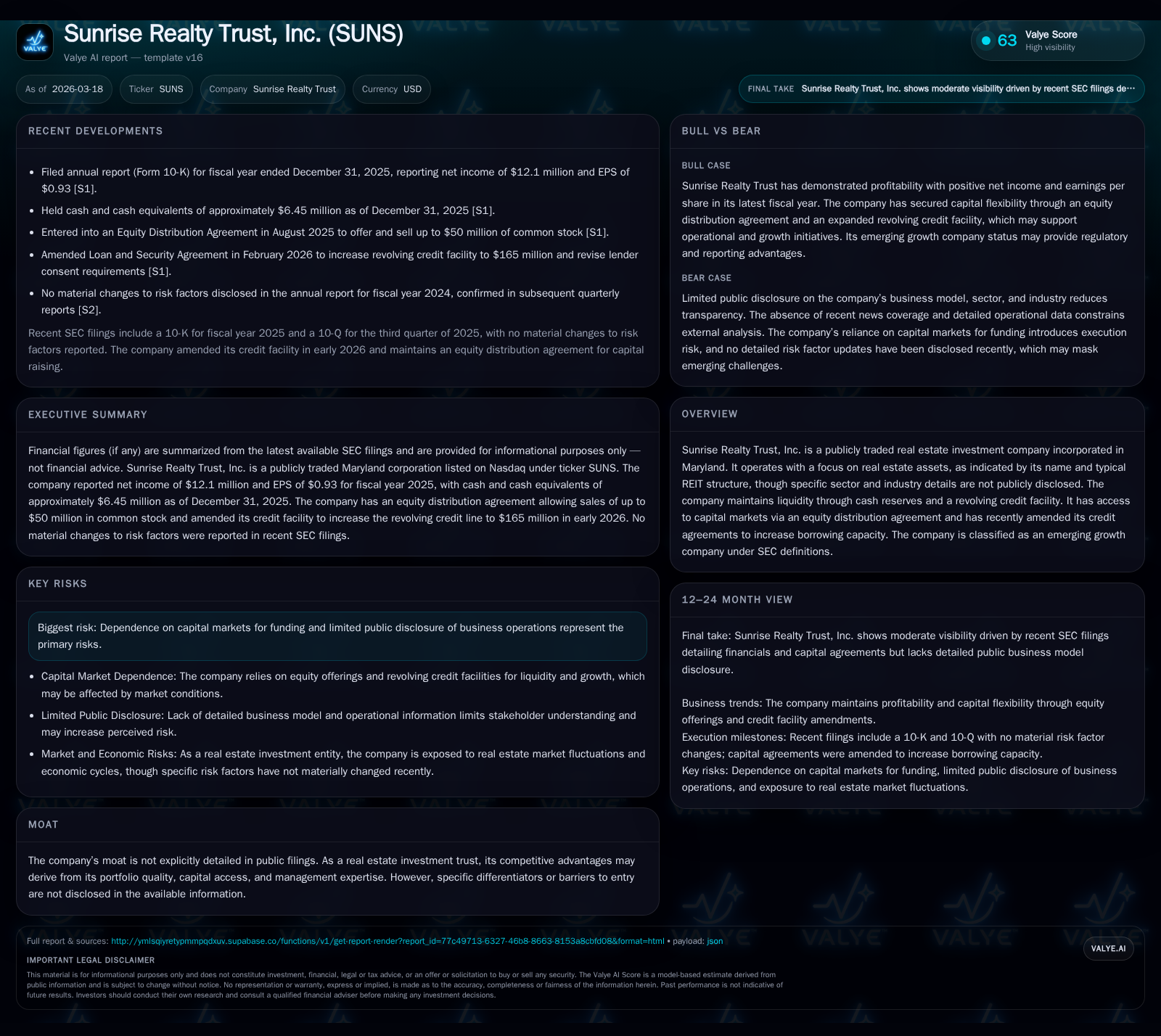
Despite its recent inception, Sunrise recorded substantial financial momentum during its first full fiscal year ending December 31, 2025. Net income advanced from approximately $6.87 million in FY2024 to $12.14 million in FY2025—a notable year-over-year increase of roughly 76.8% per [F1]. This expansion is attributable primarily to increased revenue recognition from loan origination fees and interest income arising from the growing loan portfolio.
In contrast with income growth, operating cash flow exhibited considerable volatility reflective of the company's early-stage investing profile. Operating cash flow swung from positive $1.64 million in FY2024 to negative $3.43 million in FY2025—a decline exceeding 300% year-over-year according to [F1]. This divergence can be understood within the REIT framework where upfront capital outlays for loan originations depress near-term cash inflows even as associated fees bolster earnings.
Thus, while reported profitability surged, free cash generation remains influenced by timing differences embedded within the evolving asset base deployment cycle.
Investment Strategy: Secured CRE Debt with Multi-Asset Diversification Targets
Sunrise concentrates on originating or acquiring secured loans backed by commercial real estate collateral encompassing multi-family housing (including condominiums and single-family communities), retail spaces, office buildings, hospitality properties, industrial facilities, mixed-use developments, and specialty asset classes [S1].
Hold sizes typically range between $15 million and $100 million per loan or portfolio tranche. Loans generally feature transactional maturities spanning roughly two to five years with floating rate interest determined against SOFR benchmarks plus negotiated credit spreads designed to produce target returns.
Loan-to-value (LTV) ratios are capped at approximately 75% both on individual investments at inception as well as aggregated portfolio levels—aligned with conservative underwriting disciplines prevalent among mezzanine lenders and B-note investors active within commercial mortgage capital stacks.
Beyond senior mortgages, the company intends incremental diversification into mezzanine loans, subordinate B-notes positions, CMBS tranches (commercial mortgage-backed securities), and preferred equity securities exhibiting debt-like characteristics to broaden risk-adjusted returns across CRE sectors [S1].
Projected portfolio internal rates of return are targeted initially in the low-teens percentage range before leveraging effects boost net IRRs potentially into mid-teen territory—consistent with risk-premia expectations for specialty finance platforms within CRE debt markets.
Capital Structure Evolution: Leveraging Credit Facilities and Equity to Fuel Growth
Sunrise employs a balanced capitalization framework aiming for near equal proportions of equity funding alongside secured and unsecured debt tranches [S1]. The company maintains revolving credit facilities enabling flexible use of secured borrowings which were recently amended (February 2026) to increase total revolver capacity by $25 million up to $165 million aggregate [S6,S9]. These changes also introduced refined consent protocols advocating lender coordination efficiency.
Equity capital is raised under an August 2025 Equity Distribution Agreement offering up to $50 million through at-the-market transactions managed by Raymond James & Associates [S13,S15], providing ongoing liquidity replenishment aligned with portfolio expansion needs.
This tripartite approach—approximately one-third equity contribution blended with one-third secured lending capacity plus one-third unsecured debt exposure—targets maintaining a prudent leverage ratio around 1.5x debt-to-equity without fully drawing on available credit lines [S1,S6,S9]. Such flexibility supports opportunistic financing while mitigating structural liquidity risks common during growth phases.
Return Metrics and Investor Cash Distribution Dynamics
Return on equity (ROE) based on reported net income relative to average equity balances stood near 6.7% for FY2025 per calculations using [F1] data ($12.14M net income / $181.96M equity).
Meanwhile dividend distributions indicate accelerated payout enhancements commensurate with corporate maturity. Dividends paid increased dramatically from about $1.45 million in FY2024 to over $15 million for FY2025—an uplift exceeding ninefold reflecting Sunrise’s intent to establish reliable income flows for yield-focused investors despite ongoing operating cash flow pressure [F1].
Such trajectory typifies emerging REITs transitioning from capital accumulation phases toward normalized distributions reliant on stable core earnings streams from performing loan assets.
Future Outlook: Portfolio Composition and Market Positioning Challenges
Looking ahead, Sunrise aims to deepen portfolio diversification across targeted CRE verticals consistent with stated concentration limits—balancing transitional/construction lending with stabilized properties managed by seasoned borrowers possessing credible business plans [S1].
Risk remains inherent around exposures to floating interest rates given SOFR linkages plus credit spread dynamics which may fluctuate due to macroeconomic shifts affecting borrower performance or refinancing conditions.
Disclosed risk factors have remained materially unchanged since initial filings other than routine updates emphasizing dependency on external capital markets funding channels alongside relatively limited public operational visibility at this stage [S2,S5].
Hence future growth will hinge critically on effectively managing asset quality risks alongside attracting fresh capital through equity placements or favorable debt issuance terms amidst evolving market cycles.
Milestones to Monitor: Leverage Targets, IRR Attainment, and Capital Market Access
Key performance indicators include monitoring Sunrise’s ability to sustain portfolio-level LTV ratios below its stated approximate ceiling of 75%, which safeguards collateral protection buffers essential within CRE lending frameworks [S1].
Achievement of targeted IRRs—both gross yields on underlying assets plus net returns factoring financing costs—will serve as barometers validating investment underwriting assumptions over medium horizons.
Additionally, observing ongoing access to capital markets via at-the-market equity programs alongside utilization levels against expanded revolvers will be vital signals regarding financial flexibility continuity supporting scale ambitions focused on low- to mid-teens risk-adjusted return profiles [S3,S15].
This analysis synthesizes publicly available data as of March 18, 2026 without making investment recommendations or forecasts beyond documented disclosures. Readers should consider official filings for comprehensive risk assessments.
Disclaimer: This is research-only, informational analysis and not investment advice. It may include AI-generated interpretation and general industry context. Always verify important details using primary sources.

Comments