
TAT Technologies Accelerates Growth via Diversified Aerospace OEM and MRO Platform with Strengthened Cash Position
The company leverages engineering strengths, certifications, and expanding service scope to support its 2025 revenue surge.
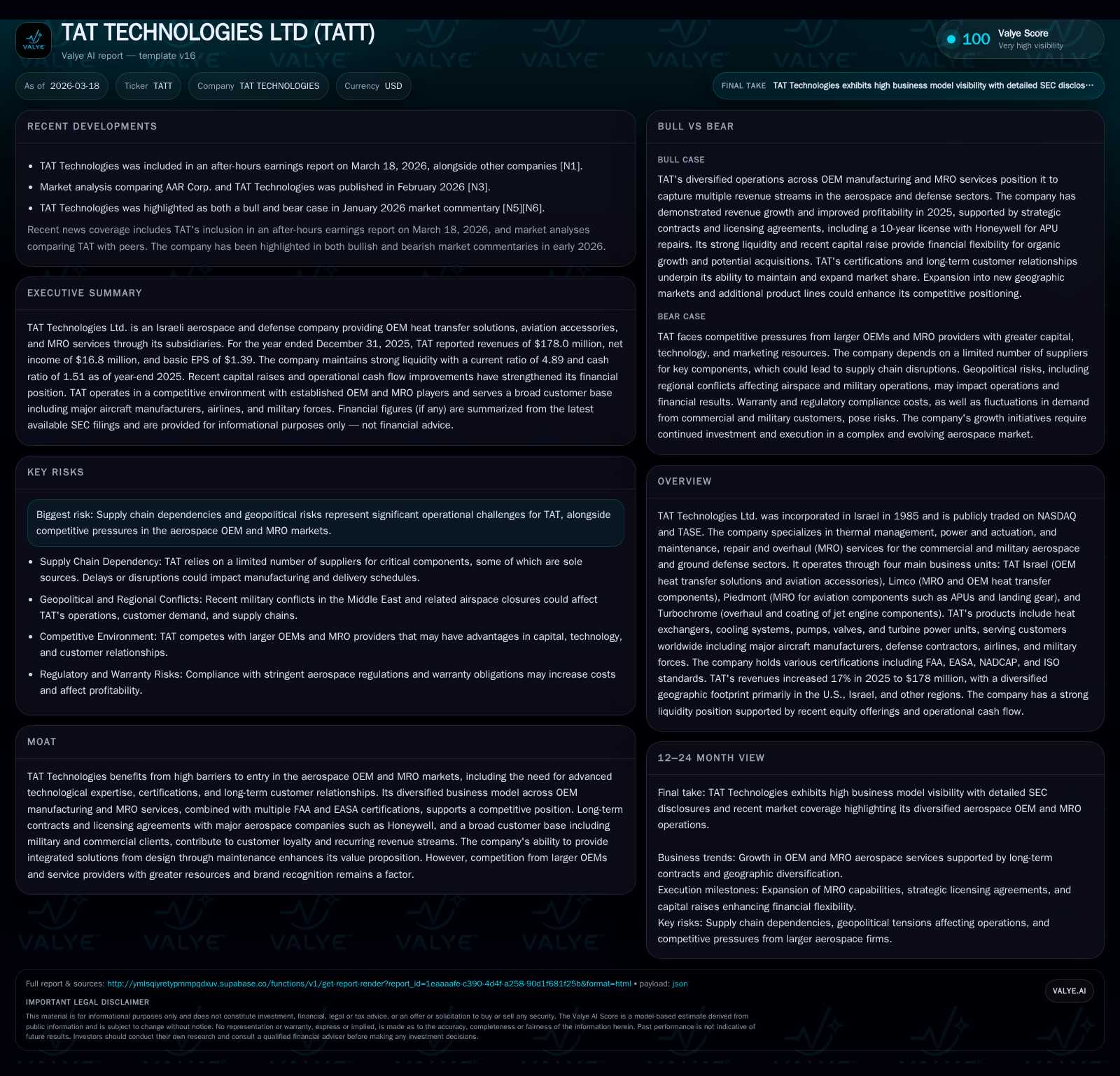
TAT Technologies Ltd. reported robust 2025 financial results driven by both organic growth and strategic capital raises, reaching $178 million in revenue, a 17% increase year-over-year. The firm’s diversified operations across OEM heat transfer solutions and MRO services underpin its competitive moat amid aerospace cyclical headwinds. With a strong cash position of $51.6 million, supported by a major equity offering in mid-2025, TAT is positioned to invest further in capacity expansion and technology innovation. Future growth depends on capturing expanding market opportunities in electrification and eVTOL platforms, while geopolitical supply risks and competition from larger OEMs remain key challenges.
Company Background and Industry Context
Founded in Israel in 1985, TAT Technologies Ltd. has developed into a leading provider of thermal management, power and actuation systems, alongside maintenance, repair, and overhaul (MRO) services primarily serving the aerospace sector's commercial and military segments [S1]. With publicly traded shares on NASDAQ and the Tel Aviv Stock Exchange since the mid-2000s, TAT operates four principal business units: TAT Israel focusing on OEM heat transfer solutions; Limco providing MRO services plus OEM components; Piedmont specializing in aviation components' MRO like APUs and landing gear; and Turbochrome handling jet engine component overhaul [S1][S11].
TAT's niche within aerospace components—especially heat exchangers, cooling systems, pumps, valves, and turbine power units—entrenches it amid an industry characterized by high barriers due to technical complexity, requiring rigorous certification such as FAA FAR regulations and NADCAP accreditation [S16]. Its customer roster spans major aircraft manufacturers including Boeing and Lockheed Martin, defense contractors like Raytheon-Collins, airlines worldwide including Lufthansa and FedEx, alongside military forces notably the U.S. Armed Forces and Israeli Ministry of Defense [S5][S16].
Historical Financial Performance
Over the last four years ending December 31, 2025, TAT consistently delivered solid top-line growth against cyclical aerospace headwinds. Revenue expanded sharply from $84.6 million in 2022 to $178.0 million in 2025 — a compounded annual growth rate exceeding 30%, with a moderated growth rate of 17% year-over-year between 2024-25 [F1].
Driving this growth was an increasing contribution from MRO service contracts alongside steady OEM product sales that collectively helped gross profit climb from $33 million in 2024 to over $44 million in 2025 [S1][F1]. Operating income surged more than 50% year-over-year to $18.8 million while net income similarly doubled to $16.8 million by end-2025 [F1]. The company also reversed prior operating cash flow deficits evident in 2024 (-$5.8 million) to positive cash generation of approximately $15.0 million during 2025—a reflection of improved cost management and higher operating leverage [F1][S14]. Capital expenditures increased notably to nearly $11 million (vs $3.9m prior year) signaling reinvestment into manufacturing capacity expansion aligned with growth ambitions [F1][S10].
Historical performance (annual)
| FY | Rev ($mm) | Net ($mm) | CFO ($mm) | OpInc ($mm) | Rev YoY | Net YoY |
|---|---|---|---|---|---|---|
| 2025 | 178 | 17 | 15 | 19 | +17.0% | +50.6% |
| 2024 | 152 | 11 | -6 | 13 | +33.7% | +139.0% |
| 2023 | 114 | 5 | 6 | +34.6% | +399.1% | |
| 2022 | 85 | -2 | -2 |
Source: SEC companyfacts cache [F1].
Capital returns and efficiency (annual)
| FY | FCF ($mm) | ROE% |
|---|---|---|
| 2025 | 4 | 9.5 |
| 2024 | -11 | 10.0 |
| 2023 | 5.2 | |
| 2022 | -2.1 |
Source: SEC companyfacts cache [F1].
Note: Earlier operating cash flow data unavailable; all figures per company filings [F1]
Drivers of Past Performance
Key factors contributing to TAT's performance include:
- Diversified revenue streams balancing OEM product sales (
29%) with services (71%), particularly MRO contracts generating recurring revenue [S1]. - Extensive certifications enabling access to regulated defense markets requiring compliance with FAA/EASA/NADCAP standards [S16].
- Strategic acquisitions such as Limco (1993) and Piedmont (2005), enhancing MRO capabilities across geographic hubs [S1].
- Effective cost control reversing prior losses set the foundation for margin expansion by optimizing mix towards higher-margin services.
- Managing supply chain complexities through preferred parts sourcing relationships mostly concentrated in Israel/US [S11][S18].
Recent Capital Expansion & Financial Condition
A pivotal event was the May-June 2025 underwritten public offering raising gross proceeds near $48 million (netting around $45.4 million after issuance costs), substantially boosting cash balances from approximately $7.4 million at end-2024 to over $51.6 million at end-2025 [S4][F1]. This capital influx empowered debt reduction initiatives where TAT lowered its bank loans by several millions alongside strengthening liquidity ratios (current ratio approximately 4.9x as of December ’25) supporting ongoing investments into R&D and capacity expansion [S6][S9].
The company maintained prudent leverage with total long-term debt standing at roughly $11.7 million while continuing positive free cash flow generation emerging during ’25 (operating cash flow minus capex approximates positive $4 million) indicating internally funded growth potential absent reliance on significant external borrowing [F1][S14].
Future Growth Prospects & Strategic Outlook
TAT’s future profit trajectory hinges on several key opportunities:
- Expansion into electrified aviation platforms including eVTOL vehicles where thermal management requirements are evolving rapidly [S23]. Developing expertise here could add competitive differentiation.
- Augmenting OEM offerings through new system/subsystem designs targeting both commercial aircraft upgrades and next-gen military projects.
- Increasing depth of MRO services — Turbochrome aims at broadening jet engine component servicing beyond current capabilities leveraging NADCAP-accredited processes [S8][S16].
- Geographic expansion targeting regions like Eastern Europe, Latin America, and Asia which currently represent smaller footprints but growing air travel demand.
- Sustained investment in engineering talent underpinning technological innovation critical given competitors’ superior brand presence or scale advantages.
Furthermore, long-term purchase order backlog stood at approximately $86 million with an additional estimated contractual pipeline near half a billion USD extending through contracts potentially maturing out to the early-to-mid-2030s reflects durable demand underpinning visibility for multiple years ahead [S7][S15]. However, this backlog includes forecasted sales under frame agreements lacking strict purchase obligations.
Risks & Operational Constraints
Challenges impacting TAT remain substantial:
- Supply chain concentration risks especially relating to sole-source component vendors predominantly located within Israel-US create vulnerability amid geopolitical tensions or trade interruptions.
- Currency exposure is material given significant expenses denominated in Israeli Shekel; fluctuations against USD can erode margins if inflation outpaces exchange rate movements despite partial hedging programs [S1].
- Elevated competition from aerospace giants possessing broader integrated system capacities restricts pricing flexibility.
- The commercial airline industry's cyclicality tied closely with macroeconomic variables introduces volatility affecting aftermarket MRO demand spikes or troughs.
- Regulatory compliance burden remains high necessitating ongoing investments just to maintain certification status particularly across multiple jurisdictions such as FAA/EASA/Chinese CAAC [S12].
Capital Allocation & Returns Analysis
While detailed ROE calculation yields approximately a modest near-single-digit return (~9.5%) based on net income relative to shareholders’ equity near $176 Million at year-end '25 [F1], the company prioritizes reinvestment into R&D (about $1.38 million spent annually representing roughly ~0.8% of revenues) along with incremental capex for infrastructure enhancement rather than shareholder dividends or buybacks—which have been negligible or absent recently reflecting a capital-intensive growth mode rather than return-of-capital focus [F1][S10].
This suggests management’s emphasis remains firmly on building scale via organic initiatives complemented by strategic acquisitions where synergies exist—as exemplified historically through Limco-Piedmont consolidation—and broadening technology portfolios aimed at sustaining competitive advantages long term.
What to Watch Going Forward (Analysis)
Without explicit forward guidance disclosed for post-2025 periods beyond backlog disclosures or general strategic direction commentary, key metrics warranting close monitoring include:
- Quarterly revenue progression confirming sustained double-digit organic growth amid easing pandemic impacts globally.
- Margin trends reflecting absorption of higher fixed costs related to capacity builds versus pricing environment dynamics amid inflationary pressures.
- Further deployment of capital raised through share issuance—tracking whether proceeds are leveraged effectively towards accretive acquisitions or cutting-edge technology development.
- New contract wins particularly within fast-growing sectors such as urban air mobility or electric propulsion components signaling successful market adaptation.
- Currency impact mitigation measures effectiveness amidst fluctuating NIS/USD rates affecting Israeli-based manufacturing cost base.
Conclusion
TAT Technologies presents a solid case study of a mid-sized aerospace component specialist leveraging technical expertise across diverse OEM manufacturing plus aftermarket MRO services segments to drive consistent top-and bottom-line expansions through dynamic aerospace cycles evidenced up through an impressive performance rebound in fiscal year ’25 supported by robust liquidity enhancement via equity financing.
While the enterprise benefits from extensive approvals/accreditations serving demanding regulated markets coupled with entrenched relationships spanning commercial airlines to military forces globally—it must continuously navigate external risk vectors including cyclical demand swings combined with evolving competitive landscape anchored by larger players commanding broader solution suites.
This positions TAT at an inflection where targeted reinvestments into new platform technologies such as electrification/eVTOL integration paired with geographic expansion efforts may unlock incremental value creation pathways amidst persistent operational vigilance over supply chain resilience and foreign exchange exposures.
This report is for informational purposes only and does not constitute investment advice or recommendations.
Disclaimer: This is research-only, informational analysis and not investment advice. It may include AI-generated interpretation and general industry context. Always verify important details using primary sources.

Comments