
Precision BioSciences Advances Genome Editing Platform Amid Continued Development Investment
Clinical-stage biotech Precision BioSciences leverages its proprietary ARCUS genome editing technology to target serious genetic diseases while managing ongoing operating losses and capital needs.
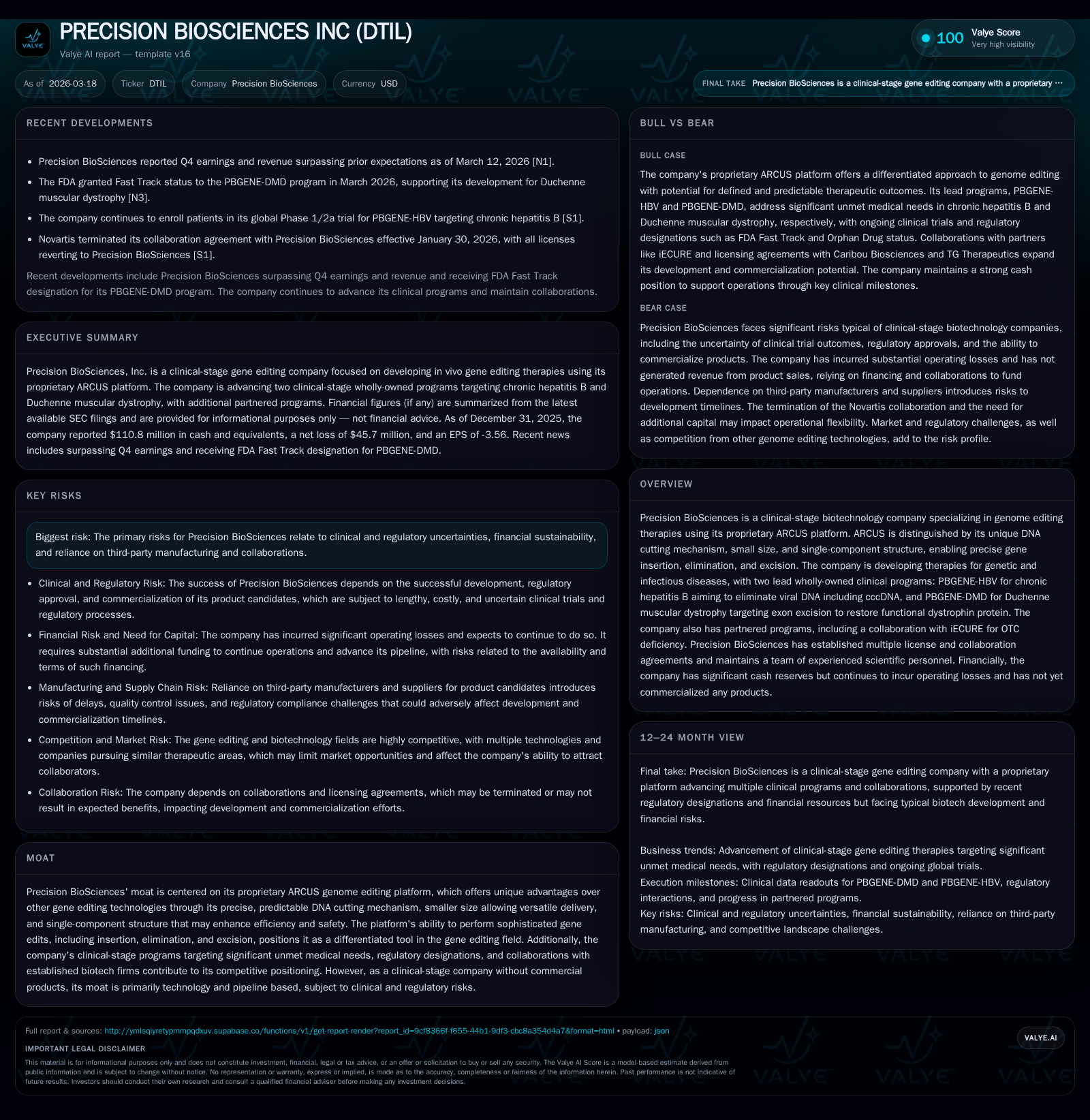
Precision BioSciences Inc (DTIL) is a clinical-stage biotechnology company focused on genome editing via its proprietary ARCUS platform. The company has yet to generate product sales revenue, relying primarily on licensing and collaboration proceeds amid substantial operating losses exceeding $45 million in fiscal 2025. Its lead wholly-owned clinical programs target chronic hepatitis B and Duchenne muscular dystrophy, with regulatory progress including FDA Fast Track designation for PBGENE-DMD. Despite promising technology differentiation and partnerships, near-term growth depends on clinical trial advancement and successful capital raises given persistent cash burn and negative operating cash flow. The company faces risks including regulatory complexities, intellectual property challenges, manufacturing dependencies, and funding sustainability.
Company Overview and Technological Differentiation
Precision BioSciences (Nasdaq: DTIL) is a clinical-stage gene editing biotechnology company utilizing its proprietary ARCUS platform to develop in vivo therapies addressing genetic diseases. ARCUS differentiates itself from other genome editing technologies by its compact size, single-component nuclease design, and unique DNA cutting mechanism that enables defined gene insertions, eliminations, or excisions with high precision and predictability [S1]. This capability supports potentially improved safety profiles essential for therapeutic applications.
The company’s pipeline includes two wholly-owned clinical candidates: PBGENE-HBV aims to eliminate chronic hepatitis B viral DNA reservoirs including cccDNA; PBGENE-DMD targets Duchenne muscular dystrophy through exon excision to restore dystrophin function. Additionally, partnered programs extend ARCUS applications beyond these wholly-owned assets [S1][N5]. FDA Fast Track designation was recently granted for PBGENE-DMD to expedite development and review processes [N5].
Historical Financial Performance
Precision BioSciences remains pre-revenue from product sales. Reported revenues historically stem from upfronts, milestones, license fees, and collaboration payments rather than commercial product sales. The company has incurred significant net losses driven mainly by research and development investments aligned with advancing clinical programs [F1].
Historical performance (annual)
| FY | Net ($mm) | CFO ($mm) | OpInc ($mm) | Capex ($mm) | Net YoY |
|---|---|---|---|---|---|
| 2025 | -46 | -66 | -52 | 0 | -738.0% |
| 2024 | 7 | -58 | -26 | 0 | +111.7% |
| 2023 | -61 | -84 | -44 | 2 | +45.1% |
| 2022 | -112 | -46 | -100 | 3 |
Source: SEC companyfacts cache [F1].
Capital returns and efficiency (annual)
| FY | FCF ($mm) | ROE% |
|---|---|---|
| 2025 | -66 | -49.6 |
| 2024 | -59 | 12.7 |
| 2023 | -86 | -325.1 |
| 2022 | -49 | -184.7 |
Source: SEC companyfacts cache [F1].
Note: Operating Cash Flow (CFO); OpInc = Operating Income; Net = Net Income; Capex = Capital Expenditures
The financials reflect high variability in investment intensity through preclinical and early clinical stages with persistent negative cash flows.
Growth Outlook and Milestones
Future growth depends on progressing lead candidates through clinical trials toward regulatory approvals or strategic partnerships generating milestone payments or royalties. Success in chronic hepatitis B offers potential impact addressing a large global patient population lacking curative options; DMD represents a severe rare disease where novel gene therapies are needed.
Fast Track designation for PBGENE-DMD facilitates rolling submissions and more frequent FDA interactions, potentially expediting development timelines [N5]. Upcoming milestones include clinical data readouts from HBV antiviral studies and DMD dose-escalation or interim efficacy results.
Expansion of ARCUS applications through collaborations diversifies the pipeline but depends on partners’ execution capabilities [S1]. Maintaining robust intellectual property protection remains critical amid competitive pressures from other genome editing platforms.
Capital Allocation and Returns
Through fiscal year 2025, Precision BioSciences has not generated positive returns; the approximate return on equity based on latest annual net income relative to equity is around negative 50%, indicative of ongoing developmental-stage investment without revenue offset [F1]. No dividends or share repurchases have been declared or executed.
At year-end 2025, the company held approximately $111 million in cash and equivalents with current liabilities near $9 million resulting in a strong current ratio (~13x), supporting short-term liquidity but underscoring the need for further capital to sustain operations given negative operating cash flows exceeding $65 million annually [F1][S10][S16].
Funding sources include equity offerings such as ATM placements diluting shareholders alongside debt financings like a term loan subject to covenants restricting indebtedness increases and minimum cash balances [S10]. Management is expected to continue pursuing mixed financing strategies combining equity issuances with collaborations to support R&D investment.
Key Risks
The company faces multiple risks including:
- Clinical trial failure or delays impacting development timelines.
- Regulatory compliance costs across multiple jurisdictions with potential enforcement consequences .
- Intellectual property disputes potentially delaying commercialization or increasing legal expenses .
- Dependence on third-party manufacturers creating supply chain risks.
- Financial sustainability challenges due to absence of product sales revenue necessitating ongoing capital raises [S10][F1].
- Product liability exposure inherent in clinical trials requiring comprehensive insurance coverage [S11].
- Data security risks associated with handling sensitive genomic information that could lead to regulatory penalties or reputational damage if breached [S6,S7,S17].
Conclusion
Precision BioSciences is an early-stage therapeutic innovator distinguished by its proprietary ARCUS genome editing platform enabling precise genomic modifications aimed at serious diseases lacking effective cures. While recent regulatory advances such as Fast Track status signal progress, the company continues intensive investment reflected in operating losses and negative cash flows.
Success will depend on advancing clinical programs efficiently while managing capital resources prudently amid an evolving competitive landscape requiring robust intellectual property defense and regulatory compliance.
Disclaimer: This is research-only, informational analysis and not investment advice. It may include AI-generated interpretation and general industry context. Always verify important details using primary sources.

Comments