
Idaho Copper Corp Pursues CuMo Project Amid Financing and Permitting Challenges
The company advances its large Idaho copper-molybdenum-silver deposit with updated studies while navigating capital constraints and regulatory risks.
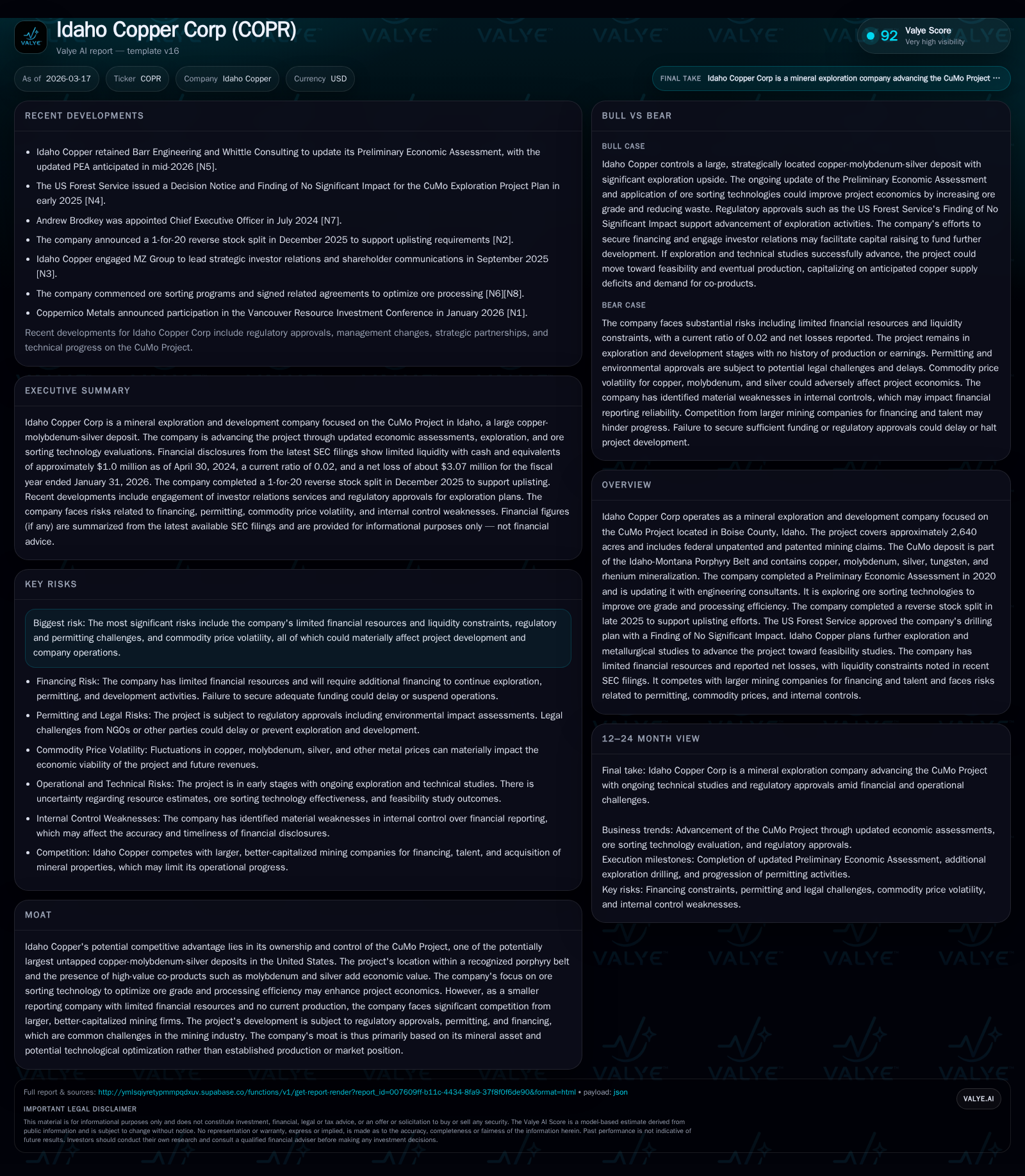
Idaho Copper Corp (COPR) operates the CuMo Project in Boise County, Idaho, focusing on a major porphyry copper-molybdenum-silver deposit with valuable co-products. The company completed a Preliminary Economic Assessment in 2020 and is updating it while investigating ore sorting technology to improve project economics. COPR faces significant hurdles securing approximately $40 million needed for a Preliminary Feasibility Study and much more for eventual construction, all under ongoing regulatory scrutiny and opposition. A reverse stock split was completed to bolster financing prospects, but substantial risks remain from litigation, permit delays, commodity volatility, and legacy environmental issues.
Company Background and Asset Overview
Idaho Copper Corp (ticker: COPR) is a mineral exploration and development company focused on advancing one of the largest untapped copper-molybdenum-silver deposits in the U.S. through its CuMo Project in Boise County, Idaho [S1]. The project encompasses approximately 2,640 acres via federal unpatented lode mining claims (126) and patented claims (6). It lies within the Idaho-Montana Porphyry Belt, characterized by calc-alkaline intrusions hosting copper, molybdenum, silver, tungsten, and rhenium mineralization [S1].
Historical Performance and Financial Snapshot
COPR has no commercial production or operational revenues from the CuMo Project or other sources. For fiscal year ending January 31, 2026 (FY2026), reported revenue was limited ($609K from earlier periods), with operating income at -$2.62 million and net income at -$3.07 million, reflecting ongoing losses typical of pre-production exploration companies [F1]. Operating cash flow remained negative at -$818K for FY2026 [F1]. Capital expenditures have been modest but increased notably in FY2019 due to drilling activities ($89K capex) [F1]. Shareholders' equity was negative at approximately -$6.45 million as of FY2026, indicating accumulated deficits [F1].
Historical performance (annual)
| FY | Net ($mm) | CFO ($mm) | OpInc ($mm) | Net YoY |
|---|---|---|---|---|
| 2026 | -3 | -1 | -3 | +40.1% |
| 2025 | -5 | -3 | -5 | -38.4% |
| 2024 | -4 | -1 | -3 | 0.0% |
| 2023 | -4 | -1 | -3 |
Source: SEC companyfacts cache [F1].
Capital returns and efficiency (annual)
| FY | ROE% |
|---|---|
| 2026 | 47.6 |
| 2025 | 99.4 |
| 2024 | 61.2 |
| 2023 | 61.2 |
Source: SEC companyfacts cache [F1].
All amounts in USD.
Recent Corporate Actions and Capital Structure Developments
To address liquidity constraints and support potential uplisting to a national exchange, COPR executed a reverse stock split at a ratio of 1-for-20 effective December 15, 2025 [S4][S14]. This consolidation aimed to meet listing criteria and attract institutional investors.
The company raised approximately $1.95 million through a private placement involving Series A Convertible Non-Voting Preferred Stock units with attached common stock warrants exercisable at $0.24 per share over three years [S4]. Despite this infusion, cash balances were limited (~$1 million as of April 2024) and insufficient alone to fund significant development milestones [F1][S7].
COPR does not pay dividends nor conduct share buybacks due to its capital-intensive growth phase and pre-revenue status [F1][S4].
Growth Prospects: Project Advancement and Technical Enhancements
COPR’s growth strategy centers on advancing CuMo through key technical milestones:
- Preliminary Economic Assessment Update: Building on SRK Consulting's May 2020 PEA, an updated study is targeted for mid-2026 incorporating recent drilling data, metallurgical testing by SGS Lakefield, and enhanced ore sorting projections [S25].
- Ore Sorting Technology: Internal analysis suggests up to 84% separation of waste rock post-mining may be achievable via ore sorting technology—significantly higher than the prior conservative estimate of ~28% used in the original PEA—potentially increasing mill feed grade and reducing processing costs [S1].
- Exploration Activities: The U.S. Forest Service’s approval of COPR’s Drilling Plan of Operations with a Finding of No Significant Impact (FONSI) allows further infill drilling aimed at upgrading resource classifications critical for Pre-Feasibility Study quality reserves [S1][S16].
- Preliminary Feasibility Study (PFS): Planned with an estimated budget around $40 million covering expanded drilling (
$12 million), metallurgical optimization ($1 million), environmental assessments, engineering design, infrastructure improvements, and community engagement [S16][S25]. - Bankable Feasibility Study & Permitting: Following PFS completion, COPR intends to prepare a Bankable Feasibility Study incorporating permitting under NEPA regulations including an Environmental Impact Statement before final investment decisions can be made [S1][S16].
These stages are essential but costly and subject to technical outcomes as well as regulatory approvals.
Industry Positioning and Competitive Environment
In a fragmented mineral exploration industry dominated by larger diversified producers with deeper resources, COPR’s competitive strength lies in its ownership of a sizable polymetallic deposit rich in copper—a metal facing global supply deficits—and valuable co-products like molybdenum and silver that can buffer against price volatility [S1][S12].
The adoption of advanced ore sorting aligns COPR with over ninety mines globally employing similar methods to optimize feed grades.
However, COPR’s smaller scale, lack of operational history or revenues, dependence on consultants due to limited staffing, alongside internal control weaknesses constrain rapid advancement without strategic partnerships or additional capital injections [S7][S8][S19][S25].
Copper price volatility combined with inflationary pressures on capital costs requires careful timing of project funding to avoid cost overruns potentially jeopardizing economic viability [S1][S16][S27].
Risks Impacting Growth Trajectory
Material risks include:
- Financial Constraints: Insufficient committed funding beyond short-term horizons; approximately $12 million projected capital need for fiscal year 2027 alone toward feasibility studies [S1][S16]. Delays or inability to secure financing could stall project progress.
- Regulatory & Litigation Risks: Legal challenges filed by NGOs contesting USFS-issued exploration permits introduce uncertainty that may delay timelines or increase compliance costs significantly [S5][S9].
- Title & Environmental Legacy Issues: Potential disputes over claim validity plus exposure to remediation costs from historical regional mining contamination pose financial risks given partial insurance coverage gaps industry-wide [S10][S22].
- Commodity Price Fluctuations: Exposure to volatile international markets for copper, molybdenum, and silver affects project economics directly; adverse price movements could render development uneconomic [S27].
- Technical Uncertainties: Mineral resource estimates remain subject to revision based on upcoming drilling; metallurgical test results bear execution risk impacting concentrator design efficiency [S20][S26].
- Operational Dependencies & Governance Weaknesses: Limited staffing heightens reliance on key personnel and consultants; noted material weaknesses in internal controls raise concerns about financial reporting reliability [S7][S19][S17].
Capital Allocation Strategy & Financial Discipline
Capital expenditures have been carefully managed given constrained liquidity levels [F1][S25]. Recent private placements injected nearly $2 million but remain insufficient for next-stage engineering phases requiring tens of millions more [S4][S16].
COPR neither pays dividends nor conducts share repurchases given ongoing losses and focus on funding exploration-related expenditures such as infill drilling campaigns, consultancy fees, metallurgical testing plans (~$1 million), permitting activities, and administrative overheads [F1][S14][S16][S25].
Free cash flow remains negative due to persistent operating cash outflows coupled with steady capex needs highlighting ongoing reliance on external financing sources [F1].
Forecasts / Milestones / Key Watch Points
Near-term milestones include:
- Updated PEA delivery by mid-2026 integrating enhanced ore sorting data,
- Completion of expanded infill drilling targeting resource category upgrades,
- Metallurgical studies optimizing concentrator circuit designs,
- Commencement of Preliminary Feasibility Study activities budgeted near $40 million,
- Advancement of permitting including NEPA-related Environmental Impact Statement submission,
- Resolution monitoring of litigation challenging exploration permits,
- Securing incremental financing via joint ventures or equity offerings.
Stakeholders should track these technical milestones alongside updates on financing progress from public disclosures.
Conclusion
Idaho Copper Corp stands poised with its extensive CuMo polymetallic asset amid rising global demand for copper products. While technical advances such as improved ore sorting promise enhanced project economics relative to earlier estimates supporting strong growth potential, persistent financial constraints coupled with material regulatory risks present challenges that could delay development timelines. Investor caution is warranted given the interplay between geological potential, execution capacity limitations, legal uncertainties, escalating capital requirements since initial feasibility projections five years ago, and governance considerations tied to internal control deficiencies. Ultimately COPR’s ability to secure timely funding while navigating permitting hurdles will critically shape its path toward commercial production beyond feasibility stages.
This analysis is based exclusively on publicly available information cited herein through SEC filings ([F1],[S#]) without speculative assumptions or unpublished data. It does not constitute investment advice or recommendations regarding Idaho Copper Corp securities.
Disclaimer: This is research-only, informational analysis and not investment advice. It may include AI-generated interpretation and general industry context. Always verify important details using primary sources.

Comments