
George Risk Industries Grows Through Product Innovation and Operational Efficiency in a Cyclical Market
RSKIA leverages specialized magnetic reed switches and targeted investments to manage housing market volatility and cost pressures.
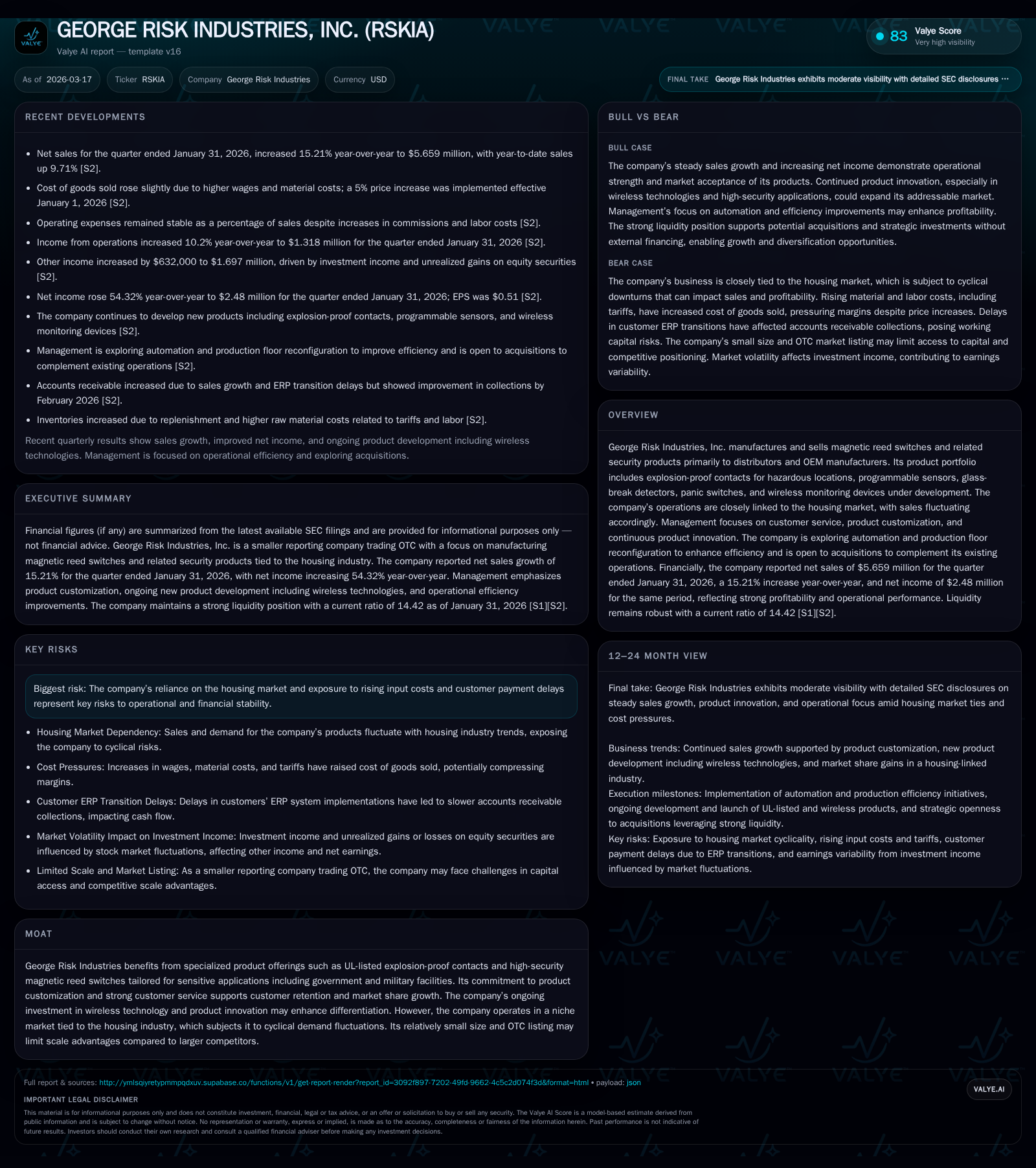
George Risk Industries, Inc. reported solid revenue growth driven by increased market share and backorder fulfillment, supported by strong customer service and product customization. The company operates in a niche segment tied closely to housing market cycles, which presents demand fluctuations but also opportunities for innovation, such as wireless security devices and explosion-proof contacts for hazardous locations. While increasing material and labor costs have pressured gross margins slightly, management’s efforts to streamline operations via automation and production reconfiguration aim to sustain profitability. George Risk maintains a strong liquidity position with prudent capital allocation emphasizing dividends and selective buybacks.
Overview of George Risk Industries
George Risk Industries, Inc. (RSKIA) specializes in manufacturing magnetic reed switches designed primarily for security applications distributed through OEMs and distributors. Its product suite extends from explosion-proof contacts intended for hazardous environments to glass-break detectors and panic switches, with ongoing R&D advancing wireless connectivity features integral for modern security infrastructure [S14]. This niche focus sets it apart in specialized markets like government facilities where UL-listed products are mandated.
Historical Financial Performance
The company demonstrated consistent top-line growth over recent years with an approximate 10.7% increase in revenue for FY2025 compared to FY2024 ($17.89 million YTD in January 2026 shows continuation of this trend) [F1][S2]. Operating income notably expanded by over 280% year-over-year from FY2024 to FY2025, reaching nearly $6.24 million - driven largely by better operating leverage, price adjustments, and robust investment returns from securities holdings [F1][S2]. However, net income dipped slightly by about 5.6% between these years indicating volatility possibly impacted by fluctuating other income components or one-time charges.
The following table summarizes recent annual financial metrics:
Historical performance (annual)
| FY | Net ($mm) | CFO ($mm) | OpInc ($mm) | Capex ($) | Net YoY |
|---|---|---|---|---|---|
| 2025 | 7 | 4 | 6 | 396000 | -5.6% |
| 2024 | 8 | 6 | 2 | 378000 | +58.9% |
| 2023 | 5 | 3 | 1 | 548000 | +33.4% |
| 2022 | 4 | 2 | 2 | 390000 |
Source: SEC companyfacts cache [F1].
Capital returns and efficiency (annual)
| FY | Div ($mm) | FCF ($mm) | ROE% |
|---|---|---|---|
| 2025 | 4 | 4 | 12.5 |
| 2024 | 3 | 6 | 13.8 |
| 2023 | 3 | 2 | 9.4 |
| 2022 | 2 | 2 | 7.3 |
Source: SEC companyfacts cache [F1].
Revenues shown here align with the trailing twelve-month data up to January-2026 [F1],[S2].
Drivers Behind Performance
Growth has been fueled by increased order fulfillment as management worked down backlogs resulting from supply chain disruptions encountered in prior periods. The continual emphasis on customization tailored to customer requirements strengthens retention within their established client base primarily servicing the housing market’s ancillary demand [S2]. Additionally, the company implemented a modest price increase of approximately 5% effective January 1, 2026, mitigating some inflationary pressures on input costs [S2].
Despite escalating wages and raw material prices—including tariffs—Cogs remained close to management's target range although slightly exceeding it short term at over ~54% of net sales [S2][S7]. This reflects industry-wide cost headwinds common among component manufacturers reliant on metals.
The combination of sustained operational efficiency alongside gains recognized in investment portfolios contributed substantially to quarterly net income improvements (+54%). Investment income principally derives from unrealized gains on equity securities managed via professional money managers—a critical differentiator since these returns exhibit market sensitivity independent of core manufacturing operations [S2][S7].
Future Growth Prospects
Looking ahead, the company continues expanding its product technology base with new developments:
- UL-certified explosion-proof contacts designed specifically for stringent hazard site requirements,
- Programmable sensors integrating temperature/humidity monitoring with hysteresis control,
- Wireless-enabled reed switches nearing final development stages aiming at next-generation security demands,
- Enhanced panic switch variants featuring LED indicators These innovations aim not just at diversification but bolstering high-margin specialized offerings suitable for government, military, nuclear plants, and financial institutions with enhanced security protocols [S14][S25].
Further operational improvements are planned through increased automation adoption along with reconfiguration of production workflows which could shorten lead times—currently flagged as a challenge during peak seasons—and partially counter rising labor input costs [S2][S7]. Management remains alert for acquisition opportunities that would complement existing lines or expand capabilities without necessitating external financing given their healthy cash balance totaling approximately $4.46 million as of January-end FY2026 [S6][F1].
Upcoming Milestones & Operational Focus Areas (Analysis)
Formal guidance remains unspecified; however, key performance indicators going forward will likely revolve around:
- Ability to maintain or improve gross margins despite input cost inflation,
- Success in launching mainstream adoption of wireless device lines,
- Effectiveness in meeting delivery timelines through automation roll-out,
- Maintaining robust dividend policy amid capital needs,
- Monitoring accounts receivable aging amidst ERP transition delays noted among major customers [S6][S7] These areas are pivotal given existing risks linked to cyclical housing trends coupled with tariff-related cost pressures.
Capital Allocation and Returns
George Risk exhibits a disciplined approach—regular dividends have grown from ~$2.26 million in FY2022 to $4.45 million in FY2025 demonstrating commitment to shareholder returns even amidst cyclical swings [F1]. Additionally, share repurchases occur opportunistically albeit on smaller scales ($32K-$56K annually recently), signaling conservative capital deployment aligned with liquidity preservation strategies.
Operating cash flow declined somewhat year-over-year (-28%) partly attributable to inventory build-ups aimed at stabilizing supply chains plus accounts receivable increases tied partially to larger clients’ ERP transitions causing payment delays—19-20% aged above ninety days recently reported though improving collections were noted post-quarter end [F1][S6][S16]. After deducting capital expenditures generally under $400K annually focused on maintenance/upgrades rather than growth capex—a free cash flow estimate stands near $3.9 million reflecting solid internal funding capabilities supporting dividends/buybacks without incurring external debt burdens or dilutive financing events.
Approximate return on equity calculated from latest annual figures stood near ~12.5%, suggesting solid profitability relative to equity base anchored by moderate-growth strategies within a specialized niche reflecting efficient use of capital assets [F1].
Risks & Industry Context Analysis
While possessing strong product differentiation through UL-listed explosion-proof devices catering to stringent regulatory environments helps cement market moat attributes—with emphasis on customization fostering customer loyalty—the company's dependence on the residential housing sector mandates sensitivity monitoring of macroeconomic housing trends which notoriously exhibit volatility tied to interest rates cycles. Costs risks further originate from sustained inflationary input trajectories inclusive of tariffs impacting raw materials like metals commonly embedded within reed switch manufacture. Additionally, accounts receivable collection risks loom during customer ERP system rollouts—as evidenced by recent spikes in overdue balances—which could pressure liquidity if prolonged beyond remediation timelines. Finally, the OTC listing status limits broad investor access potentially constraining scale economies vis-à-vis competitors but also sanctions deeper focus niches where technical competence outpaces mass-market players.
Conclusion
George Risk Industries demonstrates resilient growth by leveraging engineering innovation tailored towards security-sensitive markets while navigating cyclical dependencies effectively through operational excellence initiatives including automation frameworks intended to optimize manufacturing flow. Financial discipline underpins shareholder return programs with consistent dividend payouts balanced against measured buybacks supported by stable free cash flow generation despite rising input cost challenges. Monitoring future success will hinge significantly on commercialization pace of wireless products alongside maintaining supply chain efficiency within their core housing-related demand cycles.
This analysis compiles publicly available information as of March 17, 2026 without offering investment advice.
Disclaimer: This is research-only, informational analysis and not investment advice. It may include AI-generated interpretation and general industry context. Always verify important details using primary sources.

Comments