
Healthy Choice Wellness Corp. Balances Expansion and Profitability with Capital Constraints
HCWC pursues growth through acquisitions and new revenue streams while managing liquidity challenges and ongoing losses.
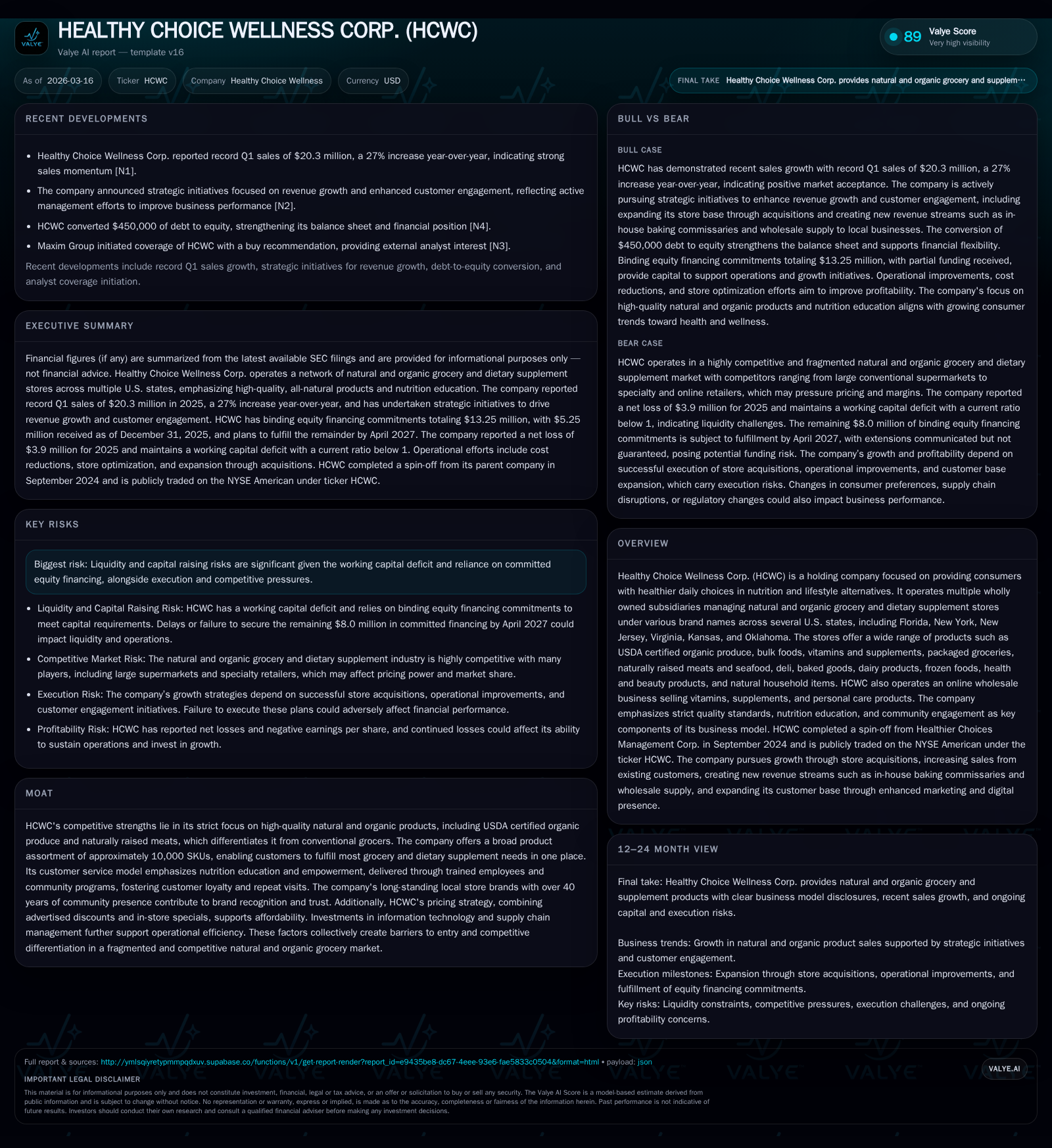
Healthy Choice Wellness Corp. operates a network of natural and organic grocery and supplement stores across multiple U.S. states, emphasizing high-quality products and nutrition education to cultivate customer loyalty. Despite historical net losses and working capital deficits, HCWC improved cash flow generation in 2025 supported by expanded sales and operational initiatives. The company plans further store expansion, in-house commissaries, and wholesale business launches to drive growth but faces risks from its capital structure and dependence on external equity financing. Monitoring cost control success and capital raising progress will be key to HCWC's near-term financial stability.
Company Overview
Healthy Choice Wellness Corp. (HCWC) is a holding company specializing in natural and organic grocery stores as well as dietary supplement retail, focusing largely on providing healthier lifestyle alternatives. It operates multiple subsidiaries running well-established local brands including Ada’s Natural Market (Florida), Green's Natural Foods (New York/New Jersey), Paradise Health & Nutrition (Florida), Mother Earth’s Storehouse (New York Hudson Valley), Ellwood Thompson’s (Virginia), and GreenAcres Market (Kansas/Oklahoma). These locations offer USDA certified organic produce, naturally raised meats without hormones or antibiotics, vitamins and supplements, packaged goods free from artificial additives, health & beauty items, and household products meeting sustainable or hypoallergenic criteria [S1][S22].
A significant facet of the business model is nutrition education delivered through employee training, newsletters, community outreach programs, health coaching sessions, cooking demonstrations, and other engagement vehicles that deepen customer attachment beyond standard retail convenience [S16]. This emphasis supports a differentiated shopping experience centered on wellness empowerment.
Historical Performance
Formed as an independent publicly traded company following a spin-off from Healthier Choices Management Corp. (HCMC) in September 2024, HCWC inherited operations spanning multiple regions with deep community roots exceeding four decades under various brand names.
The financial trends since independence illustrate growing top-line activity but persistent profitability challenges:
Historical performance (annual)
| FY | Net ($mm) | CFO ($mm) | OpInc ($mm) | Capex ($) | Net YoY |
|---|---|---|---|---|---|
| 2025 | -4 | 1 | -2 | 320634 | +12.7% |
| 2024 | -5 | -3 | -2 | 251793 |
Source: SEC companyfacts cache [F1].
Capital returns and efficiency (annual)
| FY | FCF ($mm) | ROE% |
|---|---|---|
| 2025 | 1 | -53.9 |
| 2024 | -3 | -189.3 |
Source: SEC companyfacts cache [F1].
(Net income and operating income are negative indicating losses; however cash flow from operations swung positive in 2025 from significant outflows in prior year.) [F1]
Despite revenue gains reflected indirectly by improved cash generation and working capital growth (current assets rising to roughly $10 million against liabilities exceeding $12.7 million), HCWC's current ratio remains under one at approximately 0.79 evidencing ongoing short-term liquidity constraints [F1][S6][S9]. Operating income declined further by nearly 40% year-over-year driven by expenses related to expansion efforts while net losses narrowed by around 13%, reflecting some cost improvements alongside operational scaling effects.
Future Growth Prospects
HCWC aims to return the overall business to profitability via several strategic levers:
Store Base Expansion: The company intends acquisitions of additional regional natural food stores that align with its quality standards to broaden market presence.
New Revenue Streams: Investments underway include establishing baking commissaries serving multiple local banners for fresh baked goods supply as well as launching wholesale bread and pie offerings targeting area restaurants—both aimed at diversifying revenues beyond conventional retail sales channels [S12].
Enhanced Customer Engagement: Transitioning from a points-based loyalty system to a VIP membership structure offers immediate purchase discounts which may foster deeper frequent shopping behavior though could reduce contract liabilities recognized previously under point accruals schemes [S6]. Marketing efforts include cooperative advertising programs partnering closely with suppliers promoting organic and sustainable products within communities.
E-Commerce Growth: Through its Healthy U Wholesale subsidiary operating www.TheVitaminStore.com the company expands online retailing of vitamins, supplements and health care products leveraging decades of industry knowledge BBB guidance for online trust-building remains vital given increasing digital competition [S22][S14].
Operational Efficiencies: Third-party consultants were engaged to streamline operations focusing on cost reduction to support profitability turnaround. Store optimization assessing non-performing units alongside targeted overhead leverage promises margin improvement opportunities [S4][S8].
These growth drivers are underpinned by HCWC’s strong competitive moat rooted in the strict quality control rejecting artificial additives or low-standard products combined with long-standing localized brand goodwill—critical differentiators from broader supermarket chains that have moved into natural foods but often trade breadth over specialty depth [S18][S14].
Forecasts / Milestones / What to Watch
The Company has not issued formal financial guidance post-spin-off; however management commentary highlights the following key milestones:
- Completion of planned store acquisitions advancing market reach outside core state footprints.
- Implementation progress of baking commissaries feeding both retail banners and wholesale clients during FY2026.
- Growth momentum for online wholesale business expanding SKU counts or geographic reach.
- Achievement of operational cost reductions identified by consultant engagements toward positive sustained profitability.
- Timely fulfillment of remaining $8 million Series A Preferred Stock financing commitment expected before April 2027 or extension thereof impacting liquidity outlook [S9][S15][S26].
Analysts should monitor quarterly earnings releases for updates on same-store sales trends reflecting effectiveness of customer engagement strategy shifts. Supply chain stability especially regarding organic produce sourcing amid labor shortages or inflationary input costs bears watching. Effectiveness of marketing efforts measured through customer acquisition metrics also relevant.
Returns and Capital Allocation
HCWC's return profile remains weak given ongoing net losses relative to equity employed resulting in a negative approximate ROE near -54% for FY2025 calculated by dividing net loss by year-end shareholders’ equity ($3.9m loss / $7.3m equity) [F1].
Free Cash Flow Generation improved markedly with positive operating cash flow around $1m offsetting capital expenditures near $321k resulting in estimated free cash flow near $675k supporting investment without additional borrowing burdens immediately [F1].
Capital structure reflects dependence on hybrid financing modes:
- A $7.5 million senior loan facility entered mid-2024 supports acquisition funding bearing relatively high interest near 12% maturing in July 2027.
- Equity rounds primarily via issuance of Series A Convertible Preferred Stock sourced from institutional investors linked historically to parent HCMC’s Series E Preferred holders committed gross proceeds up to $13.25 million with partial draws completed ($5.25m raised; $8m binding commitments pending) easing liquidity yet conditioning future dilution risks if conversions occur at discounted prices around $1.38 per share conversion rate [S4][S7][S9][S25].
No dividends or share repurchase programs have been declared reflecting prudent focus on debt service capability preservation amid loss recovery phase [F1][S7].
Risks Summary
Critical risks remain concentrated around liquidity availability given the sizable negative working capital position near -$2.7 million comprising elevated payables and accrued liabilities alongside the necessity of completing large equity infusions timely for operational expense coverage during expansion phases [S9][S29]. Failure or delay in raising committed funds or underperformance of store-level economics could pressure going concern assessments despite management confidence bolstered by consultant recommendations deployment.
Competitive pressures also pose challenges: HCWC operates within a fragmented but highly competitive sector dominated by large grocers like Whole Foods (Amazon-owned), Sprout’s Farmers Market regional chains, specialty operators such as Trader Joe’s plus mass-market retailers offering increasing natural product assortments often advantaged by scale purchasing power impacting supplier negotiations potentially compressing margins [S13][S14][N/A analysis].
Moreover consumer preferences may shift rapidly requiring ongoing innovation in product mix curation while maintaining rigid quality standards limiting inventory flexibility compared with conventional supermarkets able to adjust bulk purchasing strategies more readily.
Finally compliance costs related to USDA National Organic Program certification enforcement across stores remain considerable affecting operating expenses although critical for brand integrity.
Industry Context (Analysis)
The natural foods retail sector continues robust growth driven by increasing consumer health awareness including aging populations seeking more nutritious options free from artificial ingredients combined with expanding specialty diets prevalence such as gluten-free or plant-based eating patterns escalating demand for specialized SKUs typically found at HCWC subsidiaries rather than standard supermarkets1.
However success depends critically on balancing product authenticity assurance against affordability for middle-income consumers hesitant about price premiums creating competitive tension between ‘authentic niche’ retailers like HCWC versus large chain newcomers leveraging scale economies.2
Digital transformation adoption is also shaping distribution channels compelling traditional brick-and-mortar operators into omnichannel models including e-commerce vitamin/supplement sales extension where HCWC participates via Healthy U Wholesale—a necessary complement given evolving shopper habits towards convenience driven purchases outside physical stores.
This analysis is based solely on information available as of March 16, 2026 from SEC filings (Form 10-K/Q/8-K) and company-reported financials without incorporating forward-looking projections or market data beyond those disclosures.
Disclaimer: This is research-only, informational analysis and not investment advice. It may include AI-generated interpretation and general industry context. Always verify important details using primary sources.

Comments