
Kaspi.kz’s Integrated Super Apps Fuel Market Expansion and Consistent Returns
Kaspi.kz leverages a unique two-sided super app platform to drive robust growth across payments, marketplace, and fintech segments while maintaining strong capital returns amid Kazakhstan’s evolving regulatory landscape.
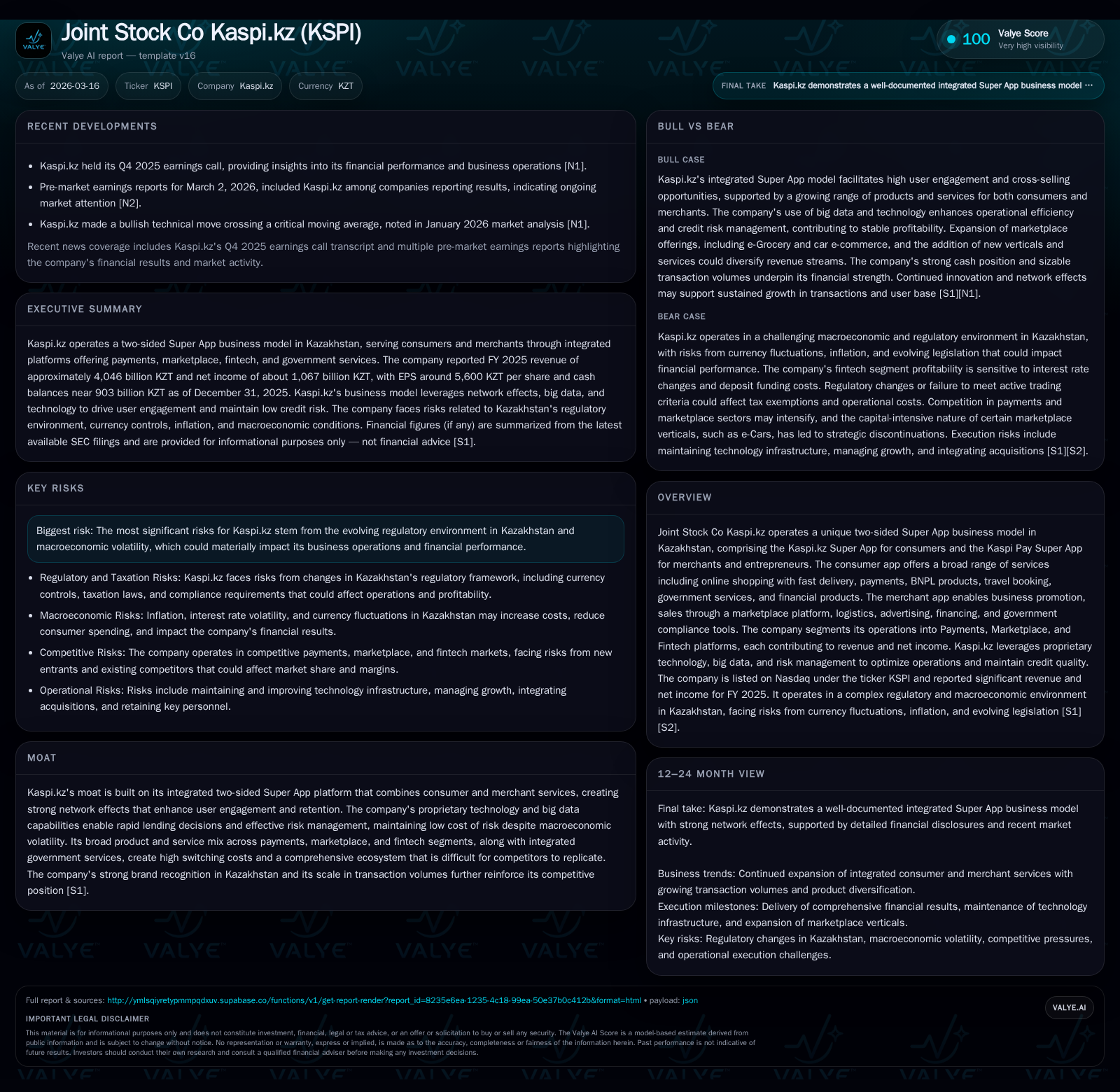
Joint Stock Co Kaspi.kz reported impressive revenue growth from 2023 through 2025, driven by increasing transaction volumes and rapid adoption of its dual consumer-merchant super apps. The company’s integrated ecosystem creates strong network effects and high switching costs that sustain user engagement and product mix expansion. Kaspi.kz maintains a robust return on equity around 41% and consistent dividend payouts backed by strong cash flows. Looking ahead, innovation in new verticals and deeper market penetration opportunities face potential headwinds from regulatory uncertainties and macroeconomic factors such as interest rates. Monitoring user transaction metrics and segment profitability will be critical to assessing ongoing operational momentum.
Revenue Surge: Historical Growth Patterns and Key Drivers
Kaspi.kz has demonstrated remarkable top-line acceleration over the past three fiscal years. Reported revenue swelled from approximately 1.91 trillion KZT in FY2023 to over 4.05 trillion KZT in FY2025, representing a compound annual growth rate close to 60% [F1]. This surge is attributable chiefly to an expanded user base engaging across Kaspi's integrated payments, marketplace, and fintech platforms. The number of monthly transactions per active consumer reached 77 by end-2025—an indicator of deepening engagement enabled by the app ecosystem's broad service coverage [S1].
Key operational drivers include rapid adoption of payments through Kaspi Gold cards, P2P transfers, BNPL financing solutions within fintech, as well as growing e-commerce volumes bolstered by logistics investments like Kaspi Postomats. Despite strong revenue growth, net income expansion decelerated modestly — rising just 1% from KZT 1.06 trillion in FY2024 to KZT 1.07 trillion in FY2025 — largely reflecting margin pressures related to evolving product mixes and one-off impacts tied to recent acquisitions [F1]. Equity also increased substantially in this period, supporting the company's capacity for reinvestment.
Historical performance (annual)
| FY | Rev ($bn) | Net ($bn) | Rev YoY | Net YoY |
|---|---|---|---|---|
| 2025 | 4046.1 | 1067.7 | +59.8% | +1.0% |
| 2024 | 2532.2 | 1056.8 | +32.3% | +24.5% |
| 2023 | 1913.5 | 848.8 |
Source: SEC companyfacts cache [F1].
Capital returns and efficiency (annual)
| FY | Div ($bn) | ROE% |
|---|---|---|
| 2025 | 646.1 | 41.0 |
| 2024 | 646.1 | 67.2 |
| 2023 | 560.1 | 76.9 |
Source: SEC companyfacts cache [F1].
Data sourced from company filings showing strong topline expansion with solid ROE support despite margin variability.
Super App Ecosystem: Structural Advantages Behind User Engagement
Kaspi.kz operates a pioneering two-sided super app structure: the Kaspi.kz app targeting consumers with services spanning e-commerce, BNPL, government digitization, travel bookings; alongside Kaspi Pay servicing merchants through marketplace access, advertising tools, payment acceptance, financing facilities and compliance software. This dual architecture gives rise to powerful network effects that reinforce user retention while creating formidable switching costs.
By integrating behavioral scoring models using proprietary transaction data across both sides of the platform, Kaspi harnesses big data capabilities not only to tailor personalized offerings but also to execute near-instant credit underwriting with low default risk [S5]. Such seamless consumer-merchant synergies enhance cross-sell potential with reduced marketing investment compared with standalone apps.
Embedded government service transactions elevate frequency further while incentivizing consistent engagement through convenience mandates — a distinct advantage hard for competitors to mimic in Kazakhstan’s ecosystem-centered digital economy [S1].
Segment Performance: Payments, Marketplace, and Fintech Revenue Contributions
Kaspi synthesizes its operations into three core segments:
Payments: Encompasses merchant acquiring services including QR payments via Kaspi Pay POS terminals; consumer bill payments; P2P transfers; earning primarily fee-based revenues supported by substantial transaction volume growth — total payment volume grew 19% year-over-year in FY2025 [S21].
Marketplace: Drives merchandise sales including e-commerce general goods (66% share), e-Cars (automotive marketplace launched post-Kolesa acquisition), e-Grocery (transitioned to first-party retail model), and travel bookings via Kaspi Travel. Recent regulatory constraints like smartphone registration impacted smartphone sales negatively in FY2025 but overall GMV increased steadily by double digits annually [S24].
Fintech: Focused on BNPL financing products for consumers plus merchant credit lines funded primarily through deposits collected on the platform with fast digital origination capabilities. Fintech yield remained stable at ~24%, although margins compressed due to higher interest cost environments impacting deposit funding expense recently [S25].
Payments and Marketplace deliver higher-margin expansion relative to Fintech which faces near-term pressure but offers long-term embedded finance growth potential [S10].
Capital Efficiency: Returns, Dividend Policy, and Cash Flow Generation
Kaspi.kz exhibits robust capital productivity indicated by an approximate return on equity near 41% for FY2025 based on net income over shareholders' equity of roughly KZT 2.6 trillion [F1]. This efficiency reflects disciplined risk management coupled with operating leverage from technology-driven scalability.
The company’s dividend payout policy demonstrates commitment to shareholder returns with consistent dividends paid since FY2023 (~560–646 billion KZT annually), equating to a significant cash distribution relative to reported net income levels [F1][S20]. Strong operating cash flows underpin these dividends while total cash & equivalents stood at approximately KZT 903 billion at YE2025 providing healthy liquidity buffers [F1].
Capex details remain limited; however, prudent expense allocation prioritizes technology investments aimed at automation (e.g., AI voice assistants, chatbots) driving customer support efficiencies and cost containment across platforms [S5].
Growth Outlook: Innovation, Market Penetration, and Regulatory Constraints
Kaspi plans continued expansion of its product portfolio targeting deeper SME penetration with enhanced advertising options within Kaspi Pay Merchant tools alongside investments in next-generation fulfillment logistics platforms designed for Kazakhstan’s geographic dispersion challenges [N1][N2][S2]. Additional growth levers include scaling e-grocery first-party retail operations and expanding government service digitization that embeds Kaspi more firmly in daily financial life.
However, external challenges loom large. Regulatory changes surrounding financial services operations require adaptive compliance measures potentially increasing operational complexity. Moreover, Kazakhstan's macroeconomic backdrop characterized by elevated base interest rates has increased funding costs notably impacting fintech margins; recovery depends on normalization of monetary conditions which remains uncertain [S18][S22].
Operational Risks and Mitigation Strategies Amid Macroeconomic Volatility
Credit risk represents a principal operational hazard given rising loan portfolios exposed to consumer creditworthiness fluctuations in an inflationary environment. Kaspi mitigates this via continuously refined behavioral scoring algorithms harnessing abundant user data sourced directly through integrated app usage patterns — translating into historically stable cost of risk metrics around 2–2.2% despite economic volatility [S5][S25].
Currency fluctuations against the tenge add complexity affecting interest expenses on foreign-denominated liabilities necessitating vigilant treasury management practices embedded within their liquidity frameworks [S22]. Regulatory unpredictability mandates agile governance structures focused on proactive compliance amid evolving legislation affecting Kazakhstan’s fintech sector.
Strategic Focus Areas: Big Data Analytics, Risk Management, and Cost Optimization
Investment emphasis remains on leveraging machine learning models assessing granular transaction-level insights enabling swift credit approvals within ~6 seconds post-application — an AI-driven advantage meaningfully slashing underwriting costs while maintaining borrower quality standards intact [S5].
Operational innovations like automated ‘Kaspi Chat’ customer service workflows reduce human touchpoints yielding margin improvements through 'automation-driven operating leverage' typical of scale fintech ecosystems fostering sustainable profitability enhancements absent commensurate expense inflation.
Such tactics also facilitate segmentation-enabled marketing campaigns allowing precision targeting enhancing conversion rates minimizing acquisition cost per active user — efficiencies gained only by players possessing deep integrative data lakes balanced against stringent privacy compliance mandates.
Monitoring Milestones: User Metrics, New Product Launches, and Market Expansion
Critical leading indicators encompass monthly transactions per active consumer/merchant—currently at 77 transactions per month underscoring high engagement velocity underlying network effect strength [N1][N2][S2]. Tracking incremental adoption rates for emerging verticals within marketplace such as rail travel ticketing or small merchant ad services will reveal organic growth sustainability.
New product innovations including pay-by-palm biometric authentication (Kaspi Alaqan), curated loan products targeting micro-businesses monitored alongside rollout success signal continued ecosystem entrenchment. Platform performance metrics such as average daily-to-monthly active user ratios alongside take-rates inform gross merchandise volume profitability trajectories crucial given competitive pressures.
Discontinuation of the capital-intensive one-party e-Cars business reflects strategic focus on scalable marketplace models better suited to Kazakhstan’s market dynamics [S24].
This document synthesizes Joint Stock Co Kaspi.kz's recent filings as of March 16th, 2026 without offering investment advice. The analysis integrates publicly disclosed financials and strategic commentary reflecting current company positioning amid Kazakhstan’s distinct market context.
Disclaimer: This is research-only, informational analysis and not investment advice. It may include AI-generated interpretation and general industry context. Always verify important details using primary sources.

Comments