
Orange County Bancorp’s 2025 Growth Fueled by Expanded Loan Portfolio and Strengthened Capital Base
Robust net income growth and balance sheet expansion underpin Orange County Bancorp’s solid 2025 performance.
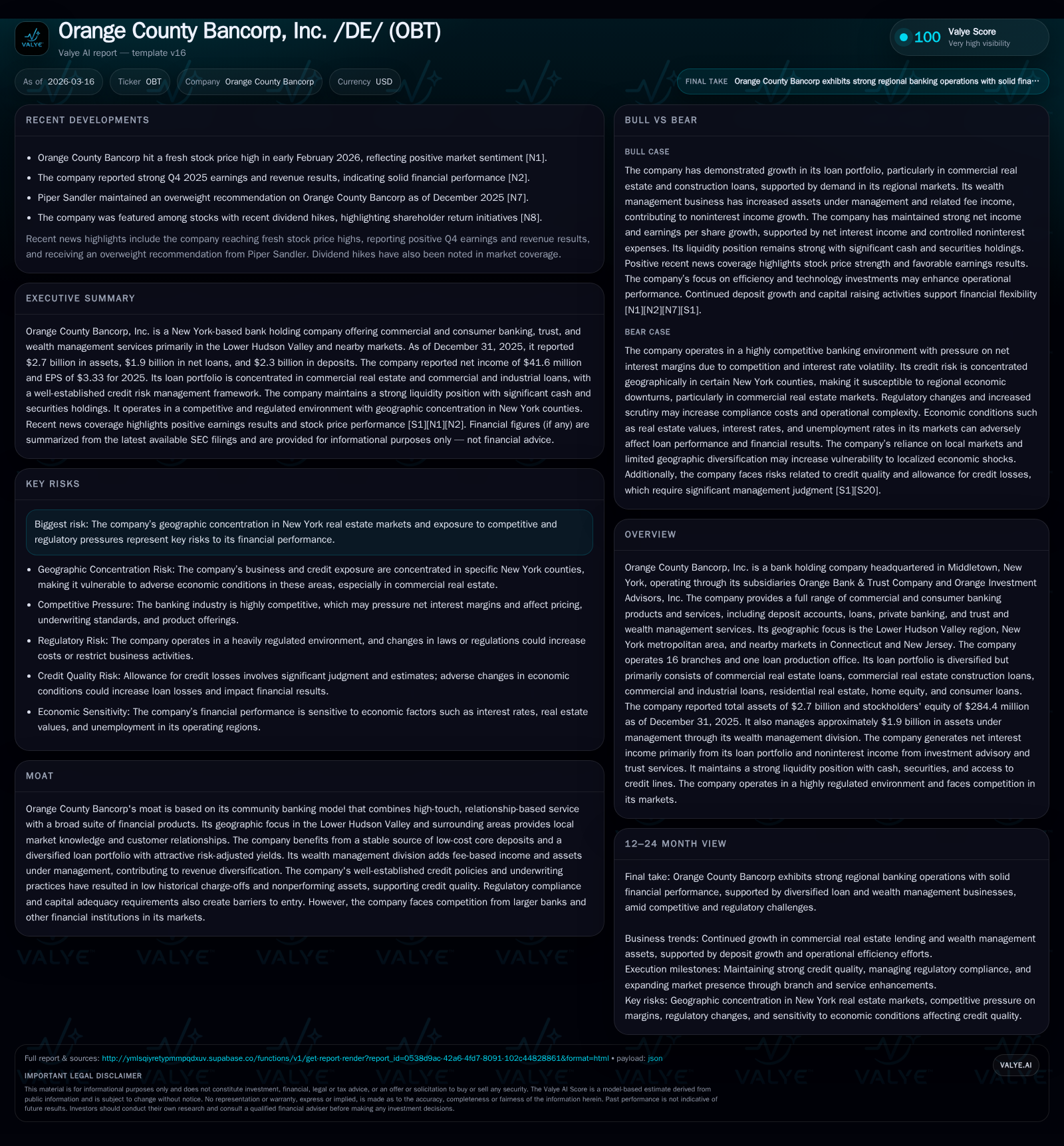
Orange County Bancorp, Inc. demonstrated a strong financial year in 2025, with net income rising nearly 50% year-over-year, driven primarily by loan portfolio growth and a supportive yield environment. Assets increased 6%, chiefly due to a 7.4% rise in net loans and higher liquidity buffers, while equity surged 53% supported by a $43 million common stock offering alongside retained earnings. The firm maintained disciplined credit practices with low charge-offs and manageable credit risk concentrated in New York real estate markets. Noninterest income improved via wealth management, complementing core interest income despite competitive pressures on margins. Capital ratios remained robust, and liquidity-focused balance sheet management combined with dividend payouts reflected a balanced capital allocation approach. While geographic and sector concentration risks persist, Orange County Bancorp appears well-positioned to benefit from regional economic growth and its community banking model.
Company Overview
Orange County Bancorp, Inc., headquartered in Middletown, New York, operates through two subsidiaries: Orange Bank & Trust Company and Orange Investment Advisors, Inc. The company offers commercial and consumer banking services complemented by trust and wealth management products focused on affluent clientele and institutions across the Lower Hudson Valley region as well as portions of Connecticut and New Jersey [S1]. With a branch network of 16 locations and one loan production office, the bank emphasizes relationship-driven community banking paired with an extensive product suite more characteristic of larger players.
The loan portfolio is notably weighted toward commercial real estate (approximately 75.9%), including construction loans (5.1%), along with smaller exposures to commercial & industrial (12.8%), residential mortgages (3.3%), home equity (1.2%) and consumer loans (1.7%) as of year-end 2025 [S11]. This mix reflects regional market specialization yet is diversified within property types such as multi-family and retail.
Historical Performance and Growth Drivers
Orange County Bancorp's recent historical performance has been characterized by steady asset growth coupled with improving profitability metrics supported largely by loan expansion and controlled expenses.
Historical performance (annual)
| FY | Net ($mm) | CFO ($mm) | Capex ($mm) | Net YoY |
|---|---|---|---|---|
| 2025 | 42 | 44 | 3 | +49.2% |
| 2024 | 28 | 35 | 2 | -5.4% |
| 2023 | 29 | 45 | 4 | +21.0% |
| 2022 | 24 | 30 | 2 |
Source: SEC companyfacts cache [F1].
Capital returns and efficiency (annual)
| FY | Div ($mm) | FCF ($mm) | ROE% |
|---|---|---|---|
| 2025 | 7 | 41 | 14.6 |
| 2024 | 5 | 33 | 15.0 |
| 2023 | 5 | 41 | 17.8 |
| 2022 | 5 | 29 | 17.6 |
Source: SEC companyfacts cache [F1].
(Net income growth reflects stability turning upward again following modest volatility in prior years; operating cash flows have generally tracked net profits but show some moderation; capex fluctuates moderately tied to branch operations.)
Key drivers behind the strong net income jump in FY2025 include robust net interest income from loan growth amid favorable asset sensitivity to a steepening yield curve that benefitted the bank’s margin profile [S1]. Commercial real estate lending accelerated (+$118 million), reinforcing core earnings contributions while deposit growth (+7.3%) provided funding stability versus more costly wholesale funding channels which were scaled back considerably during the year [S17][F1].
Wealth management also contributed meaningfully to noninterest income that rose by over $1.9 million or ~15%, reflecting both positive equity market effects on assets under management ($1.9 billion at end-2025 from $1.8 billion prior year) as well as new client inflows [S16]. Efforts to control wealth division expenses supported margin expansion despite integration investments earlier in the cycle.
Cost control efforts overall have focused on efficiency ratio optimization by monitoring compensation costs and technology spend while supporting revenue-generating initiatives without compromising service levels [S21].
Future Growth Prospects
Growth prospects hinge on several factors:
- Regional Economic Conditions: Continued strength in the Lower Hudson Valley real estate markets can support demand for commercial real estate loans where the entity holds dominant exposure.
- Deposit Expansion: Maintaining core deposit growth remains crucial for funding cost advantages; brokered deposits reduced meaningfully in favor of organic sources during FY2025 [S17][S25].
- Wealth Management: Building fee income via asset gathering and retention provides diversification away from interest rate cycles.
- Interest Rate Environment: An asset-sensitive balance sheet may benefit if rates rise further or yield curves steepen; rate volatility poses both opportunity and downside risk.
- Competitive Pressures: Larger regional banks and non-bank lenders compete aggressively on price and product innovation which may pressure margins or require increased marketing/infrastructure investment.
- Credit Quality Vigilance: While historical losses have been low owing to prudent underwriting policies focusing on collateralized exposures at conservative loan-to-values (~80%), concentration risk in local real estate markets requires careful monitoring in case of localized downturns or regulatory shifts.
Internal policies indicate continued conservative credit loss provisions despite modest economic uncertainty impacts reflected in allowance adjustments during recent quarters [S18].
Forecasts / Milestones / Expectations
Despite no explicit forward guidance published for fiscal year ending or beyond December 31st, monitoring key indicators will be important:
- Quarterly net interest margin trends reflecting asset yield vs funding cost movements.
- Deposits retention rates amid evolving pricing strategies; renewal behavior of maturing CDs (~$149 million maturing within one-year) [S17].
- Wealth advisory AUM trends correlating to equity market volatility.
- Credit quality metrics including nonperforming assets ratio and charge-offs relative to allowance for credit losses [$28 million ACL as of end-2025] [S18][S21].
- Capital adequacy compliance amid leveraging subordinated notes issuance redeemed/resized in Sept 2025 [$25 million fixed-to-floating notes replacing prior lower coupon notes] [S12][S9].
Dividend declarations continue quarterly with Q1 2026 payment announced at $0.18 per share consistent with payout policy targeting stable distributions reflective of earnings sustainability [N3][S3].
Returns / Capital Allocation
Return on equity stands at approximately 14.6% for FY2025 calculated as trailing twelve months net income over average shareholders’ equity ($41.6M / $284M), indicating effective utilization of capital resources compared to peer community banks within similar regional footprints [F1].
Operating cash flows before capital expenditures rose strongly by nearly 27% YoY providing substantial free cash flow ($41M after capex needs) supporting flexibility in capital decisions such as dividends and debt servicing [F1][S10].
Capital raises through common stock offerings raised net proceeds around $43 million during the year complemented by subordinated debt issuance renegotiations yielded enhanced tier two capital components strengthening regulatory buffers beyond "well-capitalized" standards under FRB/New York DFS rules [S6][S22].
The company has maintained prudent leverage ratios while aggressively reducing short-term borrowings from the Federal Home Loan Bank system which fell from roughly $113 million short-term advances ending FY2024 down to zero at end FY2025 – reflecting successful internal funding transformation fueled by deposit inflows exceeding incremental loan demand within the period [S26][F1].
Dividends paid increased consistent with growing profitability though still representing conservative payout ratios preserving capital for organic growth initiatives [$7 million dividends paid vs ~$42 million net income] [F1][S24]. Share repurchases were minimal indicating a current emphasis on balance sheet strengthening rather than buybacks.
Risk Profile & Competition
Orange County Bancorp faces inherent risks emanating from its geographic concentration predominantly within New York State’s Lower Hudson Valley real estate markets where economic cycles directly influence credit performance given ~75% loan exposure to commercial real estate weightings including multifamily residential rental buildings integral to the regional housing supply constraints [S21][S8].
Competition is vigorous from larger regional banks that offer wider digital platforms plus scale economies potentially pressuring pricing power especially under current rising interest rate environments that expose margin compressions if deposit cost increases outpace asset yields [S21]. Regulatory compliance requirements impose operational overhead but also function as barriers mitigating arbitrary entry into these regulated credit markets.
Credit quality contingencies are amplified given some industry segment clustering seen notably within healthcare/social assistance sectors representing significant concentration within C&I loans though these remain under prudent underwriting thresholds assuring collateral coverage to mitigate heightened risk profile impacts if downturns emerged locally or sectorally.
Conclusion
Orange County Bancorp demonstrated solid operational execution through fiscal year ending December 31st 2025 marked by notable net earnings improvement driven primarily by disciplined loan portfolio expansion funded through enhanced core deposits alongside wealth management fee momentum contributing revenue diversification benefits. Its strengthened equity position empowered strategic liabilities restructuring reflected improved capital adequacy metrics placing it among better-capitalized community institutions while maintaining healthy liquidity cushions focused on deposit-backed funding. Ongoing vigilance regarding geographical credit concentration paired with competitive developments will require continuing adaptive management but currently Orange County Bancorp benefits from its entrenched local franchise delivering meaningful relationships leveraged through high-touch service models—a dynamic likely fostering sustainable mid-cycle financial resilience barring major macroeconomic shocks.
This report is prepared solely for informational purposes based on public filings and accessible news sources as of March 16th , 2026 without offering investment advice or recommendations.
Disclaimer: This is research-only, informational analysis and not investment advice. It may include AI-generated interpretation and general industry context. Always verify important details using primary sources.

Comments