
Atlanticus Holdings Corp Expands Credit Access with Mercury Acquisition Amid Funding and Credit Risk Challenges
Atlanticus leverages fintech innovation to serve underserved US consumers, driving growth through receivables portfolio expansion and enhanced data analytics.
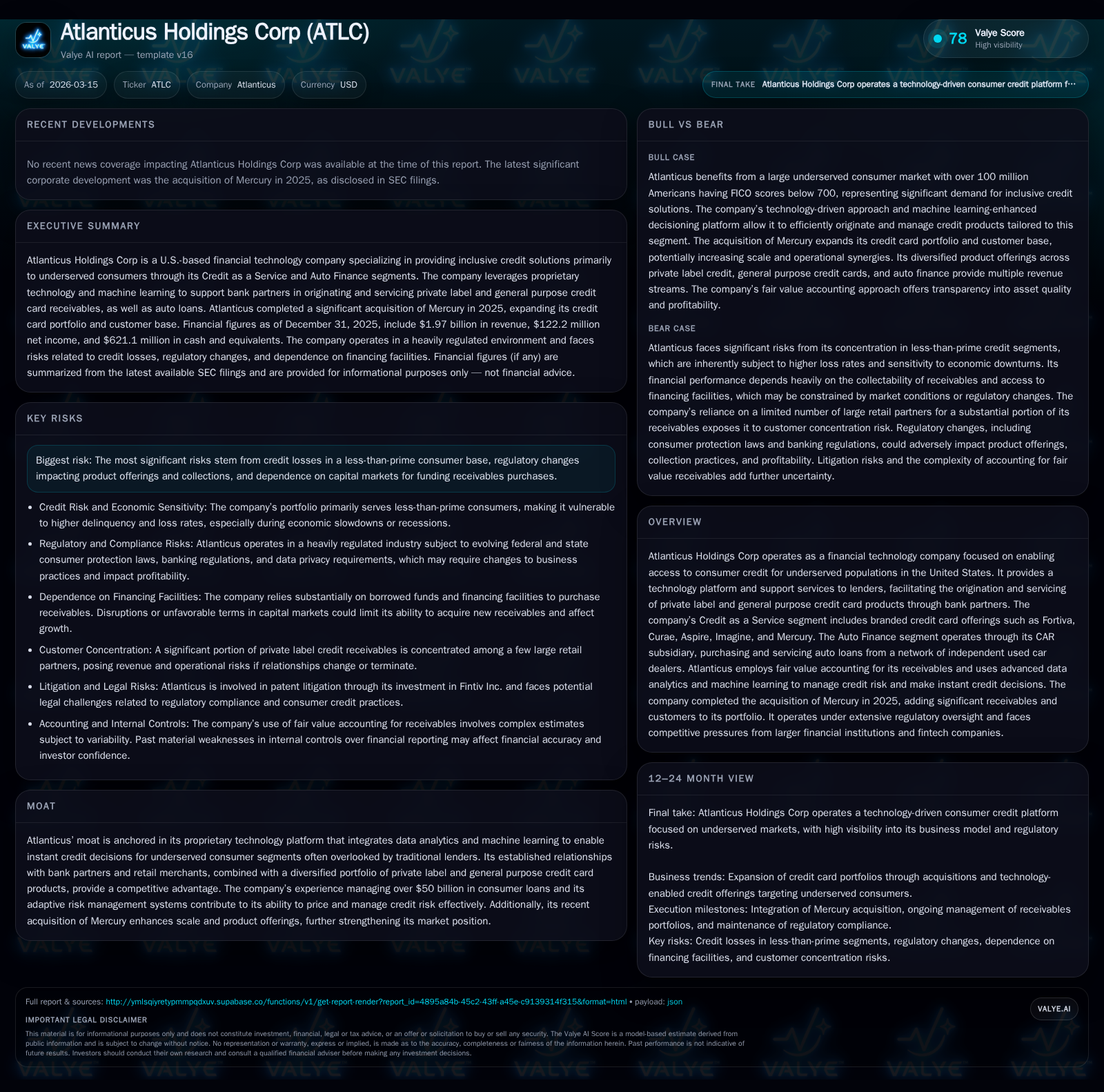
Atlanticus Holdings Corp has sustained strong revenue growth primarily driven by its acquisition of Mercury in 2025, which significantly expanded its credit card receivables. The company operates two main segments: Credit as a Service (CaaS), providing tailored credit card products via bank partnerships, and Auto Finance through its CAR subsidiary. It uses advanced data analytics and machine learning for risk management, focusing on less-than-prime consumers. Despite solid operational cash flows and increasing net income, Atlanticus faces risks from credit losses in a volatile economic environment and dependencies on capital markets for financing receivables. The company maintains a leveraged capital structure, emphasizing opportunistic buybacks and disciplined cash flow management to support shareholder returns.
Company Overview
Atlanticus Holdings Corp stands as a financial technology innovator targeting underserved everyday Americans who often lack access to traditional lending avenues. The company operates principally through two segments: Credit as a Service (CaaS) and Auto Finance. In CaaS, Atlanticus provides a technology platform facilitating the origination and servicing of private label and general purpose credit card products issued predominantly by bank partners like The Bank of Missouri, WebBank, and First Bank & Trust [S1][S3]. Its product suite features brands such as Fortiva, Curae, Aspire, Imagine, and post-2025 acquisition Mercury — collectively enabling flexible credit options including retail financing across consumer electronics, home improvement, healthcare-related services, and broad general-purpose usage [S1][S3][N1].
The Auto Finance segment operates largely through the CAR subsidiary purchasing and servicing auto loan receivables primarily from independent used car dealers involved in buy-here pay-here models across over 700 dealerships in 33 states [S6][S25]. This business complements CaaS by addressing credit-challenged consumer segments unlikely served by captive or institutional lenders.
Atlanticus emphasizes proprietary data analytics and machine learning solutions for instant credit decisioning that incorporate hundreds of customer attributes beyond conventional FICO scores. This capability allows the company’s bank partners to provide appropriately priced lending tailored for near-prime or subprime borrowers traditionally overlooked [S1][S9]. Its expertise managing over $50 billion in consumer loans historically contributes to adaptive risk management that continually refines underwriting and account servicing strategies.
Historical Growth and Financial Performance
Since 2022, Atlanticus has demonstrated robust top-line expansion with revenues rising from approximately $1.05 billion in FY2022 to nearly $2.0 billion in FY2025 — representing a compound annual growth rate (CAGR) above 21%. The major inflection point was the September 2025 acquisition of Mercury for ~$166.5 million cash consideration [S3], adding roughly $3.2 billion in gross credit card receivables and increasing customers served by 1.3 million [S3]. This acquisition materially augmented Atlanticus' scale within its general purpose credit card offerings.
Net income trends have been positive but with more modest gains relative to revenue growth — reaching $122 million in FY2025 versus $135.6 million reported in FY2022 due to some volatility tied to fair value adjustments on receivables amid shifting macroeconomic conditions [F1][S2]. Elevated inflationary pressures starting circa 2022 paired with aggressive Federal Reserve rate hikes have increased delinquencies among less-than-prime consumers, influencing charge-off rates somewhat negatively [S2][S19]. Despite these headwinds, operational efficiencies helped drive continued profitability.
Operating cash flow has grown consistently alongside revenue, accelerating from about $346 million in FY2022 up to nearly $638 million in FY2025 supported by robust collections performance across portfolio segments [F1]. Capital expenditures remain minimal given the company’s tech-driven model focused largely on software platforms rather than physical assets [F1].
Buybacks have been opportunistic: approximately $89 million repurchased in FY2022 tapered somewhat but resumed expansion reaching nearly $70 million in FY2025 reflecting management’s confidence amid stable free cash flow generation [F1]. Equity has grown steadily reflecting strong underlying profitability and retention strategies.
Financial Summary Table
Historical performance (annual)
| FY | Rev ($mm) | Net ($mm) | CFO ($mm) | Rev YoY | Net YoY |
|---|---|---|---|---|---|
| 2025 | 1968 | 122 | 638 | +50.1% | +9.8% |
| 2024 | 1311 | 111 | 469 | +13.5% | +8.2% |
| 2023 | 1156 | 103 | 459 | +10.4% | -24.2% |
| 2022 | 1047 | 136 | 346 |
Source: SEC companyfacts cache [F1].
Capital returns and efficiency (annual)
| FY | Buybacks ($mm) | ROE% |
|---|---|---|
| 2025 | 70 | 20.1 |
| 2024 | 53 | 22.6 |
| 2023 | 18 | 26.1 |
| 2022 | 89 | 41.5 |
Source: SEC companyfacts cache [F1].
Note: Capex values only available for selected years[F1]
Future Growth Prospects
Atlanticus’ future organic growth relies heavily on expanding its CaaS offerings leveraging fintech-enabled underwriting capabilities targeting near-prime consumer segments underserved by traditional banks [S1][N1]. The Mercury acquisition notably enhanced product depth within general purpose cards while maintaining footprint across private label retail partners offering custom financing solutions at point-of-sale.
Continued investments toward advancing machine learning models may improve risk segmentation granularity supporting higher approval rates without sacrificing loss mitigations [S9]. Evolving partnerships with banks and merchants could unlock new distribution channels including digital marketplaces or healthcare sectors where patient financing demand grows.
Geographically, the Auto Finance segment retains room for dealer network expansion across additional states or territories not yet penetrated while broadening product offerings including complementary floor-plan financing solutions enhances cross-selling opportunities [S25].
However, Atlanticus' ability to scale hinges considerably on access to capital markets for debt financing given its model of acquiring receivables rather than solely earning fees on services [S4][S16]. Periodic tightening of credit markets or rising interest costs could constrain volume growth or compress returns if costs escalate imprudently.
Regulatory scrutiny remains an area of uncertainty especially regarding collection practices and consumer protection reforms applicable at both federal and state levels impacting allowable fees or lending terms [S1][N1]. Continued macroeconomic volatility affecting less-than-prime consumers poses the principal downside risk through elevated charge-offs diminishing portfolio yields.
Forecasts & Milestones
While explicit guidance was not provided publicly during recent earnings call disclosures [N1], key developments to monitor include:
- Portfolio performance metrics such as delinquency trends following interest rate cycles;
- Expansion outcomes from integrating Mercury platforms with existing CaaS operations;
- New bank partner acquisitions or contract renewals;
- Regulatory developments impacting credit product offerings;
- Capital markets conditions affecting refinancing or new facility terms.
Analysts should evaluate upcoming quarterly filings for updates around changes to allowance levels on fair value receivables and any material shifts in funding cost structures affecting net spreads.
Returns & Capital Allocation
The firm’s return profile remains compelling within the fintech sub-sector given approximately a 20% estimated return on equity based on reported net income of $122 million against equity of about $609 million at FY-end (ROE = Net Income/Equity) [F1].
Strong cash conversion is evident from operating cash flow reaching nearly $638 million while capex remains nominal reflecting software-centric investments leading to approximately $637 million free cash flow generation for fiscal year ending December 31, 2025 [F1].
Capital deployment prioritizes a balanced approach retaining sufficient liquidity while executing share repurchases totaling almost $70 million annually providing accretive returns alongside organic portfolio growth [F1]. Dividend payments appear limited or absent likely reflecting reinvestment focus alongside debt servicing obligations given significant leverage employed.
Leverage entails considerable long-term senior notes with restrictive covenants limiting debt incurrence flexibility but enabling access to capital at fixed rates; sensitivity exists around refinancing amidst rising rates that heighten interest expense burdens [S4][S16]. Consistent distributions from subsidiaries fund parent obligations but remain subject to statutory limits creating some dependency risk [S15][S26].
Industry Context Analysis
Atlanticus operates amid intensifying competition from both incumbents such as traditional issuing banks benefiting from low-cost deposit bases and numerous fintech entrants innovating payment solutions including pay-over-time platforms like Klarna or Block [S11]. Differentiation arises primarily through Atlanticus’ sophisticated risk modeling serving near-prime borrowers unattractive to mainstream providers balanced by deep retail channel integrations.
Consumer credit markets face cyclical challenges amplified by economic uncertainty post-pandemic coupled with inflation-driven pressure on household budgets increasing default frequencies especially within lower score cohorts effectively underwriting dynamic loss provisions vital for sustainable margins.
Financial technology firms leveraging AI for instant underwriting continue gaining investor interest but must navigate evolving regulatory landscapes aimed at protecting vulnerable consumers while maintaining responsible lending standards.
Conclusion
Atlanticus Holdings Corp has established a scalable fintech platform effectively serving underserved U.S. consumers through diverse private label and general purpose credit programs powered by advanced data analytics. The transformative acquisition of Mercury substantially expanded scale improving revenue visibility though also introducing additional integration execution demands.
Robust operating cash flows underpin disciplined capital allocation balancing modest buybacks with reinvestments while delivering attractive returns amid moderately leveraged balance sheet constraints requiring vigilant funding strategy execution against tightening monetary policy backdrops.
Material risks derive from exposure to less-than-prime credit portfolios susceptible to economic headwinds, regulatory uncertainties around consumer finance practices, plus dependence on external capital markets availability which shape future growth potential critically.
Stakeholders will want close monitoring of portfolio performance indicators post-Mercury integration alongside capital market developments that could influence accessible financing cost amidst evolving industry competitive dynamics prompted by expanding fintech alternatives.
This analysis is intended solely for informational purposes without expressing any investment advice or recommendations regarding Atlanticus Holdings Corp securities.
Disclaimer: This is research-only, informational analysis and not investment advice. It may include AI-generated interpretation and general industry context. Always verify important details using primary sources.

Comments