
Coya Therapeutics’ Strategic Advances in Regulatory T Cell Therapies Fuel Growth Prospects
Coya Therapeutics leverages its proprietary regulatory T cell platform and combination biologics pipeline as it progresses through critical clinical stages and manages financial sustainability.
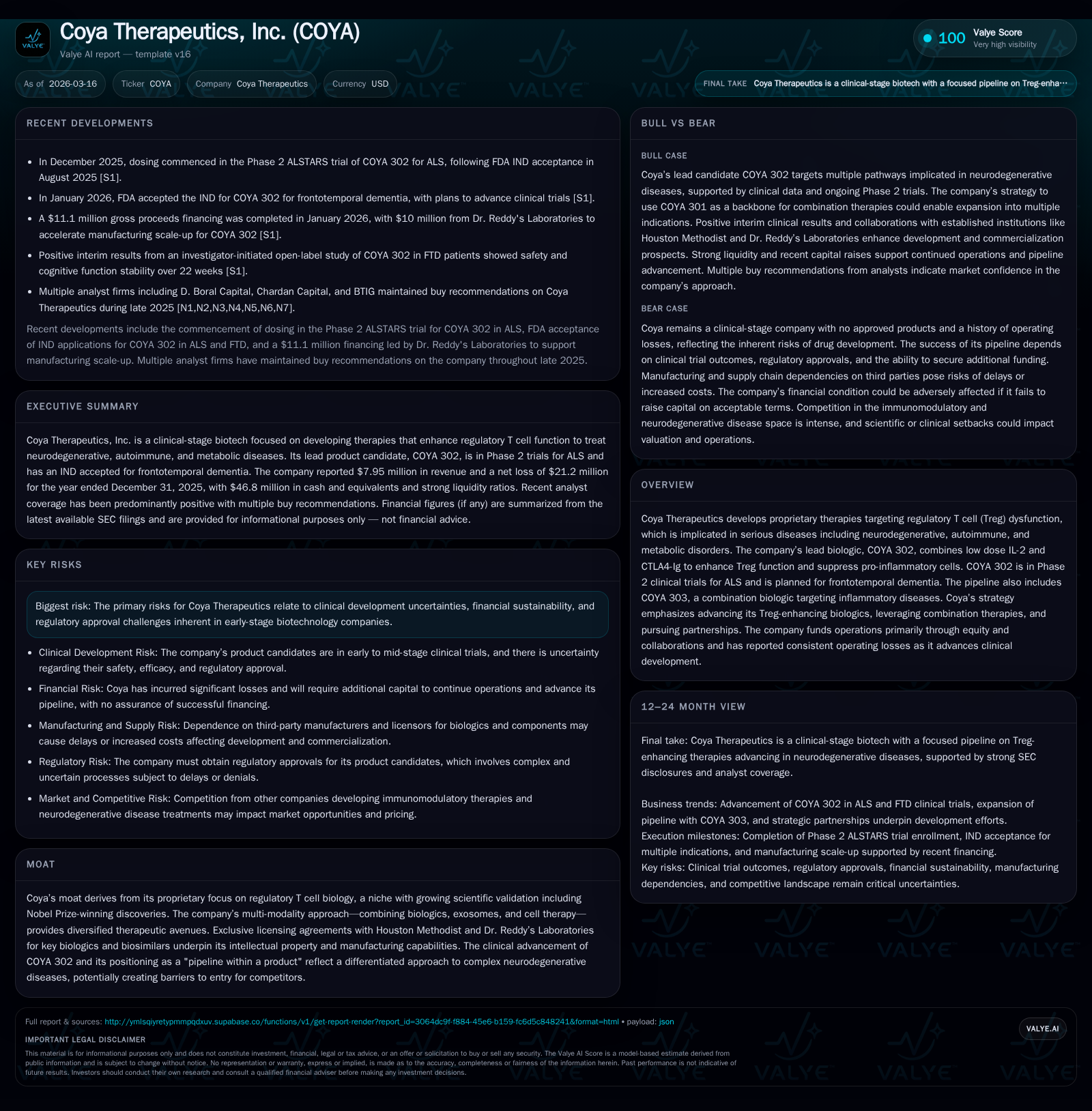
Coya Therapeutics specializes in enhancing regulatory T cell (Treg) function through innovative combination biologics, primarily COYA 302, currently in Phase 2 trials for ALS with expansion plans into frontotemporal dementia. The company has demonstrated accelerating revenue growth alongside increasing operating losses attributable to intensified R&D investment. Upcoming Phase 2 data readouts represent critical inflection points, while Coya’s exclusive licensing agreements underpin its intellectual property moat and manufacturing strategy. However, clinical, regulatory, and reimbursement risks remain significant challenges given the early-stage nature of its pipeline and ongoing capital requirements.
Historical Financial Performance: Strong Revenue Growth Amid Clinical Investment
Coya Therapeutics reported revenues of approximately $7.95 million for FY2025, up from $3.55 million in FY2024 — a robust year-over-year increase of 123.6% [F1]. This growth reflects progress in clinical-stage development of their lead asset COYA 302 and related collaborations.
Despite revenue gains, the company continues to incur substantial operating losses due to increased research and development (R&D) spending required for advancing its therapeutic candidates. Operating income declined to -$22.56 million in FY2025 from -$17.25 million in FY2024 (a deterioration of about 30.8%), while net loss expanded to -$21.23 million from -$14.88 million (a worsening of approximately 42.6%) [F1]. Operating cash flow remained negative at -$10.7 million for FY2025, consistent with prior years reflecting steady investment in clinical programs [F1].
Estimated return on equity was approximately -49.3%, calculated from net loss relative to shareholder equity of $43 million at year-end 2025 [F1]. This underscores that Coya remains heavily invested in its early-stage pipeline with no current profitability.
Historical performance (annual)
| FY | Rev ($mm) | Net ($mm) | CFO ($mm) | OpInc ($mm) | Rev YoY | Net YoY |
|---|---|---|---|---|---|---|
| 2025 | 8 | -21 | -11 | -23 | +123.6% | -42.6% |
| 2024 | 4 | -15 | -10 | -17 | -40.8% | -86.3% |
| 2023 | 6 | -8 | -11 | -8 | +34.8% | |
| 2022 | -12 | -7 | -10 |
Source: SEC companyfacts cache [F1].
Capital returns and efficiency (annual)
| FY | ROE% |
|---|---|
| 2025 | -49.3 |
| 2024 | -37.6 |
| 2023 | -22.4 |
| 2022 | 145.9 |
Source: SEC companyfacts cache [F1].
Data sourced from SEC filings XBRL cache [F1], revenue reflects growth while losses continue.
Product Innovation and Pipeline Outlook
Coya’s core therapeutic approach centers on COYA 302 — a combination biologic comprising low dose interleukin-2 (IL-2) and CTLA4-Ig designed to restore regulatory T cell (Treg) function implicated in neurodegenerative and autoimmune diseases [S1]. This "pipeline within a product" concept allows targeting multiple indications by modulating a shared immunological pathway.
The company's broader pipeline includes Treg-derived exosomes and autologous Treg cell therapies utilizing both ex vivo and in vivo modalities [S1]. These diversified platforms build upon Nobel Prize-winning discoveries related to Tregs' role in immune homeostasis [S1].
Exclusive license agreements with Houston Methodist Research Institute secure proprietary rights over key biologic constructs foundational to COYA 302 development [S1]. Additionally, a strategic partnership with Dr. Reddy’s Laboratories provides access to biosimilar manufacturing capacity supporting scalable production without significant capital expenditure [S1].
Upcoming Milestones and Clinical Development Risks
Key near-term milestones include anticipated Phase 2 data readouts for COYA 302 in amyotrophic lateral sclerosis (ALS), which will be critical for validating therapeutic potential [N1; S3]. Plans are also underway to initiate studies targeting frontotemporal dementia (FTD), another indication linked mechanistically to Treg dysfunction [S1].
However, as typical with early-stage biopharmaceutical development, timelines remain uncertain due to potential regulatory interactions, patient enrollment challenges, and biological variability impacting trial outcomes.
Capital Allocation and Financial Position
Coya finances its operations primarily through equity offerings supplemented by collaboration revenues [S18; S22]. At December 31, 2025, cash and cash equivalents totaled $46.8 million with current assets of approximately $49.9 million against current liabilities near $5.9 million — yielding a strong current ratio around 8.5 indicating solid short-term liquidity [F1].
Recent capital raises including an $11.1 million offering in January 2026 provide runway into late 2027 under current operational plans [S22]. The company does not report any debt financing which reduces leverage risk but maintains dependency on capital markets for continued funding amid ongoing R&D expenditures.
Risk Factors: Regulatory Challenges and Market Access Considerations
Coya faces multiple risks typical for clinical-stage biotechnology companies developing novel cellular therapies [S4–S7]:
- Potential delays or failures in clinical trials given complexity of neurodegenerative disease endpoints.
- Regulatory approval uncertainties including compliance risks that could delay or prevent marketing authorization.
- U.S. healthcare reimbursement challenges where payor decisions on coverage and pricing may limit commercial uptake of high-cost biologics requiring physician administration.
- Dependence on third-party manufacturers introduces operational risks related to supply continuity and quality control.
- Intellectual property disputes could arise from overlapping patents within cellular immunology fields [S15–S17].
- Evolving healthcare legislation aimed at cost containment may constrain pricing power affecting commercial viability.
Management highlights strategic alliances and internal governance as mitigation measures but acknowledges these inherent uncertainties remain material risks [S1; S4].
This report synthesizes publicly available financial statements and regulatory disclosures up to March 16, 2026. It does not constitute investment advice or recommendations but serves as an analytical overview based on documented information.
Disclaimer: This is research-only, informational analysis and not investment advice. It may include AI-generated interpretation and general industry context. Always verify important details using primary sources.

Comments