
Guru App Factory Corp: From Startup Losses to Future Growth Ambitions
The company shows early revenue growth yet struggles with financial losses and liquidity amid a competitive mobile app development landscape.
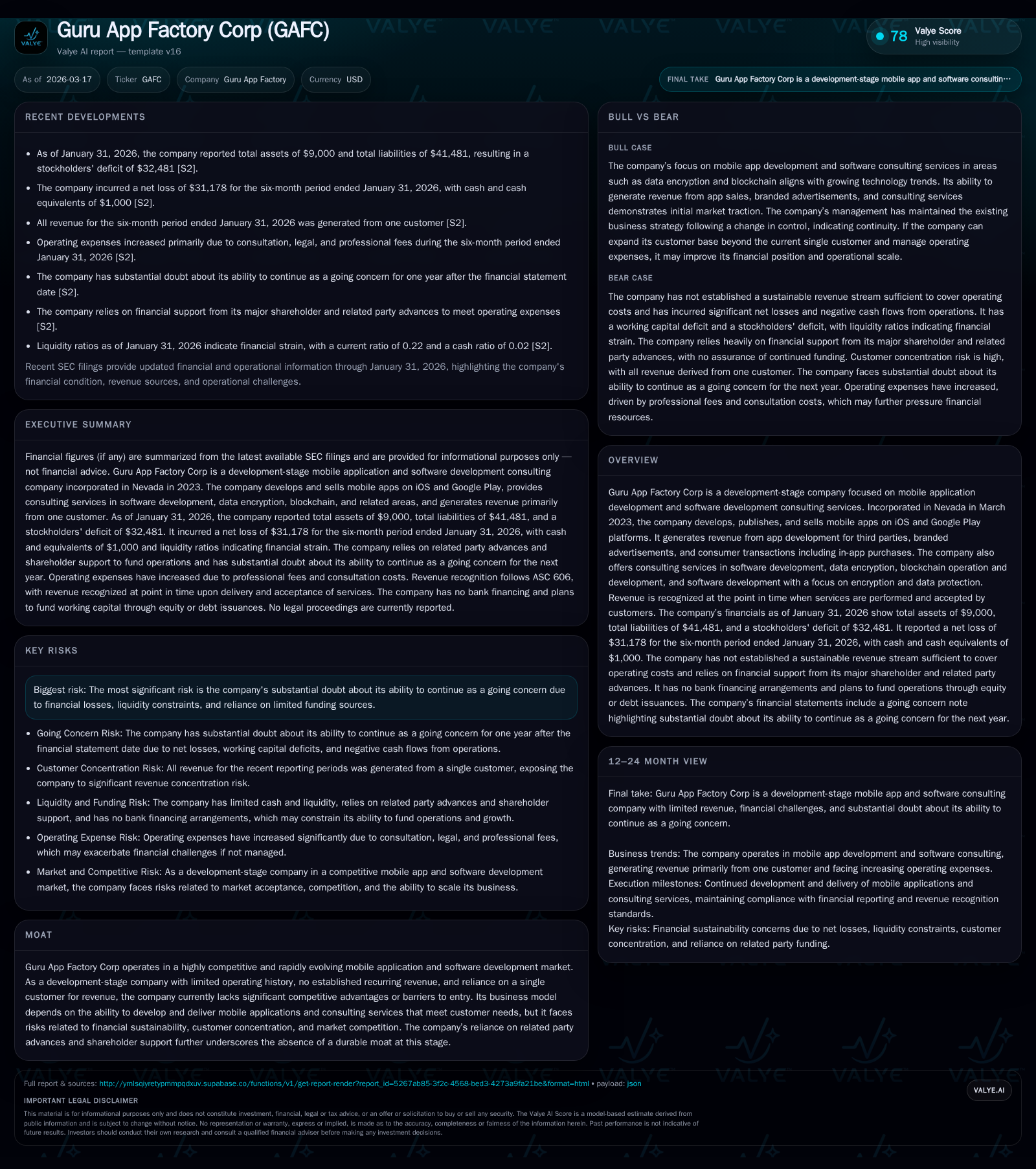
Guru App Factory Corp, incorporated in 2023, operates as a development-stage mobile app and software consulting firm with modest initial revenue gains but expanding net losses. Its FY2025 revenue rose by 14.5% to $94,500 even as net losses nearly doubled compared to the prior year, highlighting operational challenges. The company faces critical liquidity constraints with a working capital deficit exceeding $32,000 as of January 2026 and depends heavily on shareholder advances and expected equity or debt financings for short-term survival. Future growth hinges on successful capital raises, customer diversification beyond a concentrated single client, and execution in software encryption and blockchain consulting niches within a crowded market.
Historical Revenue Growth and Operating Trends
Guru App Factory Corp's fiscal year ended July 31, 2025 marked a modest top-line improvement with revenues rising to $94,500 from $82,500 in FY2024—a 14.5% increase [F1]. This growth is notable for a development-stage entity since its incorporation in March 2023. Revenue recognition follows ASC Topic 606 principles and occurs primarily upon fulfillment of app development contracts or consulting deliverables. Despite growing revenues indicating initial traction in their niche service areas such as mobile applications for iOS and Google Play stores and software consulting focused on blockchain operation and encryption technologies [S17][S18], the company's limited scale is evident.
Historical performance (annual)
| FY | Rev ($) | Net ($) | CFO ($) | Rev YoY | Net YoY |
|---|---|---|---|---|---|
| 2025 | 94500 | -43690 | -23043 | +14.5% | -90.2% |
| 2024 | 82500 | -22972 | -37641 |
Source: SEC companyfacts cache [F1].
Capital returns and efficiency (annual)
| FY | ROE% |
|---|---|
| 2025 | 3353.0 |
| 2024 | -54.2 |
Source: SEC companyfacts cache [F1].
Table 1: GAFC Historical Financial Summary (FY2024 - FY2025)
Financial Performance Under the Spotlight: Analysis of Recent Losses
More concerning than its revenue gains is GAFC's deteriorating profitability profile. Net losses nearly doubled from -$22,972 in FY2024 to -$43,690 in FY2025 [F1]. The broad increase reflects heightened operational costs related to scaling developmental activities—including legal, accounting fees—and elevated professional service expenses necessary for corporate overhead and compliance during early-stage growth [S17][S18]. Operating cash flow remains negative despite improving by about 39%, moving from -$37,641 to -$23,043 [F1], signaling persistent cash burn though some efficiency gains may be starting.
This loss expansion underscores the challenge typical of startups pushing product development while generating nascent sales. The company's substantive developmental expenses earmarked for marketing initiatives illustrate attempts to build market presence but contribute to short-term cash deficits. Profitability hurdles are compounded by the lack of recurring revenue or diversified client base.
Capital Structure, Liquidity Profile, and Going Concern Risks
The balance sheet paints an urgent picture on liquidity fronts: as of January 31, 2026 GAFC reported approximately $9,000 in total current assets against $41,481 in current liabilities—yielding a current ratio near 0.22—a critical working capital gap exceeding $32,000 that jeopardizes near-term operations [F1][S2][S3]. This massive imbalance reflects significant accrued payables alongside advances from related parties that lack formal repayment commitments but serve as essential stopgaps.
Management openly acknowledges "substantial doubt about the ability to continue as a going concern" without immediate capital infusion through equity or debt placements [S3][S8]. The company has no lines of credit or traditional bank financing; all funding thus far stems from private shareholder support plus occasional advances from insiders lacking formal promissory notes [S10][S16]. Working capital needs are anticipated to rise alongside increases in operating expenses tied to developmental activities and marketing spend [S15].
If additional funds cannot be secured on acceptable terms promptly, business continuity could be compromised severely.
Operational Focus: Product Development and Service Offerings
GAFC’s core business activities concentrate on mobile app development hosted primarily on iOS and Google Play distribution channels where it develops proprietary apps as well as third-party solutions generating revenue at delivery acceptance points—often including branded advertisements and monetization via consumer in-app purchases [S17][S18]. Alongside this primary activity lie specialized consulting services encompassing software development broadly plus niche expertise in data encryption technology implementation and blockchain system operation/development.
This focus aligns with fast-growing subsegments within IT where demand for data protection solutions and blockchain integration continues rising amid heightened cybersecurity concerns industry-wide. Such consulting niches potentially offer differentiated value relative to simple app publishing companies but face competition from both large established IT consultancies and numerous agile startups.
Growth Prospects Amid Market Competition and Funding Dependencies
Looking forward, GAFC's opportunities rest heavily on securing meaningful new contracts for both app projects and consulting engagements—thereby broadening revenue base beyond dependence on what remains a single major customer currently noted by management [S3][S8]. However, growth is constrained by acute financial risks:
- Reliance on shareholder-related party advances signifies fragile external funding access [S10][S16];
- Anticipated operating expense increases tied to start-up expansion plans inevitably elevate working capital demands jeopardizing runway absent financing success [S8];
- Market competition in mobile apps is intense with barriers to entry low; sustained differentiation remains challenging given ample substitutes.
Management’s strategic intent involves continued equity or convertible debt issuances aimed at enabling R&D investments and marketing rollout scaling but carries dilution risk for existing shareholders along with uncertainty over execution timing or capital availability—common risks for emerging IT entities lacking robust cash flows yet requiring growth capital infusion imminently [S15].
Investor Watchpoints: Risks, Milestones, and Strategic Triggers
No explicit milestone targets such as product launches or contract awards are detailed within recent disclosures; therefore investors must monitor proxy indicators of health including:
- Timing and scale of planned capital raises via private placements or convertible instruments;
- Cash runway extensions evidenced by improved working capital positions;
- Evidence of customer diversification reducing concentration risk;
- Potential shifts toward recurring revenue models enhancing stability.
Monitoring management’s regular filings around liquidity updates will be crucial given that current quarterly reports reflect ongoing negative cash flows alongside persistent net losses creating existential operational risk if unaddressed imminently.
Capital Allocation Strategy and Shareholder Returns Visibility
GAFC has not declared dividends nor instituted share buybacks post-incorporation—unsurprising considering its developmental stage status coupled with a stockholders’ deficit position (-$1,303 at FY2025 end) following accumulated losses exceeding $98K since inception [F1][S3]. Capital raised historically was predominantly allocated toward building intellectual property resources and supporting operating expenses with no excess cash flow for distributions.
Future capital allocation is expected principally toward sustaining operations via issuance proceeds strategically targeted at expanding product portfolios and market reach efforts rather than returns generation at this stage [S15]. As such, shareholders face dilution potential reflecting typical startup tradeoffs between survival-funded investment rounds versus near-term return prospects.
Disclaimer: This analysis does not constitute investment advice or recommendations but aims to provide a fact-based assessment grounded strictly on available disclosures from Guru App Factory Corp’s SEC filings up to March 17, 2026. Investors should conduct their own due diligence considering broader market conditions before making decisions.
Disclaimer: This is research-only, informational analysis and not investment advice. It may include AI-generated interpretation and general industry context. Always verify important details using primary sources.

Comments