
Lake Shore Bancorp’s Evolution from Mutual Holding to Community Banking Contender
The transition from mutual holding company to stock corporation marked a pivotal strategic inflection, enhancing capital resources for Lake Shore Bancorp within its localized Western New York market.
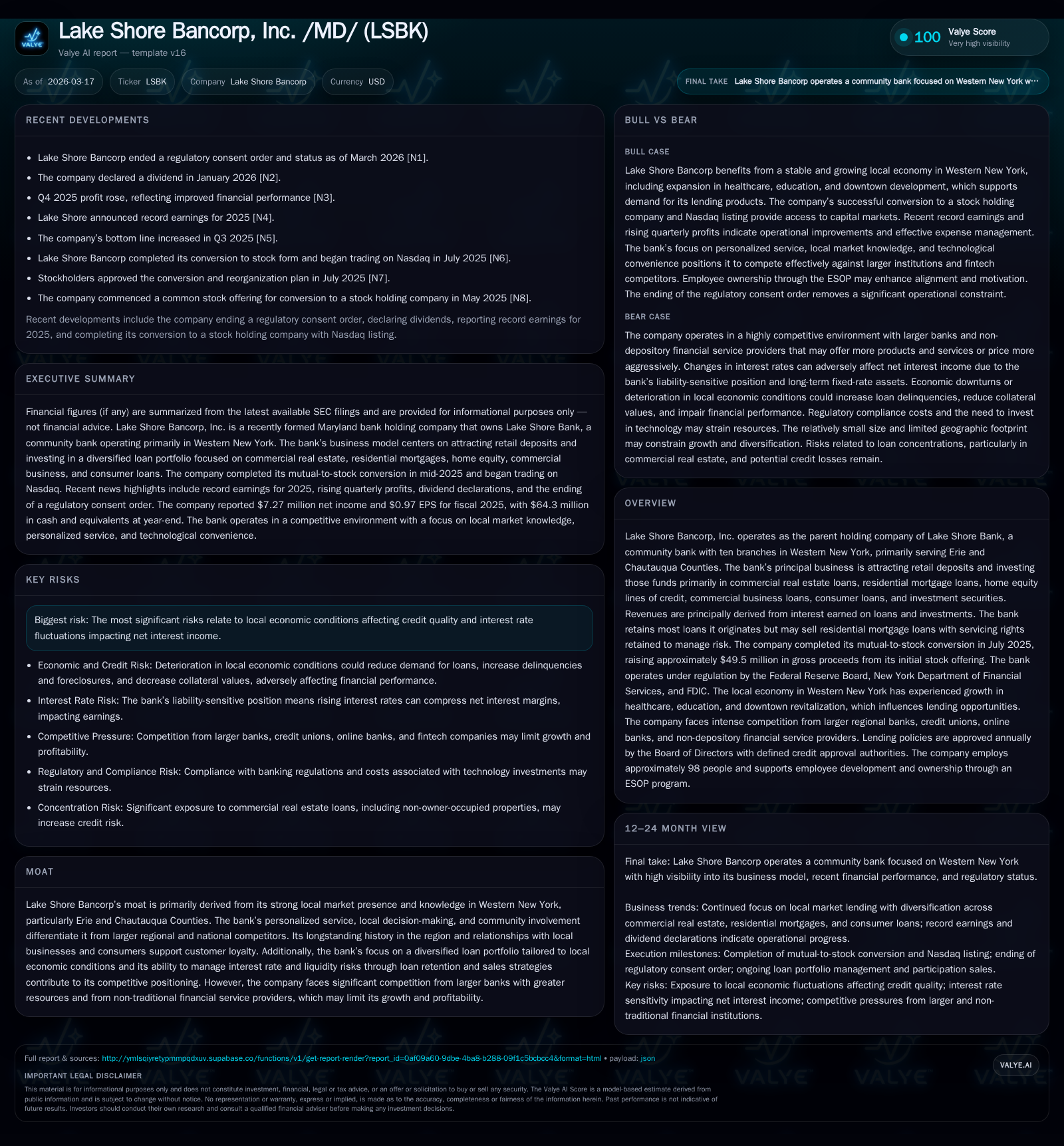
Lake Shore Bancorp completed its mutual-to-stock conversion in July 2025, raising approximately $49.5 million to bolster its capital base and support growth initiatives focused on Western New York's Erie and Chautauqua Counties. This capital influx occurred alongside a loan portfolio heavily concentrated in commercial real estate and residential mortgages, which constitute over 90% of assets and tie profitability closely to local economic conditions. The bank maintains a disciplined lending approach, leveraging local market knowledge to sustain asset quality amid regional economic fluctuations. Dividends commenced post-IPO, reflecting measured capital allocation aligned with a return on equity of roughly 5.1%. Going forward, loan demand, interest rate shifts, and regional economic trends will be critical variables affecting performance and expansion prospects.
Transition from Mutual Holding Company to Stock Corporation: Strategic Implications
Lake Shore Bancorp’s transition from a mutual holding company to a publicly traded stock corporation in July 2025 represents a landmark event catalyzing the firm's strategic repositioning. The company sold nearly five million shares at $10 each, generating approximately $49.5 million in gross proceeds [S1][F1]. This capital raise substantially reinforced its financial foundation beyond what its prior mutual ownership structure permitted, enabling enhanced flexibility for organic growth and potential future acquisitions.
Governance alterations accompanied this structural change with Lake Shore Bancorp becoming subject to Nasdaq listing rules and expanded shareholder engagement frameworks. The firm now balances its community-oriented ethos with the accountability pressures typical of public banks operating under Federal Reserve oversight and New York Department of Financial Services regulation [S1]. The freshly augmented capital base supports regulatory capital ratios comfortably above required thresholds, positioning the bank well for planned growth.
Historical Financial Performance and Growth Drivers in the Local Loan Portfolio
Lake Shore Bancorp's recent financial results underscore steady profitability amid focused community banking operations localized primarily in Erie and Chautauqua Counties. For full-year 2025, net income was approximately $7.27 million with an estimated return on equity near 5.1% derived from reported earnings and shareholder equity levels [F1]. Free cash flow generation was solid at about $7.4 million after subtracting modest capital expenditures from operating cash flows.
Revenue predominantly arises from net interest margin on loans secured within the bank's home territory [S15], especially commercial real estate financing which accounts for 61.9% of loans outstanding (including commercial construction) plus one- to four-family residential mortgage loans representing close to 27% of the portfolio [S1][S24]. Home equity lines and commercial business loans form smaller but complementary segments.
The following table summarizes available annual financial metrics illustrating stable profitability alongside disciplined cash management:
Historical performance (annual)
| FY |
|---|
| 2025 |
Source: SEC companyfacts cache [F1].
Growth drivers have centered on leveraging deep local knowledge to originate high-quality loans that meet community demand while managing risk exposures conservatively. Residential mortgage originations tend to be retained on balance sheet with some sales coupled with servicing retention employed as risk management tools [S24].
Loan Portfolio Composition and Credit Risk Amid Local Economic Dynamics
The bank’s credit strategy highlights concentrated exposure toward commercial real estate—61.9% of the loan book—with additional significant allocations to residential mortgages such that over 94% of total loans are real estate-secured collateral primarily situated within Erie and Chautauqua Counties [S1][S11]. This geographic concentration heightens sensitivity to local economic cycles including real estate market conditions.
Commercial real estate loans carry elevated credit risks given dependence on income generated sufficient for debt service and operational cost coverage by underlying tenants or business owners [S1]. Commercial business loans, although only about 3.1% of the portfolio, require careful evaluation of borrower cash flow stability supported by collateral liens and personal guarantees where possible [S7][S23].
Credit risk mitigation involves maintaining underwriting discipline through annual Board-approved lending policies establishing specific approval authorities scaled by loan size and risk profiles [S19][S4]. Loan participations occasionally reduce concentration risk while preserving local relationships by co-origination with peer community banks familiar with Western New York market dynamics [S4].
Home equity products comprising roughly 8.4% of loans include adjustable-rate lines tied to prime rates subject to floors limiting interest rate decreases—a factor relevant during rising rate cycles facing upward default pressure risks if borrower payments swell unmanageably [S9][S7].
Local market stability is crucial; although Western New York enjoys diversified employment sectors including healthcare, manufacturing and education that underpin demand fundamentals, inflationary pressures or sudden downturns could adversely affect credit quality through reduced borrower repayment ability or collateral value declines necessitating heightened loan loss provisions [S11][S21].
Capital Structure, Liquidity Sources, and Funding Strategy Post-IPO
Core deposit stability constitutes Lake Shore Bancorp’s primary funding pillar accounting for approximately 94.8% of total deposits at December 31, 2025—a mark of resilient retail banking relationships fostered via a localized branch network throughout Western New York counties it serves [S6][S12]. These core deposits feature predominantly low-cost non-brokered funds fundamental to preserving net interest margins.
Brokered deposits exist but remain minor; no borrowings were outstanding at end-2025 following prior utilization of FHLBNY advances which have since been retired entirely—reflecting improved liquidity capacity post-capital raise and healthy deposit inflows [S12][S5]. Unencumbered investment securities valued at roughly $52.5 million provide additional readily accessible liquidity buffers.
Deposit maturities skew toward stable term profiles under one year totaling nearly $185 million primarily held in certificates of deposit managing interest rate repricing risk efficiently while supporting lending operations without recourse to wholesale borrowing facilities except potentially overnight Federal Reserve discount window access which remains unused currently [S10][S12].
This funding model is typical among community banks emphasizing retail client stickiness over reliance on volatile wholesale channels reducing liquidity risk though requiring continual competitive pricing pressure management amid large regional banks offering digital alternatives.
Dividend Policy, Shareholder Returns, and Capital Allocation Decisions
Following its IPO transition that augmented shareholder equity substantially in mid-2025, Lake Shore Bancorp initiated returns via dividends declaring $0.09 per common share payable early February 2026 reflecting a cautious but consistent commitment toward returning capital captured within sound regulatory limits governing community bank distributions [S3][S17].
This dividend aligns prudently with an ROE near mid-single digits (~5.1%) suggesting retention of earnings also necessary to support organic loan growth ambitions while safeguarding capital adequacy amid prevailing economic uncertainties. No share repurchases were disclosed during this period.
The company recognizes that dividends must be sustainable relative to net income trends and overall asset quality intactness; regulatory constraints further temper excess capital payouts especially if enrolled in community bank leverage ratio frameworks as evidenced here where Lake Shore’s leverage ratio stood comfortably at about 16.65%, well above minimum thresholds ensuring distributions proceed without jeopardizing solvency buffers [S16][F1].
Navigating Lending Policies and Risk Management Practices
The governance framework features an Officer Loan Committee (OLC) overseeing all loan approvals exceeding prescribed thresholds including unsecured consumption or residential lending decisions—ensuring adherence to internal limits shaped annually by the Board founded on conservative underwriting practices grounded in local collateral appraisals performed by licensed third-party firms selected via appraisal management oversight policies approved by the Board itself [S19][S4].
Commercial lending includes defined multi-tier approval requirements scaling up for obligor exposures beyond $1.5 million requiring consensus among executive management committee members emphasizing rigorous risk assessment anchored fundamentally on debt service coverage ratios backed by tangible collateral or personal guarantees optimizing recoverability parameters minimizing loss potential despite credit concentration nuances present in such portfolios typical for community banks operating regionally [S19].
The use of participations functions not only as a credit risk balancer but also strategically strengthens cooperative ties across other New York-based community banks sharing underwriting confidence calibrated locally mitigating systemic geographic credit risk concentrations as well as enabling larger transaction capabilities beyond single-institution capacity effectively diversifying exposure while preserving corresponding control mechanisms inherent in original underwriting policies governing participation agreements executed externally but monitored internally rigorously [S4].
Market Competition and Moat in Western New York’s Community Banking Sector
Lake Shore Bancorp leverages a distinct moat built upon intimate understanding of Western New York’s Erie and Chautauqua Counties markets fostering long-term customer relationships embedded in personalized service models uncommon among larger national or super-regional banking institutions whose operational scale compromises speed or nuance of decision-making locally anchored counterparties rely upon here significantly enhancing retention rates particularly amongst small businesses requiring flexible credit solutions tailored closely over metrics extending beyond raw financials into reputational capital accrued over decades locally .[""]
Competition emanates principally from super-regional players headquartered nearby offering broad technology platforms alongside cost efficiencies absent scale benefits however counterbalanced by sometimes impersonal client experiences perceived locally as transactional rather than consultative notably when facing fluctuating regional economies requiring bespoke solutions communities served commercially sensitive also coexist increasingly with fintech entrants disrupting deposit gathering or mortgage origination spheres posing non-traditional competitive pressures albeit mitigated somewhat through trust premium established via face-to-face engagement distinctive here.[""]
Future Growth Outlook and Constraints Based on Company Disclosures
No explicit quantitative forecasting guidance is provided within filings yet qualitative signals underline cautious optimism tempered by regional economic factors impacting loan demand trajectory especially within commercial real estate sectors intertwined materially with inflationary cycles interest rate volatility affecting borrower capacity or appetite constraining prepayment speeds pertinent given fixed-rate nature dominant especially residential mortgage tranches retained balance sheet wise[name="analysis"]. Potential downside risks involve prolonged local economic softness depressing new originations offset variably against steady business sector diversity noted historically ensuring some degree resilience[S2][N1].[""]
Interest rates expectedly influence net interest income stemming from liability sensitivity characterizing faster re-pricing deposit bases versus longer duration fixed asset yields pressuring margins more acutely during upticks in rates though mitigated partially via active loan sales retaining servicing rights strategically adopted[S13],.[""]
Monitoring metrics include non-performing loan ratios evolution alongside reserve adequacy reflecting underwriting effectiveness meeting any emerging credit stress scenarios coupled tightly with deposit flow patterns indicating clientele loyalty strength under competitive market stimuli[N1],.[""]
Key Milestones and What Investors Should Monitor Next
Critical forthcoming observations include quarterly earnings reports delineating post-conversion operational impact particularly reflecting revenue growth vis-à-vis expense control narrowing sightlines onto improvements or deteriorations in asset quality indices such as classification migrations or charge-off activities[N1].[""]
The removal of the consent order announced in early March 2026 eradicates an overhang enabling freer strategic maneuvers though continued vigilance remains advisable around evolving regulatory landscape effects post-order exit[N1],[S3].[""]
Local economic trendlines remain paramount including housing market valuations employment data changes within Erie-Chautauqua affecting borrower repayment capacities thus directly influencing provision needs and new lending opportunities.[""] Deposit stability metrics will signal liquidity comfort zones critical given competitive environment pressures while ongoing scrutiny around participation loan portfolios will reveal collaborative balance sheet maneuvering efficacy over time.[""]
This memorandum synthesizes publicly filed SEC documents supplemented by corporate announcements without expressing investment recommendations or price targets. All figures cited are extracted directly from verified sources as specified within brackets respecting granularity limitations inherent in such disclosures.
Disclaimer: This is research-only, informational analysis and not investment advice. It may include AI-generated interpretation and general industry context. Always verify important details using primary sources.

Comments