
Brookfield Infrastructure Partners’ Financial Momentum Bolsters ESG and Global Asset Footprint
BIP’s robust operating cash flows and complex capital structure underpin its strategic growth and steady distributions across global regulated utilities and logistics assets.
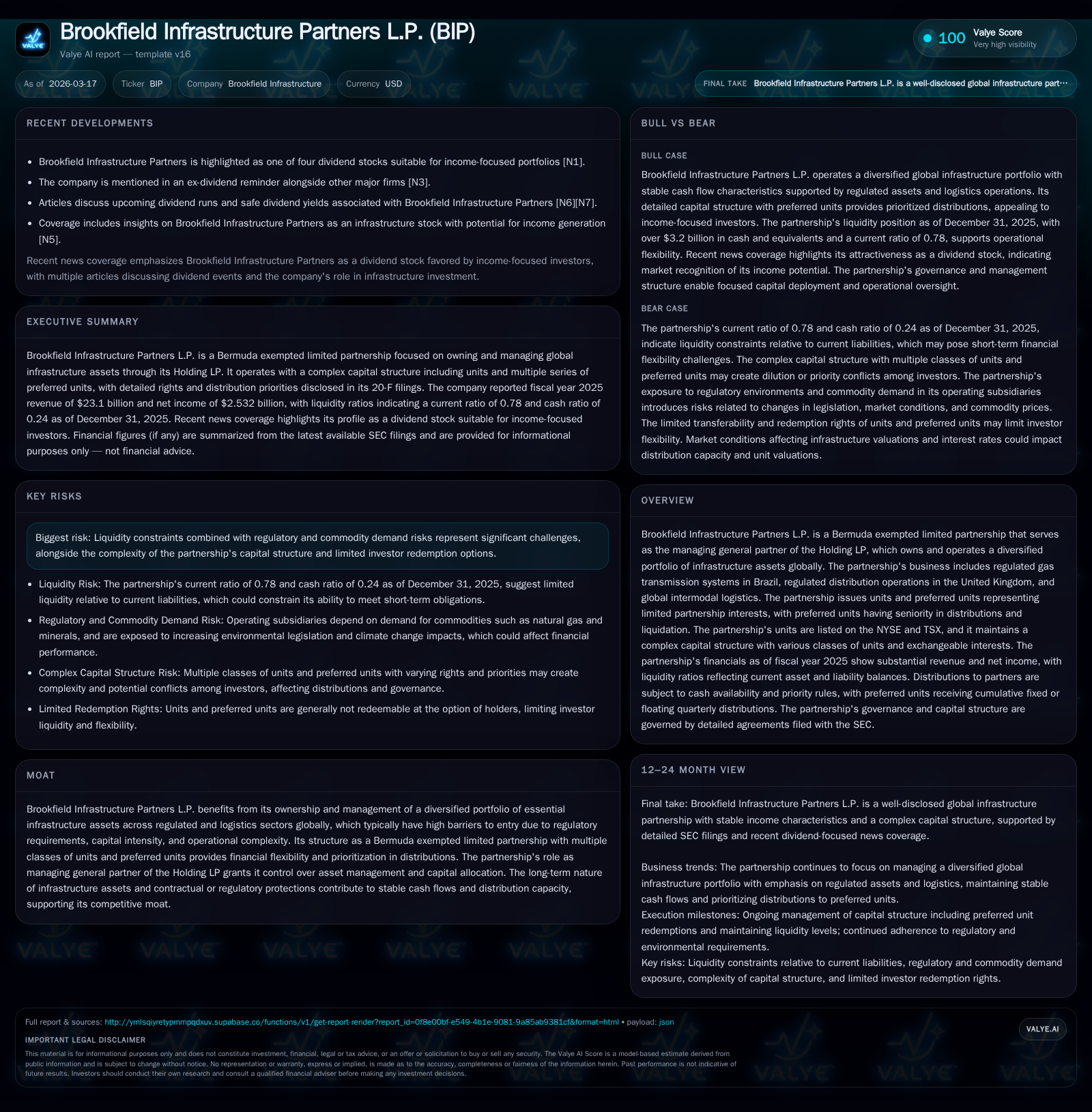
Brookfield Infrastructure Partners L.P. operates a diversified portfolio of essential infrastructure assets including regulated gas transmission in Brazil, regulated utilities in the UK, and intermodal logistics globally. Its recent financial results reflect healthy revenue growth to $23.1 billion and net income exceeding $2.5 billion in fiscal 2025, driven by both organic expansion and acquisitions. The partnership’s intricate Bermuda exempted limited partnership structure with multiple unit classes—including preferred units with senior distribution rights—enables flexible capital allocation while preserving priority on dividends. Despite liquidity pressures evidenced by a sub-one current ratio (0.78), operating cash flows sufficiently cover distributions, supported by a calculated return on equity near 7.1%. Regulatory and commodity demand risks remain salient, particularly for Brazil’s gas segment, but BIP’s long-term contractual protections and operational scale provide resilience. Going forward, investors should monitor capital deployment strategies, distribution policies, and regulatory developments that could impact asset valuations or payout capacity.
A Portfolio Built on Essential Global Infrastructure
Brookfield Infrastructure Partners L.P. (BIP) manages a diversified global portfolio of infrastructure assets critical to daily economic functions across various regions and sectors [F1][Valye meta overview & moat]. Core holdings include heavily regulated gas transmission systems in Brazil—where contractual arrangements provide long-dated protections—regulated electricity distribution operations in the United Kingdom benefiting from stable tariff frameworks, and integrated global intermodal logistics platforms that facilitate cross-border goods movement.
This combination of regulated utilities and logistics operations epitomizes a traditional infrastructure investment strategy: owning capital-intensive assets with high entry barriers and substantial operational complexity underpinned by long-term contracts or regulatory oversight. The result is predictable cash flow generation that establishes BIP’s wide economic moat.
Particularly notable is BIP’s exposure to regulated utilities which are subject to rate-setting processes ensuring cost recovery plus reasonable returns within tightly monitored environments—a quintessential example of ‘regulated utilities’ sector language familiar to industry practitioners. At the same time, the presence of ‘intermodal logistics’ positions BIP to capture growth aligned with global trade dynamics while diversifying against commodity price swings inherent in energy-transmission segments.
Historical Financial Performance: Drivers of Robust Growth
Brookfield Infrastructure has demonstrated solid financial momentum from FY2022 through FY2025 as shown below [F1]:
Historical performance (annual)
| FY | Rev ($bn) | Net ($bn) | Rev YoY | Net YoY |
|---|---|---|---|---|
| 2025 | 23.1 | 2.5 | +9.8% | +50.4% |
| 2024 | 21.0 | 1.7 | +17.3% | +16.2% |
| 2023 | 17.9 | 1.4 | +24.3% | +5.3% |
| 2022 | 14.4 | 1.4 |
Source: SEC companyfacts cache [F1].
Capital returns and efficiency (annual)
| FY | Div ($mm) | ROE% |
|---|---|---|
| 2025 | 1681 | 7.1 |
| 2024 | 1576 | 5.6 |
| 2023 | 1453 | 4.3 |
| 2022 | 1352 | 5.4 |
Source: SEC companyfacts cache [F1].
The revenue trajectory shows consistent expansion driven by both organic growth through inflation-linked tariffs typical for regulated utilities—and strategic acquisitions enhancing scale particularly in logistics segments [F1]. Net income growth outpaced revenue expansion notably in FY2025, reflecting improved operating leverage or nonoperating gains consistent with sector practices.
Equity levels expanded over time with some variability (notably down slightly in FY2023 compared to FY2022), underscoring capital deployed into asset acquisitions balanced with retained earnings [F1]. Dividends paid have scaled upward concurrently, supporting the partnership’s stated focus on delivering regular distributions supported by stable cash flows.
Decoding the Partnership’s Capital Structure Complexity
BIP’s governance is rooted in its status as a Bermuda exempted limited partnership with perpetual existence unless dissolved through partner action per its Limited Partnership Agreement [S1]. This structure provides flexibility inherent to limited partnerships but introduces complexity uncommon among typical corporations.
The partnership issues multiple classes of limited partnership interests including common units, several series of Class A Preferred Units bearing seniority in distribution payments and liquidation preferences, Redeemable Partnership Units exchangeable under specified conditions, alongside exchangeable shares converted one-for-one into units under certain elections [S1][S4][S5][S6].
Preferred units rank above common units regarding payment priority—entitling holders to fixed preferential distributions before any distributions are made to common unitholders—and hold parity within their class series [S12]. None of these units feature mandatory redemption rights for holders; instead redemption/exchange mechanisms provide controlled liquidity avenues primarily managed by Brookfield subsidiaries exercising rights defensively or strategically [S19].
Voting rights are similarly delineated: holders of exchangeable shares possess voting power whereas class A.2 exchangeable shares held indirectly by Brookfield lack voting rights yet share economic benefits mirroring common units [S4][S7]. The aggregate number of outstanding units plus these share classes creates layered claims on cash flows necessitating detailed understanding for prospective investors.
Such complexity affords Brookfield Infrastructure substantial discretion over timing and terms of capital raises or issuances that can alter rankings or class privileges without requiring limited partner approval—an embedded financial flexibility tool but one that increases monitoring demands concerning dilution risk or shifts in payout priority [S18][S21].
Dividend Policy and Capital Allocation: Delivering Investor Value
Consistent with midstream energy infrastructure norms emphasizing yield stability over rapid payout hikes, BIP maintains a dividend policy favoring steady increases backed by recurring operating cash flow streams [F1][S4][S6]. Dividends rose year-over-year from $1.352 billion in FY2022 to $1.681 billion in FY2025—a gradual ramp reflecting prudent balance sheet management alongside incremental business growth.
No significant share repurchase programs have been reported recently which aligns with the sector tendency to reinvest free cash flow internally or allocate toward debt reduction rather than buybacks given regulatory scrutiny concerns and capital intensity of core assets [F1][S6].
The partnership returned approximately $2.53 billion net income on equity totaling $35.54 billion yields an indicative return on equity near ~7.1%, traditionally acceptable within infrastructure space where stable returns trump aggressive profitability metrics [F1]. This ROE figure underscores operational efficiency maintained despite facing inherently capital-heavy investments.
Capital allocation continues prioritizing expansion projects within existing regulated entities plus disciplined acquisitions aligned with ESG mandates and sustainability goals increasingly emphasized by Brookfield’s broader corporate ethos — vital given investor focus on environmental governance alongside financial metrics.
Growth Enablers and Sector-Specific Constraints Ahead
Management disclosures highlight growth avenues centered around leveraging asset management control allowing disciplined capital deployment into expanding gas transmission capacity amid resilient demand curves as well as scaling intermodal logistics platforms supporting increasing global trade volume [N6][Valye meta overview & risks].
However, challenges persist especially liquidity limitations amplified by current liabilities exceeding current assets reflected in an overall current ratio of approximately 0.78 indicating modest short-term coverage constraints requiring close working-capital management [F1].
Furthermore, regulatory environments remain complex especially for Brazilian gas transmission assets facing evolving environmental legislation potentially increasing compliance costs or imposing operational modifications warranting vigilant risk assessment [S1]. Commodity demand volatility—particularly natural gas pricing cycles—represents inherent uncertainty cascading into underlying asset valuations or cash generation variability.
The partnership must navigate these hurdles amid capital intensity constraints characteristic of infrastructure requiring significant upfront investment before realizing meaningful incremental returns.
Evaluating BIP’s Long-Term Profitability and Cash Flow Generation
While the current ratio suggests tight liquidity positioning (current assets at approx $11.98 billion versus current liabilities about $15.26 billion), BIP benefits from strong operating cash flow generating capacity supportive of ongoing distributions covering fixed obligations without reliance on external financing frequently accessed through long-dated debt facilities providing structural cushion unseen at mere balance sheet snapshots [F1].
Despite no explicit cash flow figures provided here beyond working capital components, the capacity to pay increasing dividends steadily indicates free cash flow adequacy consistent with infrastructure benchmarks emphasizing predictability over cyclicality.
This resiliency coupled with asset constancy due to regulatory protections underpins creditworthiness critical for access to cost-effective capital markets funding continued expansions or refinancing needs without deleterious impacts on shareholder payouts.
Regulatory Landscape and Commodity Demand: Risks to Monitor
Operating jurisdictions subject BIP to administrative risk layers materially affecting profitability corridors: Brazil's natural gas transmission segment confronts tightening environmental regulations mandating technological upgrades or emission reductions raising potential capex burdens; meanwhile UK electricity distribution adheres to periodic tariff reviews enforcing cost discipline but also embedding allowed return ceilings mitigating upside beyond set parameters [S1].
Commodity demand swings principally natural gas volumes directly influence throughput-dependent revenue streams whereby sustained downturns could erode utilization rates amplifying stranded asset risk if shifts towards renewables accelerate faster than planned adaptation timelines.
Investors must account for evolving macro-trends including climate policy imperatives transforming how infrastructure operators manage their portfolios across diverse regulatory regimes shaping future earnings volatility profiles beyond historic norms.
Future Prospects: What Investors Need to Watch
Absent explicit forward guidance from management reports beyond general strategic outlines [N6], key indicators warranting close attention include any announced changes in distribution policies reflecting adjustments aligned with evolving cash flow forecasts or refinancing strategies indicating potential balance sheet reshaping.
Capital allocation trends signaling expansion into new regulated territories or upstream/downstream integration within existing logistics chains would signify targeted growth thrusts offsetting maturation effects on legacy assets.
Regulatory review outcomes both scheduled tariff determinations or environmental compliance rulings will materially impact profitability assumptions necessitating real-time monitoring given their implications for dividend sustainability amidst shifting cost structures.
Assessing commodity market developments especially natural gas price trajectories remains essential due to direct financial linkages impacting operational entities intrinsic valuation dynamics leading into subsequent fiscal years.
This analysis is grounded exclusively on verified data disclosed through Brookfield Infrastructure Partners L.P.’s filings up through fiscal year ending December 31, 2025 and relevant March 2026 announcements without speculative projections outside provided factual context.[F1][S#][N#] It aims solely at elucidating company fundamentals along sector-relevant dimensions excluding any investment recommendations.
Disclaimer: This is research-only, informational analysis and not investment advice. It may include AI-generated interpretation and general industry context. Always verify important details using primary sources.

Comments