
IceCure Medical’s Cryoablation Innovation Navigates Growth and Regulatory Challenges
IceCure Medical is advancing its cryoablation systems for tumor treatment, balancing incremental revenue growth with ongoing operating losses and regulatory milestones.
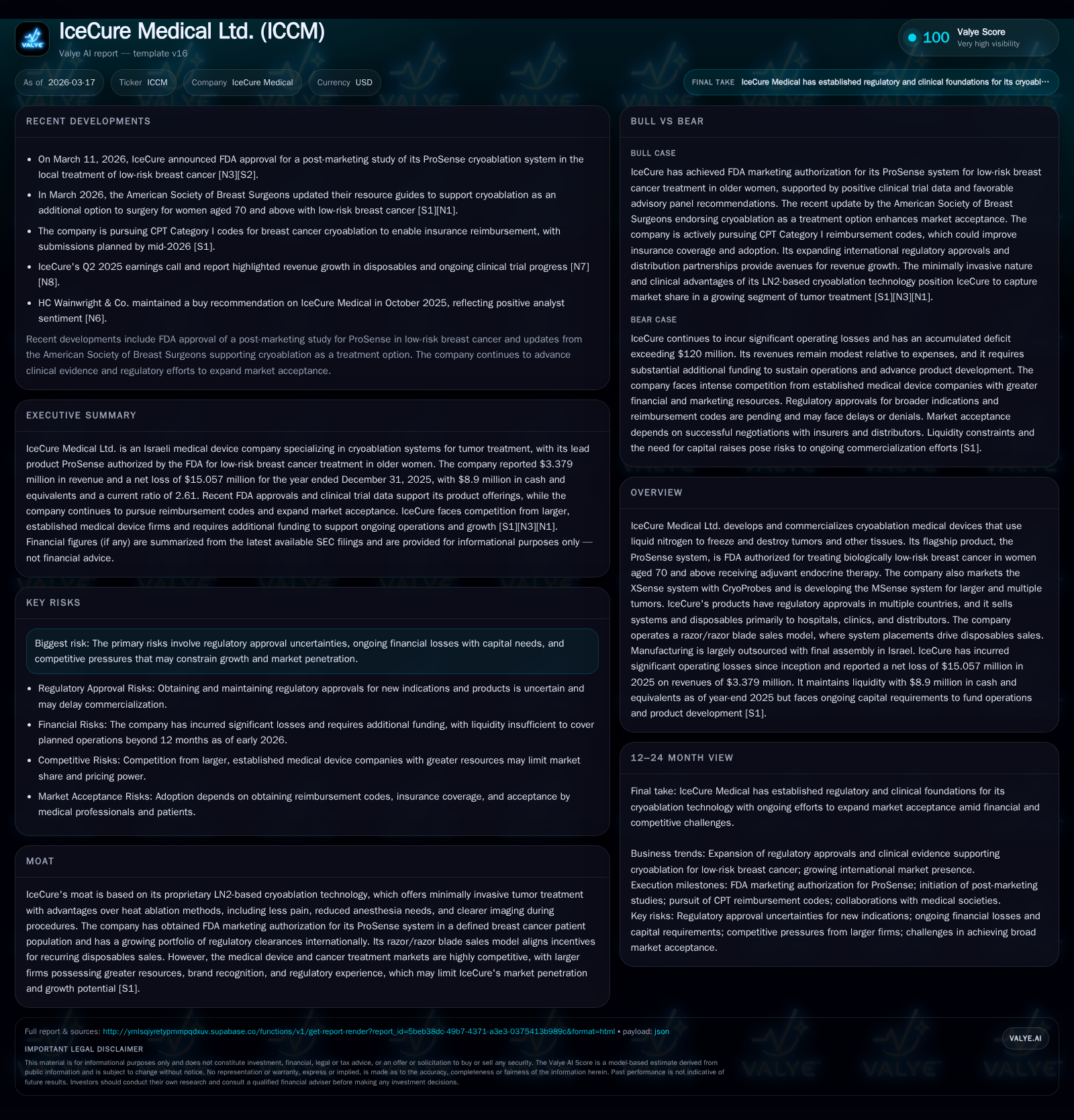
IceCure Medical Ltd. specializes in liquid nitrogen-based cryoablation devices for minimally invasive tumor treatment, with a flagship product FDA-cleared for certain breast cancer indications. Revenue has seen modest growth driven by expanding sales in the U.S. and international markets, while net losses continue due to high R&D and commercialization costs. The company’s razor/razor blade model supports recurring disposables sales tied to system placements. Recent FDA approval of a post-marketing study represents a regulatory catalyst, but competition and financial constraints pose risks. Monitoring cash flow trends and progress on broader clinical adoption will be key.
Company Overview
IceCure Medical Ltd., headquartered in Caesarea, Israel, is a commercial-stage medical device firm focusing on cryoablation technologies that utilize liquid nitrogen (LN2) to ablate benign and malignant tumors through freezing while still inside the patient’s body. Since its incorporation in 2006 and Nasdaq listing in 2021 (delisting from TASE in 2023), IceCure has developed its proprietary cryoablation platform that includes its flagship ProSense system authorized by the FDA for treating biologically low-risk breast cancer in women aged 70 and above undergoing adjuvant endocrine therapy [S1][S2]. Its product suite also comprises the XSense system cleared via FDA 510(k) pathways offering enhanced procedural efficiency, and a pipeline MSense product intended to address larger or multiple tumor treatments [S1][S11].
The company operates mainly under a razor/razor blade model where capital equipment placements (cryosystems) generate follow-on recurring revenues from disposables like probes—vital to sustaining revenue streams [S12]. Manufacturing is largely outsourced outside Israel with final assembly domestically, enabling streamlined production logistics while focusing internal resources on R&D, regulatory activities, clinical validation, and market expansion.
Historical Financial Performance
IceCure Medical’s historical financials demonstrate slow but positive revenue momentum amid persistent operating losses driven by heavy investments in clinical studies, regulatory filings, market development, and fixed general expenses.
Historical performance (annual)
| FY | Rev ($mm) | Net ($mm) | CFO ($mm) | OpInc ($mm) | Rev YoY | Net YoY |
|---|---|---|---|---|---|---|
| 2025 | 3 | -15 | -15 | -15 | +2.7% | +1.7% |
| 2024 | 3 | -15 | -13 | -16 | -4.5% | |
| 2023 | -15 | -13 | -16 | +13.7% | ||
| 2022 | 3 | -17 | -14 | -17 | -25.4% |
Source: SEC companyfacts cache [F1].
Capital returns and efficiency (annual)
| FY | FCF ($mm) | ROE% |
|---|---|---|
| 2025 | -15 | -166.4 |
| 2024 | -13 | -222.0 |
| 2023 | -13 | -120.5 |
| 2022 | -15 | -66.8 |
Source: SEC companyfacts cache [F1].
Revenue increased marginally by approximately 2.7% year-over-year to $3.38 million as of December 31, 2025 [F1]. This growth was primarily fueled by steady sales improvements across U.S., China (163% increase from low base), and certain European territories partially offset by declines in India (~71%) and Japan due to the absence of recognized distribution rights revenue versus prior periods [S12][S23].
Operating income losses narrowed slightly to -$15.09 million from -$15.70 million in fiscal year 2024 reflecting disciplined expense management offsetting higher costs linked to research & development (R&D) expansion and marketing initiatives focused on building out market penetration for the ProSense system and newer products like XSense reviewed favorably by clinicians [F1][S13]. Correspondingly, net loss reduced slightly to -$15.06 million for full-year 2025.
Operating cash flows remain significantly negative at approximately -$14.57 million for the year ended December 31, 2025 as investment in clinical trials continues alongside inventory stocking supporting future demand ramp-up [F1][S24]. Capital expenditures are minimal ($36 thousand), indicating most spending remains directed toward intangible development rather than property plant or equipment expansion.
Technological Moat & Competitive Positioning
IceCure’s primary competitive advantage rests on its proprietary LN2 cryoablation technology versus heat-based ablative modalities or argon gas-based cryosystems more common among competitors. Advantages of the LN2 method include substantially less procedural pain reducing the need for anesthesia; clearer real-time imaging during ablation facilitating precise tumor targeting; enhanced safety profile since LN2 is stored at low pressures compared to high-pressure argon gas balloon systems posing explosion risks; and lower consumable costs critical to procedural economics especially important under constrained healthcare budgets globally [S18]. Regulatory authorities such as the FDA have recognized this distinct technology profile — reflected through marketing authorization specific to a defined breast cancer population — which differentiates it from competitors lacking equivalent clinical evidence or focused indications.
However, IceCure faces formidable competition from established firms possessing broader product portfolios with extensive regulatory footprints capable of leveraging larger salesforces plus deeper pockets for sustained clinical trial investment along with global brand recognition that tends to influence hospital purchasing decisions [S20]. The company’s challenge lies in expanding penetration beyond niche applications into multisite tumor treatments while demonstrating long-term cost-effectiveness for insurance reimbursement negotiations.
Growth Prospects
Looking ahead, IceCure has several potential drivers:
- Continued adoption expansion of ProSense following recent endorsements by key U.S. professional bodies such as the American Society of Breast Surgeons updating treatment guidelines recommending cryoablation as viable surgical alternative specifically for low-risk elderly patients since March 2026 [S12][S20];
- Execution of the FDA-approved 'ChoICE' post-marketing study designed to build real-world evidence further validating safety and efficacy which could support label expansions or prompt additional payer coverage decisions [N3][S3];
- Commercial rollout of next generation products like XSense offering ease-of-use improvements expected to attract new user segments;
- Geographic expansion supported by regulatory clearances across a broad range of countries including Europe’s MDR compliance progress enabling CE-marked market participation; ongoing collaboration with distributors across Asia (notably China), Europe (Italy France Spain Germany), India and emerging markets aimed at education programs hosted jointly with opinion leaders targeting breast surgeons and interventional radiologists who are end-users of these devices [S12].
Constraints restricting growth stem from:
- Continued challenges securing broader reimbursement locally and internationally given current Category III CPT coding status limits immediate comprehensive Medicare coverage reimbursement outside select facilities;
- Capital intensity required to finance additional pivotal trials expected for label expansion or multiple tumor applications;
- Competitive invasions leveraging alternative ablation technologies or surgical innovations possibly limiting market share gains;
- Regulatory risks inherent in medical devices requiring continuous compliance updates especially under evolving EU MDR regulations and U.S post-market surveillance requirements impose incremental costs [S4][S10][S19].
Forecasts / Milestones / Expectations
While explicit formal guidance is not provided, key milestones include:
- Completion timeline of the ChoICE post-marketing study approved by FDA acts as a pivotal data collection event that stakeholders should monitor for impact on utilization rates or indication expansions impacting revenue runway;
- Efforts to secure permanent CPT Category I codes would significantly enhance reimbursement clarity potentially unlocking wider commercial adoption;
- Market penetration metrics from newly targeted territories based on distributor performance along with direct placements in U.S ambulatory centers convey sales trajectory signals;
- Progress on scaling XSense deployments signaling acceptance of next generation hardware replacing legacy models reflects innovation-cycle health;
- Additional regulatory clearances or expanded labeling announced via public releases could recalibrate revenue outlooks [N3][S12][S20].
Returns / Capital Allocation
Return metrics presently reflect negative profitability consistent with early commercial-stage medtech companies investing heavily in R&D alongside go-to-market infrastructure building:
- Approximate return on equity stands near negative -166% based on net loss relative to equity base at December ’25 [$9.05 million equity base vs net loss $15.06 million] indicating lack of current profitability but aligned with growth investment phase trends [F1];
- Negative operating cash flow at roughly $14.57 million substantiates continued cash burn requiring financing inflows;
- Free cash flow remains negative near $14.6 million given negligible capex needs indicating primary outflows are operational expenditures instead of expansion capex projects;
- Funding sourced predominantly via equity raises including an aggregate $41 million raised since beginning of 2022 through public offerings plus ATM facility utilization providing necessary liquidity buffer [$8.9M cash balance end ’25 highlights modest runway though requires careful management] [F1][S24];
- No dividends or share repurchases disclosed; capital allocation focus remains firmly on financing operational sustainment amid scaling commercialization efforts.
Industry Context (Analysis)
Cryoablation as a minimally invasive oncology treatment aligns well with healthcare trends favoring outpatient procedures reducing hospitalization times thereby cutting overall treatment costs while improving patient convenience – factors increasingly valued within aging populations prone to comorbidities disfavoring surgery. Liquid nitrogen use instead of argon gas may offer superior cost structure favorable where healthcare providers face budget constraints exacerbated post-pandemic globally. Nonetheless national healthcare payer systems globally demonstrate heterogeneity regarding willingness-to-pay influencing regional adoption variability necessitating collaborative approaches between technology developers like IceCure Medical and major hospital networks.
Closing Thoughts
IceCure Medical occupies an intriguing niche combining innovative LN2-based cryoablation technology with expanding but still nascent commercial traction primarily within breast cancer applications approved by FDA under defined criteria. The company balances slow topline revenue growth reflecting selective product adoption against persistent sizable operating losses driven by committed investments new product development efforts international market access strategies regulatory compliance overheads.
The immediate outlook hinges on successful execution of mandated post-market surveillance studies alongside effective market education amongst key physician communities influencing procedural choices combined with strategic capital management ensuring liquidity adequacy until sustainable profitability emerges or significant milestone-driven valuation inflection points manifest.
Investors should track operational KPIs around procedure volumes regionally progression updates regarding reimbursement pathways competitive landscape developments alongside efficient capital deployment efficacy maintaining ability to fund clinical innovation pipeline progression.
This analysis relies exclusively upon publicly available financial disclosures from IceCure Medical Ltd (primarily its Form 20-F filings) supplemented by recent news releases without speculative assumptions or investment recommendations.
Disclaimer: This is research-only, informational analysis and not investment advice. It may include AI-generated interpretation and general industry context. Always verify important details using primary sources.

Comments