
FTAI Infrastructure's Growth and Capital Challenges Amid Diversified Asset Expansion
FTAI Infrastructure Inc. operates critical infrastructure across railroads, ports, energy, and sustainability sectors, with notable asset concentration and elevated capital expenditures.
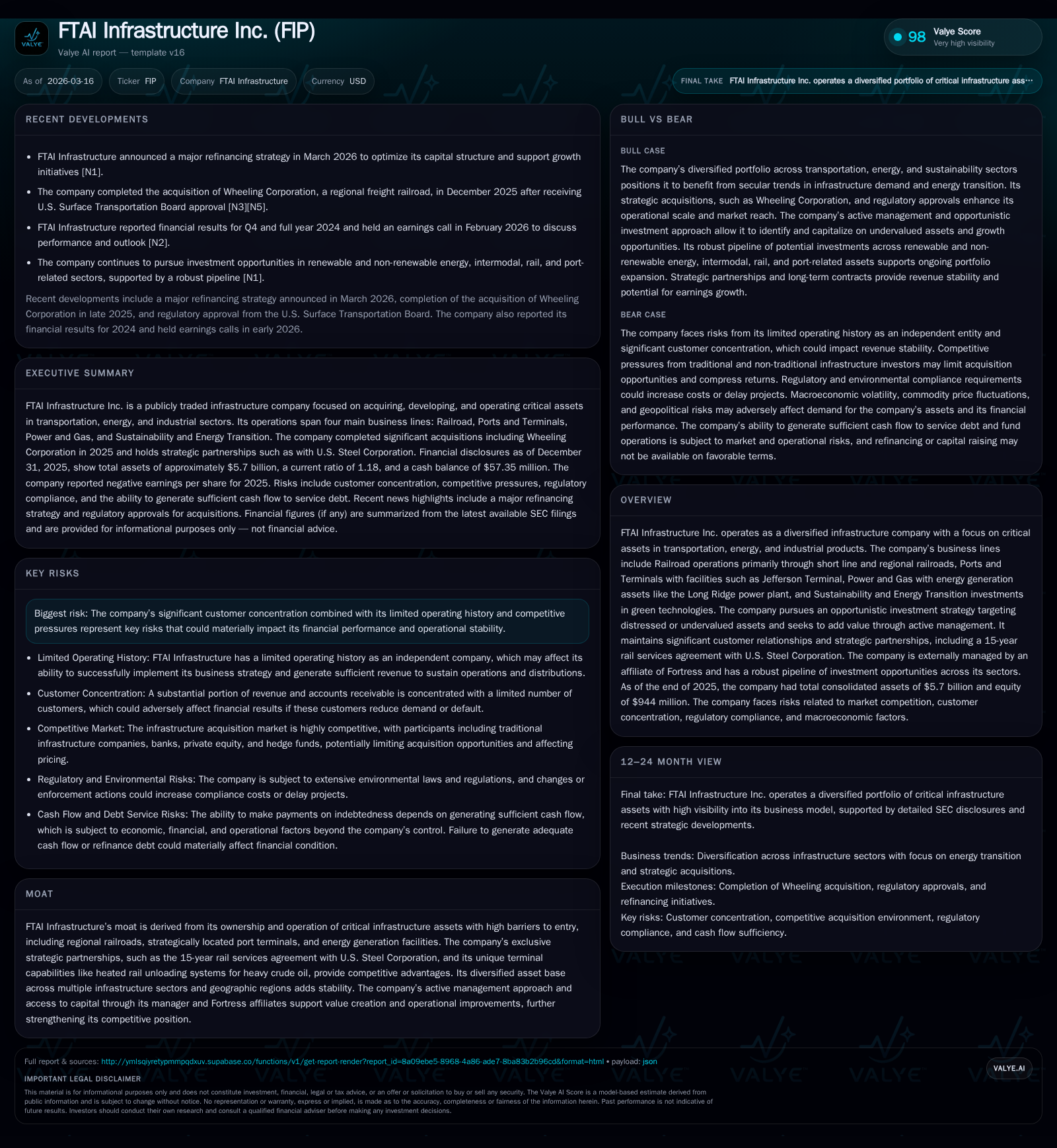
FTAI Infrastructure Inc. (FIP) is a diversified infrastructure owner/operator focusing on transportation, energy, and industrial assets acquired primarily through an opportunistic strategy targeting undervalued or distressed properties. Its large customer concentration, especially in railroad and terminal segments, combined with significant leverage and negative operating cash flows reflects challenges in sustainable profitability. The firm has experienced expanding capital expenditures as it reinvests to grow and reposition assets, while maintaining a conservative leverage target capped at 50% of total capital. Near-term refinancing efforts will be critical to liquidity management given substantial capex outlays and recurring negative cash flow. Operationally, the company's moat centres on strategic infrastructure ownership and long-term contracts but remains exposed to competitive pressures and economic cyclicality.
Business Overview
FTAI Infrastructure Inc. (FIP) is a diversified infrastructure investment company centered on acquiring, developing, and operating mission-critical assets across transportation, energy, industrial products sectors. Founded as a spin-off from FTAI Aviation Ltd., it trades publicly on Nasdaq. Its primary business lines encompass:
- Railroad Operations: Focused on North American short line and regional railroads.
- Ports and Terminals: Including Jefferson Terminal handling crude oil, refined products, clean fuels.
- Power and Gas: Operating energy generation assets such as the Long Ridge combined cycle gas power plant.
- Sustainability & Energy Transition: Investments in green technologies aimed at reducing carbon footprint.
As of the fiscal year ended December 31, 2025, Railroad contributed roughly one-third of revenues (34%), Power & Gas slightly more (36%), Ports & Terminals about one-fifth (19%), with remaining revenues from corporate and sustainability segments [S1][S4]. The company employs an opportunistic investment approach targeting distressed or undervalued assets where active management can unlock value [S10].
Historical Financial Performance
The company’s financial history since independence evidences significant volatility tied to its early-stage growth trajectory combined with elevated capital investments. According to recent SEC filings and XBRL data:
Historical performance (annual)
| FY | CFO ($mm) | Capex ($mm) |
|---|---|---|
| 2025 | -118 | 281 |
| 2024 | -15 | 80 |
| 2023 | 6 | 99 |
| 2022 | -43 | 217 |
Source: SEC companyfacts cache [F1].
Capital returns and efficiency (annual)
| FY | Div ($mm) | FCF ($mm) |
|---|---|---|
| 2025 | 14 | -399 |
| 2024 | 13 | -95 |
| 2023 | 12 | -94 |
| 2022 | 3 | -260 |
Source: SEC companyfacts cache [F1].
Operating cash flow has turned sharply negative in recent years after a brief positive phase in 2023. Capital expenditures have ballooned especially in the last two years as the company invests aggressively in existing assets and new development opportunities—capex tripled from about $79 million in 2024 to nearly $281 million in 2025 [F1]. This capex-driven spending overwhelms operating cash flow resulting in deeply negative free cash flow estimated at approximately −$399 million for 2025, underscoring substantial reinvestment demands.
Simultaneously equity has plummeted due to accumulated losses including a reported net loss of nearly $30 million mid-2022 (last available net income figure) alongside dilution effects or writedowns as suggested by falling book values from over half a billion dollars in equity at end-2022 down to a nominal figure at end-2025 [F1]. Dividends continue being paid but remain small relative to cash generation challenges.
Competitive Moat and Operational Advantages
FTAI Infrastructure’s competitive strengths stem primarily from ownership of critical infrastructure with high barriers to entry:
- Strategic railroads serving industrial customers with exclusive or long-term contracts, including a notable 15-year rail services agreement with U.S. Steel Corporation.
- Port terminals equipped with specialized handling capabilities such as heated unloading systems for heavy crude oil enhancing customer value proposition.
- Power generation facilities positioned advantageously within broader industrial sites enabling incremental value through integrated operations.
- Diversified asset portfolio dilutes sector-specific risks while providing cross-sector opportunity pipelines underpinned by Fortress-managed capital access.
This asset mix counters some operational concentration risks—both geographic and customer—although significant customer concentrations persist particularly within railroad (32% revenue from one customer in 2025) and terminal segments (10% from top Jefferson Terminal customer) noted repeatedly throughout filings [S4][S7]. However, management expresses confidence that replacement customers can be found without materially adverse impact given contractual terms and active marketing strategies.
Risks and Challenges
Several risk vectors are material for FTAI Infrastructure:
- Customer Concentration: Heavy dependence on few large customers creates vulnerability if demand fluctuates or relationships deteriorate leading to pricing pressure or volume declines.
- Financial Leverage & Liquidity: Although target leverage is conservatively capped at ~50%, current conditions reveal tight liquidity dynamics requiring ongoing refinancing efforts announced early 2026 which management indicates will be substantive [N2][S14]. High capex requirements exacerbate strain on free cash flow.
- Limited Operating History Post Spin-off: As an independent entity only since late 2021 with historical financials derived from parent reporting structures prior spin-off, execution risks persist regarding standalone operational scale-up.[S2]
- Competitive Pressure: Acquisition markets for infrastructure assets feature both traditional players like large infrastructure funds and non-traditional entrants such as hedge funds driving competition upward.[S14][S25]
- Regulatory Environment: Changes especially related to rail industry regulation (e.g., potential impacts of "Rail Shipper Fairness Act" proposals), environmental compliance costs including contamination remediation at port sites such as Long Ridge / Repauno facilities.[S16][S24]
- Cybersecurity Risks: Increasing cyber threats pose operational risks potentially disruptive to information systems underpinning day-to-day activities.[S6][S7]
Future Growth Prospects & Strategic Outlook
FTAI Infrastructure’s future growth trajectory relies heavily on several factors documented explicitly by management:
- Continued investment across core sectors with emphasis on acquiring undervalued/distressed assets offering potential for yield improvement via active operational management.[S10]
- Development of existing property upgrades such as expanded capacity at ports or redevelopments into hubs like Long Ridge for industrial/energy production utilization.[S11][S26]
- Expansion within Sustainability & Energy Transition businesses aligned with increasing market demand for green technologies supportive of decarbonization trends.[S8]
- Leveraging Fortress affiliate's pipeline for deal sourcing plus flexible capital structures.[N2]
Nonetheless, growth may be capped by debt covenant limitations restricting new financings or distributions,[S9][S14], competitive pressure on acquisitions prices compressing yield opportunities,[S25], regulatory headwinds raising compliance costs,[S24], or execution issues integrating new acquisitions especially following larger deals such as the Wheeling acquisition described.[S17]
Capital Allocation & Returns Profile
From reported financial data:
- Negative operating cash flows combined with massive capex spend drive pronounced negative free cash flow (-$399 million in FY25), indicating heavy reinvestment outweighing internal funding capacity[F1].
- Despite these strains dividends are maintained around ~$13 million annually suggesting measured shareholder returns though coverage appears weak based on cash generation[F1].
- Equity base significantly shrunk signaling erosion of net asset value likely due to accounting adjustments coupled with operating losses[F1].
- No explicit return on equity metrics stated but calculated ROE approximates −138% indicating deep losses relative to equity[F1].
Management targets corporate leverage below ~50% total capital with substantial governance controls through restrictive covenants preventing excess indebtedness or dividend payouts outside defined parameters[S9][S21]. The interplay between aggressive growth reinvestment needs versus financial discipline will shape capital allocation going forward.
Forecasts & Near-Term Milestones To Watch — Analysis Perspective
The company has not issued detailed numeric guidance publicly but upcoming focal points include:
- Execution of the announced refinancing strategy expected to improve liquidity flexibility[N2][S23].
- Progression on expansion/redevelopment projects notably at key terminals or Long Ridge power site increasingly important for capacity buildout[S11][S26].
- Customer contract renewals amid large individual customer concentration testing revenue stability[S4][S7].
- Integration outcomes around acquisitions such as Wheeling Rail segments assessing cost synergies/SARBOX compliance impact[S17].
- Monitoring regulatory developments particularly federal rail pricing legislation which could affect profitability[S24].
Continuous review of quarterly reports will be essential for monitoring changes in cash flows, capex pacing, debt levels and segment revenues which together drive valuation multiples used by infrastructure investors worldwide.
Sector Context — Analysis Detail
Infrastructure asset owners like FTAI Infrastructure operate within capital intensive ecosystems where stable yet growing revenue streams are prized alongside high barriers limiting competition. Diversification across transport (railroads/ports), energy generation/fuels transition positions firms well against commodity cyclicality but requires careful balancing act managing capital deployment versus returns amidst evolving regulation particularly around emissions targets plus increasing shareholder activism advocating transparent ESG alignment strategies.
Competition has intensified given the emergence of myriad investor types flooding infrastructure markets globally seeking yield amid low interest rate environments pushing acquisition prices higher thus compressing initial returns but promising longer term inflation-linked rent escalators supporting asset appreciation potential.
Conclusion
FTAI Infrastructure represents an ambitious platform blending multiple infrastructure verticals underpinned by long duration contracts and strategic asset positioning secured by Fortress-backed management expertise. However, acute challenges remain evident stemming from elevated capex requirements fueling negative free cash flow amid modest equity capitalization eroding returns metrics significantly below parity. Material client revenue concentrations pose downside risk if disruption occurs while ongoing refinancing efforts highlight liquidity is under active management scrutiny heading into the near term.
Investors should watch carefully for signs of operational stabilization particularly improved free cash flow dynamics complemented by progress deploying new capital projects within sustainability initiatives that could reframe growth prospects sustainably. Regulatory developments around railroad tariffs alongside geopolitical macro risks affecting commodity markets also merit attention given their outsized influence on key revenue drivers within relevant segments.
This analysis summarizes public filings, SEC materials, earnings call transcripts, and market news up to March 16th, 2026 without furnishing investment advice or recommendations governed under Valye News editorial policy.
Disclaimer: This is research-only, informational analysis and not investment advice. It may include AI-generated interpretation and general industry context. Always verify important details using primary sources.

Comments