
Lifecore Biomedical’s Long-Term Manufacturing Contracts Support Revenue Growth Amid Persistent Losses
Stable, decade-long ophthalmic manufacturing agreements underpin revenue gains despite ongoing net losses and operational challenges.
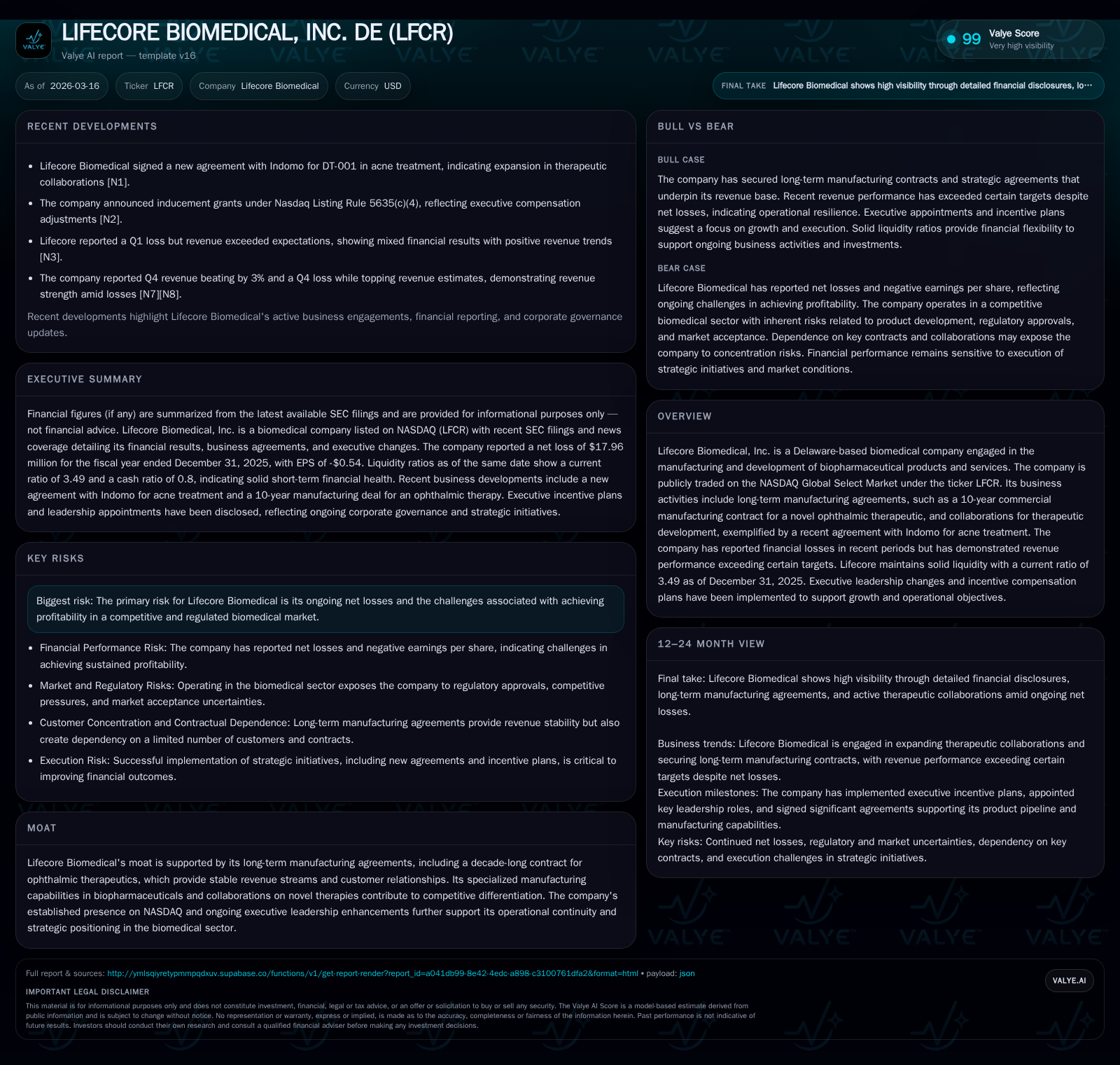
Lifecore Biomedical, Inc. operates in the biopharmaceutical manufacturing sector with a specialty in ophthalmic therapeutics and emerging acne treatments. The company’s revenue has grown modestly over recent years, driven by long-term contracts including a pivotal 10-year manufacturing agreement for a novel ophthalmic product. Despite strengthening revenue, Lifecore continues to report net losses and faces the challenge of transitioning to profitability within a competitive and highly regulated industry. The company's liquidity remains strong, supported by a high current ratio and positive cash flow from operations in its latest fiscal period. Key growth prospects lie in expanding therapeutic collaborations and leveraging manufacturing expertise, balanced against risks from net losses and regulatory pressures.
Company Overview
Lifecore Biomedical, Inc., incorporated in Delaware and listed on NASDAQ under LFCR, specializes in manufacturing biopharmaceutical products primarily focused on ophthalmic therapeutics. The company maintains long-term manufacturing contracts that provide predictable revenue streams while expanding into new therapeutic areas.
A recent agreement with Indomo for DT-001 targets acne treatment development, signaling efforts to diversify beyond ophthalmology [N1]. These collaborations leverage Lifecore’s specialized manufacturing capabilities to address emerging market demands.
Historical Financial Performance
Lifecore's revenues have shown recovery following earlier declines during restructuring phases in the early 2020s. Revenue increased from $141 million in FY2018 to $152.8 million by FY2019 and remained stable through FY2025 with an approximate 8.3% year-over-year increase reflecting contract fulfillment and potential volumetric growth under existing agreements [F1].
Historical performance (annual)
| FY | Net ($mm) | CFO ($mm) | OpInc ($mm) | Capex ($mm) | Net YoY |
|---|---|---|---|---|---|
| 2025 | -18 | 7 | -1 | 4 | -249.5% |
| 2024 | 12 | 0 | -9 | +112.1% | |
| 2023 | -100 | -17 | -22 | +13.2% | |
| 2022 | -115 | -24 | -59 | 26 |
Source: SEC companyfacts cache [F1].
Capital returns and efficiency (annual)
| FY | FCF ($mm) | ROE% |
|---|---|---|
| 2025 | 4 | 126.5 |
| 2024 | 106.2 | |
| 2023 | 2353.7 | |
| 2022 | -51 | -126.4 |
Source: SEC companyfacts cache [F1].
Operating losses have narrowed significantly from nearly $59 million negative in FY2022 to just below breakeven (-$0.7 million) in FY2025, highlighting operational leverage despite an increased net loss attributed partly to one-time or investment-related factors [F1].
Cash flow from operations improved markedly into positive territory at $7.33 million in FY2025 during reduced capital expenditures compared to prior peak investment years.
Drivers of Past Growth
Key growth drivers include Lifecore's decade-long commercial manufacturing contracts for ophthalmic therapeutics that provide steady revenue visibility . Operational efficiencies supported by incentive compensation plans aligned with financial performance targets have also contributed to reducing operating losses [S7][S8]. The company’s transition to calendar-year reporting enhances transparency for investors.
Future Growth Prospects
Growth prospects focus on:
- Contract Manufacturing Expansion: Sustained demand for specialized ophthalmic drug production supports order backlogs.
- Pipeline Collaborations: The Indomo partnership on acne therapy development marks diversification into dermatological treatments that may generate higher-margin opportunities depending on clinical success [N1][S3].
Challenges include regulatory approval timelines, pricing pressures from pharmaceutical clients seeking cost-effective outsourcing options, and competition among contract manufacturers emphasizing scale advantages.
Forecasts and Milestones to Watch
While explicit guidance is unavailable, key indicators include:
- Quarterly revenue trends under long-term contracts.
- Progress updates on new therapeutic collaborations impacting future revenues.
- Achievement of Adjusted EBITDA targets linked to executive incentives during CY2025 transition and calendar year 2026 plans [S7][S23].
- Management commentary on margin improvement initiatives and capital expenditure plans.
Returns and Capital Allocation
Returns remain constrained by recurring net losses despite an approximate ROE above 100%, which reflects negative equity due to cumulative losses rather than true profitability [F1].
The balance sheet shows $17.47 million in cash & equivalents as of December 31, 2025, paired with a current ratio of approximately 3.49 indicating strong liquidity [F1][S13][S18].
Capital allocation prioritizes operational funding and growth investments without dividends or share repurchases currently, consistent with industry norms during development phases [S5][S6][S9].
Risks Considerations
Continued net losses present valuation challenges; regulatory compliance demands can delay product commercialization increasing costs [S2][S4]. Competition intensifies among contract manufacturers where scale and technological innovation drive margins.
Leadership changes coupled with incentive plan adjustments reflect governance efforts aimed at improving performance amid industry headwinds [S8][S23].
Sector Context (Analysis)
Contract manufacturing organizations like Lifecore play critical roles as pharmaceutical companies outsource biologics production requiring specialized compliance standards—a niche where Lifecore’s decade-spanning agreements provide competitive advantage.
Diversification into dermatology aligns with broader CMO industry trends responding to evolving therapeutic demands.
Conclusion
Lifecore Biomedical balances stable contractual revenues against ongoing investments needed for profitable scale-up amid competitive pressures. Its strong liquidity supports near-term operations while strategic partnerships expand pipeline breadth. Monitoring quarterly earnings alongside milestones from new collaborations will be essential to assess progress toward sustainable profitability beyond reported net losses. This case illustrates how consistent manufacturing capacity under long-duration contracts can provide foundational stability amidst volatile biomedical innovation cycles.
This analysis is based solely on disclosed filings and verified sources without forward-looking projections or investment recommendations.
Disclaimer: This is research-only, informational analysis and not investment advice. It may include AI-generated interpretation and general industry context. Always verify important details using primary sources.

Comments