
IHS Holding Ltd’s Recovery from Losses and Capital Structure Amid Emerging Markets Risks
IHS Holding Ltd displayed a return to positive net income in 2025 following multi-year losses, supported by steady telecom tower leasing revenue and a complex debt profile.
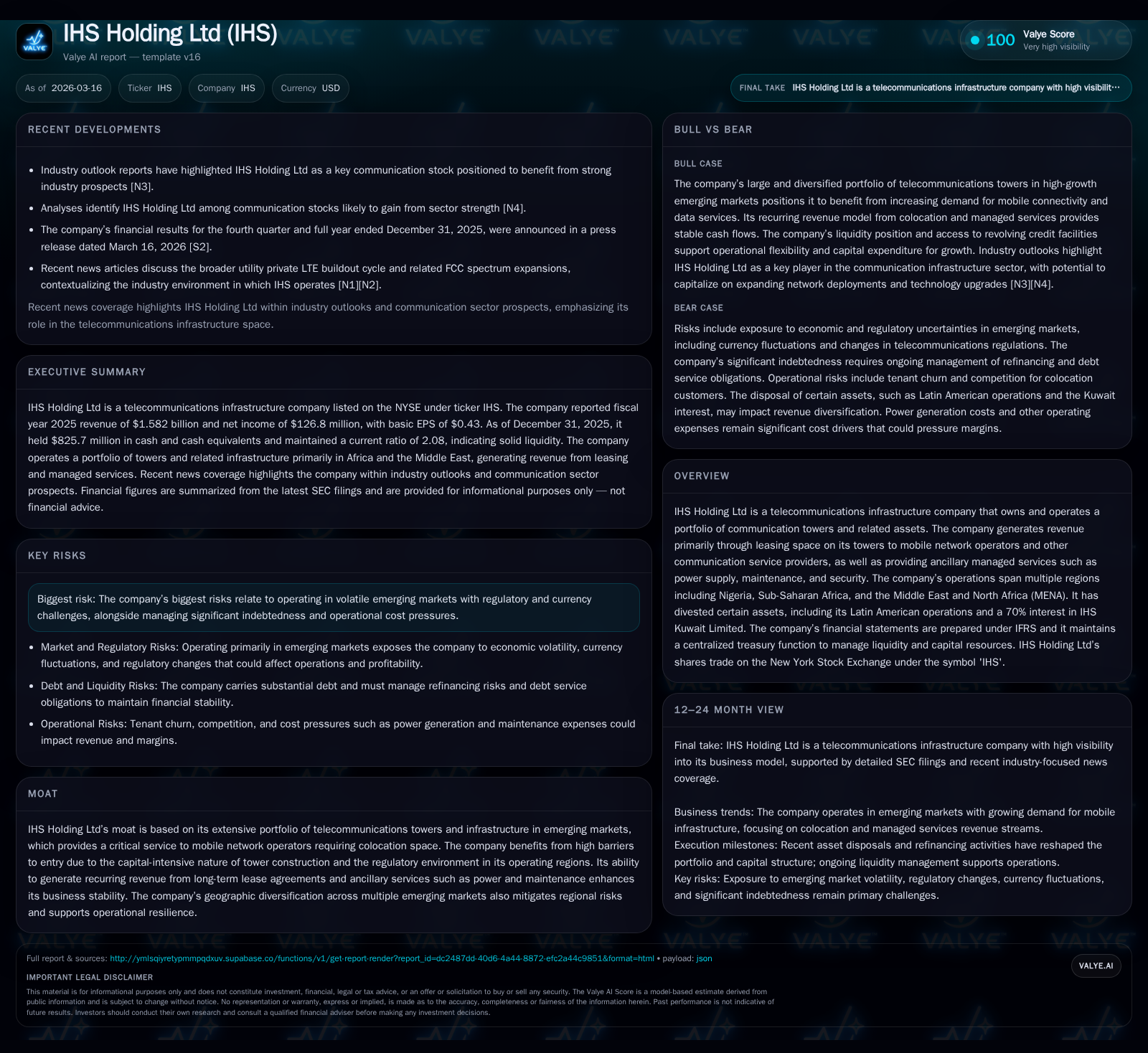
IHS Holding Ltd operates a broad portfolio of telecommunications towers across emerging markets including Nigeria and MENA, deriving recurring revenue mainly from long-term leases to mobile operators. After consecutive net losses between 2022 and 2024, the company reported a net income of $127 million in 2025 on $1.58 billion revenue, despite a 7.6% revenue decline year-over-year. The capital structure remains leveraged with extensive debt facilities across currencies and regions, while liquidity levels are robust. Strategic asset divestitures and geographic diversification underpin its competitive moat, although exposure to volatile emerging market regulatory and currency environments poses ongoing risks.
Company Overview
IHS Holding Ltd specializes in telecommunications infrastructure with an extensive portfolio of communication towers leased primarily to mobile network operators across emerging regions such as Nigeria, Sub-Saharan Africa, and the Middle East and North Africa (MENA) [S1]. The company's business model leverages high barriers to entry through capital-intensive tower construction coupled with regulatory complexity that protects incumbents like IHS. It supplements core leasing revenues with ancillary managed services including power supply, maintenance, and security for more stable cash streams.
The firm has strategically divested non-core operations such as its Latin America footprint and a majority interest in IHS Kuwait Limited to concentrate resources geographically [N4]. Its shares trade on the NYSE under ticker "IHS" [S1].
Historical Financial Performance
IHS reported annual revenues peaking at approximately $2.13 billion in 2023 before declining to $1.71 billion in 2024 and further to $1.58 billion in 2025 [F1]. This descending top-line trend aligns with asset sales and portfolio refinement efforts documented in filings [S1].
Net income trajectory marks a turnaround after multi-year losses: from -$470 million in 2022 to worsening -$1.99 billion in 2023 driven by impairments or restructuring charges, improving to -$1.64 billion loss in 2024 before posting positive net income of $127 million in 2025 [F1]. This rebound underscores operational stabilization but also reflects one-time adjustments impacting prior years.
Equity has remained negative since significant impairment-driven losses starting FY2023; equity position stood at -$89.8 million at December 31, 2025 [F1]. The negative book value emphasizes challenges faced historically but is partly mitigated by consistent cash flow generation capacity supported by the recurring nature of tower leases.
Historical performance (annual)
| FY | Rev ($bn) | Net ($mm) | Rev YoY | Net YoY |
|---|---|---|---|---|
| 2025 | 1.6 | 127 | -7.6% | +107.7% |
| 2024 | 1.7 | -1644 | -19.5% | +17.3% |
| 2023 | 2.1 | -1988 | +8.4% | -322.7% |
| 2022 | 2.0 | -470 |
Source: SEC companyfacts cache [F1].
Capital returns and efficiency (annual)
| FY | ROE% |
|---|---|
| 2025 | -141.2 |
| 2024 | 555.8 |
| 2023 | -572.4 |
| 2022 | -34.6 |
Source: SEC companyfacts cache [F1].
Revenue declines reflect divestitures while net income volatility relates primarily to impairment charges and restructuring expenses rather than core operations [S1]. The company's key performance indicators include revenue growth and Adjusted EBITDA margins monitored internally though these exclude certain non-cash or exceptional items [S1].
Growth Prospects
Growth opportunities lie primarily in increasing colocation rates on existing towers as mobile data demand rises across emerging markets [N4]. Ancillary services such as power provision enhance revenue streams while geographic diversification across Nigeria and Sub-Saharan Africa reduces single-market risk but introduces regulatory and currency complexities typical of these regions [N4].
Recent divestments of Latin American assets signal strategic focus sharpening towards core markets with higher growth potential [N4]. Additionally, the merger agreement announced February 17, 2026 with MTN Group Limited could materially alter scale and operational reach subject to closing conditions [S3].
Forecasts & Key Milestones
No explicit forward guidance or financial forecasts have been formally disclosed beyond annual filings as of March 16, 2026 [S2]. Investors should track developments related to the MTN merger agreement for potential impact on scale economies and capital structure [S3]. Operational focus remains on optimizing tower utilization rates while managing inflationary pressures on operating costs.
Capital Structure & Liquidity
As of December 31, 2025, IHS Holding reported total liquidity resources approximating $1.23 billion composed of about $853 million cash & equivalents alongside revolving credit facilities totaling roughly $374 million available globally [S4] [F1]. This liquidity supports near-term obligations including organic capital expenditure needs.
The company's capital structure remains leveraged due to previous acquisitions and infrastructure investments:
- Term loans include a $200 million loan maturing December 2027 with interest rates linked to Term SOFR plus margins escalating up to approximately 7.5% annually [S5], a dual-tranche term loan of approximately $439 million maturing October 2029 split between U.S. dollar and South African rand tranches each bearing respective floating rates plus margins around mid-4% range [S6], [S8],
- Revolving credit facilities denominated in USD ($300 million facility terminated June 2025 replaced by a similar sized facility available through September 2028), Nigerian naira (NGN100 billion facility expiring March 2029), among others provide liquidity buffers though no outstanding draws were reported under some facilities as of March 13, 2026 [S7], [S9],
- Senior notes outstanding include approximately $700 million maturing between 2026–28 along with longer-dated notes totaling over $1 billion maturing circa 2030–31 at coupon rates near high-7% or low-8% levels [S16],
- Facilities also exist denominated in Brazilian real (BRL), euro (EUR), CFA franc (XOF) enhancing financing flexibility but adding currency risk considerations [S10]–[S12].
Financial covenants typically require maintaining interest coverage ratios (EBITDA/interest expense) and leverage ratios (net debt/EBITDA), monitored quarterly without reported breaches as per latest filings [S14], [S21].
Capital Allocation & Returns Profile
No dividends were declared or paid during fiscal year ended December 31, 2025 reflecting prudent cash management prioritizing debt servicing amid recovery from historic losses [S13], [S22]. No share repurchases were conducted according to disclosures.
Return on equity calculated from latest annual net income over negative equity base is negative (-141%) illustrating accounting distortions from prior impairments despite recent profitability [F1]. Explicit ROE targets or dividend policies remain undisclosed.
Risk Considerations
Operating predominantly in emerging markets exposes IHS Holding to heightened regulatory uncertainty affecting tariffs or site approvals; currency volatility impacting dollarized debt servicing costs; inflationary pressures elevating operational expenditures; alongside refinancing risks related to substantial indebtedness amid evolving macroeconomic conditions [N4], [S4]–[S29].
Maintaining service uptime amid infrastructure constraints and adapting to evolving cellular technologies requiring incremental investment remain operational challenges.
Conclusion & What To Watch (Analysis)
IHS Holding Ltd's return to profitability after several challenging years highlights resilience rooted in its critical telecom infrastructure footprint serving expanding mobile networks across key emerging markets. However, top-line contraction linked chiefly to strategic divestitures advises caution on sustainable growth absent organic expansion or acquisitions.
The complex capital structure featuring multi-currency liabilities necessitates vigilant liquidity management; current cash balances plus revolvers provide near-term financial cushioning.
Key investor catalysts include progress toward closing the MTN merger agreement which could reshape scale economics significantly.
Monitoring should focus on:
- Trends in colocation rates indicating mobile operator adoption,
- Regulatory developments especially within Nigeria,
- Currency fluctuations affecting financial results,
- Debt maturity execution including refinancing prospects,
- Potential shifts toward shareholder returns amid improving earnings.
This report is based solely on publicly available filings and news sources as referenced without any predictive assertions regarding stock performance or investment recommendations.
Disclaimer: This is research-only, informational analysis and not investment advice. It may include AI-generated interpretation and general industry context. Always verify important details using primary sources.

Comments