
FVCBankcorp's 2025 Growth Supported by Loan Portfolio Expansion and Solid Capital Management
FVCBankcorp leverages regional market strength and diversified lending to drive profitability improvements and maintain capital adequacy.
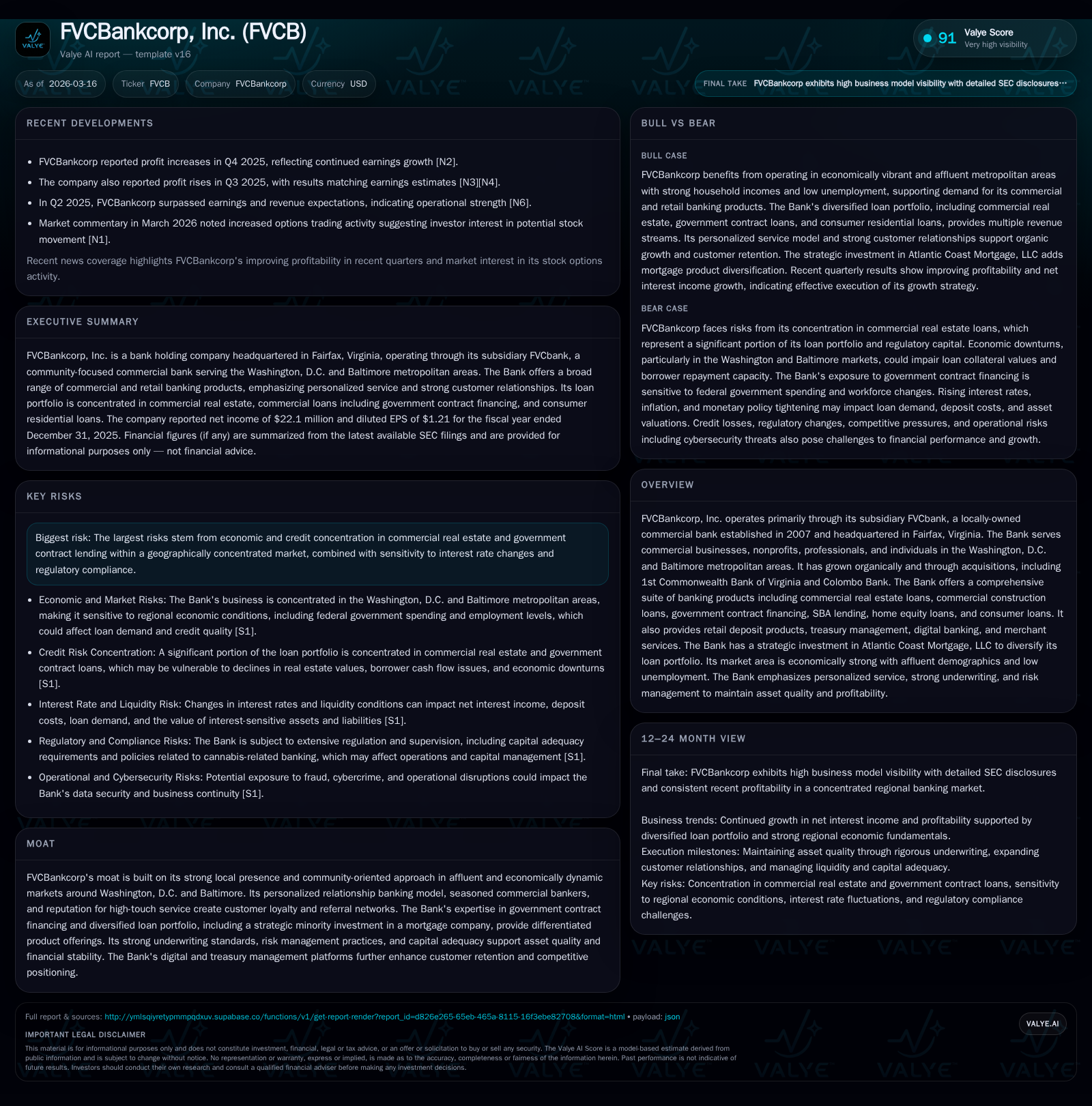
FVCBankcorp, Inc., a community-centric bank serving Washington D.C. and Baltimore regions, has demonstrated steady growth through organic expansion and strategic acquisitions. In 2025, the company increased net income by 46% year-over-year, driven primarily by loan portfolio growth and higher net interest income. The bank maintains strong capital ratios well above regulatory minimums and has improved liquidity via deposit growth, while carefully managing credit risk and interest rate sensitivity inherent in its commercial real estate and government contract loans. Future prospects hinge on continued regional economic resilience, effective risk management, and loan diversification strategies including mortgage investments.
Company Overview
FVCBankcorp, Inc. operates through its wholly owned subsidiary FVCbank, a locally focused commercial bank founded in 2007 with headquarters in Fairfax County, Virginia. The bank strategically serves affluent and economically robust metropolitan areas surrounding Washington, D.C., and Baltimore. Its client base comprises small- to medium-sized businesses—including government contractors—nonprofits, professionals, as well as retail consumers.
Growth has historically been a blend of organic expansion via branch openings and customer acquisition alongside two significant acquisitions: 1st Commonwealth Bank of Virginia (2012) and Colombo Bank (2018). These moves broadened geographic reach into high-income Virginia counties like Arlington and Fairfax as well as Maryland suburbs.
Historical Performance Drivers
Financially, FVCBankcorp’s performance is anchored predominantly in net interest income derived from its loan portfolio complemented by noninterest revenue streams such as service fees, merchant services, insurance commissions, gains on investment securities sales, and income from its equity stake in Atlantic Coast Mortgage LLC (ACM).
Historical performance (annual)
| FY | Net ($mm) | CFO ($mm) | Capex ($) | Net YoY |
|---|---|---|---|---|
| 2025 | 22 | 24 | 47000 | +46.4% |
| 2024 | 15 | 18 | 141000 | +294.1% |
| 2023 | 4 | 16 | 212000 | -84.7% |
| 2022 | 25 | 22 | 166000 |
Source: SEC companyfacts cache [F1].
Capital returns and efficiency (annual)
| FY | Buybacks ($mm) | FCF ($mm) | ROE% |
|---|---|---|---|
| 2025 | 7 | 24 | 8.7 |
| 2024 | 0 | 18 | 6.4 |
| 2023 | 1 | 16 | 1.8 |
| 2022 | 1 | 22 | 12.3 |
Source: SEC companyfacts cache [F1].
Net income showcased substantial improvement over three years culminating in a strong gain in 2025 with over $22 million earned [F1]. Operating cash flow trends align with profitability improvements while capital expenditures remain modest relative to size.
The increase in net income is primarily attributed to expanding average earning assets—particularly loans—and efficient interest rate risk management by the Asset and Liability Committee maintaining stable net interest margins [S1].
Loan Portfolio Growth & Composition
Loans receivable increased approximately $71 million (4%) to nearly $1.94 billion at year-end 2025 [S18]. Commercial real estate remains the largest single component (~53%), though the mix within CRE shifted:
- Owner-occupied CRE rose sharply to $266 million compared with prior year levels,
- Non-owner-occupied CRE declined moderately,
- Commercial construction loans decreased marginally [S18][S19].
Notably, commercial & industrial (C&I) loans jumped over one-third year-over-year to $453 million from $337 million previously—a growth driven by higher loan originations coupled with increased warehouse lending activity supporting ACM's mortgage business extension [S19][S12].
Consumer residential loans contracted by about $28 million due mainly to repayments rather than reduced demand.
Loan maturities are well staggered across short- (<1 year), medium-, and long-term buckets with approximately half of loans repricing annually or sooner which helps manage interest rate exposure effectively [S19].
Deposit Base and Liquidity Position
Deposits grew by roughly $127 million or around +7%, reaching an estimated $2 billion by December-end of ’25 [S18]. This deposit buildup underpins funding stability essential for ongoing lending expansion.
However, nearly half of these deposits (~45%) are uninsured beyond FDIC limits—primarily reflecting large corporate or high-net-worth client balances—posing liquidity considerations should confidence falter under stress scenarios [S20]. Despite this concentration risk, FVCBankcorp mitigates potential cash flow interruptions through access to:
- Wholesale funding channels including brokered certificates of deposit,
- Secured credit lines with FHLB ($464 million available) and discount window borrowings from FRB ($257 million available),
- Membership in the IntraFi Network allowing deposit redistribution for FDIC insurance maximization [S4][S5][S8][S20].
Liquid assets comprising cash equivalents plus investment securities totaled roughly $281 million or about 12% of total assets at end ’25 providing a liquid buffer [S4]. Investment securities held are mostly U.S. government-backed or municipal bonds qualifying as both liquidity reserves and collateral for public deposits.
Capital Adequacy & Returns
Shareholders’ equity climbed over $18 million during the year ending at $253.6 million at December ’25 up from $235 million prior year-end [F1]. Tangible common equity stood near $246 million after adjusting for goodwill/intangibles.
Capital ratios provide a solid cushion against regulatory requirements:
- Total risk-based capital ratio at 15.38%,
- Tier 1 risk-based capital ratio at approximately 14.37%,
- Common Equity Tier 1 ratio above minimums at roughly the same level,
- Leverage ratio exceeding mandated levels near approximately 12.23%—all demonstrating prudent capital management relative to risk-weighted asset growth [S22].
The company initiated share repurchases totaling approximately $6.7 million during ’25 after no buybacks in ’24 indicating renewed confidence in capital deployment amid earnings improvement [F1]. Return on equity is roughly estimated near 8.7% based on net income over average equity—a notable improvement consistent with rising profitability.
Asset Quality & Credit Risk Management
Nonperforming loans (NPLs) decreased modestly to about $10.7 million from nearly $13 million the prior year; the NPL ratio was a moderate 0.47% of total assets compared with prior years’ levels suggesting stable credit trends despite macroeconomic uncertainties [S13].
Management emphasizes rigorous underwriting policies particularly within concentrated real estate lending segments where exposure is closely monitored via loan-to-value caps (~80%), debt service coverage ratios (>1.2x), collateral analyses, and personal guarantees when appropriate.
Special mention rated loans increased substantially to nearly $48 million indicating heightened monitoring on borderline credits but not necessarily expected losses—a prudent precaution given sector sensitivities [S13].
Allowance for credit losses uses peer data calibrated models due to limited internal historical losses since inception emphasizing conservative loss provisioning frameworks aligned with regulatory guidance ASC326 [S1].
Business Model & Competitive Moat
FVCBankcorp’s advantage stems largely from its entrenched local presence centered on personalized banking relationships within affluent metro markets exhibiting strong income profiles and educated workforce demographics supportive of business growth dynamics. Its specialized expertise financing government contractors coupled with product diversification into SBA lending, construction financing, treasury services, digital banking innovations and merchant processing reinforce differentiated offerings. The strategic minority investment in ACM enhances diversification helping mitigate concentration risks inherent in commercial real estate dominance while tapping into residential mortgage demand via purchase pipelines [N2][S12]. The integration of technology platforms alongside high-touch service aligns with sector trends aiming to blend digital efficiency without sacrificing relationship depth.
Outlook & Growth Prospects
Looking forward beyond fiscal '25 results:
- Continued economic strength within the Washington-Baltimore corridor provides tailwinds for loan demand across diverse sectors.
- Expansion opportunities may arise from leveraging ACM partnerships further into residential markets complementing core C&I growth plans.
- Monitoring for potential credit headwinds linked to CRE concentration or government spending adjustments will remain critical given geographic/climate risks.
- Interest rate variability presents both risks (funding cost increases potentially compressing net interest margins) as well as opportunities if asset repricing outpaces liabilities.
- Deposit gathering efforts maintaining core stability amid growing uninsured balances will be vital for liquidity resilience. Key milestones include quarterly loan origination pace variability, asset quality metrics evolution particularly stressed credits, capital usage decisions including dividends/buybacks policies adjustments aligned with regulator relations.
Conclusion
FVCBankcorp exhibits financial health characterized by solid profitability enhancement driven through measured balance sheet growth supported by disciplined credit oversight within strategically targeted markets exhibiting favorable economic fundamentals. The company's proactive liquidity management combined with robust capitalization positions it well amidst competitive regional banking environments where relationship banking sustains high customer loyalty rates critical for future organic growth trajectory bolstered by ancillary businesses such as mortgage investments. Risks remain notably tied to economic shocks impacting commercial real estate valuations or shifts in federal contract spending but balanced against diversified product offerings allowing adaptive response capabilities evident across recent reporting periods. Overall transparency observed through consistent financial disclosures corroborates an institution focused on sustainable expansion paired with prudent risk controls underpinned by experienced management governance frameworks.
This analysis synthesizes publicly available information including FVCBankcorp’s SEC filings as of March '26 without speculation or forward-looking predictions beyond stated company disclosures or verifiable facts.
Disclaimer: This is research-only, informational analysis and not investment advice. It may include AI-generated interpretation and general industry context. Always verify important details using primary sources.

Comments