
Stoneridge Inc’s Shift to Smart Electronics and Its Impact on Profitability
Stoneridge’s strategic divestiture of its Control Devices segment heralds a focused pivot to embedded electronics amid persistent profitability challenges.
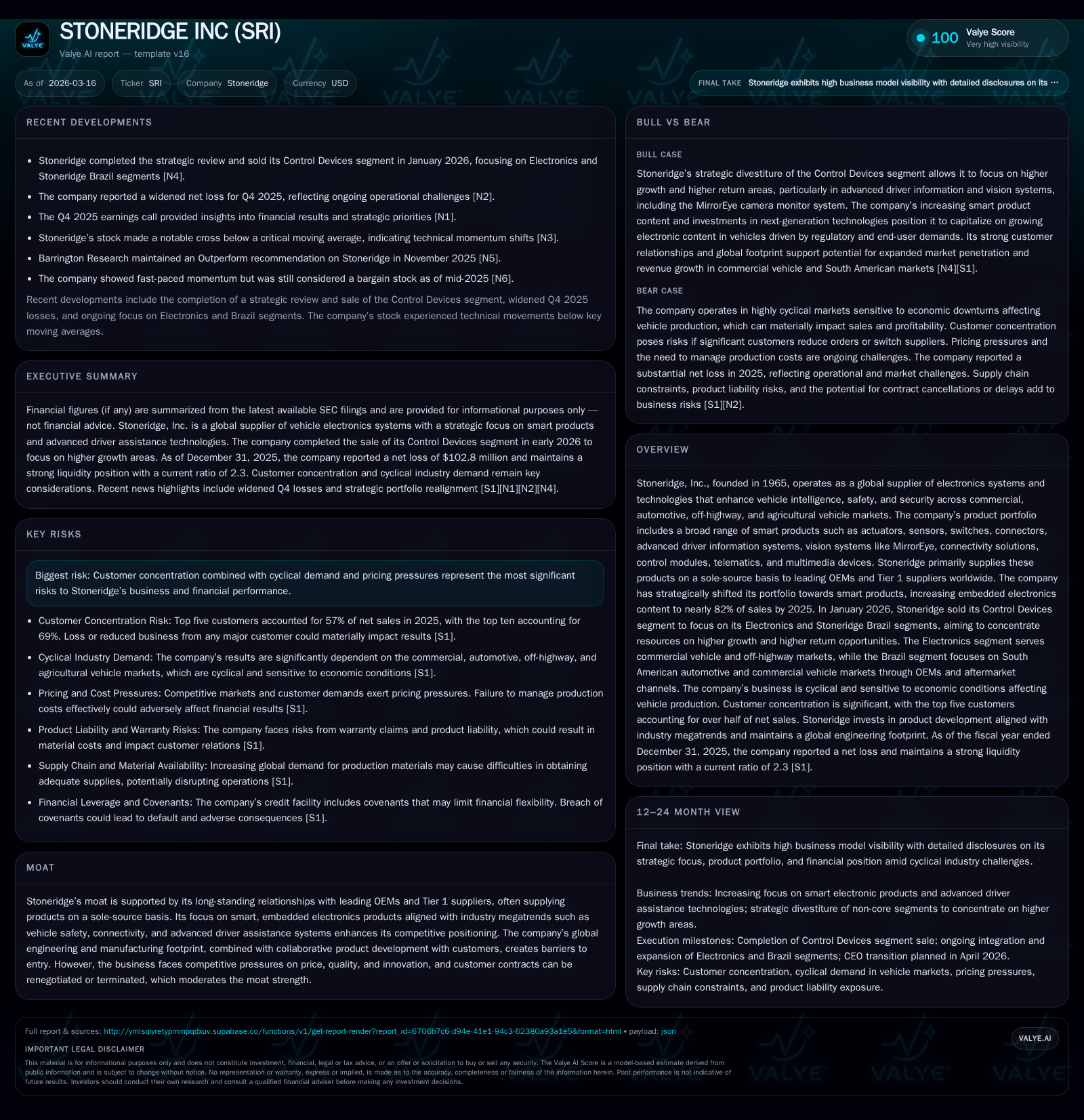
Stoneridge, historically anchored by traditional control devices, has accelerated its transition toward smart, embedded electronics products constituting nearly 82% of sales by 2025. Despite this strategic refocus and the January 2026 divestiture of its Control Devices segment, the company recorded a significant operating loss of $38.6 million in 2025, reflecting intense pricing pressures and cyclical demand volatility in commercial vehicle markets. The high customer concentration and contract renewal uncertainties further complicate revenue visibility. While operating cash flow remains positive, limited free cash flow and leveraged balance sheet dynamics constrain capital allocation flexibility. Key metrics to monitor include the growth trajectory of its Electronics and Stoneridge Brazil segments and the execution of next-generation embedded product programs.
Revenue Growth and Shifts in Product Mix: A Look Back to 2025
Stoneridge’s trajectory over the past decade reveals a deliberate transformation from traditional vehicle control devices towards advanced embedded electronics aligned with megatrends such as vehicle safety and connectivity. From a revenue base of approximately $644.8 million in fiscal year (FY) 2015 ([F1]), top-line advanced to $824.4 million by FY2017, representing an annualized increase driven by expansion into smarter products that integrate embedded logic or electronics components.
This strategic shift is underscored by the rise in the proportion of "smart products" within total sales—from just over 50% in 2014 up to nearly 82% by the end of 2025 ([S1][S24]). These smart products encompass key electronic systems including actuators, sensors, advanced driver information systems, vision systems like MirrorEye®, connectivity modules, telematics, and multimedia devices designed primarily for global commercial and automotive OEMs on a sole-source basis ([S17]).
Despite this growth in higher-technology content, financial performance showed signs of strain. Operating income declined from modest positive levels in prior years—$12.8 million in FY2023—to a substantial operating loss of $38.6 million in FY2025 ([F1]). The worsening margin profile reflects intensifying pricing pressure from OEM customers seeking cost reductions amidst competitive industry dynamics ([S4],[S8]) and cyclical downturn effects impacting vehicle production volumes, particularly in commercial vehicle markets that constituted about half of net sales as of 2025 ([S5]).
Historical performance (annual)
| FY | Net ($mm) | CFO ($mm) | OpInc ($mm) | Net YoY |
|---|---|---|---|---|
| 2025 | -103 | 34 | -39 | -522.3% |
| 2024 | -17 | 48 | 0 | -218.8% |
| 2023 | -5 | 5 | 13 | |
| 2022 | 7 | 3 |
Source: SEC companyfacts cache [F1].
Capital returns and efficiency (annual)
| FY | ROE% |
|---|---|
| 2025 | -57.2 |
| 2024 | -6.7 |
| 2023 | -1.8 |
| 2022 |
Source: SEC companyfacts cache [F1].
Note: YoY calculated where data available; operating income YoY shows sharp reversal reflecting market headwinds.
Emerging Market Dynamics and the Sale of Control Devices Segment
In January 2026, Stoneridge completed the sale of its Control Devices segment—its legacy business focused on actuators, sensors, switches and connectors primarily serving the automotive market—marking a pivotal step toward portfolio concentration ([N2][S24]). This unit included traditional electromechanical components used across powertrain management, safety systems, climate control and more.
The divestiture enables Stoneridge to reallocate resources exclusively toward two remaining segments: Electronics and Stoneridge Brazil ([S12]). The Electronics segment centers on advanced driver information solutions, vision technologies such as MirrorEye camera monitor systems, connectivity modules and compliance products targeted at OEMs with contracts spanning model lifecycles lasting three to seven years ([S17],[S24]).
Meanwhile, Stoneridge Brazil provides telematics solutions, vehicle security alarms and multimedia devices primarily for South American automotive and commercial vehicle markets via a blend of OEM direct sales and aftermarket channels ([S5],[S24]). This localized footprint paired with broader global engineering capabilities supports scaling embedded electronics penetration aligned with regional OEM needs.
The strategic realignment toward technology-driven segments aims at capturing growing demand for connected vehicle systems amid evolving regulatory safety mandates and consumer expectations for convenience features.
Analyzing Profitability Challenges and Operating Loss Drivers
Stoneridge’s widening losses stem from several interrelated factors captured during their Q4/FY2025 earnings call: cyclical softness in core commercial vehicle production volumes weighing on sales; aggressive pricing pressures from Tier-1 suppliers within automotive supply chains; intensified competition demanding continuous innovation investment; plus near-term costs associated with restructuring activities post-divestiture ([N1],[N4],[S1],[S4]).
Manufacturing cost inflation related to semiconductor shortages—particularly impacting printed circuit boards and microprocessors essential for electronic modules—exacerbates margin compression ([S6],[S27]). The company faces pressures balancing cost reduction requirements imposed by OEM partners while investing heavily in R&D pipelines vital for next-generation products.
Collectively these dynamics depress profitability despite maintaining positive operating cash flow (CFO) with $34 million generated during FY2025 ([F1]). However, free cash flow constrained near $6.8 million after capital expenditure outlays underscores ongoing capital intensity demands necessary for sustaining innovation-led revenue growth.
Managing Customer Concentration and Contract Risks
Stoneridge’s revenue base exhibits high dependency on several major OEM customers—Volvo (18%), PACCAR (15%), Traton (11%), Daimler Truck (7%), Ford (6%) comprised the top five clients accounting for nearly two-thirds of net sales—and the top ten customers represented approximately 69% concentration as of FY2025 ([S4],[S18]).
These relationships are typically governed by sole-source or requirements contracts tied to specific vehicle platforms spanning multi-year production cycles but lacking firm volume commitments or binding purchase orders ([S4],[S26]). This creates inherent volatility wherein customer decisions around model redesigns or platform cancellations can materially disrupt forecasted revenues.
Moreover, longstanding contracts are often subject to renegotiation clauses enabling OEMs leverage for price reductions or volume adjustments amid market downturns or cost pressures—exposing Stoneridge’s earnings to unpredictable shifts ([S26],[S27]). Customer insolvency risks amplify receivables uncertainties given sizeable outstanding balances maintained against key accounts ([S1]).
The company's strategy hinges on deepening engineering collaboration during early vehicle design phases to secure—and ideally extend—program lifecycle engagements critical for revenue visibility.
Capital Allocation Strategy: Cash Flow, Dividends, and Debt Overview
Financially, Stoneridge exhibits strained returns reflective of recent losses with return on equity estimated at -57.2% for FY2025 given net losses exceeding $102 million relative to shareholders’ equity near $180 million ([F1]).
Current assets comfortably exceed current liabilities yielding a solid current ratio around 2.3x supporting working capital needs ([F1]). Operating cash flow remains positive at $34 million but high capital spending—roughly $27 million annually—limits free cash flow availability (~$6.8 million), constraining reinvestment flexibility or distribution capacity.[F1]
The company carries a substantial debt load with roughly $180.9 million drawn under its Fifth Amended Credit Facility amended through mid-2027 featuring covenant relief including temporarily loosened leverage limits but imposing restrictions on dividends, share repurchases and certain investments ([F1],[S7],[S23]).
Recent buyback activity appears suspended post-2022 while dividend payments are discretionary yet currently unreported suggesting conservative capital preservation amid operational headwinds.
Outlook: What Investors Should Monitor Next
Although explicit fiscal guidance is unavailable following the divestiture completion ([N2],[N3]), watchpoints emerging from disclosures include:
- Execution progress unlocking revenue growth within Electronics segment notably ramping MirrorEye system penetration into European/North American commercial platforms supported by multi-year production contracts.
- Expansion success and integration depth advancements within Stoneridge Brazil focusing on local OEM engagements alongside aftermarket channel development.
- Management’s ability to navigate ongoing pricing pressures through manufacturing efficiencies or product innovation amidst cyclicality affecting commercial/off-highway vehicle production.[N1]
- Potential impacts from global supply chain constraints involving semiconductors and raw materials influencing production schedules or costs.[S6]
- Monitoring covenant compliance under amended credit facility terms given elevated leverage levels limiting capital deployment options.
- Progress achieving technological differentiation sustaining sole-source agreements mitigating acquisition risk from competitor bidding.
This combination will dictate whether Stoneridge can convert its strategic portfolio realignment into sustainable financial improvement or remain challenged amid broader industry cyclicality.
This analysis synthesizes publicly filed SEC documents alongside recent earnings commentary without offering investment recommendations or price expectations.
Disclaimer: This is research-only, informational analysis and not investment advice. It may include AI-generated interpretation and general industry context. Always verify important details using primary sources.

Comments