
D. Boral ARC Acquisition I: SPAC Merger Strategy and Capital Deployment Outlook
BCAR progresses from its IPO capital raise to a $500 million merger deal, leveraging an experienced management team amid execution risks.
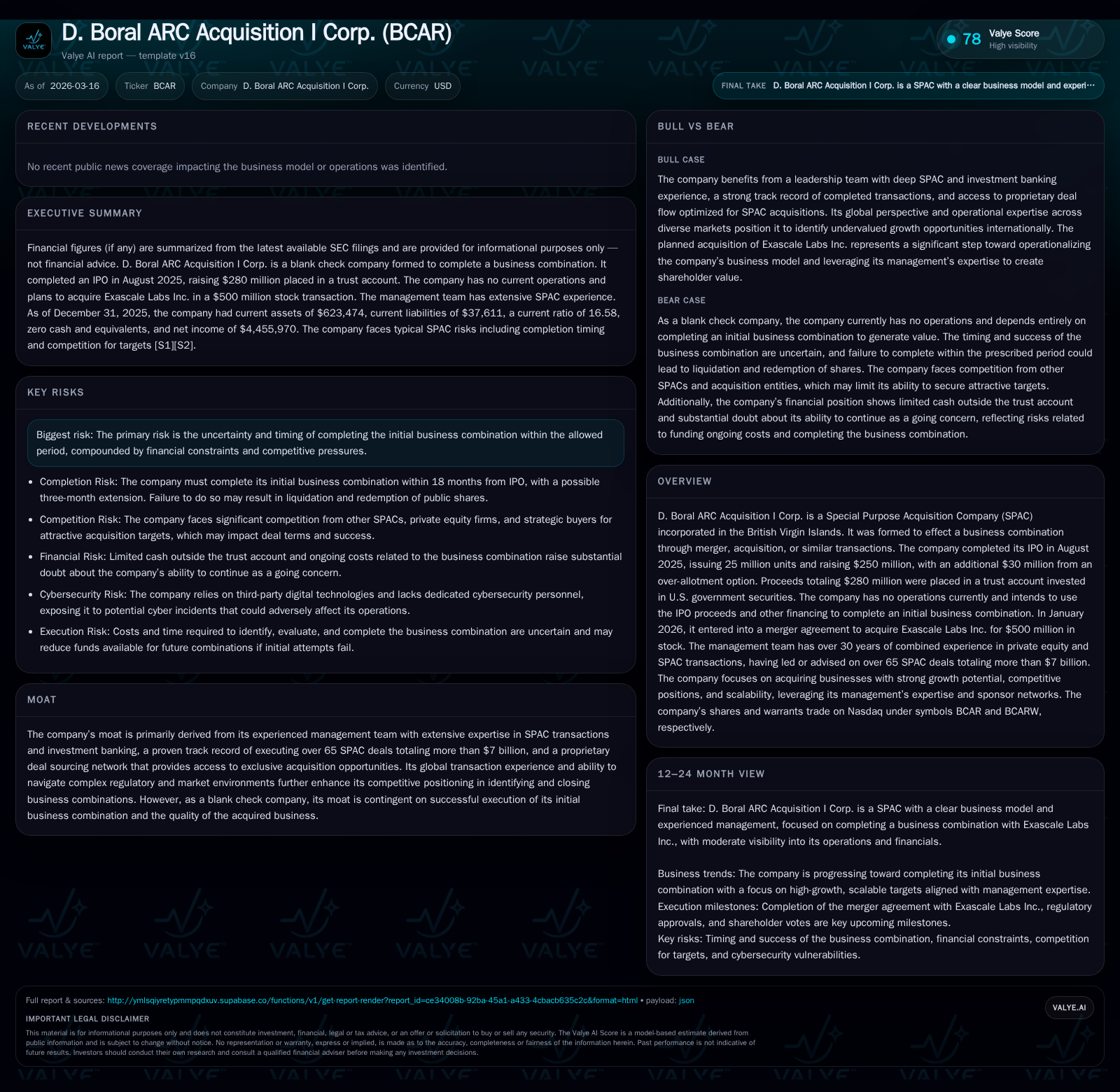
D. Boral ARC Acquisition I Corp. (BCAR) launched its SPAC with $280 million net proceeds placed into a trust account following its August 2025 IPO and over-allotment close. The Company demonstrated strong insider expertise with over 65 SPAC deals totaling more than $7 billion, enabling access to premium acquisition targets. In January 2026, BCAR entered a merger agreement to acquire Exascale Labs Inc. for $500 million in stock consideration. While this marks a significant growth milestone, BCAR carries typical SPAC pre-combination risks including limited operational cash outside the trust, potential dilution from share issuance, and execution timing constraints within the initial business combination period.
IPO Genesis and Capital Structure Setup
D. Boral ARC Acquisition I Corp., incorporated in the British Virgin Islands as a special purpose acquisition company (SPAC), completed an initial public offering (IPO) on August 1, 2025. The offering consisted of 25 million units sold at $10 each, raising gross proceeds of $250 million. Each unit comprises one Class A ordinary share plus one-half redeemable warrant exercisable at $11.50 per share. Concurrently, a private placement issued an additional 200,000 units to the sponsor at the same unit price without underwriting discounts. Following partial exercise of the underwriters' over-allotment option closed mid-August 2025, the company raised an incremental $30 million from selling 3 million additional units.
Net proceeds totaling approximately $280 million were segregated into a trust account invested primarily in U.S. government treasury obligations with maturities no greater than 185 days or equivalent money market funds compliant with Rule 2a-7 under the Investment Company Act [S1][S6][S10]. This structure ensures liquidity preservation while mitigating risks associated with longer-term investments that could jeopardize non-investment company status. The arrangement aligns with industry-standard protections for public investors in blank check entities by earmarking funds exclusively for prospective business combinations or redemption obligations.
Following IPO closing, holders could elect to separate units into component ordinary shares and warrants which now trade independently on Nasdaq under symbols "BCAR" (shares) and "BCARW" (warrants), while unseparated units continue under "BCARU" [S6][S22]. The capital structure foundationally incorporates mandatory redemption provisions where public shareholders can redeem their shares for pro rata trust account amounts upon consummation of the business combination irrespective of voting preferences.
Historical Financial Snapshot Across BCAR's Formation Year
As expected for a SPAC in its formation stage without operating revenue-generating activities, BCAR recorded a modest operating loss of approximately USD -320,658 for fiscal year ending December 31, 2025 [F1]. The positive net income reported—USD 4,455,970—is attributable chiefly to interest income generated from trust account investments rather than operational profits [F1]. Cash on hand excluding trust assets was negligible at year-end [F1], highlighting reliance on the trust account’s liquidity until the initial business combination closes.
BCAR sustained working capital of circa USD 585,863 against minimal current liabilities (~USD 37,611), producing a notably high current ratio of roughly 16.58 reflective of its liquid asset base juxtaposed with small operational payables consistent with early-stage SPAC profiles [F1]. Moreover, despite no operational earnings production capacity presently deployed, computed return on equity (ROE) stands at an elevated approximately 760.6%, distorted by little equity book value combined with investment yield gains rather than ongoing operations [F1].
Historical performance (annual)
| FY |
|---|
| 2025 |
Source: SEC companyfacts cache [F1].
This data underscores BCAR's typical lifecycle stance: collecting investor funds in escrow-like trust while preparing for target evaluation and acquisition rather than active commercial operation.
Management Expertise and Deal Sourcing Moat
BCAR’s management team possesses significant domain expertise aggregating over three decades across private equity investing and SPAC sponsor leadership roles [S15][S16]. Collectively responsible for orchestrating or advising more than sixty-five SPAC transactions exceeding USD seven billion in aggregate deal value since 2020 [S15], they leverage deep-sector relationships spanning investment banks, venture capital firms, family offices, and institutional investors to secure proprietary deal flow inaccessible to many peers.
Such a network ensures BCAR can access off-market targets aligned strategically with their acquisition criteria including companies exhibiting strong growth trajectories or emerging global champions in varied markets [S15][S16]. Their cross-border transaction experience permits navigation through complex multi-jurisdictional regulatory frameworks and cultural business practices imperative for consummating international mergers efficiently—an edge over less seasoned competitors amid ongoing heightened scrutiny faced by blank check entities.
Their integrated approach includes rigorous quantitative screening coupled with qualitative appraisal focused on defensible competitive positioning and value creation potential post-business combination [S15][S12]. This confluence forms the core moat underpinning BCAR’s ability to identify higher-quality target companies suitable for public market transition leveraging their established administrative infrastructure.
Strategic Partnership: Merger Agreement with Exascale Labs
On January 11, 2026, BCAR formalized an Agreement and Plan of Merger with Exascale Labs Inc., marking its inaugural business combination [S3][S9]. The transaction entails BCAR acquiring Exascale through a stock-for-stock merger valued at USD 500 million payable via issuance of fifty million newly minted shares at an implied per-share valuation of $10 each.
Post-merger ownership is structured such that former Exascale shareholders will receive PubCo Class A common shares carrying one vote per share or PubCo Class B shares endowed with twenty votes per share proportionally calculated based on the conversion formula detailed in the Merger Agreement [S9][S13]. Additionally, Simple Agreements for Future Equity (SAFE) holders in Exascale will convert their interests into PubCo Class A equity upon closing.
The deal will execute through two sequential merger steps: first BCAR reincorporates as a Delaware entity by merging into its wholly-owned subsidiary PubCo; subsequently PubCo’s Merger Sub merges into Exascale making it a wholly owned subsidiary [S9]. This dual-step approach facilitates regulatory compliance while aligning governance under U.S. jurisdiction.
The strategic rationale highlights synergy expectations through integration leveraging BCAR’s public listing platform combined with Exascale’s growth potential in scalable tech markets [S16]. However such transactions historically require meticulous due diligence focusing on intellectual property valuation, customer retention risk mitigation strategies, and ensuring working capital targets are met—factors critical given Exascale’s potentially early stage or volatile financial profile common among SPAC targets.
Growth Outlook and Key Obstacles Post-Merger
Post-transaction expansion is predicated on Exascale Labs’ ability to scale operations profitably across geographies using BCAR's capital infusion and market access advantages [S5]. Targeted criteria include robust revenue growth trajectories coupled with sustainable free cash flow generation after scaling overhead leveraging existing infrastructure.
However considerable headwinds exist: foremost is uncertainty surrounding timing constraints imposed by SPAC rules requiring closings within specified periods (18 months initially plus possible extensions). Failure triggers liquidation mechanics returning investor funds minus costs which can impair confidence [S19][S20]. Financial limits also emerge given fixed capital size tempered by possible redemptions exercised by public shareholders reducing available cash pools upon closing.
Market competition intensifies pressure as multiple blank check firms vie for similar high-growth targets possessing limited availability at favorable valuations; this dynamic may compress negotiating leverage or prompt pursuit of higher-risk early-stage firms subjecting outcomes to volatility [S15]. Operational integration challenges stemming from merging cultural practices globally alongside adapting governance processes remain focal concerns requiring robust management oversight post-close.
Governance of Capital Allocation and Shareholder Rights
BCAR adopts standard governance practices protecting public shareholder interests amid forthcoming structural changes from its business combination [S6][S7]. Upon completion investors may redeem shares at trust-account based prices — initially approximately $10 plus earned interest irrespective of their merger vote—thereby limiting downside exposure given preset liquidity terms.
The proposed transaction involves potential changes in controlling ownership exerted through new equity issuances that dilute pre-deal holders although sponsors waive redemption rights on founder/private shares mitigating conflict concerns [S14]. While formal shareholder approval may be solicited discretionary decisions regarding seeking such votes balance cost/time considerations against risk appetite acknowledging practical challenges during compressed transaction windows [S7].
Further flexibility exists allowing financing augmentation via forward purchase agreements or backstop arrangements providing supplementary capital if necessary—standard tools enabling alignment between sponsors and market demands maintaining robustness during deal execution phases [S14][S18].
Risk Landscape: Liquidity, Execution, and Regulatory Challenges
Embedded risks characteristic of pre-business combination SPAC stage companies dominate BCAR’s environment. Most prominently identified is substantial doubt about continuation as a going concern attributed primarily to scant operational cash reserves outside the trust account coupled with incurred sizeable expenses pursuing initial combinations launching cash burn profiles typical within this lifecycle phase [S1][S11].
Additionally reliance on third-party technology providers subjects BCAR to cybersecurity vulnerabilities lacking dedicated protection personnel or procedural frameworks internally; any significant breach could materially disrupt planned operations or investor confidence despite implemented monitoring approaches aiming to mitigate such threats periodically reviewed by board oversight functions [S2].
Regulatory exposures stem from evolving SEC scrutiny focusing on disclosure adequacy around conflicts of interest along with substantive review mandates applicable to blank check vehicles demanding rigorous compliance regimes; due diligence intensity further complicates timeline adherence risking costly delays or investor skepticism ultimately impacting deal feasibility/terms negotiation leverage negatively influencing outcomes absent contingencies being built-in upfront [S4][S28].
Competition remains intense not only from peer SPACs but also seasoned private equity funds and corporates active in strategic acquisitions narrowing pipeline exclusivity despite management’s reputed network advantages potentially eroding premium transaction opportunities thereby impacting projected returns profiles adversely absent deft execution agility especially under volatile macroeconomic backdrops amplifying execution hurdles compounded by inflationary/capital cost pressures prevailing broadly across acquisition spaces contemporaneously [S15][S26].
Critical Milestones and Performance Indicators to Monitor
Looking ahead analysts should track statutory completion windows constraining deal closure—currently eighteen months post-IPO extendable once via shareholder approval—for signs whether timely shareholder vote solicitations materialize indicating progression towards deal ratification or deteriorating feasibility prompting market caution .
Redemption activity measured shortly before final vote dates gauges community sentiment towards perceived value proposition reflecting confidence levels underpinning participation reducing pro-forma liquidity once cash payouts occur directly influencing scale/structure options available at close consequently affecting downstream capitalization tables impacting post-close valuation multiples traded publicly also serving as sentiment barometer shaping secondary trading dynamics post-combination rounding out comprehensive assessment kit useful when triangulating fundamental health versus technical investor appetite dynamics thus supporting holistic performance scenario sets capable informing contingent strategic planning exercises vital given nascent evolution stages typical among new SPAC-sponsored enterprises beyond immediate merger event horizon.
Maintaining vigilance around cost overruns relative to budgets covering due diligence expenses assessing refinancing needs or supplemental equity raises essential particularly when bridging unexpected diligence findings increasing negotiation complexity exacerbated where counterparties demand enhanced warranties collateralization measures otherwise absent previously assuming seamless process flows underpinning initial assumptions augmenting transparency levels reassuring stakeholders mitigating reputational/financial downside risk if adverse conditions manifest unexpectedly later in cycle enabling proactive remedial measures preventing cycle disruption events hardening transaction closure prospects enhancing sustainable value creation capacity over time.
Disclaimer: This report is prepared solely for informational purposes based on publicly available SEC filings and company documents as of March 16, 2026. It does not constitute investment advice or recommendations. Readers should perform further analysis before considering any action related to D. Boral ARC Acquisition I Corp.
Disclaimer: This is research-only, informational analysis and not investment advice. It may include AI-generated interpretation and general industry context. Always verify important details using primary sources.

Comments