
Aprea Therapeutics Leverages Synthetic Lethality Amid Clinical Gains
Aprea advances precision oncology pipeline with early clinical successes yet confronts financial sustainability challenges.
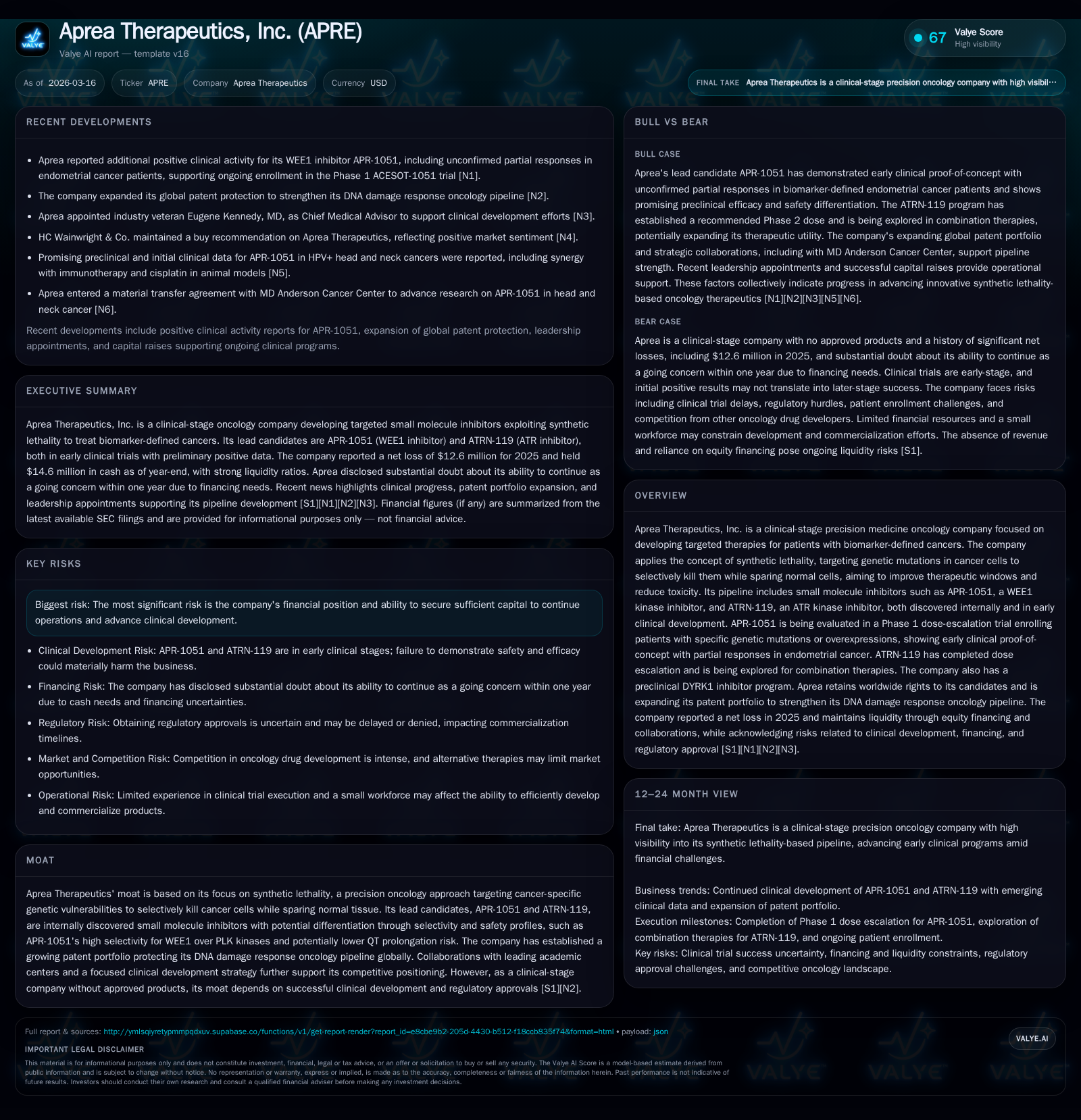
Aprea Therapeutics, a clinical-stage biotech specializing in synthetic lethality-based cancer therapies, has shown promising Phase 1 results for its WEE1 inhibitor APR-1051 and ATR kinase inhibitor ATRN-119. While these developments underscore scientific differentiation and a growing patent estate, the company’s cash burn and operating losses weigh heavily on near-term prospects. Vigilance on trial progression milestones, potential regulatory hurdles, and capital raising will be crucial as Aprea balances innovative promise with financial headwinds.
Tracing Aprea’s Growth: From Pipeline Evolution to Clinical Milestones
Aprea Therapeutics’ trajectory over recent years reflects deliberate reshaping of its discovery and development focus post its acquisition of Atrin Pharmaceuticals in mid-2022 ([S1]). Prior to this acquisition, Aprea’s programs centered largely around mutant p53 reactivation strategies; Atrin’s WEE1 and ATR kinase inhibitors refocused the portfolio towards DNA damage response (DDR) modulation leveraging synthetic lethality principles.
This pivot has ushered in multiple clinical trial initiatives. The pivotal Phase 1 dose-escalation study for APR-1051 commenced patient enrollment in Q2 2024 ([S1]), reaching cohort eight (220 mg once daily) by early March 2026. Across cohorts at doses between 70 mg to 220 mg, early data indicate a dose-response increase in single-agent activity with notable partial responses (uPR) reported in patients suffering from endometrial cancer ([N1], [S1]). Meanwhile, ATRN-119 has successfully completed dose escalation with exploratory efforts underway examining mono and combination therapy settings ([S1], [N4]).
Financially, the company sustains significant development expenditures reflected in annual operating losses: for FY2025 these stood at –$13.2 million, improving modestly by about 7.6% year-over-year (-$14.3 million in FY2024) indicating a consistent but capital-intensive R&D effort ([F1]). Net losses followed a similar trend narrowing slightly by 2.8% from –$12.96 million in FY2024 to –$12.6 million in FY2025 ([F1]). The contraction of losses suggests controlled operational scaling concurrent with advancing clinical programs.
Historical performance (annual)
| FY | Net ($mm) | CFO ($mm) | OpInc ($mm) | Capex ($) | Net YoY |
|---|---|---|---|---|---|
| 2025 | -13 | -13 | -13 | 15478 | +2.8% |
| 2024 | -13 | -14 | -14 | 15478 | +9.3% |
| 2023 | -14 | -12 | -15 | 93093 | +87.3% |
| 2022 | -113 | -25 | 25709 |
Source: SEC companyfacts cache [F1].
Capital returns and efficiency (annual)
| FY | FCF ($mm) | ROE% |
|---|---|---|
| 2025 | -13 | -101.3 |
| 2024 | -14 | -67.1 |
| 2023 | -12 | -84.3 |
| 2022 | -25 | -439.3 |
Source: SEC companyfacts cache [F1].
Note: Operating income and net income reflect incremental improvements aligned with clinical trial progression despite no commercial revenues.
Precision Oncology Focus: Scientific Differentiation and Moat Analysis
Central to Aprea’s scientific strategy is its exploitation of synthetic lethality—a targeted oncology paradigm wherein vulnerabilities created by genetic mutations are exploited for cell-selective killing ([S1]). Specifically targeting key kinases involved in cell cycle regulation and DNA repair pathways such as WEE1 and ATR positions Aprea within the DDR inhibitor class but with important selectivity distinctions.
APR-1051 exhibits high selectivity for WEE1 kinase relative to closely related PLK kinases which often mediate off-target toxicities—this may translate into an improved therapeutic window and tolerability profile compared to earlier generation inhibitors ([S1]). Additionally, reduced risk of QT prolongation potentially differentiates APR-1051 favorably against competitors that struggle with adverse cardiovascular effects ([S1]).
Complementing scientific differentiation is a growing global patent portfolio securing core chemical entities and methods of treatment encompassing the DDR inhibitors under development ([N2]). These intellectual property assets afford critical barriers protecting market potential and partnership attractiveness.
Collaborations with top academic institutions bolster preclinical rigor and translational insight into biomarker-defined populations likely to benefit from these targeted agents ([S1], [N2]). The interplay of patented selectivity nuances with synthetic lethality targeting underpins a defensible moat contingent upon clinical validation.
Clinical Highlights: APR-1051 Dose Escalation and ATRN-119’s Combination Potential
The ACESOT-1051 Phase 1 trial data affirm dose-dependent pharmacodynamic activity across ascending dose cohorts enrolling biomarker-selected patients harboring specific genetic aberrations affecting DNA damage repair machinery ([S1], [N1]). Early partial responses notably include unconfirmed efficacy signals in endometrial carcinoma—an indication where aberrant cell cycle kinases present compelling vulnerabilities.
With nine planned cohorts ranging from 10 mg up to the current highest dose tested at 300 mg once daily,[S1] observed tolerability alongside emerging efficacy readouts supports further dose optimization decisions ahead.
ATRN-119’s clinical journey reached completion of the initial dose escalation phase permitting transition into exploratory monotherapy arms as well as combination therapy strategies with other anticancer agents aiming to enhance synergistic DNA damage induction while combating tumor resistance mechanisms ([S1], [N4]).
Such combination regimens represent standard practice within DDR therapies due to pathway interdependency and resultantly heightened apoptotic stress when pairing WEE1 or ATR inhibition with chemotherapeutics or immunotherapies.
The February appointment of Dr. Eugene Kennedy as Chief Medical Advisor brings considerable oncology clinical development expertise that can help shepherd these complex trial designs towards critical milestones expediently ([N3]).
Balancing Act: Financial Position, Cash Burn, and Capital Needs
As of December 31, 2025, Aprea held approximately $14.6 million in cash and cash equivalents against current liabilities near $2.76 million yielding a strong current ratio over 5.6x—a liquidity buffer affording flexibility for operations in the short term ([F1]).
However, operating cash flow remains negative at nearly –$12.9 million annually reflecting intensified spend primarily driven by clinical trial activities and associated overheads without offsetting revenues ([F1]). Capital expenditures are negligible (~$15K annually), consistent with a research-heavy biotech where the major outlays pertain to contracted R&D rather than fixed asset investments ([F1]).
The stark reality emerges from explicit going concern doubt language disclosed within SEC filings citing persistent net losses since inception coupled with forecasted capital requirements exceeding available cash unless replenished through financings or collaborations ([S1], [S4]). This underscores an existential imperative for timely capital procurement amidst developmental inflection points.
Forward-Looking Signals: What to Watch in Trials, Regulatory Paths, and Funding
Key near-term milestones include the completion of remaining patient cohorts within APR-1051’s Phase 1 dose escalation study—successful accrual rates and emerging safety/efficacy data will influence strategic dosing decisions for subsequent expansion cohorts or combination trials ([S1]). Additionally anticipated are regulatory interactions potentially involving IND amendments supporting label or protocol enhancements.
Further development depends on advancing ATRN-119 through proof-of-concept stages particularly within combination arms exploring synergistic efficacy windows ([S1], [N4]).
Funding procurement remains paramount; should internal resources prove inadequate during these costly stages without revenue streams or existing partnerships providing non-dilutive capital support future financings or collaborations may decisively shape operational continuity risk profiles ([S4], [N3]). The enlistment of Dr. Kennedy could expedite trial optimization facilitating smoother attraction of investors or partners focused on accelerating time-to-data delivery.
Careful surveillance of trial enrollment pace bottlenecks—always a concern in precision medicine niches due to narrow biomarker-defined populations—and FDA feedback cycles will provide critical visibility into feasibility constraints affecting timelines ([S1]).
Capital Allocation Overview: Cash Reserves, Operating Cash Flow, and Shareholder Returns
With no revenues generated thus far owing to early development stage status,[F1] Aprea maintains no dividends or share repurchase programs typical of biotechnology firms focused exclusively on pipeline maturation.[F1] Operating cash flow deficits reflect all-in investments into R&D activities rather than expansion CAPEX where minimal spending affirms a lean facility footprint constrained primarily by variable expenses linked directly to experimental therapeutics advancement.[F1]
Return on equity is profoundly negative around –101% given sustained net losses dwarfs equity base (~$12.44 million at FY-end), an archetypal pattern reflective of embryonic biotech enterprises engaged heavily in discovery-to-clinic transitions.[F1]
Investors should view this capital deployment profile aligned tightly with hypothesis-driven drug development where upfront expenditures precede scaleable revenue inflows subject to successful approvals.
Risk Factors Spotlight: Development Challenges and Market Dynamics
Aprea operates under multiple risk vectors characteristic yet compounded within DDR inhibitor-focused oncology therapeutics:
- Clinical: Early-stage candidates carry inherent trial outcome uncertainties including failure risks from limited efficacy or unacceptable toxicity signals during escalation phases.[S4],[S5]
- Regulatory: Complex FDA approval pathways requiring rigorous demonstration of safety/efficacy alongside challenges spanning IND submission timing delays threaten development cadence.[S6],[S7]
- Patient Recruitment: Biomarker-stratified populations constrain eligible subject pools risking enrollment delays critical for statistically meaningful conclusions.[S8]
- Competition: DDR space populated by larger players intensifies pressure on differentiation beyond selectivity necessitating accelerated proof-of-concept achievements.[S9]
- Financial Exposure: High operating losses combined with going concern indicators heighten funding dependency vulnerability potentially forcing program scale-backs absent timely capital infusion.[S10]
- Compliance & Litigation: Adherence to broad healthcare laws such as Anti-Kickback Statutes and False Claims Acts introduces operational complexity with potential legal repercussion costs if violated inadvertently.[S11]-[S16] Collectively these reinforce that while scientific promise is materializing clinically at Aprea,the pathway remains fraught demanding diligent resource allocation coupled with agile operational execution.
This report synthesizes publicly filed SEC documents [F1]-[S29] alongside recent news releases [N1]-[N4] respecting Aprea Therapeutics without providing specific investment advice or price targets.
Disclaimer: This is research-only, informational analysis and not investment advice. It may include AI-generated interpretation and general industry context. Always verify important details using primary sources.

Comments