
Microvast Holdings Advances Battery Technology Amid Liquidity and Capital Constraints
Microvast reports revenue growth and operational improvements in 2025 but faces ongoing liquidity challenges and capital-intensive expansion needs.
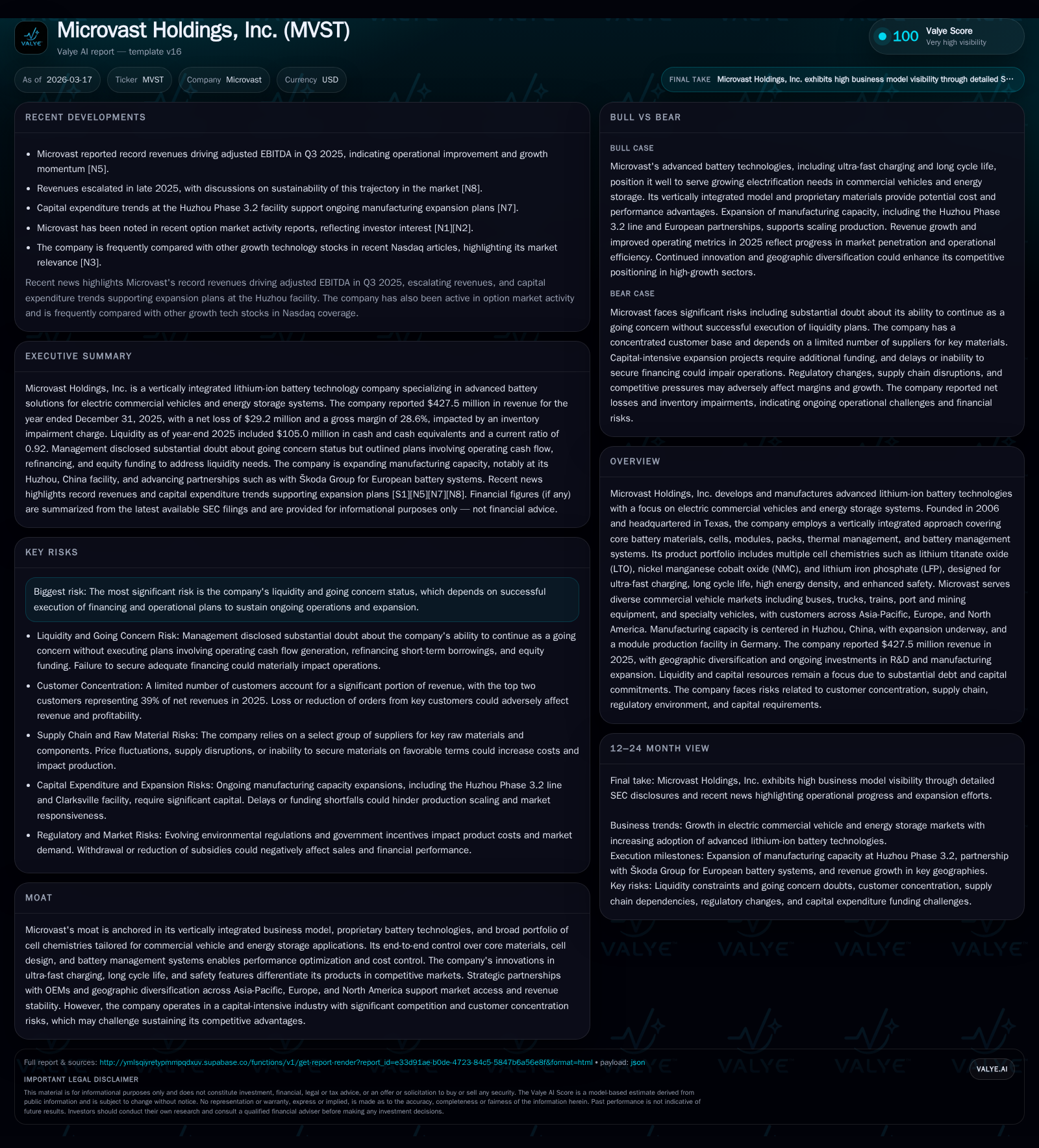
Microvast Holdings, Inc. achieved a 12.6% revenue increase in fiscal 2025, driven by geographic diversification and proprietary lithium-ion battery technology innovations for commercial EVs and energy storage systems. Despite generating positive operating income and strong operating cash flow, the company recorded a net loss of $29.2 million, reflecting continued investment in growth and capital expenditures. Liquidity remains constrained with a current ratio below one and substantial short-term debt obligations, compounded by regulatory and tax complexities in repatriating overseas funds. The firm is pursuing additional financing and asset divestitures to support completion of its Clarksville manufacturing expansion and ongoing operations while navigating risks including customer concentration, regulatory changes, and competitive pressures [F1][S1][S4][S6][S8][S10][S12].
Company Overview
Microvast Holdings, Inc., headquartered in Stafford, Texas, specializes in advanced lithium-ion battery technologies designed for electric commercial vehicles and energy storage systems (ESS). Founded in 2006 and publicly listed since 2021, Microvast employs a vertically integrated model encompassing core cell materials (cathode, anode, electrolyte, separator), cells, modules, packs, thermal management systems, and intelligent battery management systems [S1]. This integration supports technological advancements such as ultra-fast charging (10%-80% state of charge within 10-30 minutes), extended cycle life (exceeding 20,000 cycles retention for LTO cells), enhanced energy density, and rigorous safety standards vital for heavy-duty transport applications [S22].
Geographically, Microvast's revenue sources are diversified across Asia-Pacific (notably China), Europe (Italy, France), and North America. Recent years have seen strategic expansion into Europe and the U.S., where customers prioritize technology quality over price sensitivity compared to Asian markets [S6][S11][S17].
Historical Financial Performance
According to SEC XBRL data [F1], Microvast's financial results over recent years demonstrate steady revenue growth alongside operational improvements:
Historical performance (annual)
| FY | Rev ($mm) | Net ($mm) | CFO ($mm) | OpInc ($mm) | Rev YoY | Net YoY |
|---|---|---|---|---|---|---|
| 2025 | 428 | -29 | 76 | 7 | +12.6% | +85.1% |
| 2024 | 380 | -195 | 3 | -116 | +23.9% | -83.8% |
| 2023 | 307 | -106 | -75 | -107 | +49.9% | |
| 2022 | 204 | -54 | -160 |
Source: SEC companyfacts cache [F1].
Capital returns and efficiency (annual)
| FY | FCF ($mm) |
|---|---|
| 2025 | 56 |
| 2024 | -25 |
| 2023 | -262 |
| 2022 | -205 |
Source: SEC companyfacts cache [F1].
Revenue growth of approximately 12.6% in 2025 was driven by significant increases in North American (+173%) and European (+13%) markets while Asia-Pacific revenues remained stable [S6][S17]. Operating income swung positive reflecting improved cost controls and product mix optimization despite prior years’ substantial operating losses [F1]. Net losses narrowed but remain reflective of ongoing investment cycles.
Notably, operating cash flow improved sharply from negative territory to $75.9 million in 2025, supporting free cash flow generation after more moderate capital expenditures compared to prior peak investments [F1][S14]. However, liquidity metrics indicate constraints: as of December 31, 2025, current assets totaled $448.7 million versus current liabilities of $488.3 million yielding a current ratio near 0.92; this includes significant short-term debt maturities and accounts payable obligations linked to expansion projects [F1][S10].
Growth Outlook & Strategic Initiatives
Microvast aims to capitalize on growing demand for electrified commercial vehicles and ESS by scaling proprietary battery technologies globally [S1][S22]. Key initiatives include completion of the Clarksville Tennessee manufacturing facility pivoted towards lithium iron phosphate (LFP) cells aligned with market trends favoring cost-effective ESS solutions [S12][S14].
Partnerships such as with Škoda Group for European LTO cell platforms illustrate efforts to penetrate higher-margin regional markets while meeting domestic content requirements essential for competitive positioning within infrastructure incentive programs [S22].
Risks include customer concentration with two largest customers accounting for nearly 40% of revenues; pricing pressures amid competition from established Chinese manufacturers; supply chain uncertainties particularly for raw materials sourced primarily from Asia-Pacific; regulatory compliance costs including new EPA lithium battery waste handling rules anticipated in the U.S.; and geopolitical tensions impacting operations [S15][S23].
Capital Allocation & Financial Position
Following its SPAC business combination that generated net proceeds above $700 million in mid-2021, Microvast has invested heavily (> $500 million) into manufacturing facilities across China, Germany (completed), and the U.S., focusing on capacity expansion [S4][F1]. Capital expenditures peaked at roughly $187 million in FY23 but declined sharply to approximately $20 million in FY25 reflecting a transition from build-out phase towards operational scaling.
The company’s equity stood at approximately $410 million at year-end 2025 despite an accumulated deficit exceeding $1 billion resulting in an approximate return on equity around -7% [F1]. No dividends or share repurchases have been reported; earnings continue to be reinvested into R&D and operational growth initiatives [F1][S14].
Liquidity remains a key challenge with sizeable short-term debt obligations including bank borrowings ($106 million), convertible bonds ($41.7 million), convertible loans ($140.9 million fair value measurement), alongside restricted cash balances held abroad that cannot be readily repatriated without tax consequences [F1][S4][S8][S10]. The company is actively pursuing refinancing options along with asset divestitures such as the planned sale of its Lake Mary facility expected to close mid-2026 [S4]. Equity raises under a Controlled Equity Offering Sales Agreement have also provided incremental funding totaling nearly $28 million through early 2026 [S8].
Industry Positioning & Competitive Landscape
Within the specialized commercial EV battery segment targeting electrification of buses, trucks, specialty vehicles, trains, port equipment, and ESS applications—a sector forecasted for sustained double-digit growth—Microvast differentiates through its vertically integrated technology platform covering multiple cell chemistries including LTO’s extreme cycle durability niche alongside NMC and LFP formats [S1].
The proprietary control over materials combined with rapid innovation cycles facilitates adaptability absent legacy constraints faced by older incumbents . Geographic diversification across Asia-Pacific, Europe, and North America reduces exposure to any single regulatory or market environment risk though competition remains intense especially from large Chinese manufacturers exerting pricing pressure domestically.
Emerging solid-state battery technologies pose medium-term competitive risks should they achieve scalable commercialization but currently remain at pilot or demonstration stages industry-wide .
Key Milestones & Risks To Monitor
While explicit forward guidance is not disclosed due to liquidity uncertainties, key milestones include:
- Completion timeline and ramp-up progress at Clarksville Tennessee facility focused on LFP cell production meeting U.S ‘Buy America’ standards.
- Conversion of backlog valued near $196 million into revenues during fiscal years ’26/’27.
- Continued progress toward sustained operating profitability supported by higher-margin sales mix.
- Execution success of planned financing initiatives including equity raises and asset sales bolstering liquidity runway.
- Resolution or mitigation of supplier liens/litigation related to Clarksville project reducing balance sheet contingencies.
- Impact assessment of new regulatory frameworks including EPA lithium battery waste regulations becoming effective in 2027.
- Monitoring customer concentration risks given top customers’ revenue share approaching two-fifths.
- Supply chain stability especially regarding critical raw materials sourcing from Asia-Pacific regions amidst geopolitical tensions.
Conclusion
Microvast Holdings represents an innovator focused on advanced lithium-ion batteries tailored for commercial EVs and ESS markets with growing presence across major global regions supported by vertical integration spanning materials to system controls.
Despite encouraging operational improvements reflected in positive operating income and cash flow generation during fiscal year 2025 alongside robust top-line growth driven by geographic expansion efforts, larger challenges persist around liquidity constraints exacerbated by capital-intensive expansions, cash flow timing mismatches due to short-term debt maturities, and concentrated customer exposure that together continue to temper financial sustainability outlooks.
Investors should closely monitor execution progress on manufacturing capacity expansions particularly Clarksville plant completion, as well as success securing additional capital funding needed to support growth ambitions while managing regulatory compliance costs within an increasingly competitive landscape.
This analysis is based exclusively on publicly available SEC filings ([F1],[S1]-[S29]) and news sources ([N1]) without opinion or investment recommendations.
Disclaimer: This is research-only, informational analysis and not investment advice. It may include AI-generated interpretation and general industry context. Always verify important details using primary sources.

Comments