
Primis Financial's Rebound: From Losses to Profit and Operational Flexibility
After years of losses, Primis Financial Corp. achieved a significant turnaround in 2025 driven by asset monetization, diversified lending, and disciplined capital management.
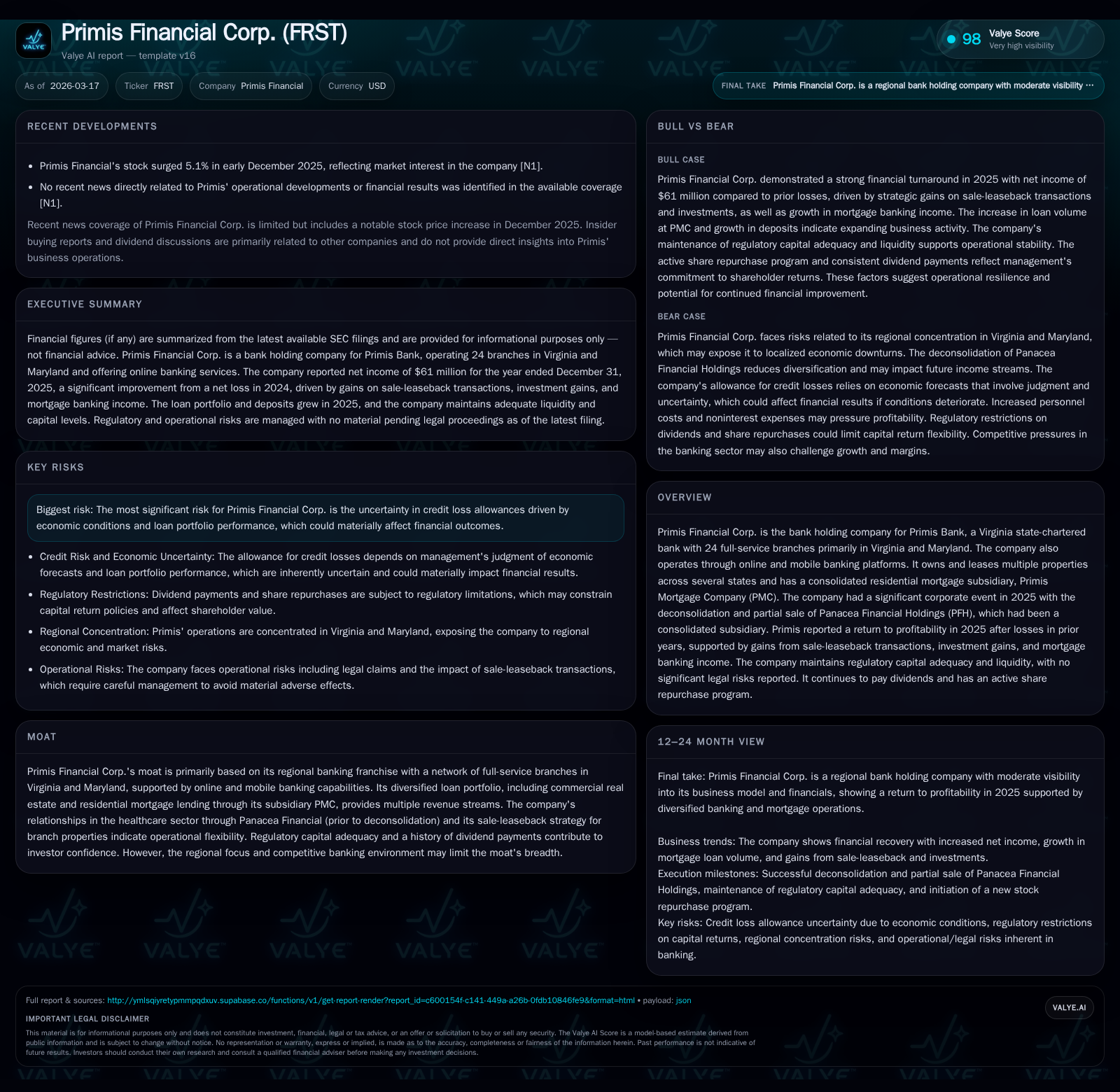
Primis Financial Corp., a Virginia and Maryland regional banking franchise, returned to profitability in 2025 following multi-year losses. Key contributors included gains from sale-leaseback transactions of branch properties, investment income, and mortgage banking revenue. The company’s strategic shift towards operational flexibility and its diversified loan portfolio underpin stable future prospects amid ongoing credit risk challenges. Capital adequacy remains robust with consistent dividend payouts supporting investor confidence.
From Struggles to Strength: Recent Historical Performance Overview
Primis Financial Corp. weathered a turbulent period from 2023 to early 2025 marked by consecutive net losses before staging a formidable recovery. Its net income swung from negative $7.83 million in 2023 to negative $16.21 million in 2024—reflecting mounting pressures on core operations—before leaping sharply to a positive $61.44 million in 2025 [F1]. This represents an extraordinary year-over-year net income increase of roughly 479%, underscoring the impact of non-recurring gains alongside improved operational performance.
Operating cash flow (CFO) followed an uneven pattern; after peaking around $29.66 million in earlier years (2019-20), CFO had retreated to $19.53 million in 2024 before declining further to approximately $10.77 million in 2025 [F1]. Meanwhile, capital expenditures grew moderately from $1.19 million in 2024 to $1.73 million in 2025, indicating reinvestment aligned with strategic initiatives [F1].
This volatile financial trajectory reflects the complex interplay of legacy loan portfolio challenges, restructuring efforts, and opportunistic asset disposition that characterized the firm’s recent history.
Historical performance (annual)
| FY | Net ($mm) | CFO ($mm) | Capex ($) | Net YoY |
|---|---|---|---|---|
| 2025 | 61 | 11 | 1734000 | +479.2% |
| 2024 | -16 | 20 | 1194000 | -106.9% |
| 2023 | -8 | 1924000 | -155.4% | |
| 2022 | 14 | 1012000 |
Source: SEC companyfacts cache [F1].
Capital returns and efficiency (annual)
| FY | Div ($mm) | FCF ($mm) | ROE% |
|---|---|---|---|
| 2025 | 10 | 9 | 14.5 |
| 2024 | 10 | 18 | -4.6 |
| 2023 | 10 | -2.1 | |
| 2022 | 10 | 3.6 |
Source: SEC companyfacts cache [F1].
Table: Historical Financial Summary: FY2022–FY2025 — Net Income, Operating Cash Flow & Capex [F1]
Asset Monetization and Operational Transition: The Role of Sale-Leasebacks
A pivotal catalyst for Primis’s rebound was the execution of sale-leaseback transactions during 2025 involving eighteen retail branch properties located primarily within its Virginia and Maryland footprint [S1]. This maneuver converted owned land and buildings into leased assets while retaining operational control over the same premises.
Such sale-leasebacks unlocked substantial liquidity without disrupting customer access or branch network continuity—a critical consideration given Primis's regional franchise dependence on physical presence. By divesting real estate ownership yet maintaining branch operations via leases, Primis improved balance sheet flexibility and reduced capital tied up in fixed assets.
This change also aligns with sector trends where community banks adapt to evolving banking behavior by reallocating capital from property holdings toward digital infrastructure and lending capacity.
Loan Portfolio Composition Driving Diversified Revenue Streams
Primis’s revenue base benefits from a sensible diversification across its loan book. The mix prominently features commercial real estate loans alongside residential mortgages processed through its subsidiary Primis Mortgage Company (PMC) [F1].
The commercial real estate segment typically carries varied risk weightings depending on property type and borrower creditworthiness—a factor that requires prudent credit loss allowance calibration especially amidst uncertain economic cycles [S1]. Concurrently, PMC generates mortgage banking income which enhances fee revenue streams distinct from interest yields on loans.
The integration of mortgage origination coupled with traditional commercial lending supports a multi-pronged approach to revenue generation mitigating concentration risks inherent in regional banking franchises.
Capital Adequacy and Investor Confidence through Dividend Consistency
Equity capital totaled approximately $423 million at the end of 2025 compared with $352 million a year earlier—a testament partly to retained earnings recovery post-profitability [F1]. This translates into an approximate return on equity (ROE) of around 14.5% for fiscal year 2025 (net income divided by average equity), a respectable figure within regional bank peer groups signaling effective capital deployment.
Importantly for shareholders, Primis sustained dividend payments consistently over this period with outflows near $9.87 million annually despite financial headwinds experienced pre-2025 [F1]. Share repurchases resumed modestly in 2025 after previous inactivity at about $807,000—indicating cautious but deliberate capital returns alongside balance sheet strengthening efforts.
Collectively these factors underpin investor confidence conveying solid regulatory capital adherence alongside shareholder value considerations.
Credit Risk and Economic Uncertainty: The Foremost Challenge Ahead
The predominant risk factor flagged by company disclosures centers on uncertainty surrounding credit loss allowances influenced by broader economic conditions impacting loan performance [S1]. Credit exposures concentrated in commercial real estate are particularly sensitive to downturns or localized market stress given cyclical dynamics—making loan portfolio quality vigilant monitoring essential.
Volatility in provisions can materially shift earnings outcomes quarter-to-quarter as charge-offs or reserves adjust responsively. While the company maintains diligent underwriting standards refined since prior periods’ adversities, macroeconomic unpredictability remains a specter for future earnings consistency.
Strategic Outlook for Growth in Virginia and Maryland Markets
Primis’s strategic horizon remains anchored within its established regional footprint comprising twenty-four full-service branches principally across Virginia (22 branches) and Maryland (2 branches) markets [S1]. This geographic focus both consolidates entrenched customer relationships yet inherently restricts growth breadth compared with banks pursuing national expansion.
Digital platforms augmenting online and mobile banking offer scalable avenues for customer engagement beyond physical branches; however competitive pressures among regional banks persist strong given proximity dynamics and overlapping service areas.
Future growth will likely hinge on deepening penetration within key markets leveraging the hybrid physical-digital model while cautiously expanding mortgage lending channels through PMC to capitalize on episodic housing finance demand spikes.
Financial Returns Analysis: Profitability, ROE, Cash Flow, and Capital Allocation
The profitability resurgence culminated in net income surpassing $61 million in FY2025 yielding an approximate ROE near 14.5% based on comparable equity levels—reflecting operating leverage improvement after several years of losses [F1].
Operating cash flows recorded $10.77 million though down sharply by nearly half year-over-year as some working capital shifts occurred post-sale-leasebacks coupled with reinvestment activities [F1]. Capital expenditure rose moderately signaling selective asset investments albeit remaining controlled relative to historical peaks.
Free cash flow—defined here as operating cash flow less capex—remained positive at roughly $9 million supporting ongoing dividend payments close to $9.9 million and small-scale share repurchases of about $0.8 million [F1]. This indicates prudent balance between returning capital and cushioning liquidity buffers after strategic transformations.
Such disciplined capital allocation reflects management’s balanced approach prioritizing sustainable growth alongside shareholder distributions amid evolving market dynamics.
What Investors Should Watch Next: Key Milestones and Risks
While explicit guidance was not directly disclosed for forthcoming periods in filings reviewed, several critical indicators warrant attention:
- Credit Quality Metrics: Monitoring allowance for loan losses trajectory amidst changing economic forecasts remains vital given exposure sensitivities particularly within commercial real estate.
- Further Asset Strategy: Additional sale-leaseback or property monetization moves may surface as management seeks continued operational agility or liquidity enhancements.
- Branch Network Stability vs Digital Adoption: Balancing physical footprint maintenance against accelerating digital channel adoption will shape cost structures and customer acquisition paradigms.
- Regulatory Environment: Ongoing compliance obligations including capital requirements must be met without compromising growth initiatives.
- Legal Proceedings: Although no material legal risks are currently flagged per disclosures [S1], vigilance remains standard given occasional lender liability or contract claims endemic to banking operations.
Investors would do well to track quarterly updates focusing on these parameters alongside macroeconomic indicators influencing lending conditions.
This report is intended solely for informational purposes based on publicly available data through March 17, 2026. It does not constitute investment advice or recommendations.
Disclaimer: This is research-only, informational analysis and not investment advice. It may include AI-generated interpretation and general industry context. Always verify important details using primary sources.

Comments