
Baidu’s Strategic Pivot: Balancing AI Ambitions and Financial Volatility
Baidu is leveraging AI-driven innovation and autonomous technologies to fuel growth despite recent profitability headwinds and cash flow pressures.
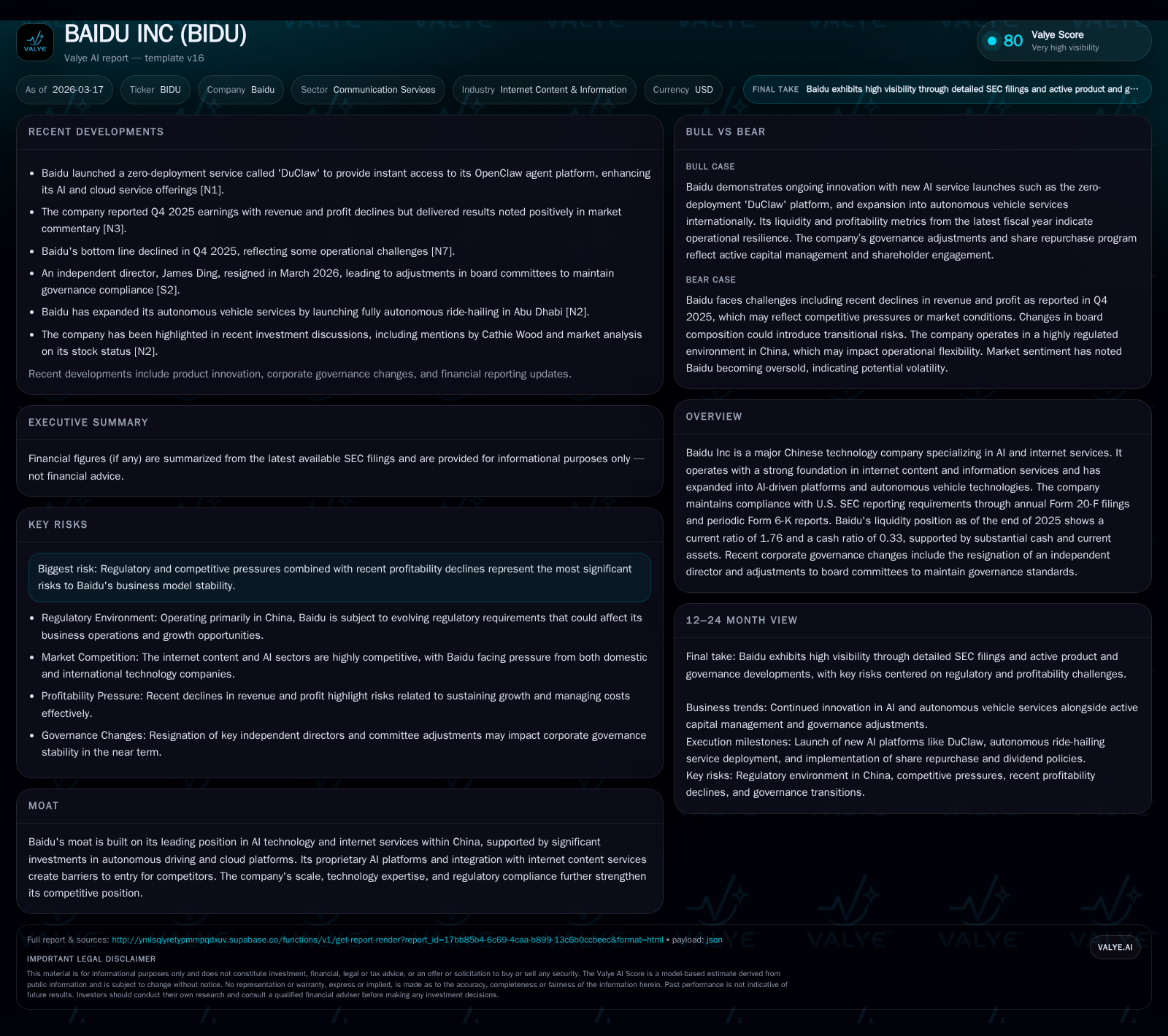
Baidu Inc, a key Chinese internet content and AI technology provider, exhibits a duality between pioneering advancements in AI platforms and autonomous driving, and marked financial volatility evidenced by a sharp operating loss in 2025. Historical data shows robust revenue growth fueled by diversification into AI, yet escalating investment costs have compressed margins and triggered negative free cash flow. Governance adjustments and complex regulatory dynamics further shape Baidu’s operational environment. With strategic capital allocation including share repurchases continuing amid earnings pressure, market participants should focus on upcoming catalysts like earnings releases and the impact of newly launched options trading.
From Internet Content Leader to AI Powerhouse: Historical Growth and Financial Trends
Baidu has transitioned from primarily internet content monetization toward becoming an AI-centric technology conglomerate anchored on advanced machine learning platforms and autonomous vehicle technology. SEC XBRL data shows Baidu's revenue grew from approximately $13.0 billion in 2017 to a level reflecting a 28.3% year-over-year increase by year-end 2025—underscoring expansion across search advertising, cloud services, video content, and emerging AI offerings [F1].
Operating income rose through the early 2020s peaking above $3 billion before declining sharply to a -$833 million loss in 2025 as investments intensified in next-generation technologies such as autonomous driving platforms [F1]. This illustrates the cost pressures typical of tech firms pivoting towards capital-intensive ventures.
Capital expenditures rose materially, increasing from about $1.2 billion in 2022 to $1.73 billion in 2025 (+54.9% YoY), highlighting Baidu’s commitment to infrastructure expansion for its growing AI and cloud footprint [F1]. Operating cash flow inverted into negative territory at -$431 million in 2025, indicative of cash burn linked with aggressive development phases.
Historical performance (annual)
| FY | Net ($bn) | CFO ($bn) | OpInc ($bn) | Capex ($mm) | Net YoY |
|---|---|---|---|---|---|
| 2025 | 0.8 | -0.4 | -0.8 | 1726 | -75.5% |
| 2024 | 3.3 | 2.9 | 2.9 | 1114 | +13.8% |
| 2023 | 2.9 | 5.2 | 3.1 | 1576 | +161.0% |
| 2022 | 1.1 | 3.8 | 2.3 | 1201 |
Source: SEC companyfacts cache [F1].
Capital returns and efficiency (annual)
| FY | Buybacks ($mm) | FCF ($bn) | ROE% |
|---|---|---|---|
| 2025 | 792 | -2.2 | 2.1 |
| 2024 | 866 | 1.8 | 9.0 |
| 2023 | 671 | 3.6 | 8.3 |
| 2022 | 279 | 2.6 | 3.4 |
Source: SEC companyfacts cache [F1].
Note: Revenue data for some years is unavailable; YoY percentages are calculated where possible.
This trajectory reflects Baidu’s reinvention efforts—integrating proprietary AI tools within legacy internet services while managing the financial implications of scaling emerging technologies.
Profitability Volatility: Dissecting Operating Income and Net Earnings
The transition from consistent multi-billion dollar operating profits to a sizable operating loss in calendar year 2025 underscores challenges linked to rising R&D expenses targeting artificial intelligence architectures and autonomous vehicle development lacking immediate revenue offsets [F1][N1][N13][S1].
Despite this, net income remained positive at $799 million in 2025, likely due to significant non-operating income such as tax credits or one-time gains unrelated directly to core operations [F1]. This divergence cushions headline earnings but questions remain on profit sustainability absent these factors.
Operating cash flow declined dramatically from prior years’ positive range above $2 billion to negative $431 million in 2025, indicating cash pressures amid heavy strategic investments [F1]. These patterns reflect tradeoffs faced by tech leaders pursuing long-term platform dominance.
AI Innovations and Autonomous Driving: Engines for Future Growth
Central to Baidu’s strategy are innovations like "DuClaw," a zero-deployment service enabling instant access to its open agent platform—facilitating scalable AI integration without infrastructure complexity [N7][S1]. This positions Baidu strongly within China’s unique regulatory landscape.
Simultaneously, Baidu continues investing substantially in China's autonomous driving sector—developing full-stack solutions including perception algorithms, connectivity, real-time mapping, and vehicle integration systems [N10][N8][S1]. These high barriers-to-entry provide competitive moats as mobility shifts accelerate domestically.
Together these initiatives form dual pillars for growth: enhancing monetization from next-gen internet services while capturing emerging smart transportation markets.
Capital Allocation: Share Repurchases Amid Cash Flow Dynamics
Despite negative free cash flow estimated at approximately -$2.16 billion (operating cash flow minus capex), Baidu repurchased shares worth about $792 million in fiscal year 2025—a sign of management confidence or valuation support efforts amid earnings pressure [F1][S4][S5][S6].
Equity capital expanded steadily reaching roughly $38 billion at end-2025; however return on equity contracted near 2.1%, highlighting reduced efficiency in generating net income from shareholder funds [F1]. No dividends were declared during this period consistent with reinvestment priorities.
This capital deployment profile demonstrates balancing shareholder returns against necessary funding for transformative technology investments.
Governance Updates and Regulatory Environment
Corporate governance changes included the resignation of independent director James Ding with consequent committee reorganization effective March 17, 2026—maintaining compliance amidst board turnover during critical phases [S2][S5].
Regulatory risks remain significant due to operational complexities within China combined with U.S.-based audit oversight under the Holding Foreign Companies Accountable Act (HFCAA). While the Public Company Accounting Oversight Board (PCAOB) regained inspection capabilities reducing delisting risk momentarily, ongoing uncertainties require investor vigilance [S1].
These governance and regulatory factors add layers of operational risk intrinsic to major Chinese technology firms.
What Investors Should Watch Going Forward
Key near-term catalysts include:
- Quarterly earnings releases clarifying whether investment losses stabilize or improve [N1][N5].
- Progress updates on commercialization timelines for autonomous driving technology impacting growth outlooks [N10].
- Market impact following the launch of Baidu March 2027 options trading that may affect liquidity and volatility profiles [N14][N9].
- Investor sentiment shifts highlighted by notable positions such as those from Cathie Wood signaling changing views on tech innovation plays [N11].
- Ongoing regulatory disclosures related to PRC jurisdiction enforcement affecting valuation multiples [S1][S2].
Monitoring these developments will be critical for assessing if Baidu’s strategic pivot can overcome short-term financial pressures toward sustained technological leadership.
This analysis is based solely on public filings up to March 17, 2026 ([F1], [N#], [S#]) without providing investment advice.
Disclaimer: This is research-only, informational analysis and not investment advice. It may include AI-generated interpretation and general industry context. Always verify important details using primary sources.

Comments