
LINKBANCORP's Strategic Expansion and Financial Trajectory in Mid-Atlantic Banking
LINKBANCORP has leveraged targeted mergers to build regional scale while managing credit concentrations and regulatory capital requirements.
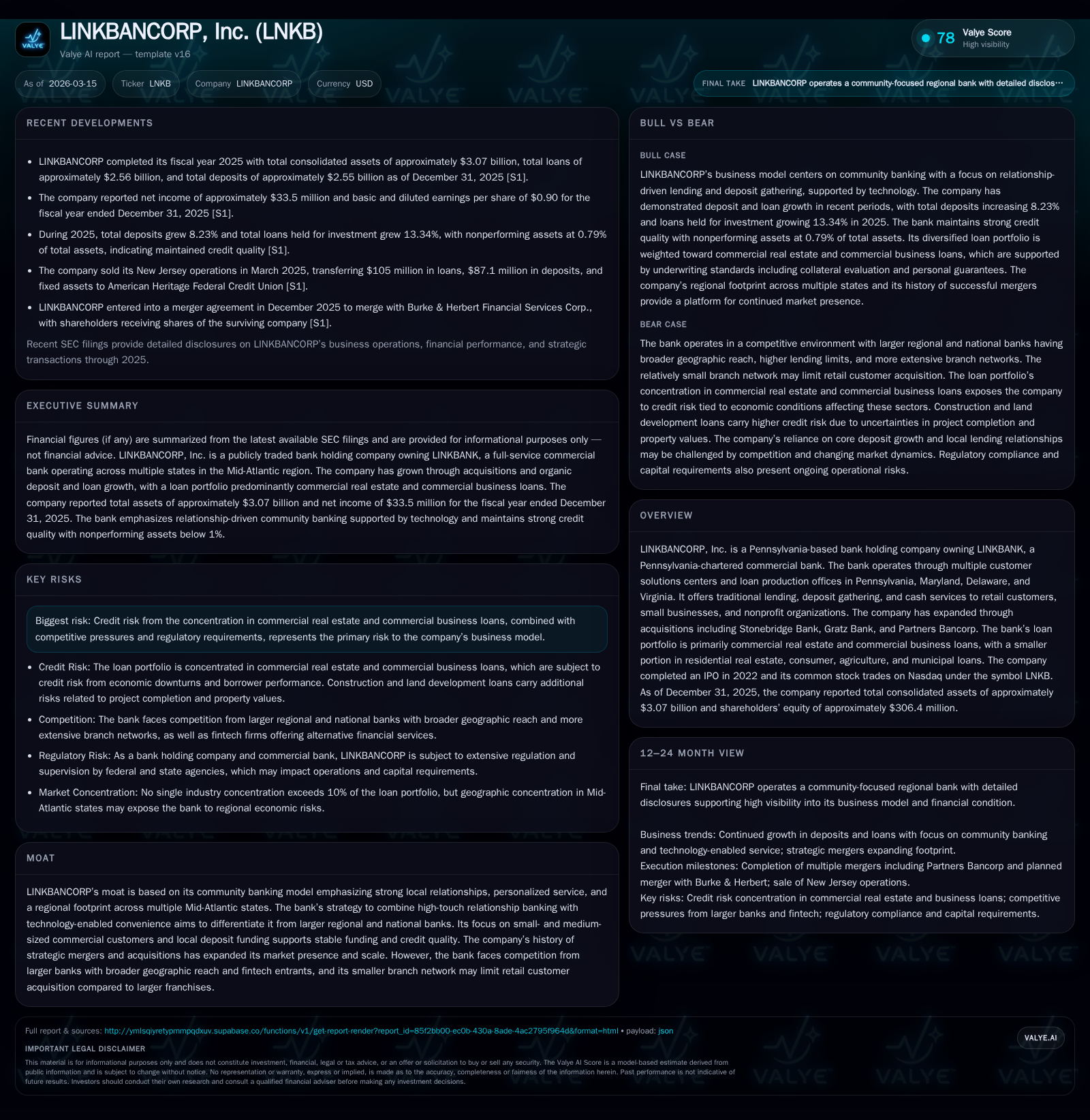
LINKBANCORP, Inc. has pursued a multi-year consolidation strategy through acquisitions of Stonebridge Bank, Gratz Bank, and Partners Bancorp, growing its asset base to over $3 billion by 2025. Its loan portfolio remains heavily concentrated in commercial real estate but is managed with prudent underwriting limits and oversight. The company has demonstrated a financial turnaround from losses in 2023 to profitability and robust cash flow generation by 2025, supported by IPO capital infusion and organic growth. Challenges remain from loan portfolio concentration risks and integration complexities tied to an upcoming merger with Burke & Herbert Financial Services Corp.
Building Scale: Historical Growth Fueled by Acquisitions
LINKBANCORP’s trajectory since its formation in 2018 reflects a deliberate buildout through strategic acquisition of complementary community banks within the Mid-Atlantic region. The initial leap came with the acquisition of Stonebridge Bank in October 2018, which constituted the bank holding company status inception. Thereafter, the September 2021 Gratz Bank merger marked a significant enlargement of their deposit franchise and geographic reach within Pennsylvania.
The most substantial expansion occurred with November 30, 2023's completion of the Partners Bancorp merger, incorporating its wholly-owned subsidiaries The Bank of Delmarva and Virginia Partners Bank. These moves culminated in consolidated assets surpassing $3 billion by the end of 2025 [F1][S1].
Notably, LINKBANCORP transitioned from a growth phase dominated by acquisitions into one that increasingly leverages organic customer relationship banking. Revenue growth underpinned by this broader asset base reached $186.5 million for fiscal year 2025—a robust increase of approximately 11.3% year-over-year from $167.6 million in fiscal 2024 [F1]. Net income followed suit with an impressive turnaround from a $11.7 million loss in 2023 to $33.5 million profit in 2025—marking effective operational scaling post-mergers.
Capital injections facilitated by the company’s September 2022 IPO provided net proceeds near $34.7 million which strengthened capital buffers at the bank subsidiary level through a $20 million direct recapitalization [S1]. Further capital flexibility was attained via a private placement concurrent with the Partners Merger announcement earlier in 2023.
Loan Portfolio Composition and Credit Risk Management Practices
A defining characteristic of LINKBANCORP’s risk profile derives from its loan portfolio concentration centered on commercial real estate (CRE). As of December 31, 2025, CRE including multifamily loans represent roughly $1.56 billion or about 61% of total loans held for investment, reflecting a dominant focus that subjects the bank to sector-specific cyclicality [S13][F1]. This exposure includes owner-occupied, non-owner occupied commercial properties, as well as multifamily residential buildings.
The bank pairs this concentration with diversification across commercial business loans, residential real estate (including first liens), consumer credit, agriculture loans, and municipal debt segments—each constituting smaller portions of the entire portfolio [S4][S16]. Moreover, it maintains prudence through layered underwriting controls administered by its Senior Loan Committee—a panel combining CEO-level oversight alongside credit officers—to ensure consistent application of credit policies.
Risk mitigation strategies include self-imposed single borrower loan limits set substantially below regulatory caps: internal maximums at $30 million versus legal lending limit near $47.5 million as of late-2025 [S4]. Collateral coverage parameters are similarly conservative with typical loan-to-value ratios capped around 80% on CRE deals to buffer against potential market value erosion.
Heightened risk monitoring encompasses proactive stress testing on cash flows and collateral valuations to assess adherence to debt service coverage thresholds under varied economic scenarios—an approach aligned with supervisory guidance addressing CRE concentration risk faced by regional lenders exceeding conventional risk-based capital multiples [S16].
Capital Structure, Liquidity, and Regulatory Capital Adequacy
From a funding perspective, LINKBANCORP relies predominantly on core deposits collected across its markets, which accounted for about $2.31 billion or approximately 90% of total deposits as of December 31, 2025 [S4]. This strong core deposit base supports liquidity stability compared to more volatile wholesale funding sources.
The company supplements these core funds mostly through short-term brokered deposits amounting to roughly $35 million which are not considered primary but provide tactical balance sheet flexibility [S7]. Reciprocal CDARS and ICS deposits contribute another $290 million facilitating managed deposit inflows without escalated concentration concerns.
On the debt front, the firm holds Federal Home Loan Bank (FHLB) advances totaling approximately $115 million at year-end 2025; maturity profiles require active refinancing or repayment strategies particularly for tranches due in early months after reporting date [S4][S7].
Regulatory capital adherence reflects compliance with Basel III capital adequacy standards applicable both at the bank and consolidated holding company levels as assets crossed the $3 billion threshold triggering more stringent requirements [S6]. Internal capital policies mandate buffers beyond well-capitalized regulatory minimums providing resilience against potential earnings volatility or loan losses.
Linking this all together is an emphasis on maintaining liquidity sufficient to support lending growth while navigating demands related to deposit behavior shifts influenced by interest rates and competition dynamics within their regional footprint [S4][S5].
Evaluating Profitability: Revenue, Net Income, and Operating Cash Flow Trends
Financial results indicate substantive improvement following years marked by operational costs linked to merger integration efforts and credit provisioning adjustments. Fiscal year data reveals revenue progression from approximately $167.6 million in FY2024 to $186.5 million at FY2025 end—a material increase paralleling asset growth trends [F1].
Net income swings are more pronounced: recovering from an operating loss exceeding $11 million in FY2023 to positive profits nearing $33.5 million two years later illustrates successful leverage management post-expansion combined with improved earning asset performance [F1]. The resulting return on equity estimated near a healthy mid-teens range (~12%) signals effective use of shareholder capital amidst growing scale.
Operating cash flows (CFO) have been steady at about $25 million annually between FY2024-25 after negligible values recorded during turnaround year FY2023; this sustained cash inflow underpins healthy liquidity positions allowing ongoing reinvestment without strain [F1]. Concurrently capital expenditures contracted nearly half between these periods indicating reduced incremental investment requirements now that branch network consolidations have largely settled [F1].
Free cash flow approximates nearly $24 million demonstrating capacity for dividend payments or debt reduction without compromising operational needs.
Dividend Policy and Capital Return Strategy
LINKBANCORP initiated dividend payments shortly after its IPO launch year (FY2022) and has demonstrated consistent increases aligning payouts with expanding earnings base—from approximately $3.3 million paid out in FY2022 rising steadily above $11 million most recently reported for FY2025 [F1].
While no share repurchase activity has been formally disclosed or emphasized in filings reviewed, dividends appear calibrated conservatively relative to net income—indicating balanced preservation of capital against competing allocation priorities such as loan book expansion or contingent operational costs [F1].
The dividend trajectory evidences management’s intent to reward shareholders steadily while maintaining financial flexibility amid market uncertainties tied to sector lending exposures and regulatory scrutiny.
Growth Prospects Amid Market Risks and Competitive Landscape
Looking ahead, LINKBANCORP's growth is likely influenced by multiple vectors: sustained integration gains from recent mergers could drive deeper cross-selling opportunities within enhanced regional footholds spanning Pennsylvania through Maryland, Delaware and Virginia—a footprint combining eight customer solutions centers plus loan production offices across these states provides a platform for scalable organic growth [S1].
However, reliance on commercial real estate loans exposes the firm to cyclical risk associated with potential real estate market downturns that could pressure credit quality despite currently low nonperforming asset ratios (~0.79% total assets at end-2025) supported by rigorous underwriting regimes [S13][S16].
Competitive headwinds arise from larger regional/national banks possessing broader service offerings and wider branch networks making customer acquisition challenging given LINKBANK’s comparatively smaller physical presence. Additionally, fintech entrants introduce technology-driven disruptions threatening traditional banking models requiring continual innovation investments that may tax operating margins further if not managed efficiently [S9].
Maintaining local relationship banking ethos while integrating technology-enabled convenience will remain critical for differentiation within these competitive pressures.
Merger Outlook: Integration Complexity and Expected Milestones
The announced but pending merger agreement between LINKBANCORP and Burke & Herbert Financial Services Corp introduces immediate business uncertainties through required regulatory approvals subject to standard risks including delays or imposed conditions potentially limiting transaction benefits or extending timelines post-announcement [S1].
During pendency periods, LINKBANCORP is contractually constrained from pursuing certain business actions absent consent which may restrict more opportunistic moves until clearance is obtained—in parallel employee morale or customer relationships could face strain as uncertainty lingers around eventual organizational changes.
Regulatory scrutiny also intensifies as combined asset size approaches thresholds invoking enhanced capital requirements adding complexity for planning and capital allocation until closure occurs.
Monitoring milestones such as formal approval notices or court rulings will be essential markers indicating progress toward final integration phases impacting future earnings trajectories.
Key Metrics Summary Table
Historical performance (annual)
| FY | Rev ($mm) | Net ($mm) | CFO ($mm) | Capex ($mm) | Rev YoY | Net YoY |
|---|---|---|---|---|---|---|
| 2025 | 187 | 34 | 25 | 1 | +11.3% | +27.9% |
| 2024 | 168 | 26 | 25 | 3 | +323.8% | |
| 2023 | -12 | 0 | 1 | -309.2% | ||
| 2022 | 6 | 2 | 2 |
Source: SEC companyfacts cache [F1].
Capital returns and efficiency (annual)
| FY | Div ($mm) | FCF ($mm) | ROE% |
|---|---|---|---|
| 2025 | 11 | 24 | |
| 2024 | 11 | 23 | 9.4 |
| 2023 | 5 | -1 | -4.4 |
| 2022 | 3 | 0 | 4.0 |
Source: SEC companyfacts cache [F1].
This table highlights LINKBANCORP’s recent financial progression capturing impressive revenue acceleration post-acquisition activities coupled with net profitability restoration following a loss-making year marked by integration costs or credit adjustments. Operating cash flow consistency supports ongoing reinvestment capacity amid declining capex demands indicative of matured infrastructure investments.
This analysis synthesizes publicly available financial disclosures and company statements up through early March 2026 without forecasting beyond provided information or incorporating unverified speculation. It focuses on factual evaluation pertinent for institutional stakeholders seeking granular insights into LINKBANCORP's strategic positioning within community banking sectors across Mid-Atlantic markets.
Disclaimer: This is research-only, informational analysis and not investment advice. It may include AI-generated interpretation and general industry context. Always verify important details using primary sources.

Comments