
PagerDuty Accelerates Profitability Through Integrated AI Operations Platform
PagerDuty’s shift to an AI-centric digital operations cloud has reversed years of losses, underpinning a robust profitability surge and setting the stage for sustainable growth.
After enduring multi-year operating losses through fiscal years 2023 to 2025, PagerDuty swung to positive operating income and a significant net profit in FY2026 [F1]. This turnaround is largely driven by its strategic evolution into a comprehensive AI-powered digital operations platform integrated with over 700 ecosystem tools, enhancing enterprise resilience across IT, security, and customer service functions [S1]. While the company faces tightening regulatory compliance and heightened competition risks, its AI innovations such as agentic workflows and investments in generative AI promise ongoing operational differentiation [S1][N4]. Capital deployment has aggressively included share buybacks alongside strong free cash flow generation, supported by elevated return on equity levels nearing 70% [F1].
From Persistent Losses to Profit: Historical Performance Trends
PagerDuty’s financial trajectory over the past four fiscal years illustrates a marked transformation from sustained losses to profitable operations. Between fiscal years 2023 and 2025, the company reported sizable operating losses of approximately -$129 million, -$96 million, and -$59 million respectively. This sequence of narrowing losses culminated in a positive operating income of $5.8 million reported in FY2026—a near 110% year-over-year improvement in operating income [F1].
Similarly, net income improved dramatically, swinging from a negative $128 million in FY2023 to a positive $173 million by FY2026—a stunning increase exceeding 500% YoY. This net margin expansion signals both operational leverage on revenue growth and disciplined cost management during this pivot phase.
Operating cash flow also rose substantially from $17 million in FY2023 to approximately $115 million in FY2026 while capital expenditures remained modest at around $3 million annually. This healthy cash generation strengthens the company’s balance sheet liquidity despite prior loss years.
Historical performance (annual)
| FY | Net ($mm) | CFO ($mm) | OpInc ($mm) | Capex ($mm) | Net YoY |
|---|---|---|---|---|---|
| 2026 | 173 | 115 | 6 | 3 | +505.7% |
| 2025 | -43 | 118 | -60 | 3 | +43.2% |
| 2024 | -75 | 72 | -96 | 2 | +41.5% |
| 2023 | -128 | 17 | -129 | 5 |
Source: SEC companyfacts cache [F1].
Capital returns and efficiency (annual)
| FY | Buybacks ($mm) | FCF ($mm) | ROE% |
|---|---|---|---|
| 2026 | 135 | 112 | 68.4 |
| 2025 | 100 | 115 | -32.9 |
| 2024 | 50 | 70 | -43.8 |
| 2023 | 12 | -53.3 |
Source: SEC companyfacts cache [F1].
FY2023-FY2026 figures per SEC filings and company financials [F1]
This financial rebound underscores PagerDuty’s successful transformation journey coupled with an increasingly scalable economics model.
Strategic Evolution Fueling Growth Drivers
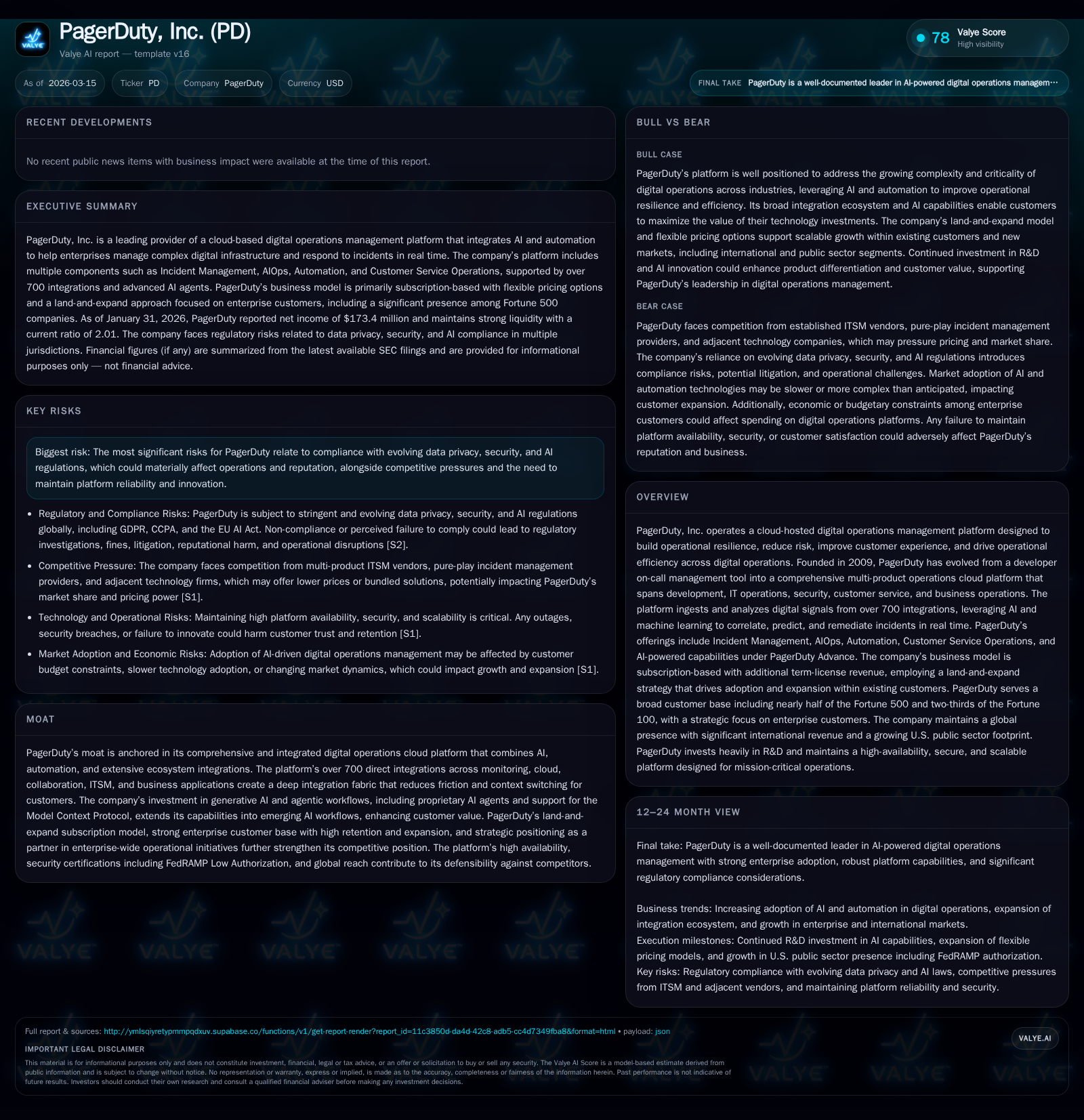
Originating as a dependable developer on-call management tool at its founding in 2009, PagerDuty has transcended its initial niche product offering into an expansive digital operations cloud platform designed for today’s complex enterprise technology environments [S1].
The platform now spans multiple operational domains including IT operations (ITOps), security incident response, customer service operations, and broader business operations integration.
Crucially, PagerDuty benefits from an extensive ecosystem connectivity matrix with over 700 integrations encompassing key categories such as monitoring tools like Datadog or New Relic; observability platforms; collaboration applications including Slack or Microsoft Teams; IT Service Management (ITSM) systems such as ServiceNow; plus various business-critical software layers [S1]. This integration fabric reduces operational friction for customers by minimizing disruptive context switching among siloed toolchains—an essential boon for Site Reliability Engineering (SRE) teams seeking rapid incident context correlation.
PagerDuty derives recurring revenue primarily through subscription-based models complemented by term-license arrangements that facilitate land-and-expand customer dynamics vital for annual recurring revenue (ARR) growth.
AI Integration and Platform Expansion: Pillars for Future Growth
At the heart of PagerDuty’s future growth prospects lies its differentiated investment strategy around artificial intelligence capabilities.
The company has embedded advanced generative AI technologies along with proprietary AI agents within its product suite branded as PagerDuty Advance—offering enhanced automation and intelligent orchestration capabilities that streamline incident detection and accelerate resolution cycles [S1][N4].
Of particular note is PagerDuty’s pioneering support for 'agentic workflows', where autonomous AI agents interact seamlessly with the platform’s incident data streams applying predictive analytics to remediate issues proactively ahead of user impact—a distinct advantage for modern enterprises navigating increasing digital complexity.
These innovations foster higher operational resilience while freeing up practitioner bandwidth previously consumed by manual firefighting tasks—enabling organizations to reallocate resources toward innovation priorities.
Anticipating Growth Constraints: Compliance and Competitive Pressures
Despite technological strengths, PagerDuty faces substantive headwinds stemming from regulatory compliance regimes and intensified market competition.
Data privacy legislation such as the U.S.'s CCPA alongside Europe’s GDPR imposes stringent requirements on processing sensitive personal data in operational workflows managed by SaaS providers like PagerDuty [S2]. Noncompliance risks extend beyond penalties to reputational damage affecting customer retention.
Moreover, cybersecurity obligations demand continuous investment into platform reliability and vulnerability mitigation given PagerDuty's positioning at critical infrastructure junctures managing enterprise incident response processes.
Additionally, well-capitalized competitors across AIOps and digital experience monitoring spaces increase pressure on feature innovation velocity and pricing frameworks.
PagerDuty's management must sustain balanced strategic emphasis on compliance robustness while fueling R&D cycles—requiring cohesive governance at executive levels involving CTO/CISO stewardship integrated with board oversight [S1][S2].
Financial Expectations and Market Milestones Ahead
While explicit forward-looking guidance remains sparse following the recent earnings release documenting profitability transition ([N1], [N3]), key performance indicators warrant close observer attention:
- Maintaining or expanding operating profit margins signaling lasting leverage capture on subscription growth;
- Effective monetization trajectories for new AI-driven product lines under PagerDuty Advance;
- Customer retention rates combined with land-and-expand dynamics reflecting stable ARR growth;
- Continued strong free cash flow generation supporting capital initiatives;
- Ability to sustain integration breadth without performance tradeoffs;
- Monitoring competitive responses potentially impacting pricing or sales productivity.
Valye analysis indicates these metrics will be pivotal anchors shaping investor perception as PagerDuty solidifies its operational footing.
Capital Deployment: Share Repurchases, Cash Flow, and Return on Equity
Capital allocation during this rebound interval reflects confidence backed by robust financial results.
PagerDuty progressively escalated its share repurchase program—from approximately $50 million annually during FY2024 up to nearly $135 million by FY2026—signaling management’s conviction that market valuations offered compelling capital return opportunities coincident with improving fundamentals [F1].
Financial flows confirm ample liquidity preservation: annual operating cash flow stood near $115 million matched against conservative capital expenditures below $3 million annually yielding free cash flow surpassing $111 million in FY2026 alone.
Equity base contraction consistent with repurchases alongside soaring net income drove return-on-equity measures close to an impressive ~68%, illustrating highly efficient reinvestment of shareholder capital amidst the turnaround phase [F1].
These dynamics showcase effective buy-and-build economics typical of mature SaaS operators who leverage land-and-expand subscription models to convert initial investments into expanding lifetime value streams.
Risk Management in Cybersecurity and Data Privacy Landscape
Governance structures rigorously oversee cybersecurity risk through dedicated board audit committee mechanisms tasked specifically with monitoring threat landscapes affecting PagerDuty’s platform continuity [S1].
Operational execution rests with seasoned C-suite technology officers including CTO, CISO, and CIO who drive comprehensive cybersecurity frameworks encompassing incident response escalation protocols aligned tightly with regulatory mandates.
This layered security posture encompasses proactive vulnerability management complemented by real-time threat remediation processes coordinated among cross-functional teams—crucial given the sensitive nature of incident data caching high-value enterprise workloads.
Such governance sophistication assuages concerns over potential breaches or data misuse risks inherent in SaaS providers orchestrating mission-critical digital operations.
This memo reflects information gathered up to March 15, 2026 derived strictly from documented earnings disclosures ([F1]), official SEC filings ([S1]–[S3]), and recent market reports ([N1]–[N4]). It refrains from speculative forecasts or valuation commentary consistent with Valye News content policies.
Disclaimer: This is research-only, informational analysis and not investment advice. It may include AI-generated interpretation and general industry context. Always verify important details using primary sources.

Comments