
GPGI's Transition to a Diversified Industrial Platform Clouds Profitability and Cash Flow Outlook
The 2025 financial year saw GPGI absorb Husky Holdings amid a sharp operating loss, challenging its growth trajectory and cash generation.
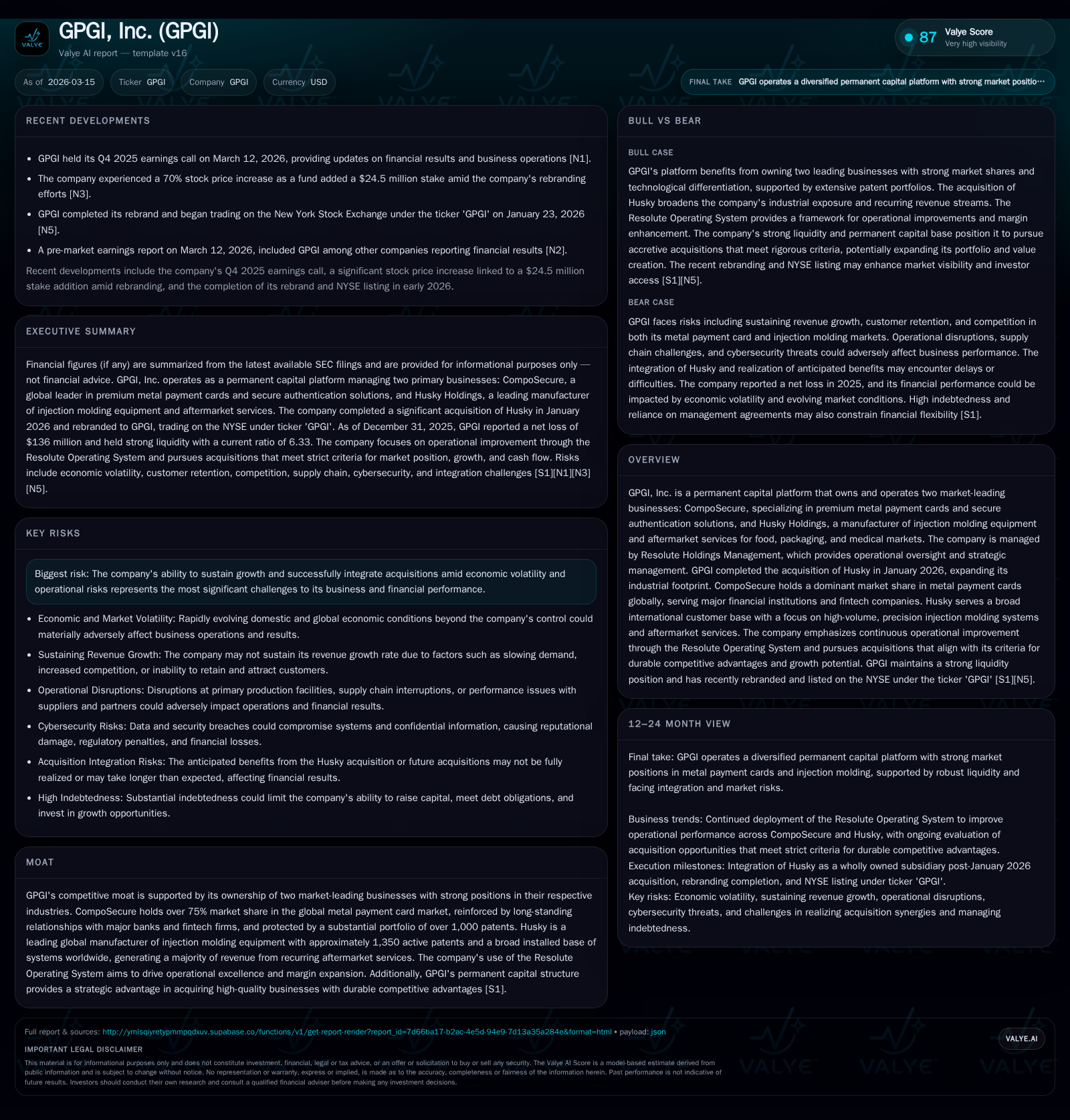
GPGI, Inc., historically a leader in premium metal payment cards through CompoSecure, expanded its industrial footprint by acquiring injection molding equipment manufacturer Husky Holdings in early 2026. Despite dominant market shares and a broad patent portfolio, the company's 2025 performance deteriorated significantly with operating income plunging into a sizable loss and negative free cash flow reported. The newly integrated Husky business adds both opportunities for diversification and complexities around margin expansion and operational integration. While management emphasizes deployment of the Resolute Operating System to drive performance improvements, risks around leverage, supply chain disruptions, and economic volatility remain pronounced. Close attention should be paid to how effectively GPGI capitalizes on operational synergies from Husky's acquisition and stabilizes its cash flows going forward.
Company Overview and Evolution
GPGI, Inc., formerly known as CompoSecure, Inc., acts as a permanent capital platform focused on owning high-quality businesses with strong competitive positions. As of early 2026, GPGI owns two principal businesses: CompoSecure, a leading manufacturer of premium metal payment cards integrating proprietary material science and secure authentication technologies; and Husky Holdings LLC, an injection molding equipment producer serving food, packaging, and medical markets worldwide. The acquisition of Husky closed in January 2026 representing a strategic diversification beyond payment cards into industrial manufacturing.
Management of GPGI’s operating subsidiaries is delegated to Resolute Holdings Management, Inc., which operates under a fee-based model to oversee operations and strategy execution including implementation of the Resolute Operating System (ROS). This system aims at instilling a continuous improvement culture driving more consistent growth and margin expansion.
Historical Financial Performance
The company's financial trajectory through FY2025 illustrates significant challenges coinciding with the Husky acquisition process as well as operational headwinds:
Historical performance (annual)
| FY | Net ($mm) | CFO ($mm) | OpInc ($mm) | Capex ($mm) | Net YoY |
|---|---|---|---|---|---|
| 2025 | -136 | -23 | -14 | 0 | -153.2% |
| 2024 | -54 | 130 | 108 | 7 | -379.2% |
| 2023 | 19 | 104 | 119 | 11 | +3.1% |
| 2022 | 19 | 93 | 115 | 9 |
Source: SEC companyfacts cache [F1].
Capital returns and efficiency (annual)
| FY | Div ($mm) | FCF ($mm) | ROE% |
|---|---|---|---|
| 2025 | 0 | -23 | -55.9 |
| 2024 | 9 | 122 | 37.4 |
| 2023 | 93 | -2.4 | |
| 2022 | 84 | -2.1 |
Source: SEC companyfacts cache [F1].
Analyzing this data reveals:
- A dramatic reversal from positive operating income (~$108M to $119M range) in prior years to a loss of $13.7M in fiscal year ending December 31st 2025.
- Net income dropped further into negative territory reaching -$136M compared to a loss of approximately $54M the previous year.
- Operating cash flow also suffered heavily moving from +$129.6M in prior year to negative $22.9M.
- Capital expenditures ceased entirely in FY2025 likely reflecting the timing around Husky’s acquisition; this may not represent sustained trend.
- Equity saw marked improvement from deep negatives to positive $243M post-transaction.
- No dividends were distributed during the turbulent period signaling retained focus on financial stabilization.
This weakening in profitability and cash flow contrasts with steady growth phases seen before Husky's addition.
Drivers Behind Historical Results
The decline reflects several underlying factors:
- Transaction-related costs associated with acquiring Husky Holdings including legal fees and integration expenses [S1].
- Operational disruptions due to merging two different industry businesses under one holding structure possibly complicating reporting periods.
- Macro-economic pressures including raw material cost volatility especially stainless steel impacting Husky’s margins [S8].
- Supply chain disruptions potentially affecting both segments given dependency on specialized components for metal cards (chips etc.) and injection molding machinery parts [S10].
- Ramp-up costs for deploying the Resolute Operating System across both enterprises while awaiting synergy benefits to materialize [N1][S1].
Competitive Positioning & Moat Analysis
CompoSecure dominates the niche metal payment card sector holding over 75% global market share backed by more than a thousand patents protecting its materials science innovations alongside embedded EMV chip technology certified by international payment networks such as Visa or Mastercard [S1][S8]. Its customer roster includes major banks and fintech innovators globally giving durable revenue visibility.
Husky Holdings complements this with leadership in injection molding equipment outfitted with roughly 1350 active patents supporting high volume moldings predominantly serving food packaging as well as medical supply markets—sectors where recurring aftermarket parts form majority revenue thus enabling stable cash flows [S1][S8]. Both companies benefit from the strategic support provided by Resolute Holdings facilitating disciplined operations that emphasize technological differentiation.
This dual-anchor structure affords GPGI wide moats: entrenched intellectual property rights limiting competitor entry; customer stickiness due to certification requirements especially for CompoSecure; geographic diversification across industrial verticals via Husky reducing cyclicality exposure.
Future Growth Prospects & Catalysts
Growth paths identified by management rely principally on:
- Accelerating adoption of enhanced metal payment cards integrated with secure authentication services such as Arculus cold storage wallets targeting crypto wallets albeit subject to regulatory uncertainties around digital assets [S1].
- Leveraging operational efficiencies through systematic roll-out of ROS practices focused on yield improvement at manufacturing sites under both businesses.
- Expanding Husky’s footprint into emerging economies benefiting from rising urbanization trends fueling packaged goods demand coupled with aftermarket service penetration.
- Bolt-on acquisitions either adding adjacent capabilities within current segments or entering new sectors offering similar durable characteristics aligned with stringent six-point acquisition criteria outlined by management (great position + good industry + tech differentiation + organic/inorganic growth + margin expansion + sustainable FCF generation) [S17].
However,* these prospects face caps driven by:
- Economic downturns globally risking consumer spend curtailment impacting bank issuance volumes that underpin CompoSecure sales.
- Supply constraints or spikes in raw material pricing especially steel significantly squeezing margins at Husky if price escalation can't be passed along effectively [S8].
- Integration complexity hindering timely realization of projected synergies post-Husky acquisition potentially diluting near-term returns [S11].
- Regulatory hurdles impacting certain new product lines or digital authentication solutions raising compliance costs or reducing addressable customer base [S10].
Key Risks Reviewed
GPGI faces multifaceted risks including:
- Highly leveraged capital structure creating refinancing risk correlating strongly with interest rate variability given considerable floating-rate debt exposure [S4][S7].[F1]
- Possible cybersecurity incidents compromising product security or customer data damaging reputation particularly critical given high-profile global banking clientele reliant on CompoSecure’s secure cards [S11].
- Operational bottlenecks due to supply chain vulnerabilities spanning multiple continents involving metals fabrication components plus sensitive chip sourcing creating shipment delays or quality issues jeopardizing customer satisfaction [S10].
- Difficulty executing acquisitions smoothly while achieving forecasted margin expansions inherent when scaling ROS system among distinct operating cultures [N1][S19].
- Macroeconomic geopolitical instability especially tariffs impacting imported raw materials increasing cost bases unpredictably challenging planning assumptions for both segments [S24].
Capital Allocation & Returns Profile
The company refrained from dividend payouts during FY2025 reflecting preservation needs amid integration investment demands and operating losses reported. Prior-year dividends totaled $8.9 million though payout history remains quite conservative indicating prioritization of reinvestment over direct shareholder returns currently [F1][S27]. Buybacks are not documented.
Cash flow generation turned negative last fiscal year driven largely by operating losses coupled with no capital expenditures recorded—a departure from previously stable positive free cash flow trends supporting incremental investing activity. This abrupt reversal may prove temporary contingent upon successful assimilation of Husky capacity requiring likely resumed capital investments ahead for innovation or expansion efforts while restoring operational profitability targets through ROS initiatives [F1].
Estimated return on equity manifested deeply negative at roughly -55.9% reflecting net loss severity relative to positive equity post-acquisition reset illustrating current period stress points despite balance sheet improvement since net liability levels observed earlier highlighting transitional phase impact [F1].
Outlook & Monitoring Points (Analysis)
Absent explicit forward guidance publication thus far post-disclosure dates examined [N1], investors should monitor:
- Quarterly updates on profit stabilization reflecting realization of workflow enhancements via Resolute Operating System rollout along both CompoSecure’s advanced card manufacturing lines plus Husky’s equipment production cycles.
- Progress toward margin recovery particularly how raw material cost inflation effects are managed either via supplier optimization or pricing power enhancement amidst competitive landscape dynamics.
- Announcement regarding bolt-on acquisitions signaling continued execution against stated investment criteria clarifying growth trajectory clarity within consolidated platform context.
- Debt servicing capability improvements tracking through improved EBITDA performance mitigating refinancing risks related to significant credit facility utilization exposing interest rate sensitivity given variable rate structure noted in disclosures [S6][S7].
- Expansion pace into regulatory guarded markets related to Arculus Authenticate product suite gaining traction constraining systemic cyberthreat impacts alongside broader adoption hurdles common in emerging fintech authentication technologies conditioning revenue buildup profiles.
Conclusion
GPGI presents an intriguing permanent capital vehicle blending high-moat technology-centric manufacturing at CompoSecure combined with industrial cyclical exposure through recent acquisition of Husky Holdings. While dominant market shares underpin resilience potential within core niches supported by extensive patent portfolios ensuring competitive barriers intact, the shifting financial landscape reflected starkly poorer profitability metrics underscored by integration expenses plus macroeconomic input cost volatility invoke caution during this transition phase. Maintaining liquidity amidst heightened indebtedness forms another critical determinant influencing medium-term strategic flexibility making operational execution against ROS programs pivotal. Ultimately shareholder value creation hinges substantially on GPGI’s ability not only to embed acquired assets efficiently but also foster organic tech-led innovation pathways balancing cyclical industrial demand fluctuations inherent at Husky forging a sustainable consolidated entity offering credible upside possibilities balanced against visible near-term financial headwinds.
This analysis is based solely on information available through SEC filings dated March 12th/15th and publicly released earnings call transcripts without speculative extrapolation beyond documented facts. It is intended solely for informational review without investment recommendations.
Disclaimer: This is research-only, informational analysis and not investment advice. It may include AI-generated interpretation and general industry context. Always verify important details using primary sources.

Comments