
Fossil Group’s Turnaround Plan Confronts High Leverage and Sales Decline
Fossil Group pursues brand-led refocus and cost rightsizing amid ongoing margin pressure and operational challenges.
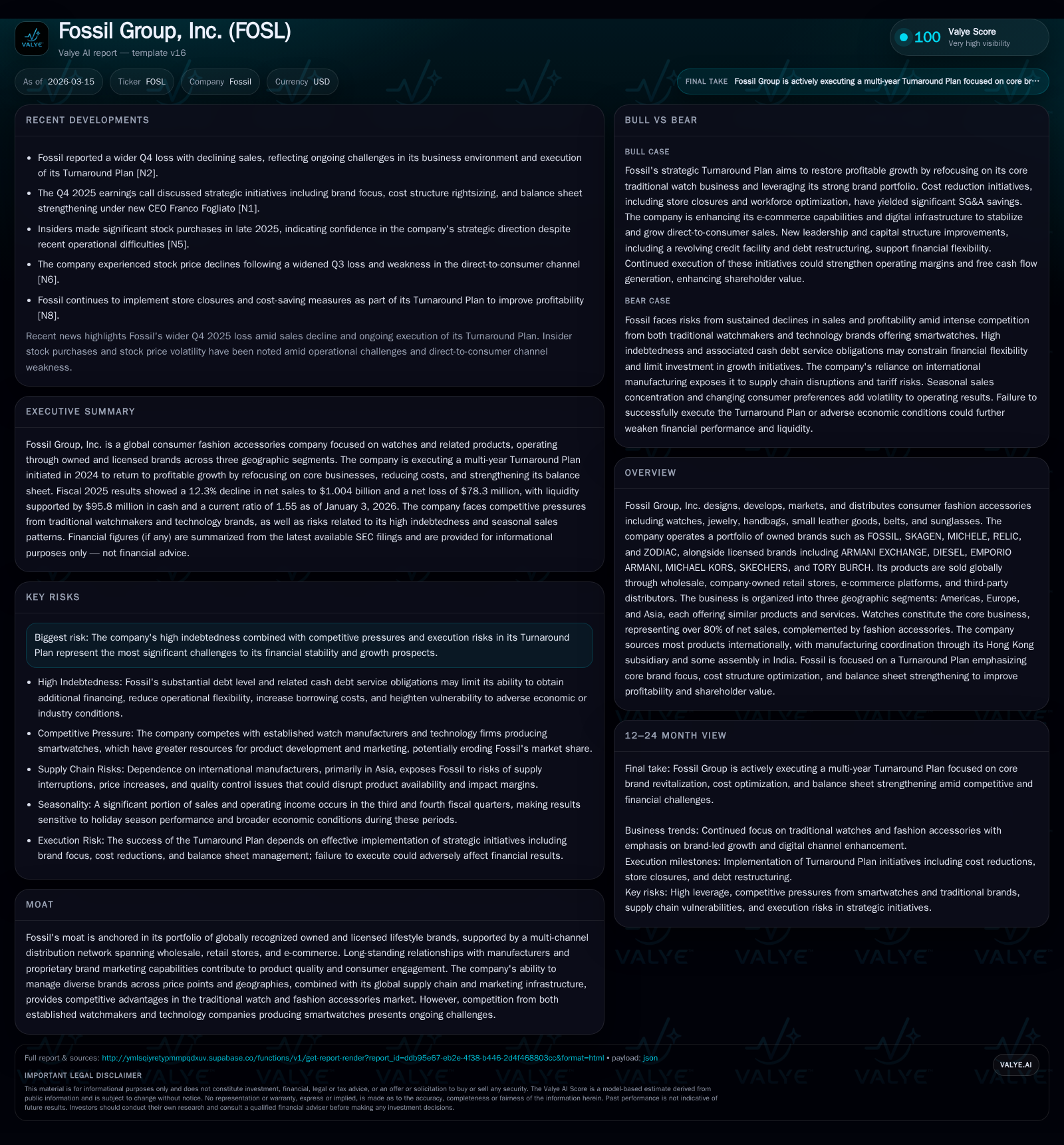
Fossil Group, a global designer and distributor of fashion accessories, is executing a strategic turnaround focused on returning to its traditional watches core, reducing costs, and strengthening its balance sheet. The company’s revenues declined by 8.4% year-over-year in fiscal 2025 with operating losses narrowing but remaining negative. Persistent headwinds include tariff impacts, competitive pressures from smartwatches, and substantial indebtedness that limits flexibility. Management aims to drive growth through brand innovation, supply chain improvements, and disciplined capital allocation.
Company Overview and Business Model
Fossil Group, Inc. specializes in consumer fashion accessories including watches—which make up more than 80% of net sales—jewelry, handbags, small leather goods, belts, and sunglasses. Its portfolio includes owned brands such as FOSSIL, SKAGEN, MICHELE, RELIC, and ZODIAC alongside licensed brands like ARMANI EXCHANGE, DIESEL, EMPORIO ARMANI, MICHAEL KORS, SKECHERS, and TORY BURCH [S1]. This diverse brand set targets style-conscious consumers across multiple price points globally.
Manufacturing primarily occurs overseas with coordination through regional warehouses located in Dallas (Americas), Eggstätt (Europe), and Hong Kong SAR (Asia). Distribution channels include wholesale customers where the company has a physical presence as well as third-party distributors in other markets; direct-to-consumer sales are facilitated via company-owned retail stores and e-commerce platforms [S13], [S24].
The business is managed across three geographic segments: Americas accounted for 42.9% of consolidated revenue in fiscal 2025; Europe contributed 33.2%; the remainder derives from Asia including Australia and major Asian markets ([S4], [S5]). Each segment offers a similar product mix through wholesale and direct channels.
Historical Performance: Revenue and Profitability Trends
The company has faced significant revenue contraction over recent years. Fiscal year 2025 revenue declined by approximately 8.4% year-over-year to roughly $1.0 billion compared to fiscal 2024 [F1]. Earlier in the decade revenues were substantially higher (e.g., over $3.5 billion in fiscal 2014), reflecting structural market shifts.
Operating income remained negative but improved materially from a loss of $104 million in fiscal 2024 to a loss of about $19 million in fiscal 2025 [F1]. Net income data shows volatility historically but no positive net income in recent years [F1].
Operating cash flow swung negative again in fiscal 2025 (-$58 million) after positive cash flow the prior year [F1], indicative of working capital pressures amid soft sales. Capital expenditures declined to approximately $2.6 million in fiscal 2025 from higher levels in prior years [F1].
Margin pressures are intensified by tariffs on imports primarily from China which increased costs by about 140 basis points during fiscal 2025 alongside a product mix shift away from smartwatches which generally carry lower margins ([S1], [S12], [S23]).
Historical performance (annual)
| FY | CFO ($mm) | OpInc ($mm) | Capex ($mm) |
|---|---|---|---|
| 2025 | -58 | -19 | 3 |
| 2024 | 47 | -104 | 7 |
| 2023 | -59 | -143 | 9 |
| 2022 | -111 | -1 | 13 |
Source: SEC companyfacts cache [F1].
Capital returns and efficiency (annual)
| FY | Buybacks ($mm) | FCF ($mm) |
|---|---|---|
| 2025 | 0 | -60 |
| 2024 | 0 | 40 |
| 2023 | 1 | -68 |
| 2022 | 12 | -124 |
Source: SEC companyfacts cache [F1].
Note: Financial figures are approximations based on SEC filings per [F1]; SG&A savings reported for FY25 only.
Turnaround Plan: Strategic Focus Areas
In September 2024, CEO Franco Fogliato launched a Turnaround Plan focused on three pillars:
- Refocusing Core: Emphasizing traditional watches over smartwatches; relaunching the FOSSIL brand platform; optimizing wholesale footprint; leveraging licensed brands; improving go-to-market execution; driving channel profitability.
- Rightsizing Cost Structure: Achieved ~$100 million reductions in SG&A expenses through workforce reductions, converting smaller international markets to distributor models, and closing 49 underperforming retail stores.
- Strengthening Balance Sheet: Monetization of non-core assets; improved working capital management; liquidity bolstered by new revolving credit facility secured August 2025 replacing prior facility; senior notes exchange offer completed November 2025 reducing near-term maturities ([S1], [S7], [S16], [S24]).
For fiscal year 2026 onward the plan evolves towards:
- Driving profitable growth via innovation anchored on flagship watch icons and collaborations.
- Modernizing point-of-sale experiences and focusing on key customers.
- Stabilizing e-commerce through digital investments.
- Enhancing supply chain agility for best-in-class performance.
- Establishing an emerging brands organization for scalable future growth.
- Delivering improved free cash flow while strategically deploying capital for growth and debt reduction ([S7], [S24]).
Market Challenges and Competitive Environment
The traditional watch segment faces competition from luxury watchmakers such as TAG Heuer and Movado as well as technology companies dominating smartwatches including Apple, Garmin, and Samsung [S22]. Fossil has shifted focus away from smartwatches given stronger branding advantages within traditional watches.
Tariffs arising from U.S.-China trade tensions increased gross margin costs by approximately 140 basis points during fiscal year 2025 with ongoing tariff volatility creating uncertainty ([S1]). The U.S., accounting for about one-third of sales, is particularly affected due to import exposure.
Inventory levels remain pressured by cautious buying patterns among wholesale customers amid macroeconomic uncertainty impacting consumer discretionary spending worldwide [N2], [S1].
High financial leverage constrains operational flexibility: long-term debt approximated $201 million at fiscal year-end plus availability under a $150 million revolving credit facility with approximately $16 million outstanding at year-end. Debt covenants restrict incurrence of additional financing or strategic transactions without lender approval ([S7]–[S9], [S14]–[S17], [S19]).
Returns and Capital Allocation
No dividends have been declared recently; share repurchases have been immaterial (approximately $164k buybacks in FY25). Capital allocation prioritizes debt reduction within efforts to rebuild shareholder value ([F1]).
Free cash flow remains negative at an estimated $60 million deficit for FY25 due to operating losses combined with modest capital spending funded from operations ([F1]).
Equity book value declined significantly over recent years consistent with sustained losses but was approximately $103 million at FY25 end compared to over $400 million several years ago ([F1]). Approximate return on equity is volatile due to net income fluctuations but recent figures suggest limited profitability driven mainly by non-operating factors rather than core business returns ([F1]).
Outlook Considerations
Investors should monitor:
- Revenue recovery progress through brand innovation especially within traditional watches plus potential premium product launches assembled domestically.
- Gross margin trends amidst tariff uncertainties balanced against supply chain improvements.
- Continued discipline on SG&A expense reductions beyond initial rightsizing achievements.
- Liquidity stability considering seasonal borrowing base fluctuations under the asset-based revolving credit facility.
- Inventory management effectiveness amid evolving consumer demand patterns impacting wholesale partners.
- Development progress within emerging brands aimed at future scalable growth beyond legacy labels.
- Compliance with debt covenants tied to borrowing base availability thresholds which could constrain flexibility if breached ([S7], [S16]–[S21]).
- Macroeconomic factors including trade policies influencing tariff impacts on cost structure.
Conclusion
Fossil Group is navigating significant operational challenges amid a comprehensive restructuring effort initiated in late 2024. The company leverages its portfolio of lifestyle brands distributed globally but faces execution risks heightened by substantial indebtedness limiting flexibility. Success depends on revitalizing traditional watch offerings aligned with consumer engagement strategies while maintaining financial discipline focused on deleveraging through free cash flow improvement over coming years.
This analysis is based exclusively on information contained within publicly available SEC filings dated up to March 12, 2026 and relevant news sources cited herein. It does not constitute investment advice or recommendations regarding Fossil Group's securities.
Disclaimer: This is research-only, informational analysis and not investment advice. It may include AI-generated interpretation and general industry context. Always verify important details using primary sources.

Comments