
Liquidmetal Technologies' Commercialization Bottlenecks and Manufacturing Expansion
Liquidmetal Technologies’ proprietary bulk amorphous alloy technology faces scaling challenges amid ongoing losses and strategic manufacturing ventures.
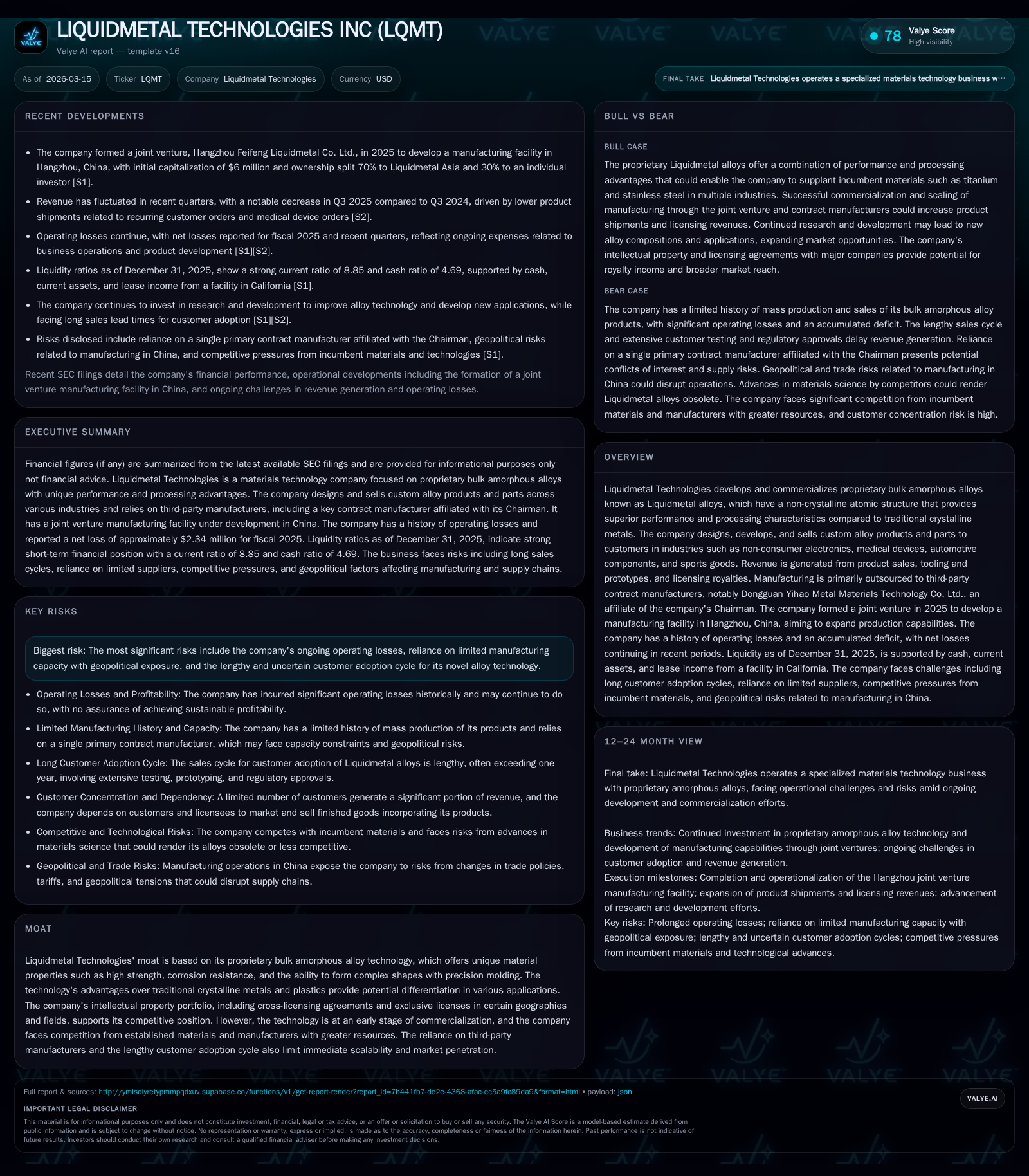
Liquidmetal Technologies, known for its proprietary bulk amorphous alloys with superior strength and precision molding capabilities, continues to struggle with limited revenue growth and widening operating losses over recent years. The company’s reliance on a single third-party manufacturer in China presents supply constraints and geopolitical risks, which it hopes to address through a joint venture for a new manufacturing facility in Hangzhou targeted for completion in 2026. While the technology holds promise across medical devices, automotive parts, and non-consumer electronics, lengthy customer adoption cycles and regulatory hurdles slow market penetration. Liquidity remains sufficient to fund near-term operations, but profitability remains elusive.
Unique Advantages of Liquidmetal Alloys: Foundations of the Business
Liquidmetal Technologies specializes in proprietary bulk amorphous alloys characterized by a non-crystalline atomic structure that distinguishes them from traditional crystalline metals encountered in typical industrial applications [S2]. These materials embody a blend of high elastic limit, exceptional strength and hardness, excellent corrosion resistance, non-magnetic properties, and the ability to replicate complex geometries via precision molding techniques similar to plastics injection molding—delivering dimensional control and surface finishes approaching precision machining tolerances.
The amorphous structure mitigates inherent weaknesses found in crystalline counterparts such as grain boundaries that often limit durability or introduce stress points. The company's alloys thus have the potential to supplant traditional high-performance metals like titanium or stainless steel in targeted uses where weight savings combined with mechanical performance matter. Moreover, these alloys enable manufacture of innovative geometries previously unviable with cast or machined crystalline metals [N1][S2]. This forms the technological moat underpinning Liquidmetal’s product differentiation.
Design engineers benefit from the material's processability which reduces complexity by enabling a single alloy composition to meet multifaceted criteria—strength, corrosion resistance, finish quality—without needing custom alloy tweaks typical of conventional metallurgy.
Historical Revenue Trends and Operating Losses: A Growth Analysis
Financial results illustrate significant challenges commercializing this advanced material technology. Revenue peaked at $558K in 2020 but has since contracted sharply to $77K by FY2022 as per reported figures [F1]. Given annual data up to FY2022 only captures revenue explicitly stated; operational commentary suggests continuing modest revenues along with fluctuating order volumes primarily driven by limited recurring customers.
Operating income reflects deepening losses from -$750K FY2022 escalating to -$3.7M FY2025 while net income narrowed slightly less severely—from -$2.39M FY2022 to -$2.34M FY2025 (Figure 1). This divergence owes partly to reduced non-operational expenses or other income elements unaccounted for here [F1].
Operating cash flow mirrors loss persistence with a worsening outflow trajectory: -$1.78M FY2022 deteriorated further to -$2.75M FY2025 despite drastically pared capital expenditures ($4K in 2025 vs $630K in 2019) demonstrating tight fiscal discipline but dependency on external financing when required [F1].
Historical performance (annual)
| FY | Net ($mm) | CFO ($mm) | OpInc ($mm) | Net YoY |
|---|---|---|---|---|
| 2025 | -2 | -3 | -4 | -55.0% |
| 2024 | -2 | -1 | -3 | +26.2% |
| 2023 | -2 | -1 | -3 | +14.5% |
| 2022 | -2 | -2 | -1 |
Source: SEC companyfacts cache [F1].
*Note: Revenue data post-2022 unavailable; operating metrics extrapolated from filings [F1]
Despite clear technical promises of its alloy portfolio, financials suggest persistent difficulties scaling volume production and translating technology into profitable sales.
Manufacturing Dependencies and the Strategic Hangzhou Joint Venture
A core bottleneck for Liquidmetal lies within its highly concentrated manufacturing base. The company relies predominantly on Dongguan Yihao Metal Materials Technology Co., Ltd., a contract manufacturer affiliated with Chairman Professor Lugee Li [N1][S3][S26]. This single-source supplier model introduces notable risk vectors:
- Capacity is limited relative to anticipated demand growth.
- Geopolitical exposure via China-based manufacturing subjects operations to tariff changes, trade policy shifts under U.S.-China tensions, sanctions or export restrictions.
- Supply chain uncertainties arising from labor disputes or regulatory hurdles.
To alleviate these constraints and scale production capabilities pivotal for mass-market adoption, Liquidmetal established a joint venture in 2025 aimed at developing a manufacturing facility in Hangzhou city [N1][S28]. Targeted operational readiness is expected by end-2026 though this timeline carries execution risk due to permitting delays, foreign investment controls under Chinese law changes, cost overruns or capital contribution shortfalls by joint venture partners.
Success of this JV will determine the breadth at which Liquidmetal can meet prototype-to-commercial transition demands—a critical milestone given extended "customer adoption cycles" typical for innovative material technologies requiring repeated validation before full-scale deployment.
Market Penetration Challenges in Diverse End-Use Industries
Liquidmetal targets several verticals comprising custom components fabricated from its bulk amorphous alloys: non-consumer electronics like specialized sensors or connectors; medical devices requiring stringent FDA premarket approvals; automotive parts subject to safety standards; and sports goods demanding performance materials [N1][S2][S7].
However:
- Medical device applications face protracted regulatory clearances involving Section 510(k) pathways or premarket approvals that impose cost/time barriers ([S7]).
- Varied custom design requirements limit standardized production runs thereby constraining economies of scale.
- Dominance of incumbent materials such as titanium or stainless steel backed by entrenched suppliers prolongs customer switching costs.
- Licensing revenue streams remain nascent as market adoption lags initial expectations.
Consequently, despite technological superiority claims (e.g., precision molding paired with superior corrosion resistance), sales pipeline development remains elongated with uncertain conversion rates impacting overall revenue trajectories.
Forecasting Growth Amid Customer Adoption Cycles and Capacity Expansion
Liquidmetal has not provided explicit multi-year guidance beyond ongoing emphasis on ramping its joint venture manufacturing facility [N1][S28]. Given historical volatility coupled with extended sales lead times noted internally ([S16],[S17]), near-term revenue growth will likely hinge on successful JV commissioning enhancing regular shipments from mass-production capable facilities.
Key metrics warrant monitoring include:
- Volume increases from recurring customers particularly within medical device applications currently generating modest orders;
- Licensing revenue development indicative of expanding IP monetization;
- Marginal improvements in gross margin percentages achievable only once higher throughput reduces fixed tooling costs per unit ([S12],[S13]);
- Progress on regulatory approvals facilitating expanded OEM applications.
Absent these tangible developments, sustained operating losses are probable given existing expense structure.
Capital Structure, Liquidity Position, and Capital Allocation
As of late FY2025 reporting periods Liquidmetal maintains approximately $7.16 million cash & equivalents plus an additional roughly $12 million investments mainly held as debt securities yielding interest income used to fund ongoing operations [F1][S6]. This liquidity translates into a strong current ratio around 8.85x illustrating robust short-term solvency relative to $1.53 million current liabilities detailed on balance sheet end-2025 [F1].
Capital expenditures remain minimal—just $4K in year ending December 31, 2025—signifying focus on optimizing current assets rather than investing heavily into new physical infrastructure outside JV commitments ([F1],[S23]).
Operating cash flows reflect persistent burn at about -$2.75M FY2025 after factoring modest capex resulting in negative free cash flow indicative of continued dependence on equity issuances or external funding if needed ([F1],[S6]). No dividend payments or share repurchase programs are evident reflecting the company's prioritization of preserving capital towards R&D and business expansion over shareholder distributions ([F1],[S5]).
ROE approximations indicate negative returns consistent with net loss trends underscoring challenges translating investments into profitability given small equity base juxtaposed against multi-year deficits ([F1]).
Risks from Geopolitical Factors, Regulatory Environment, and IP Litigation
Operational risk stemming from concentrated China-based manufacturing exposes Liquidmetal significantly to international trade volatility—including tariffs hikes under shifting U.S.-China policies—and potential restrictions limiting exports/imports critical for global customer fulfillment ([S3]).
Medical device markets necessitate FDA premarket clearances often prolonged by unpredictable review times imposing delays with financial implications ([S7]). Regulatory compliance costs have been noted as ongoing burdens affected by evolving U.S./foreign laws impacting licensing sales strategies.
Intellectual property is central yet contested; enforcement demands substantial legal resources with litigation risk arising both offensively against competitors or defensively against infringement claims challenging patent scope or exclusivity rights ([S4],[S21]).
Additionally corporate governance provisions grant management defensive tools potentially deterring hostile takeovers but may limit shareholder actions impacting stock price dynamics ([S22]). Cybersecurity dependencies pose existential hazards should data breaches disrupt sensitive production or client information flows ([S22]).
Overall these multidimensional risk factors accentuate uncertainties surrounding accelerated commercialization timelines that investors must weigh prudently.
Investor Takeaways: Valuation Considerations and Watchpoints
Liquidmetal Technologies presents a classical early-stage advanced materials technology profile balancing profound innovation against tangible execution hurdles compounded by niche market penetration struggles and geopolitical exposure.
While its bulk amorphous alloy compositions convey differentiated value propositions for durable precision molded components across technical specialties—a moat supported by granted patents and exclusivity mechanisms—the path towards sustainable profitability is impeded by:
- Restricted contract manufacturing capacity wholly reliant on related third-party suppliers,
- Lengthy customer adoption intervals especially within FDA-regulated medical device sectors,
- Fluctuating order volumes resulting in uneven top-line performance,
- Ongoing operating losses maintained through healthy liquidity buffers but reliant on disciplined capital allocation without current distribution returns,
- Regulatory complexity encompassing trade policy fluctuations and intellectual property enforcement costs,
- Strategic importance pinned on the successful scale-up of the Hangzhou joint venture manufacturing site whose commissioning timing remains subject to multiple external factors.
Key investor watchpoints should include announcements regarding:
- The operational status updates around the Hangzhou JV production ramp,
- Any increase in recurring commercial shipments particularly within medical devices,
- Growth or broadening of licensing royalty streams reflective of IP leverage expansion,
- Regulatory milestones advancing product approvals accelerating downstream customer acceptance,
- Updates addressing supply chain resilience amid broader geopolitical shifts affecting China-manufactured inputs.
Given these considerations Liquidmetal embodies the quintessential tension between disruptive material science promise poised against commercialization realities that define many young high-potential specialty materials companies today.
This analysis aims solely to present factual company information combined with sector context without providing investment recommendations or assessments relative to security valuation strategies.
Disclaimer: This is research-only, informational analysis and not investment advice. It may include AI-generated interpretation and general industry context. Always verify important details using primary sources.

Comments