
Eastman Kodak’s Financial Recalibration: From Pension Windfall to Operating Break-even
Kodak’s recent pension asset reversion has materially reshaped its liquidity and debt profile while its operating results remain uneven.
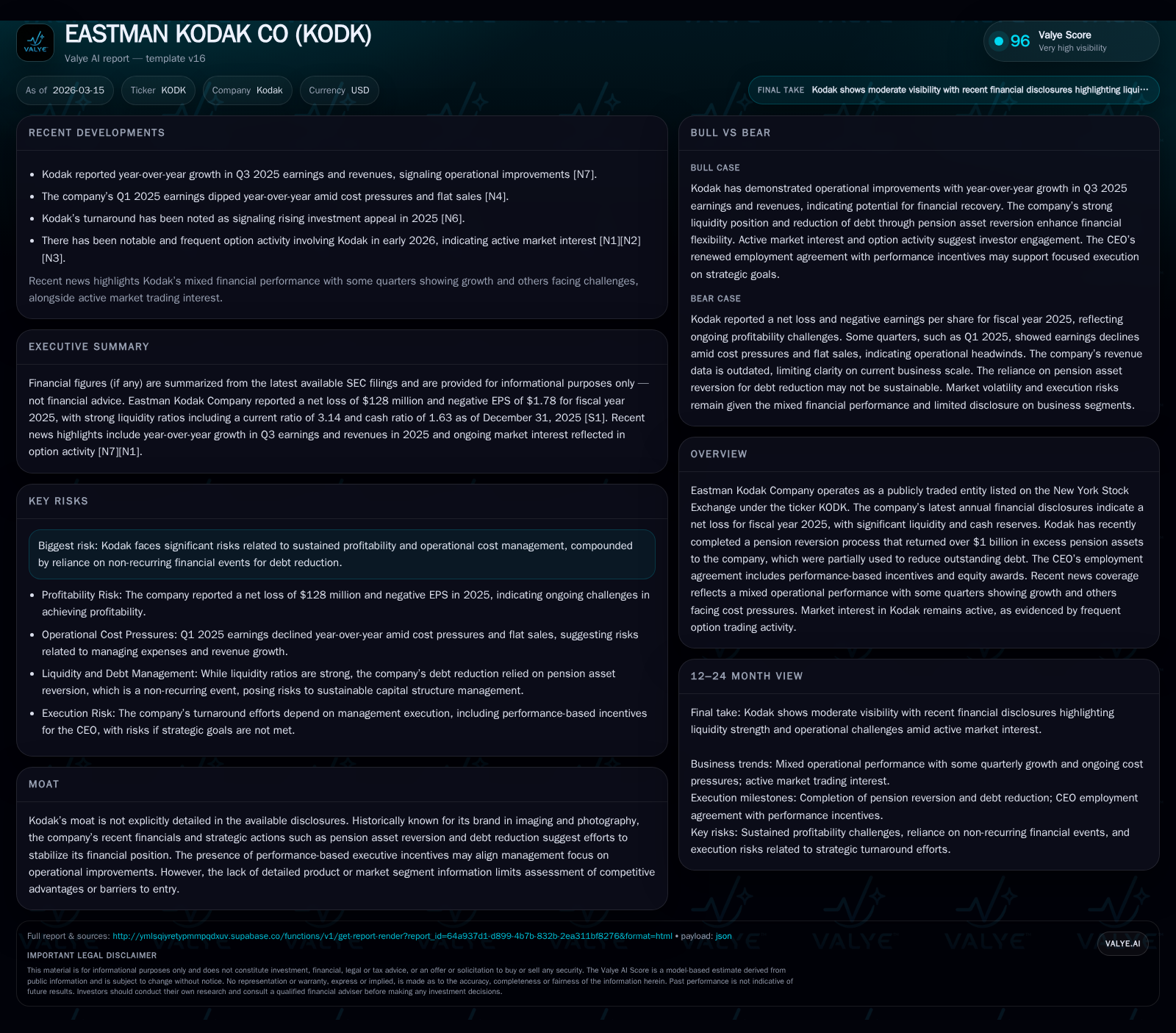
Eastman Kodak Company’s trajectory highlights a critical juncture where a non-recurring pension windfall bolstered cash reserves, enabling significant debt reduction and liquidity enhancement. Despite this capital restructuring, Kodak’s operating income has hovered around break-even with ongoing net losses, underscoring persistent profitability challenges. Management’s performance-linked incentives and steady, though modest, capital returns signal an intent to align operational execution with financial discipline. Key attention points include the sustainability of cash flows absent similar financial events and the company’s capacity to convert liquidity improvements into lasting growth.
Kodak’s Historical Performance: Revenue Plateau and Profitability Swings
Eastman Kodak’s revenue trajectory presents a picture of stagnation over the past several years. Revenues measured approximately $414 million in both FY2017 and FY2016, with no material top-line expansion apparent through these latest figures [F1]. This flatness underscores Kodak’s struggle to rejuvenate its core imaging-based revenue streams or replace them with new growth drivers.
Operating income has been volatile, dipping as low as a $26 million loss in FY2022 before marginally recovering to breakeven ($0) by FY2025 [F1]. This indicates some level of margin stabilization—likely achieved through cost control or efficiency improvements—but it falls short of generating positive operating profitability. Net income swings are more pronounced: surging positive results in FY2023 and FY2024 (e.g., $75 million and $102 million respectively) were followed by a dramatic swing back to a $128 million loss in FY2025 [F1]. This volatility suggests episodic impacts outside core operations influence reported earnings.
Notably, operating cash flow (CFO) surged extraordinarily from negative $7 million in 2024 to positive $480 million in 2025 [F1]. This outsized increase aligns temporally with the pension reversion event rather than organic business improvement. Meanwhile, capital expenditures declined from $56 million in FY2024 to $34 million in FY2025 [F1], reflecting either reduced reinvestment or rationalized capex plans amid uncertain growth.
Historical performance (annual)
| FY | Net ($mm) | CFO ($mm) | OpInc ($mm) | Capex ($mm) | Net YoY |
|---|---|---|---|---|---|
| 2025 | -128 | 480 | 0 | 34 | -225.5% |
| 2024 | 102 | -7 | -7 | 56 | +36.0% |
| 2023 | 75 | 38 | 4 | 32 | +188.5% |
| 2022 | 26 | -116 | -26 | 31 |
Source: SEC companyfacts cache [F1].
Capital returns and efficiency (annual)
| FY | Div ($mm) | Buybacks ($mm) | FCF ($mm) |
|---|---|---|---|
| 2025 | 2 | 7 | 446 |
| 2024 | 4 | 1 | -63 |
| 2023 | 4 | 0 | 6 |
| 2022 | 4 | 1 | -147 |
Source: SEC companyfacts cache [F1].
Revenue YoY is derived between FY24 and FY25; Operating income YoY shows movement from loss to break-even. Net income swings reflect large non-operating impacts.
Impact of the Pension Asset Reversion on Kodak’s Liquidity and Debt Profile
Kodak’s financial recalibration hinged on the completion of a pension asset reversion from the Kodak Retirement Income Plan (KRIP), which returned $1.023 billion in excess assets as of November 26, 2025 [S14]. This comprised roughly $614 million in cash plus about $409 million in investments primarily held as hedge funds undergoing redemption [S14].
From these reverted assets, Kodak redirected about $256 million to establish the Kodak Cash Balance Plan for ongoing employee benefits—designed to avert additional cash costs—and retained the balance [S14]. Approximately $312 million of cash was deployed immediately toward term loan prepayments, slashing outstanding debt from a higher unspecified level down to roughly $200 million by year-end [S14],[F1]. Remaining liquid funds were earmarked for excise taxes associated with the reversion ($153 million due late-2025) and planned gradual redemption of hedge fund assets anticipated through 2026–28 [S14],[S16].
This transaction created a substantial one-time liquidity infusion that materially improved Kodak’s capital structure by deleveraging term loans and augmenting cash reserves evidenced by reported cash & equivalents of approximately $337 million at December 31, 2025 [F1]. The resulting current ratio stands at an estimated robust 3.14 (Current Assets of $841M vs Current Liabilities of $268M) [F1], underscoring an enhanced short-term liquidity buffer.
These dynamics reflect a transformative but non-operational source of cash flow strengthening that provides temporary balance sheet relief yet does not directly impact underlying earnings generation.
Operational Dynamics: Mixed Quarterly Results Amid Cost Pressures
Recent quarters have shown inconsistent operational performance complicated by cost absorption challenges. News coverage highlights fluctuations between modest revenue growth spurts and increased expense pressures compressing margins [N1],[N2].
SEC filings cite management discussion addressing tightened margins due to raw material cost increases alongside efforts to control overheads [S1],[S2]. The variability creates uncertainty around earnings quality as episodic gains often offset by higher costs or one-off charges.
This pattern reflects margin compression driven by adverse cost absorption dynamics common among legacy industrial firms undergoing transition.
Corporate Governance and Incentive Alignment Under New Employment Agreements
Kodak has aligned executive incentives with operational improvement goals via employment agreements featuring performance-linked bonuses capped at up to 125% of base salary and equity grants structured as time-vesting and performance-vesting restricted stock units (RSUs) over multi-year horizons [S20].
These measures aim to ensure management focus on medium-term financial targets despite current profitability challenges.
Outlook on Growth Prospects and Financial Constraints
Kodak faces headwinds including regulatory risks, litigation exposures, competitive pressures dampening revenue prospects, and ongoing cost volatility [N1],[N2],[S4],[S7].
While the pension reversion temporarily improves liquidity allowing some flexibility for reinvestment or deleveraging strategies, there is limited public indication of sustainable organic growth drivers or breakthrough innovation initiatives [S8]. The company acknowledges risks tied to dependence on one-time financial events for relief limiting long-term growth absent operational improvements [S4],[S7].
Capital Allocation Trends: Dividends, Repurchases, and Debt Reduction
Post-pension windfall capital allocation reflects prudence balanced with shareholder returns. Dividends paid were minimal at approximately $2 million for fiscal year 2025—a decline from prior levels consistent with cautious cash management amid earnings uncertainty [F1],.
Share repurchases increased moderately to about $7 million in fiscal year 2025 compared with prior minimal activity but remain restrained relative to free cash flow largely boosted by pension-related inflows [F1],.
Capital expenditures decreased nearly 40% year-over-year to about $34 million aligning with conservative investment posture amid uncertain outlooks [F1]. Crucially, term loan principal repayments following pension asset deployment reduced leverage significantly enhancing balance sheet flexibility [S14],[F1].
Together these moves indicate measured balance sheet repair focus rather than aggressive expansion.
What to Watch: Cash Flow Sustainability and Market Sentiment
Key metrics for future monitoring include sustaining elevated operating cash flows absent repeat financial injections like the pension event [F1],[S14], timing and conversion rates of investment redemptions impacting corporate liquidity through early FY2028 [S14],[S16], and quarterly profitability trends reflecting cost containment effectiveness.
Investor interest evidenced by heightened options trading activity further signals market focus on Kodak's strategic developments ([N1],[N2]).
These factors collectively will determine if Kodak can transition from structurally improved but loss-making status into consistent profit generation and value creation.
Disclaimer: This report is for informational purposes only and does not constitute investment advice or recommendations. Analysis is based exclusively on data provided through official filings and verified news sources without speculative extrapolation beyond cited disclosures.
Disclaimer: This is research-only, informational analysis and not investment advice. It may include AI-generated interpretation and general industry context. Always verify important details using primary sources.

Comments