
Star Gold Corp.'s Exploration Challenges and Funding Dynamics
The company's early-stage exploration efforts at its Longstreet Property face persistent financial and operational headwinds amid a constrained capital environment.
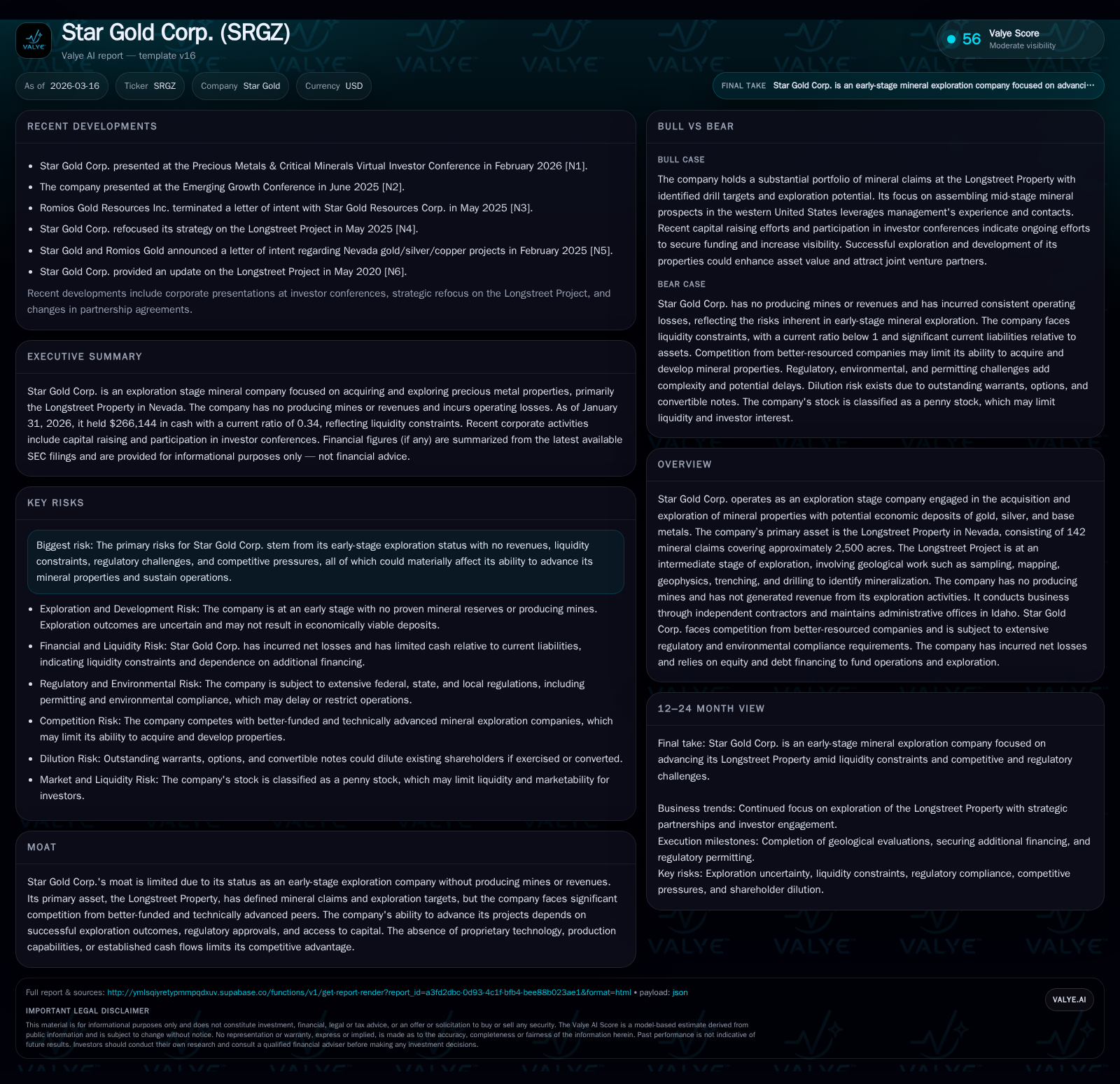
Star Gold Corp. remains in the exploration phase with no producing mines or revenue, focusing predominantly on its Longstreet Property in Nevada. Despite incremental progress in geological activities, the company continues to record operating losses and experiences liquidity challenges, relying heavily on equity financings to fund operations. Future growth hinges critically on successful exploration outcomes, regulatory approvals, and access to capital, while significant risks around dilution, competitive pressures, and regulatory compliance persist.
From Humble Beginnings: Historical Exploration Performance and Financial Track Record
Star Gold Corp. operates without producing mines or revenues from mineral extraction activities. The company's financial history from fiscal year (FY) 2022 through FY2025 illustrates consistent operating losses and net deficits reflective of its status as an exploration-stage entity largely engaged in property acquisition and geological assessment rather than commercial mining. Specifically, FY2025 ending April 30 showed an operating loss of $203,028 (a deepening loss by 4.4% year-over-year) and a net loss of $257,386 (an 8.3% increase YoY) [F1]. Meanwhile, operating cash flow has slightly improved by 10.8% in the same period but remains negative at -$157,294.
This pattern underscores the fundamental challenge for junior explorers: sustained expenditures on exploratory work absent any operational revenue. The company’s balance sheet reflects this trend with negative equity of approximately -$314,755 as of FY2025 [F1]. These figures align with management’s expectation of continued losses as Star Gold advances its property evaluations.
Historical performance (annual)
| FY | Net ($) | CFO ($) | OpInc ($) | Net YoY |
|---|---|---|---|---|
| 2025 | -257386 | -157294 | -203028 | -8.3% |
| 2024 | -237711 | -176337 | -194503 | +44.0% |
| 2023 | -424840 | -282810 | -400552 | -8.0% |
| 2022 | -393195 | -253129 | -389033 |
Source: SEC companyfacts cache [F1].
Capital returns and efficiency (annual)
| FY | ROE% |
|---|---|
| 2025 | 81.8 |
| 2024 | 414.4 |
| 2023 | -235.6 |
| 2022 | -65.0 |
Source: SEC companyfacts cache [F1].
Table: Star Gold Corp. historical annual financial performance highlighting ongoing cash burn and losses [F1].
Core Mineral Assets: The Significance of the Longstreet Property in Nevada
Star Gold’s principal asset is the Longstreet Property in Nevada—a collection of 142 mineral claims spanning approximately 2,500 acres [S1][S6]. These claims consist largely of unpatented mining claims governed under the Mining Law of 1872. The company controls about 137 of these claims directly while leasing the remaining five from local ranchers under specific agreements known as the "Clifford Lease" [S1][S27].
Unpatented claims grant Star Gold rights to explore for minerals on federally owned public lands subject to compliance with federal and state regulations but do not convey ownership of land itself—a typical approach among junior exploration companies aiming to mitigate upfront acquisition costs.
The Company’s focus on the intermediate stage of exploration involves fieldwork such as geological mapping, sampling programs focused on precious metals like gold and silver alongside base metals potential presence [S1][S21]. Independent contractors conduct much work given Star Gold’s lean administrative structure centered in Idaho [S16].
Despite this strategic assemblage of prospective mineral acreage with defined drill targets informed by earlier studies performed by third parties or predecessors [S14], there is no producing mine nor proven reserves presently declared—the project remains speculative pending further assay results.
Exploration Progress and Operational Developments Over Time
Since acquisition efforts intensified over past years culminating with various geological campaigns—involving trenching and reconnaissance drilling—the exploration program aims at identifying economic mineralized zones for potential resource delineation [S1][S6][N1]. The data gathered through rock sampling and geophysics contribute to refining drill targets intended to verify mineralization characterized thus far by inferred resources.
Notably absent is any commercial production or revenue generation consistent with its exploratory classification [S1]. Participation at industry events like the Precious Metals & Critical Minerals Virtual Investor Conference in February 2026 illustrates management’s efforts to engage capital markets stakeholders amid fundraising needs [N1]. Such forums serve dual functions as platforms for dissemination of operational updates while scouting joint venture partners essential for scaling development stages without excessive equity dilution.
Pathways forward likely depend on successful definition of mineral deposits sufficient to attract partner investment or financing capable of underwriting costly feasibility studies needed prior to construction decisions.
Decoding Liquidity and Capital Structure Amid Funding Imperatives
Liquidity metrics paint a constrained picture for Star Gold Corp., typical for junior explorers lacking cash flow from operations. As of January 31, 2026, the company held current assets valued at approximately $352K against current liabilities surpassing $1 million—translating into a depressed current ratio near 0.34 indicating short-term coverage insufficiency without external infusions [F1]. Cash and equivalents approximated only $266K during that period.
Funding recently improved via a private placement closed February 27, 2026 that raised roughly $3.68 million through combined debt conversion and issuance of common stock plus warrants priced at $0.04 per unit [S3][S24]. While this capital injection provides temporary runway allowing continuity in exploration expenditures—such as drilling campaigns—it introduces dilution risk notable for shareholders given associated warrants exercisable at $0.08 within twelve months: this contingent dilution could represent material expansion of share count if executed.
Debt levels remain manageable with convertible notes aggregating around $627K convertible into over 31 million shares representing nearly 27% pro forma ownership dilution if conversions occur [S11]. Board members and insiders participated alongside accredited investors in financing rounds reflecting their vested commitment but also concentration risk linked to management control over strategic decisions.
Overall capital structure constraints combined with penny stock categorization exacerbate trading illiquidity hampering secondary market transactions for shareholders and complicating additional capital raises unless terms are enticingly favorable to new investors [S7][S8].
Future Growth Prospects: Geological Potential vs. Market and Regulatory Realities
Growth prospects for Star Gold pivot almost entirely upon proving up economically viable mineral reserves through ongoing exploration success primarily within its Longstreet Project boundaries [S1][N1]. Biophysical heterogeneity combined with advanced geological modeling forms the basis for optimism around drill target prioritization—however field realities underscore high uncertainty inherent in early-stage exploration ventures.
Externally facing risks curtail upside expectations: regulatory complexities encompassing environmental permitting governed stringently across federal agencies including Bureau of Land Management plus Nevada Department of Environmental Protection impose timelines often extending over months or years before minable approvals can be granted [S18][S20]. Furthermore fluctuating precious metals prices regulate project economics; downturns may stall advancement thereby extending cash burn cycles beyond comfortable durations.
Substantial competition exists within Western US mining claims involving better-capitalized entities able to leverage technical expertise or pursue acquisitions aggressively impacting Star Gold’s access both to financing sources and quality property opportunities alike [S16]. Consequently any material project milestone such as favorable assay intercepts will be crucial catalysts enhancing partnerships or JV negotiations fueling growth beyond purely internal funding constraints.
Capital Allocation Patterns: Equity Raises, Cash Flow Constraints, and Dividend Policy
Star Gold’s capital deployment focuses primarily on sustaining exploration activities financed through successive equity offerings noting significant operating cash flow deficits annually near six-figure ranges we documented earlier [F1][S4]. No dividends have been declared nor share repurchases implemented reflecting prudent retention policies aligned with current non-revenue generating status where reinvestment supersedes distributions [S4][S28].
Without meaningful operational cash inflows projected short term there's reliance on efficient capital raises calibrated against dilution impacts noted above. Management appears oriented toward balancing continuation capital sufficiency while limiting excessive shareholder value erosion though tradeoffs between timing versus pricing remain acute challenges given OTCQB listing limitations.
No formal forecasts are currently provided beyond planned technical programs tied explicitly to exploration phases; hence investor attention gravitates toward milestones like drilling results releases or permit advances currently approximated but unscheduled precisely due to regulatory pacing.[N1]
Risks in Focus: Penny Stock Status, Regulatory Hurdles, and Competitive Pressures
Critical risk disclosures emphasize Star Gold's vulnerability arising from multiple angles: its status as a penny stock constrains liquidity restricting broker-dealer willingness to transact shares which can negatively impact investor exit opportunities or wider market participation [S7][S8][S12]. Extensive regulatory oversight demands costly environmental studies complemented by permitting requirements enclosing reclamation bonding making compliance financially strenuous with uncertainties introducing execution delays therefore cost overruns possible [S5][S18][S20].
Competitive pressures stem from rivals possessing superior access to capital reserves enabling more aggressive acquisitions or accelerated development programs potentially marginalizing Star Gold's claims competitiveness or bargaining power among financing partners.[S16]
Moreover intrinsic geological unpredictability inherent within mineralization estimates introduces risk where resource models might not translate into mineable reserves adversely affecting future valuations leading possibly to write-offs rendering investments speculative by nature.[S22]
Finally governance considerations spotlight concentrated insider ownership (~30%) which could align management interests closely with operational agility but also raises risks surrounding minority shareholder influence dilution.[S19]
What Investors Should Monitor: Upcoming Milestones and Market Sentiment
Absent explicit forward guidance beyond standard caveats embedded in filings investors should closely watch forthcoming deliverables anticipated from ongoing exploration campaigns such as drill intercept assay reports that materially redefine resource confidence levels providing tangible proof points critical for advancing development stages.[N1][S3]
Additional cues derive from regulatory permit progress enabling transition beyond exploration potentially reducing timeline uncertainty that retards investor enthusiasm.
Furthermore any announcements regarding joint venture arrangements or strategic partnerships would provide validation signals reflecting external confidence beneficially impacting market sentiment given scarce internal financial resources underpinning execution plans.
Given prevailing volatility typical amongst junior mining entities Shareholders must weigh sector fundamentals namely gold price trends plus macroeconomic variables influencing cost structures alongside company-specific operational achievements shaping overall valuation trajectories.
Disclaimer: This analysis is based solely on publicly filed information up to March 16th, 2026 and does not constitute investment advice or recommendations.
Disclaimer: This is research-only, informational analysis and not investment advice. It may include AI-generated interpretation and general industry context. Always verify important details using primary sources.

Comments