
Elbit Systems Boosts Profitability on Backlog Growth Amid Geopolitical Tensions
The global defense technology firm leverages strong order backlog and strategic operations to deliver sizable earnings growth in 2025.
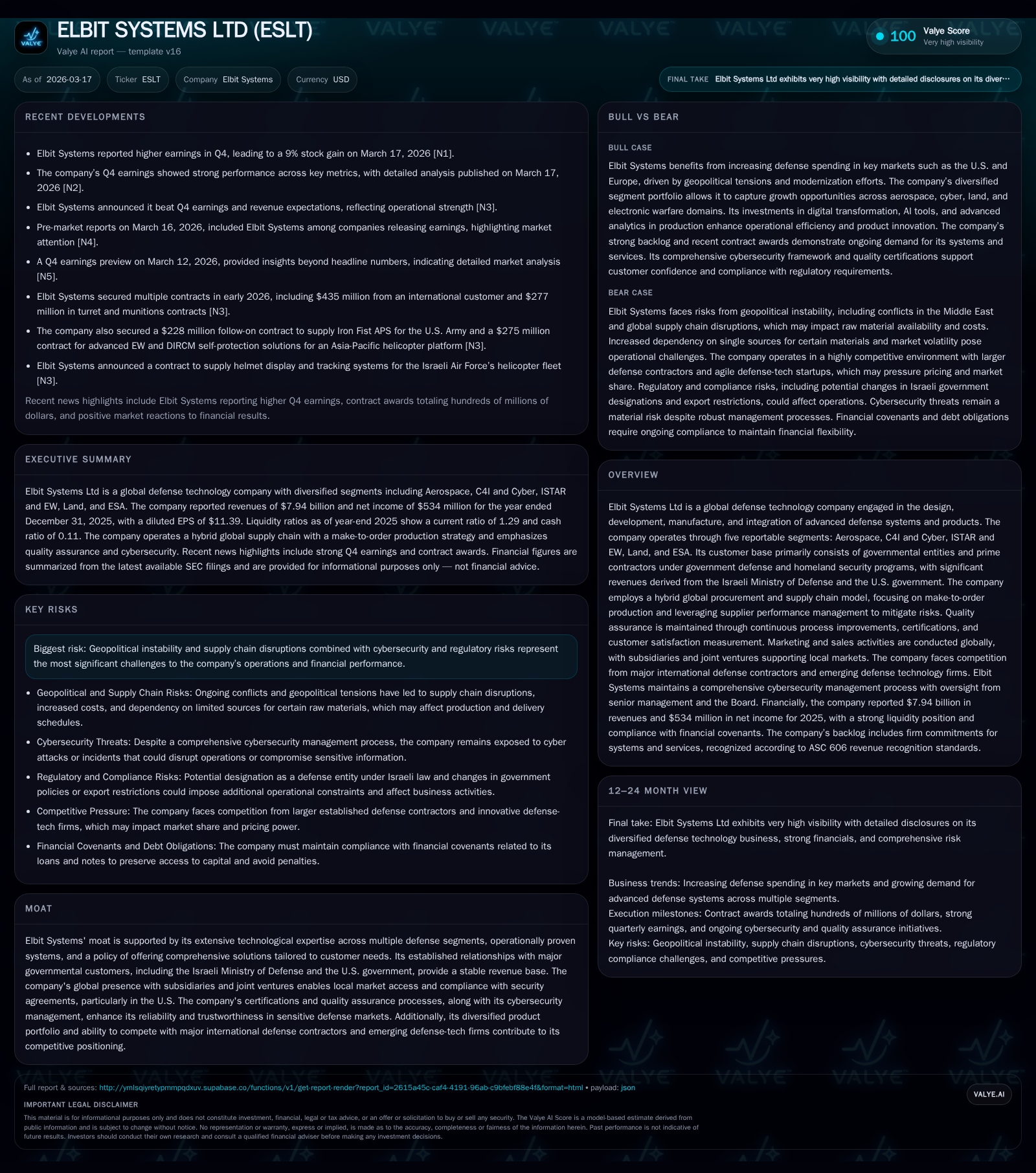
Elbit Systems Ltd recorded robust financial expansion in 2025, driven by a 16.3% rise in revenues to $7.94 billion and a sharp 37.3% increase in operating income to $671 million. Growth was fueled primarily by surging demand from the Israeli Ministry of Defense and international customers amid heightened geopolitical tensions in the Middle East and Ukraine. The company’s $28.1 billion order backlog, with over 70% from outside Israel, reflects sustained momentum, though supply chain risks from regional conflicts and protectionist trade policies remain challenges. Elbit’s capital allocation shows disciplined reinvestment with $226 million capex and moderate dividends, underpinning a healthy 12.9% return on equity.
Company Overview
Elbit Systems Ltd is a global defense technology leader engaged across multiple segments including Aerospace, C4I and Cyber, ISTAR and EW, Land, and ESA (Electronic Systems & Advanced solutions) [N1][S1]. Its primary customers include the Israeli Ministry of Defense (IMOD) and the U.S. government as well as other international defense entities.
Historical Financial Performance
Elbit demonstrated steady revenue growth accelerating in 2025:
Historical performance (annual)
| FY | Rev ($bn) | Net ($mm) | CFO ($mm) | OpInc ($mm) | Rev YoY | Net YoY |
|---|---|---|---|---|---|---|
| 2025 | 7.9 | 534 | 778 | 671 | +16.3% | +66.4% |
| 2024 | 6.8 | 321 | 535 | 489 | +14.3% | +49.3% |
| 2023 | 6.0 | 215 | 114 | 369 | +8.4% | -21.9% |
| 2022 | 5.5 | 275 | 240 | 367 |
Source: SEC companyfacts cache [F1].
Capital returns and efficiency (annual)
| FY | Div ($mm) | FCF ($mm) | ROE% |
|---|---|---|---|
| 2025 | 112 | 553 | 12.9 |
| 2024 | 89 | 320 | 9.8 |
| 2023 | 89 | -73 | 7.3 |
| 2022 | 87 | 35 | 10.0 |
Source: SEC companyfacts cache [F1].
Revenue growth was supported by expanding sales mainly to IMOD, which accounted for an increasing share of revenues over the years, alongside growing international contracts particularly in North America and Europe [S6][S8].
The Land segment notably increased operating income from approximately $151 million in FY2024 to about $264 million in FY2025, driven by higher demand for munitions during regional conflicts [S19]. The ISTAR and EW segment also improved operating income by around $33 million year-over-year.
Operational Context and Strategy
Elbit operates a hybrid global procurement model balancing efficiency with risk management through supplier performance monitoring and diverse sourcing where feasible [S1][S13]. Geopolitical tensions including the Russia-Ukraine conflict, Middle East hostilities termed "Swords of Iron," and evolving trade restrictions have introduced supply chain challenges prompting inventory increases for critical materials such as explosives components [S1][S10]. This approach helps mitigate disruptions from constrained shipping routes like the Red Sea.
Quality assurance integrates continuous process improvement methods such as Lean and Kaizen within a consolidated ERP ecosystem featuring Manufacturing Operations Management (MOM) systems that support Industry-4.0 digital transformation initiatives including AI-driven analytics for production efficiency [S1][S10]. These capabilities contribute to meeting stringent government acceptance criteria while maintaining essential ISO/AS certifications.
Competitive Landscape
Elbit competes with major multinational defense contractors like Lockheed Martin, Boeing, Raytheon, Northrop Grumman, BAE Systems as well as emerging deep-tech defense firms such as Anduril Industries and Shield AI known for disruptive innovations [S6][S8]. Despite intense competition, Elbit's broad technological expertise across segments combined with localized market presence supported by subsidiaries under strict security agreements sustains its competitive edge [N11][S8].
Outlook and Growth Drivers
Elbit's order backlog stood at $28.13 billion at end-2025—about four years of revenue at current run rates—with over two-thirds sourced internationally outside Israel, demonstrating global expansion success [S18]. Approximately half of this backlog is expected to be executed within the next two years.
Ongoing geopolitical tensions have elevated demand for mechanized warfare capabilities including counter-drone systems (C-UAS), cyber-defense solutions, precision munitions, and intelligence platforms aligning well with Elbit’s portfolio [S18][N9]. Increased European defense spending further supports opportunities in C4ISR modernization programs.
Challenges include supply chain constraints due to single-source components subject to export controls or subcontractor localization requirements and regulatory complexities affecting cross-border transactions involving classified technologies [S13][S22]. Potential designation as an Israeli "defense entity" could introduce acquisition restrictions impacting future M&A or foreign investment activities pending governmental approvals [S1].
Capital Structure and Returns
As of December-end-2025, Elbit held solid liquidity with cash reserves of approximately $635 million complemented by bank loans ($81 million), commercial paper ($48 million), and longer-term notes totaling about $308 million supporting working capital needs reflected by a current ratio of roughly 1.29 [F1][S5][S7].
Operating cash flow reached approximately $778 million in FY2025—up nearly +46% year-over-year—supported by advance payments from customers; capital expenditures were about $226 million primarily directed towards facility upgrades and ERP system enhancements [F1][S24]. Dividend payments totaled around $112 million indicating a balanced capital return approach.
Return on equity was approximately an attractive ~12.9%, highlighting effective use of capital amid margin expansions including gross profit margins near ~24% of revenues [F1][S12][S15].
Risk Factors
Geopolitical uncertainty remains a key risk factor impacting personnel availability during reserve duties and elevating labor costs despite indemnities; supply chain vulnerabilities persist due to reliance on limited sources for critical inputs compounded by transport disruptions from regional conflicts or sanctions regimes [S22][S10][S13]. Cybersecurity threats are managed through a comprehensive governance framework led by dedicated CISO teams focusing on governance, incident response, application security, and supplier compliance mitigating potential impacts [S22][S1]. Compliance with international industrial participation obligations adds complexity requiring coordinated management across jurisdictions; failures could result in penalties or lost business opportunities [S16][S21].
Conclusion: What to Watch Next
Near-term performance will depend on successful backlog execution amid ongoing normalization of supply chains impacted by geopolitical flux; contract wins outside Israel will indicate sustainability of international market penetration.
Monitoring U.S. and European defense budget allocations toward modernization programs aligned with Elbit’s offerings will be crucial alongside regulatory developments concerning its Israeli defense entity status.
Progress on digital factory initiatives embedding AI-driven operational tools will serve as key indicators of scalable capacity benefits for anticipated volume increases.
Overall, managing labor cost pressures through government support or internal efficiencies will materially influence profitability amidst an uncertain macro environment.
This analysis is based exclusively on publicly available information without offering investment advice or recommendations.
Disclaimer: This is research-only, informational analysis and not investment advice. It may include AI-generated interpretation and general industry context. Always verify important details using primary sources.

Comments