
dLocal's Rapid Revenue Expansion Highlights Emerging Markets Opportunity and Legal Risks
dLocal’s 2025 results illustrate strong growth driven by emerging market payments innovation, counterbalanced by ongoing litigation and governance concentration.
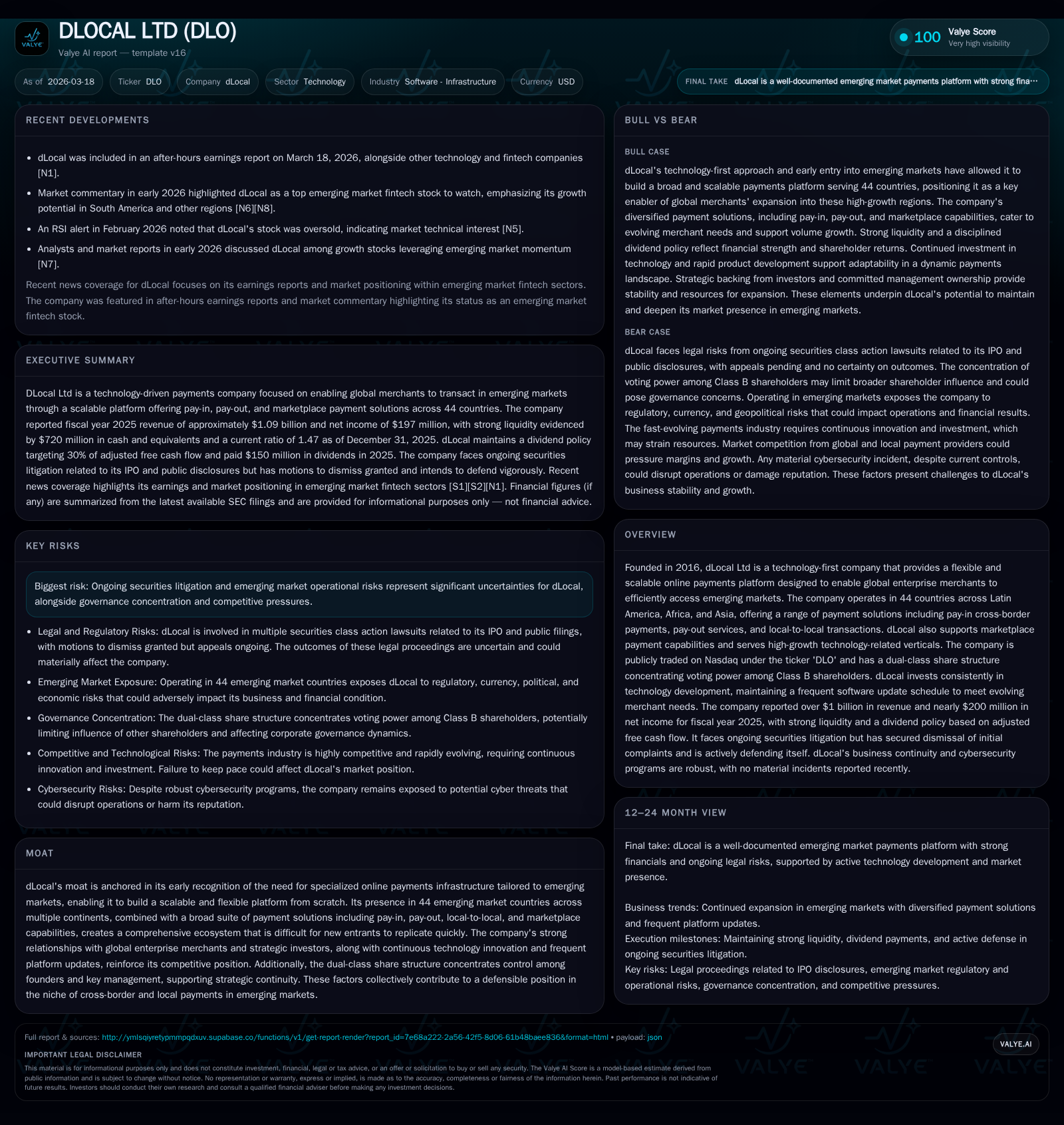
dLocal Ltd, a payments technology platform enabling global merchants to access 44 emerging markets, delivered robust revenue growth of nearly 47% in 2025, reaching over $1 billion. The company’s scalable, multi-product platform—covering pay-in, pay-out, and marketplace solutions—has established a defensible market position fueled by continuous technological innovation and geographic expansion. However, regulatory and legal risks persist, including notable securities litigation currently under appeal in New York courts. Capital allocation remains disciplined with an evolving share repurchase program and sustained dividend policy representing around 30% of adjusted free cash flow.
Historical Growth and Performance
dLocal Limited has demonstrated rapid expansion since its founding in 2016 to become a critical payments facilitator across emerging markets. The company's top-line surged impressively by 46.6% in fiscal year (FY) 2025 to $1.09 billion from $746 million in FY2024 [F1]. This acceleration reflects broad merchant adoption of its flexible platform that spans Latin America, Africa, and Asia—regions often underserved by traditional payment processors.
Net income growth exceeded revenue gains with a 63.4% increase year-over-year to $197 million in 2025 [F1]. This resulted in a strong return on equity approximating 34.6%, given the reported equity base of about $569 million [F1]. The relatively higher net income growth suggests improving operating leverage and efficiency gains amid scale.
The company’s operating cash flows experienced a remarkable turnaround from a cash outflow of nearly $33 million in 2024 to positive generation of about $415 million in 2025 [S1][S16]. This was driven by increased profits before taxes (adjusted for non-cash items) alongside expanded working capital inflows mainly linked to merchant-related funds that dLocal manages transiently as part of payment processing. A positive inflow of $163 million in working capital contrasts with an outflow the prior year, underscoring enhanced business dynamics [S16].
Investing activities were modestly positive at $5.3 million generated compared with negative investing cash flow the prior period due primarily to timing differences related to financial asset acquisitions and disposals [S1][S16]. Capital expenditures remained consistent at roughly 3% of revenues (approximately $37 million), reflecting continued investment mainly into internal software development and IT infrastructure to sustain platform agility [S1][S7][S13].
Financing cash usage increased by over $50 million to $121 million primarily attributable to a significant dividend payout increase ($150 million paid versus prior periods), partially offset by lowered share repurchases which fell sharply due to suspension of active buybacks during the year [S1][S8][S15][S16].
Historical performance (annual)
| FY | Rev ($mm) | Net ($mm) | Rev YoY | Net YoY |
|---|---|---|---|---|
| 2025 | 1094 | 197 | +46.6% | +63.4% |
| 2024 | 746 | 120 | +14.7% | -19.2% |
| 2023 | 650 | 149 | +55.2% | +37.2% |
| 2022 | 419 | 109 |
Source: SEC companyfacts cache [F1].
Capital returns and efficiency (annual)
| FY | ROE% |
|---|---|
| 2025 | 34.6 |
| 2024 | 24.6 |
| 2023 | 32.8 |
| 2022 | 27.2 |
Source: SEC companyfacts cache [F1].
Note: Dividend figure estimated based on disclosures; no buybacks occurred during FY25 under authorized plan.
Business Model and Market Position
dLocal operates as a technology-first online payments infrastructure provider targeting emerging markets—a segment characterized by fragmented payment methods, regulatory complexity, and limited cross-border facilitation options [S14]. Initially launching pay-in cross-border payments functionality focused on Brazil, dLocal expanded rapidly into multiple countries managing local acquiring licenses and compliance regimes across Latin America (including Mexico, Argentina, Colombia), Africa (Nigeria, South Africa), and Asia (India, Philippines) [S14].
The company offers diversified product lines: cross-border pay-in solutions enabling global merchants to accept local payments; fast-growing pay-out services allowing efficient local settlements; local-to-local transactions bridging domestic payment ecosystems; plus marketplace capabilities supporting e-commerce aggregators [S1][S14][S13]. Securing one of the world's largest e-commerce platforms as an early marketplace client underscores trust in dLocal’s technology.
This comprehensive suite coupled with scale creates network effects making it difficult for new entrants without similar geographic reach or regulatory footholds to compete effectively quickly. Proprietary technical expertise also fuels daily platform updates—a distinct advantage relative to typical industry software release cadences measured in months or quarters—allowing real-time adaptability amid evolving merchant needs and local regulations [S7][S13].
Forward Growth Prospects
Looking ahead, dLocal aims to leverage its scalable platform further into underpenetrated emerging markets while deepening wallet share within existing verticals such as retail ecommerce, digital services, gaming, travel bookings, and remittances [N1]. The continuous rollout of new products targeting pay-out expansion or marketplace verticals could unlock additional transactional flows.
The strategic backing from investors like General Atlantic coupled with meaningful insider ownership via founders supports both organic growth initiatives and potential acquisitions aiming at complementary technologies or market entries [S14]. However, sizeable political and foreign exchange currency risk inherent in emerging markets may cap upside if volatility intensifies or regulatory regimes tighten unexpectedly.
Legal Challenges and Risk Factors
dLocal faces ongoing securities litigation related primarily to allegations that its IPO registration statements contained misstatements or omissions pertaining to business disclosures circa mid-2021 through mid-2023 [S4][S6][N1]. Two consolidated class action lawsuits filed in New York courts were dismissed at trial court level but are currently under appellate review with oral arguments scheduled shortly [S4][S12]. Another putative class action alleges regulatory compliance inadequacies concerning Argentina foreign exchange controls during recent periods [S4].
These proceedings introduce substantial uncertainty around potential liabilities or reputational damage despite no provisions currently recorded due to indeterminate outcomes pending further legal process [S4]. Operational risks remain high given geopolitical instability, regulatory changes, and compliance complexity across jurisdictions where dLocal operates.
Capital Allocation and Returns Profile
dLocal maintains a disciplined approach toward returning capital while supporting reinvestment into technology innovation.
In line with its dividend policy articulated publicly, the company targets approximately 30% of adjusted free cash flow for annual payouts (defined as net operating cash flow excluding merchant working capital changes minus capex). In fiscal year 2025, this translated into nearly $150 million distributed representing roughly $0.525 per share [S8][F1]. A further dividend totaling about $57 million was declared for payment mid-2026 demonstrating consistency.
Share repurchase programs have been active previously with cumulative spend reaching $100 million under recent cycles ending June 2023; no buybacks occurred during FY25 under the authorized but unused $200 million plan. In March 2026 the Board announced reopening a more sizable buyback authorization for up to $300 million expiring roughly one year later [S15][N2]. These buybacks provide optionality for managing capital return depending on market conditions.
Liquidity remains strong: cash balances stood at approximately $720 million end-2025 providing ample runway for working capital needs typical for high volume merchant funds held briefly before payouts plus ongoing investment needs [F1][S5][S16].
Summary Considerations
dLocal occupies an important niche facilitating digitally enabled commerce growth across emerging markets that lack mature cross-border payment infrastructures often taken for granted elsewhere.
Its historical financial track record exhibits rapid revenue acceleration accompanied by improving profitability metrics supported by operational scale benefits. Critical competitive advantages encompass:
- Breadth across geographies spreading execution risk yet offering growth optionality;
- Product diversity spanning inbound/outbound/local settlement functions essential for modern marketplaces;
- Agile proprietary technology continuously updated daily aligning tightly with shifting merchant regulatory environments;
- Supportive investor base paired with long-term founder-led governance fostering strategic consistency;
- Strong cash generation enabling balanced allocation between reinvestment/dividends/buybacks.
Risks remain pronounced nonetheless:
- Pending multi-front securities litigations connected to disclosures underpinning IPO transition creating financial/legal absorption uncertainty;
- Operational hazards intrinsic to volatile emerging markets where currency controls or political shifts might disrupt flows;
- Governance concentrated via dual-class shareholder structure limiting outside counterbalance reducing activist risk but potentially elevating oversight scrutiny concerns.
Overall,dLocal represents a powerful example of financial-services innovation tailored expressly for emerging market complexities—currently reaping the benefits yet navigating risks inherent in these dynamic frontiers.
This analysis is intended solely for informational purposes based on publicly available data without any investment recommendation.
Disclaimer: This is research-only, informational analysis and not investment advice. It may include AI-generated interpretation and general industry context. Always verify important details using primary sources.

Comments