
Cheetah Net Supply Chain Service’s Transition Challenges and Growth Outlook
Cheetah Net’s pivot to logistics and warehousing marks a fundamental strategic shift amidst a complex regulatory and geopolitical landscape, with significant implications for its financial performance and competitive positioning.
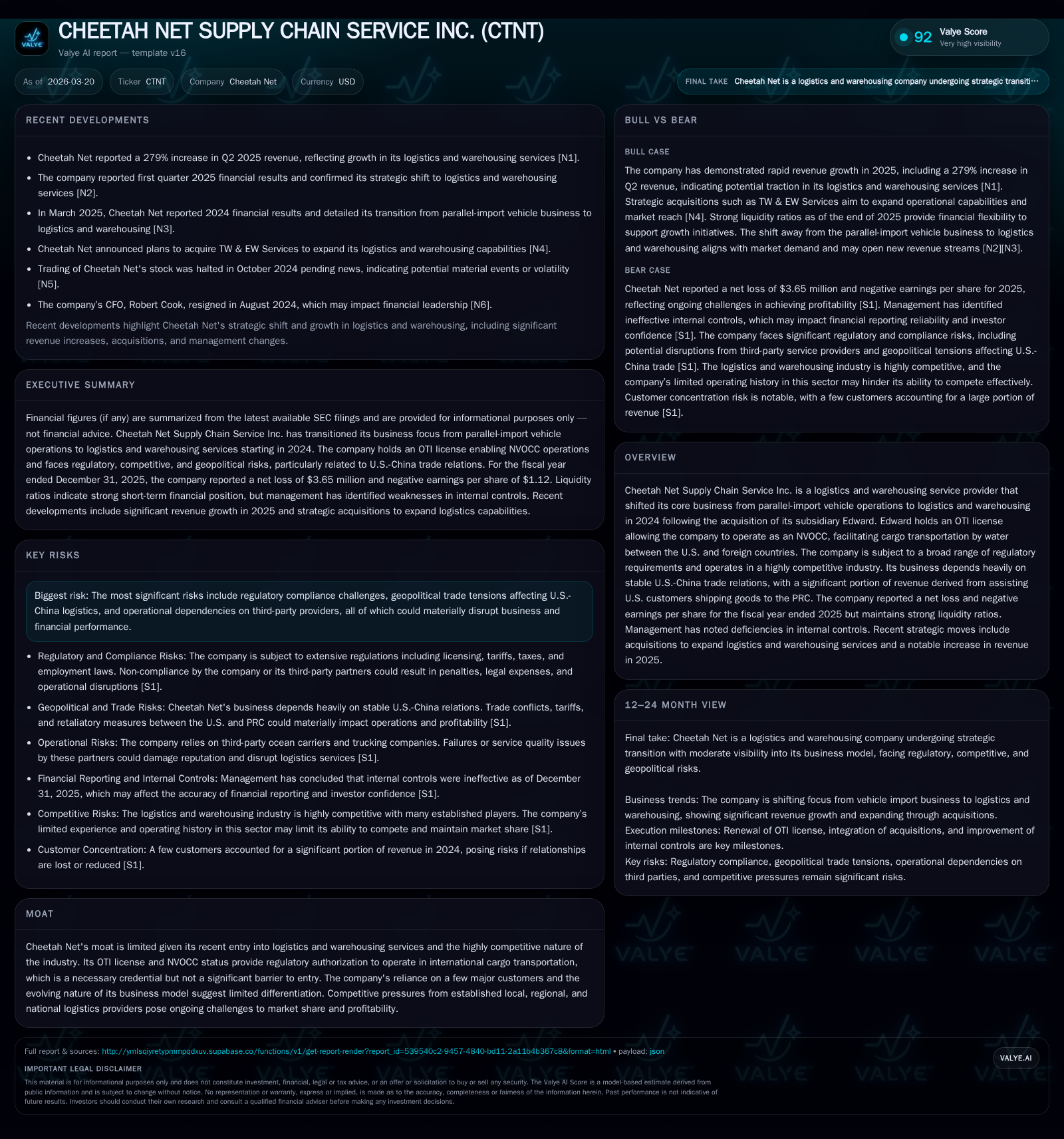
In 2024, Cheetah Net Supply Chain Service Inc. transitioned from parallel-import vehicle operations to logistics and warehousing following the acquisition of Edward, an NVOCC-licensed subsidiary. This shift introduced regulatory complexities, intense industry competition, and strong dependence on U.S.-China trade stability. Financial results through 2025 reveal operating losses and near-zero operating cash flow, underscoring transitional challenges. Future growth depends on successful integration, regulatory navigation, geopolitical developments, and establishing competitive service offerings amid limited differentiation.
Transformation from Parallel-Import Vehicles to Logistics & Warehousing
Cheetah Net Supply Chain Service Inc., historically engaged in parallel-import vehicle operations, shifted its core business strategy in early 2024 upon acquiring its subsidiary Edward [S1, S6]. This acquisition granted Cheetah Net an Ocean Transportation Intermediary (OTI) license authorizing operation as a Non-Vessel Operating Common Carrier (NVOCC), enabling legal maritime cargo forwarding between the U.S. and foreign countries [S1]. The OTI license requires renewal every three years; failure or delay may materially disrupt operations due to regulatory prohibitions on logistics activities [S14].
This repositioning places Cheetah Net within the logistics and warehousing sector—a highly regulated domain involving tax law compliance, anti-money laundering statutes, privacy protections, employment wage-hour requirements [S6], and securities regulations applicable to public companies [S7]. The company faces the challenge of rapidly developing expertise and scalable infrastructure to compete with established freight forwarding providers.
While the OTI license is essential legal authorization for international transport operations, it represents a baseline credential rather than a competitive advantage; many competitors hold similar licenses with longer operational histories [S1]. Therefore, differentiating through service quality and efficiency is central to Cheetah Net's strategic objectives.
Historical Financial Performance: Consequences of Strategic Pivot
Financial metrics from FY2023 through FY2025 reflect the costs and challenges accompanying this transition. In FY2023—prior to full pivot—operating income was positive at approximately $1.39 million [F1]. Following discontinuation of parallel-import vehicles and growth in logistics services during 2024–2025, operating income declined sharply into negative territory: -$3.74 million in FY2024 further deteriorated to -$4.58 million by FY2025—a year-over-year decline of about 22% [F1].
Net income followed a similar trend: slightly positive ($134K) in FY2023 before deep losses of -$5.19 million in FY2024 improving modestly to -$3.65 million in FY2025; sustained unprofitability indicates ongoing investment or market entry costs [F1].
Operating cash flow declined dramatically: from a strong inflow of $5.61 million in FY2023 down to $242K in FY2024 then collapsing into slightly negative (-$2K) by FY2025—a deterioration exceeding 100% year-over-year [F1]. Capital expenditures remained steady around $365K annually over these years [F1], indicating that negative free cash flow arises principally from operational losses rather than accelerated growth spending.
Despite these headwinds, liquidity remains strong with a current ratio above 6.7x as of December 31, 2025—current assets near $9.07 million against liabilities around $1.35 million [F1]. Shareholders’ equity contracted from approximately $12.62 million at end-FY2024 to about $9.36 million after absorbing losses through FY2025 [F1]. Return on equity is roughly estimated at -39%, reflecting ongoing earnings deficits relative to invested equity capital [F1].
Historical performance (annual)
| FY | Net ($mm) | CFO ($mm) | OpInc ($mm) | Capex ($) | Net YoY |
|---|---|---|---|---|---|
| 2025 | -4 | 0 | -5 | 365000 | +29.7% |
| 2024 | -5 | 0 | -4 | 365000 | -3976.0% |
| 2023 | 0 | 6 | 1 |
Source: SEC companyfacts cache [F1].
Capital returns and efficiency (annual)
| FY | FCF ($) | ROE% |
|---|---|---|
| 2025 | -367075 | -39.0 |
| 2024 | -122780 | -41.1 |
| 2023 | 1.9 |
Source: SEC companyfacts cache [F1].
Numbers sourced directly from SEC companyfacts filings for fiscal years ended December 31.
Regulatory Landscape and Operational Compliance Implications
Logistics operations are subject to multilayered regulatory frameworks enforced federally and at state levels with oversight bodies including the Federal Maritime Commission (FMC) for OTI licensing [S6], Consumer Financial Protection Bureau for payment-related compliance [S8], Federal Trade Commission for consumer protection standards [S9], Department of Transportation for safety governance [S10], Occupational Safety and Health Administration (OSHA), among others.
Non-compliance risks extend beyond fines—they may include injunctions limiting or suspending operations that could critically disrupt service continuity impacting customer confidence and revenue streams [S6]. Furthermore, Cheetah Net’s reliance on third-party ocean carriers and trucking contractors introduces operational risk: partners’ non-compliance or litigation could cascade onto Cheetah Net exposing it to liabilities or reputational damage without clear remedies given indirect control over partners’ compliance practices .
Intellectual property litigation risk also exists as evolving IP laws expose even inadvertent infringement—potentially resulting in legal expenses or injunctions limiting use of key technologies such as freight management software underpinning logistics solutions .
Management disclosed internal control deficiencies as of December 31, 2025 that impede reliable financial reporting assurance under JOBS Act requirements for emerging growth companies [S20], complicating investor confidence building and corrective action implementation essential for governance robustness.
Dependence on U.S.-China Trade Flows and Geopolitical Risks
Cheetah Net’s growth prospects are constrained by pronounced dependency on stable U.S.-PRC trade relations since significant revenue derives from facilitating shipments from U.S. customers destined for the PRC market [S1]. This bilateral relationship remains volatile post-pandemic with tariff escalations beginning March 2025 triggering reciprocal Chinese tariffs on U.S.-origin goods plus additional restrictive non-tariff barriers impacting commodity flows [S15].
Trade policy unpredictability subjects freight volumes—and consequently revenues—to fluctuations challenging accurate forecasting or hedging strategies. Any prolonged deterioration or stalemate threatens shipment demand abruptly destabilizing core revenue streams critical for achieving scale economies required in logistics operations [S15].
Competitive Dynamics in U.S. Logistics and NVOCC Sector
The logistics market is intensely competitive featuring local niche providers alongside large multinational integrators leveraging scale advantages including technology-enabled supply chain visibility platforms.
Competition centers on pricing strategies where margins face pressure under commoditized freight rates; quality differentiation via reliability guarantees; transportation speed critical for just-in-time clients; plus emerging value-added digital services aimed at customer retention [S19].
Cheetah Net confronts incumbents with limited logistics operating history beyond two years since acquisition-driven entry—lacking brand recognition or diversified client base—the firm must rapidly expand salesforce capabilities while maintaining high service consistency given buyer preference for proven convenience and reliability when selecting providers .
Capital Allocation Insights and Returns Analysis
Capital allocation has been conservative reflecting tight free cash flow conditions driven by operating losses despite moderate capital expenditures held constant near $365K annually supporting infrastructure development rather than aggressive expansion [F1]. No dividends or share buybacks were reported aligning with typical nascent-stage repositioning requiring reinvestment prioritization.
Operating cash flows contracted into slight negative territory (-$2K) by FY2025 highlighting severe free cash flow constraints challenging self-funding capacity necessitating external financing aligned with working capital demands endemic in freight-forwarding businesses bearing delayed receivables cycles versus vendor payables extensions [F1,S20,S26].
Equity erosion combined with estimated return on equity near -39% underscores capital returns deterioration reinforcing urgency around achieving profitable scale before investor attrition intensifies or credit lines restrict liquidity flexibility.
Future Growth Drivers and Constraints Based on Management Commentary
Explicit forward guidance remains limited due to early-stage transformation uncertainties; however disclosures emphasize reliance on securing timely OTI license renewals prior to May 31, 2027—foundational for trade continuity—and remediation of internal control deficiencies identified as ineffective as of December 31 2025—both pivotal prerequisites for stabilizing governance conducive to sustained growth execution [S14,S20,S24].
Growth opportunities focus on scaling international freight forwarding volumes alongside expanded warehousing offerings augmented by investments toward digital platform development intended to automate supply chain visibility—a costly initiative diverting managerial resources yet critical amid competitor technology arms race dynamics .
Risks remain significant including geopolitical tensions alongside concentration risk from heavy revenue dependence on two major customers comprising nearly all revenues early on—exposing vulnerability if partnerships dissolve due to service dissatisfaction or strategic shifts compounding business model fragility during ramp-up phases [S12,S14,S21].
Key Upcoming Milestones Investors Should Monitor
Stakeholders should watch closely:
- Renewal status of Edward’s OTI license before mid-2027 ensuring uninterrupted NVOCC operations.
- Progress addressing internal control deficiencies verifying improved compliance posture aligned with auditor expectations.
- Developments impacting U.S.-China trade policies including tariff adjustments or new bilateral agreements affecting cargo volumes.
- Execution milestones related to digital platform deployment positioned as differentiator amid crowded logistics operator ecosystems.
- Shifts toward broader customer diversification minimizing concentration risks given historical reliance on limited clients.
- Potential capital raising activities triggered by free cash flow deficits impacting balance sheet strength.
Each factor functions as an inflection point influencing operational viability assessments without speculative forecasts offered here due to absence of concrete guidance.
Disclaimer: This analysis is based solely on publicly filed documents sourced through SEC companyfacts data extraction dated March 20th, 2026 along with contemporaneous SEC Form 10-K disclosures. No investment advice or forecast projections are provided herein.
Disclaimer: This is research-only, informational analysis and not investment advice. It may include AI-generated interpretation and general industry context. Always verify important details using primary sources.

Comments