
MAIA Biotechnology’s Clinical Development and Capital Constraints Define Its 2025 Trajectory
The clinical-stage biopharma depends on its lead immunotherapy candidate amidst escalating operational losses and capital needs.
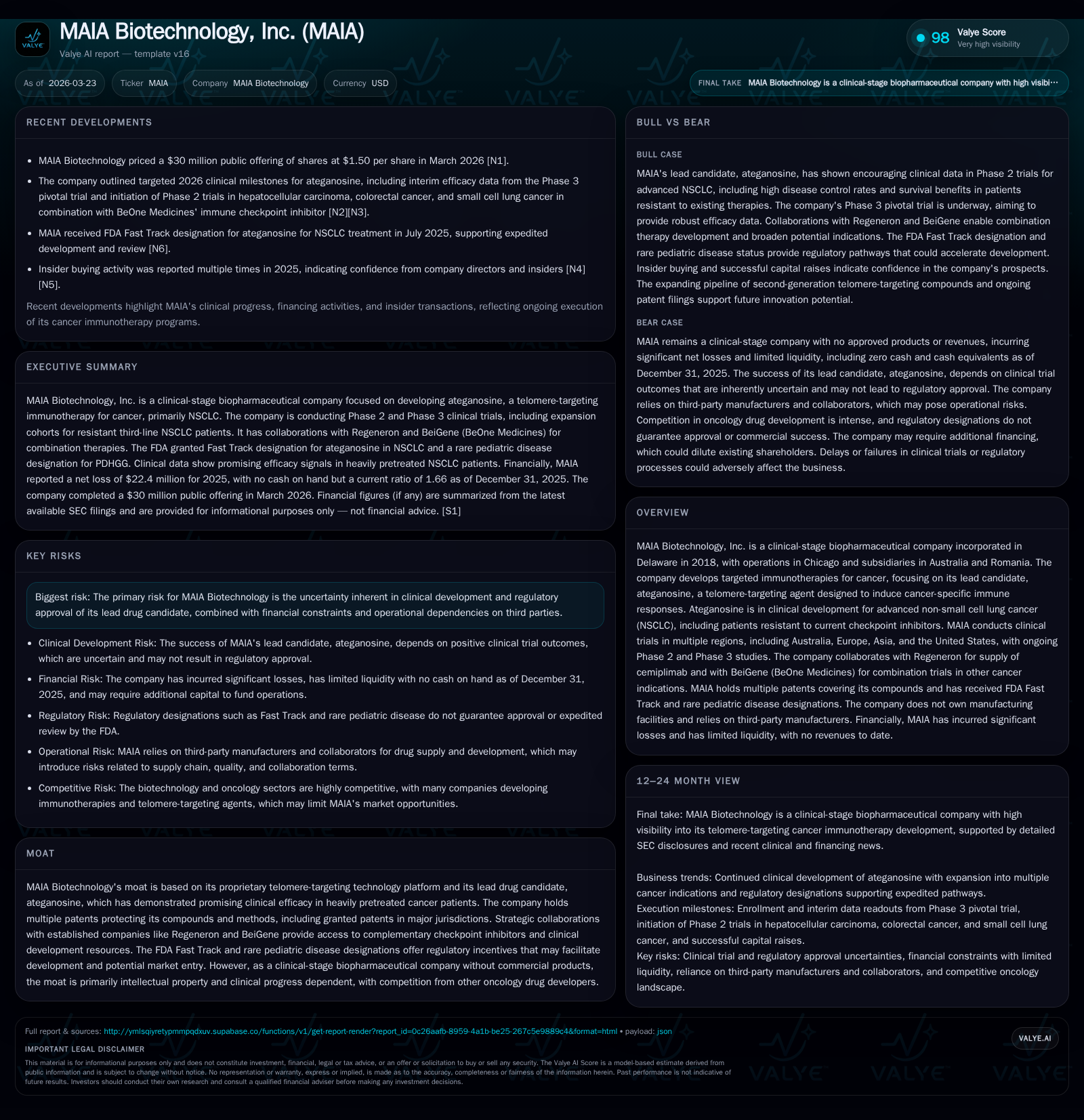
MAIA Biotechnology, Inc. remains focused on advancing its lead drug candidate, ateganosine, a novel telomere-targeting immunotherapy for advanced NSCLC resistant to checkpoint inhibitors. Despite no revenue through 2024 and steep operating losses growing to nearly $24 million in 2025 [F1], the company pursues multiple Phase 2 and Phase 3 trials across global regions. Its strategic collaborations with Regeneron and BeiGene provide clinical supply support and combination trial opportunities, while regulatory Fast Track designation could expedite approvals. However, raising additional capital via offerings such as the $30 million public share sale in early 2026 [N1] reflects financial strain and dilution risk amid ongoing clinical uncertainty.
Company Overview
MAIA Biotechnology, Inc., incorporated in Delaware in August 2018, is a clinical-stage biopharmaceutical firm developing cancer immunotherapies centered around telomere-targeting mechanisms. With headquarters in Chicago and subsidiaries spanning Australia and Romania, MAIA’s flagship candidate is ateganosine (also known as THIO or 6-thio-dG), which uniquely combines telomere targeting with dual mechanism immune activation effects aimed at destroying cancer cells selectively.
The company's clinical programs primarily focus on advanced non-small cell lung cancer (NSCLC), including patients demonstrating resistance to standard checkpoint inhibitors such as anti-PD-1 therapies. The approach involves sequencing ateganosine administration prior to checkpoint inhibitors like Libtayo® (cemiplimab), supplied by Regeneron under a no-cost clinical supply agreement signed in early 2021 [S1]. This collaboration not only conserves significant study costs but grants Regeneron exclusive development rights for the combination during the study period.
In addition to NSCLC, MAIA is broadening clinical trials into other solid tumor indications including hepatocellular carcinoma (HCC), colorectal cancer (CRC), and small cell lung cancer (SCLC) using combinations with BeOne Medicines’ immune checkpoint inhibitor tislelizumab [S1]. Following encouraging Phase 2 data, MAIA initiated pivotal Phase 3 trial THIO-104 in mid-2025 targeting third-line NSCLC patients resistant to prior therapies. The study design randomizes up to 300 subjects against chemotherapy directly providing robust comparative efficacy data.
Historical Financial Performance
Since inception, MAIA has recorded no revenues attributable to commercial sales or licensing of products as its therapeutic candidates remain investigational without approved markets [F1]. Over recent years, its operating losses have expanded significantly due to escalating expenses related to clinical development activities and regulatory processes:
Historical performance (annual)
| FY | Rev | CFO ($mm) | OpInc ($mm) |
|---|---|---|---|
| 2025 | -19 | -24 | |
| 2024 | 0 | -16 | -17 |
| 2023 | 0 | -13 | -20 |
| 2022 | 0 | -12 | -16 |
Source: SEC companyfacts cache [F1].
Operating income deteriorated by roughly 43% between FY2024 and FY2025 emphasizing intensifying clinical program expenditures without offsetting revenues. Similarly, operating cash flow outflows worsened by approximately 20% year-over-year [F1]. The absence of any revenue stream through the latest filings confirms that MAIA’s value is built purely on pipeline progression rather than commercial performance.
The company ended FY2025 with no cash or equivalents on its balance sheet post spending but maintains some liquidity through receivables and short-term assets yielding a current ratio above one—indicating sufficient near-term coverage of current liabilities though not implying long-term financial stability without additional funding [F1].
Future Growth Prospects
MAIA’s growth outlook hinges principally on successful da Vinci-style development of ateganosine into a regulatory-approved treatment for advanced NSCLC subpopulations lacking effective treatment options today. Positive interim data supporting its novel mechanism may accelerate FDA review via existing Fast Track status granted by the agency alongside potential Rare Pediatric Disease designation incentives also held by their drug candidate portfolio [S1].
Concrete pathways driving growth include:
- Completion—and ultimately positive results—of ongoing Phase 3 THIO-104 pivotal trial comparing ateganosine plus checkpoint inhibition versus chemotherapy.
- Successful initiation of Phase 2 testing of ateganosine combined with tislelizumab in alternate tumor types like HCC and CRC expanding the indication footprint.
- Leveraging partnerships with Regeneron and BeiGene facilitating supply chain efficiencies and access to established immune checkpoint medicines for combination regimens.
- Potential accelerated approval filings anticipated during mid-to-late calendar year 2026 based on cumulative clinical data originating primarily from THIO-101 trial extensions and THIO-104 interim analyses.
Encumbrances that could cap growth stem largely from well-known oncology R&D risks: lengthy unpredictable regulatory gating mechanisms; challenges recruiting heavily pretreated patient cohorts globally; competitive dynamics against incumbents developing their own immune-oncology platforms; evolving pricing/reimbursement frameworks especially within Medicare-centric payor landscapes; & intellectual property defense pressures given complex multi-jurisdictional patent environs .
Forecasts / Milestones / Expectations
While explicit guidance figures have not been disclosed publicly beyond filings, critical near-term milestones include:
- Filing intended for accelerated FDA approval of ateganosine targeting advanced NSCLC during calendar year 2026 contingent on available Phase 2/3 datasets [S1].
- Data readouts anticipated throughout ongoing multi-arm Phase 2 expansion cohorts assessing monotherapy efficacy as well as combination sequences offering key safety & efficacy insights.
- Initiation of additional phase trials in alternative cancer indications leveraging BeiGene collaboration slated for later in calendar year 2026.
- Monitoring outcomes from ongoing fundraising activities such as the March 2, 2026 underwritten public offering raising gross proceeds around $30 million at $1.50 a share evidencing capital sourcing efforts required to sustain further development phases [N1], [S3].
Absent commercially marketed products or direct sale agreements, progress can be benchmarked largely by clinical milestones attained, regulatory submissions made, study enrollment pace maintained, disclosure transparency about interim outcomes provided by MAIA’s management.
Returns / Capital Allocation
Given MAIA’s pre-revenue status characteristic of early-stage biotech firms heavily invested in R&D pipelines rather than generating profits:
- Return on equity is negative at an extreme magnitude (~ -943% per FY2025 net loss divided by equity) reflecting ongoing losses without earnings generation [F1].
- Operating cash flow continues deeply negative driven by trial expenses (~ $18.8 million outflow in FY2025), illustrating reliance on external capital sources rather than internal free cash generation [F1].
- No dividends have been declared or paid historically with no plans foreseeable given reinvestment priority into clinical programs over shareholder cash returns [S26].
- No share repurchase initiatives exist; instead dilution risk increases given planned equity offerings such as the March 2026 public share issuance announced at $30 million gross proceeds aiming to replenish working capital post-intensive development expenses [N1], [S3], [S26].
This pattern aligns with typical financing profiles within biotech early-adopters where capital allocation favors sustaining pipeline momentum over yield distributions until commercial viability is demonstrated.
Intellectual Property and Competitive Positioning
MAIA holds multiple granted patents covering its proprietary telomere-targeting compounds and therapeutic methods across key markets conferring an IP moat essential for safeguarding future commercialization potential against competitors pursuing analogous immunotherapies . Nevertheless, it remains exposed to infringement litigation risks common within oncology biotechnology involving more resourceful adversaries potentially challenging patent validity or enforcing blocking positions adversely impacting freedom-to-operate scenarios [S25],[S28].
Strategic collaborations serve as critical enablers both cost-wise—through receipt of checkpoint inhibitors such as cemiplimab—and clinically via access to complementary agents accelerating combination therapy development—essential within rapidly evolving immune-oncology standard-of-care environments marked by multipronged modalities being tested simultaneously industry-wide.
Regulatory Environment & Risk Factors Summary
MAIA operates under considerable regulatory complexity involving:
- Prolonged timelines intrinsic to FDA/foreign authority approvals,
- Necessity of companion diagnostics potentially mandated for patient selection,
- Pricing pressures amid healthcare reform efforts internationally,
- Compliance burdens arising from anti-kickback statutes, false claims act risks including reimbursement fraud allegations,
- Data privacy laws affecting multinational trials notably GDPR impact across EU jurisdictions,
- Requirement for cGMP-aligned contract manufacturing oversight given outsourcing strategy.
Furthermore, inducements related to government scrutiny over drug pricing policy changes pose added uncertainty over future market access conditions potentially compressing obtainable margins upon approval if their products reach commercialization stage ,,[S24],[S27].[S12] details widespread US federal/state statutes affecting various dimensions of operations — underscoring that rigorous compliance infrastructure is inseparable from long-term success prospects.
Conclusion and Forward-Looking Considerations (Analysis)
MAIA Biotechnology remains categorized among the classic high-risk high-reward biopharma players currently reliant exclusively on pipeline progress without any commercialized revenue streams establishing stability or profit generation so far. Its lead asset ateganosine represents a mechanistically innovative approach seeking to address unmet treatment gaps especially within refractory NSCLC settings suffering limitations from existing immune checkpoint blockers alone.
However substantial operational losses expanding year-over-year combined with a depleted cash position at December-end 2025 dictate ongoing reliance on equity financings like the recent $30 million public offering announced March ’26 — albeit dilutive — as lifeline funding enabling continued Phase advancement across multiple countries leveraging partnerships supplying key agents thereby partially alleviating expense burdens.[N1],[S3]
Investors assessing MAIA should keenly observe forthcoming clinical readouts underpinning potential FDA accelerated approvals alongside enrollment execution pace within pivotal THIO-104 studies spanning challenging recruitment pools endemic among heavily pretreated oncologic cohorts.[S1] Potential broader tumor expansions beyond NSCLC into HCC, CRC might diversify future revenue opportunities yet increase complexity requiring calibrated capital deployment decisions.[S1] Optimal navigation through evolving health policy landscapes governing drug pricing reimbursement alongside safeguarding patent estate integrity will be equally paramount.
In sum, MAIA typifies developmental-stage biotech entities where value is inherently tethered tightly to scientific novelty validation events combined with astute capital management stretching finite resources amid persistent operational deficits—a classic interplay reflecting contemporary oncology innovation cycles.
This analysis synthesizes information derived strictly from publicly filed documentation dated through March 23, 2026, news releases around March 3, and validated financial disclosures ending fiscal year December 31, 2025 without projecting unreported metrics or issuing investment guidance.
Disclaimer: This is research-only, informational analysis and not investment advice. It may include AI-generated interpretation and general industry context. Always verify important details using primary sources.

Comments