
SilverBox Corp V's Launch Journey Sets Stage for Strategic Acquisition
SilverBox Corp V, a newly public SPAC, lays a financial foundation amid execution uncertainties toward its initial business combination targeting high-value companies.
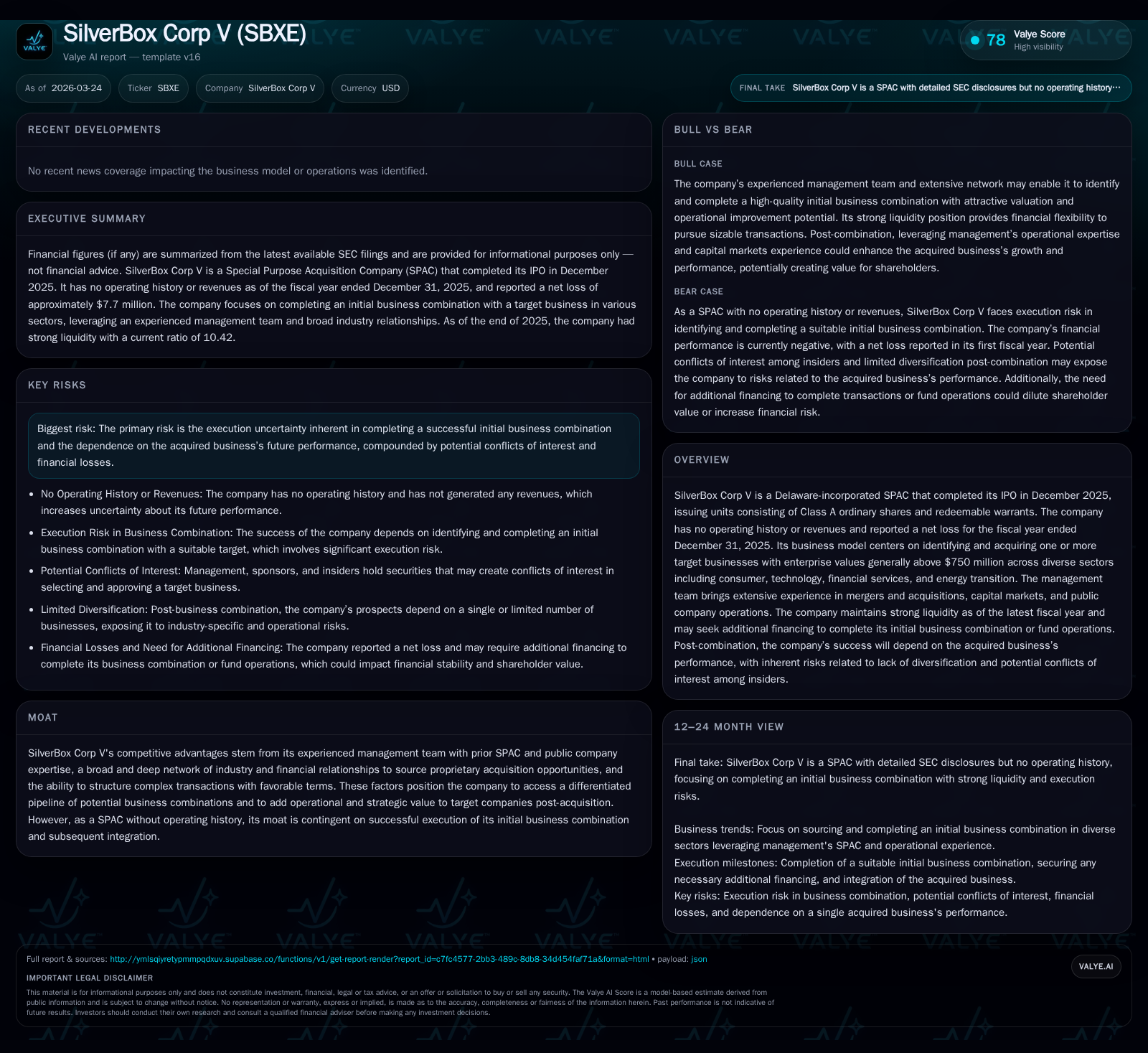
SilverBox Corp V completed its IPO in December 2025, raising capital primarily held in trust for acquiring businesses with enterprise values exceeding $750 million. The company recorded no operating revenue and incurred net losses in its inaugural fiscal year, reflecting pre-operating costs. It benefits from an experienced management team and broad industry connections, which form the core of its competitive advantage. Success hinges on completing and integrating an initial business combination, with risks relating to timing, shareholder redemptions, and dependence on the acquired target's performance.
From IPO to Initial Results: SilverBox’s Inaugural Year Under the Microscope
SilverBox Corp V is a recently formed SPAC incorporated in Delaware that launched its initial public offering in December 2025. The offering consisted of units including one Class A ordinary share alongside one-third of a redeemable warrant exercisable at $11.50 per share, generating gross proceeds of approximately $276 million backed by a private placement of nearly $2 million to SilverBox Sponsor V LLC [S12], [F1]. These funds were placed into a Trust Account invested solely in U.S. government securities or equivalent ultra-short maturity assets until deployment for acquisition purposes.
Reflecting its nascent operational lifecycle typical of blank check companies, SilverBox reported zero revenues for its fiscal year ended December 31, 2025. It posted an operating loss of roughly $8.43 million largely attributable to organizational costs, legal fees, transaction-related expenses, and general administrative overhead associated with going public and preparing for acquisition activities. The net loss stood at approximately $7.69 million during this period as no substantive operating activities have commenced [F1], [S1].
Historical performance (annual)
| FY |
|---|
| 2025 |
Source: SEC companyfacts cache [F1].
Table: Historical Financial Snapshot FY2025 based on audited filings [F1].
The high current ratio underscores minimal short-term obligations relative to cash equivalents held within the Trust Account alongside receivables or prepaid expenses comprising current assets.
Capital Structure and Liquidity: Financial Firepower for Acquisition
SilverBox holds substantial cash-reserved capital earmarked exclusively for transactional purposes—the hallmark characteristic of SPACs focused on acquisition deployment. At fiscal year-end 2025, about $276 million was held in the Trust Account invested prudently with negligible risk exposure, alongside warrants that contribute theoretical equity dilution depending on exercise outcomes but are valued under Level 3 fair value inputs consistent with IPO documentation terms [S4], [S6], [S7].
There was no reported debt as of year-end 2025, emphasizing reliance on IPO proceeds and trust-held funds for acquisition financing. Given target acquisitions are anticipated to exceed available cash alone due to enterprise value thresholds above $750 million, additional financing through equity-linked securities or loans may be sought contemporaneously with business combinations to cover cash shortfalls or shareholder redemptions [S14], [S15], [S16], [S27].
Liquidity metrics indicate strong coverage ratios with nominal current liabilities (~$92K), reaffirming ample runway for due diligence and acquisition efforts prior to capital deployment.
Target Markets and Differentiation Approach
SilverBox adopts a thematic sector strategy encompassing consumer goods including food & agriculture; technology-driven verticals such as e-commerce platforms, internet/media services; financial technology; industrial technology; infrastructure; and energy transition markets aligned with secular tailwinds toward sustainability-focused ventures [S5].
Target selection prioritizes businesses exhibiting leading market positions complemented by significant recurring revenue streams supported by diversified customer bases to reduce concentration risk. Operational improvement opportunities suggesting scope for margin expansion post-acquisition are also emphasized.
The company leverages an extensive network spanning private equity firms, credit funds, investment bankers, restructuring advisors alongside direct relationships with prospective target management teams—facilitating proprietary transaction pipelines less accessible to generalist acquirers or competing SPACs.
Management Experience as Competitive Advantage
While SilverBox lacks operating history by nature of being a blank-check vehicle without commercial revenues yet, it anchors competitive differentiation firmly upon its management team’s prior SPAC transactions experience alongside public company executive tenure. This expertise encompasses sourcing efficiency, complex transaction structuring including cross-border deals, and operational scale-up capabilities post-transaction completion (notably across affiliated SilverBox entities) [S23].
Such domain knowledge facilitates access to high-quality deal flow while enabling strategic value-added support after closing—critical elements supporting their competitive moat though contingent upon closing suitable transactions successfully.
Execution Risks and Dependencies
Primary risks revolve around completing an initial business combination within mandated NYSE deadlines (typically around two years post-IPO). Delays or failures could trigger liquidation scenarios adversely impacting shareholders’ invested capital ([S22]). Additionally, any acquisition entails reliance on one target’s operating results — introducing concentration risk typical in single-SPAC models.
Conflicts between sponsors/managers holding Founder Shares who waive redemption rights versus public shareholders exercising them en masse could affect pro forma capital structures post-merger. Regulatory compliance around redemption processes—whether via proxy solicitation or tender offer rules—is critical ([S8]–[S10], [S19]).
Legal or regulatory hurdles may delay closings along with challenges evaluating unproven management teams at targets risking operational disappointments following de-SPAC transitions ([S22]). Extensive due diligence and independent fairness opinions are essential particularly when affiliated party transactions arise ([S21]).
Capital Allocation Policy Ahead of Business Combination
SilverBox has not declared dividends nor engaged in share repurchases—a standard stance given lack of cash-generative operations thus far. Founder Shares totaling approximately 6.9 million issued pre-IPO remain subject to lockups limiting sales until after combination closure or other stipulated events ensuring alignment between insiders and public investors ([S12], [S13]).
Post-transaction strategies may include reinvestment into operational enhancements of acquired entities or bolt-on acquisitions using leftover cash not expended at closing ([S18]). Sponsor purchases on secondary markets are expected only under strict regulatory compliance minimizing conflicts while preventing misuse of material nonpublic information ([S17], [S26]).
Outlook: Milestones and Market Signals Post-IPO
No explicit forward guidance or detailed milestones have been disclosed regarding timing or pipeline progress toward an initial business combination despite active search efforts noted ([N#] absent). Key indicators will include announcements of letters of intent or definitive agreements relating to sizeable targets exceeding stated enterprise value thresholds.
Shareholder vote scheduling if mandated under Cayman law requiring majority approvals will be material alongside redemption election statistics impacting capitalization tables and valuation assumptions derived from warrant exercises post-closing ([S8]–[S10]). Financing arrangement updates such as PIPE closes or revised terms may also provide insights into deal momentum.
Investors should monitor competitive dynamics among peer SPACs vying for similar-sized targets within favored sectors like energy transition where consolidation trends remain robust yet bidding intensity is elevated.
Disclaimer: This analysis relies exclusively on publicly filed SEC documentation up through March 23, 2026 ([F1],[S#]) without extrapolations beyond available data or projections without concrete disclosure. It does not constitute investment advice but provides an informed narrative around SilverBox Corp V’s corporate profile and strategic posture as an emerging SPAC entity.
Disclaimer: This is research-only, informational analysis and not investment advice. It may include AI-generated interpretation and general industry context. Always verify important details using primary sources.

Comments