
HomesToLife’s Expansion and Profit Recovery Highlights Risks from Customer and Vendor Concentrations
The furniture company’s significant acquisition and operational improvements fueled revenue growth and margin expansion in 2025.
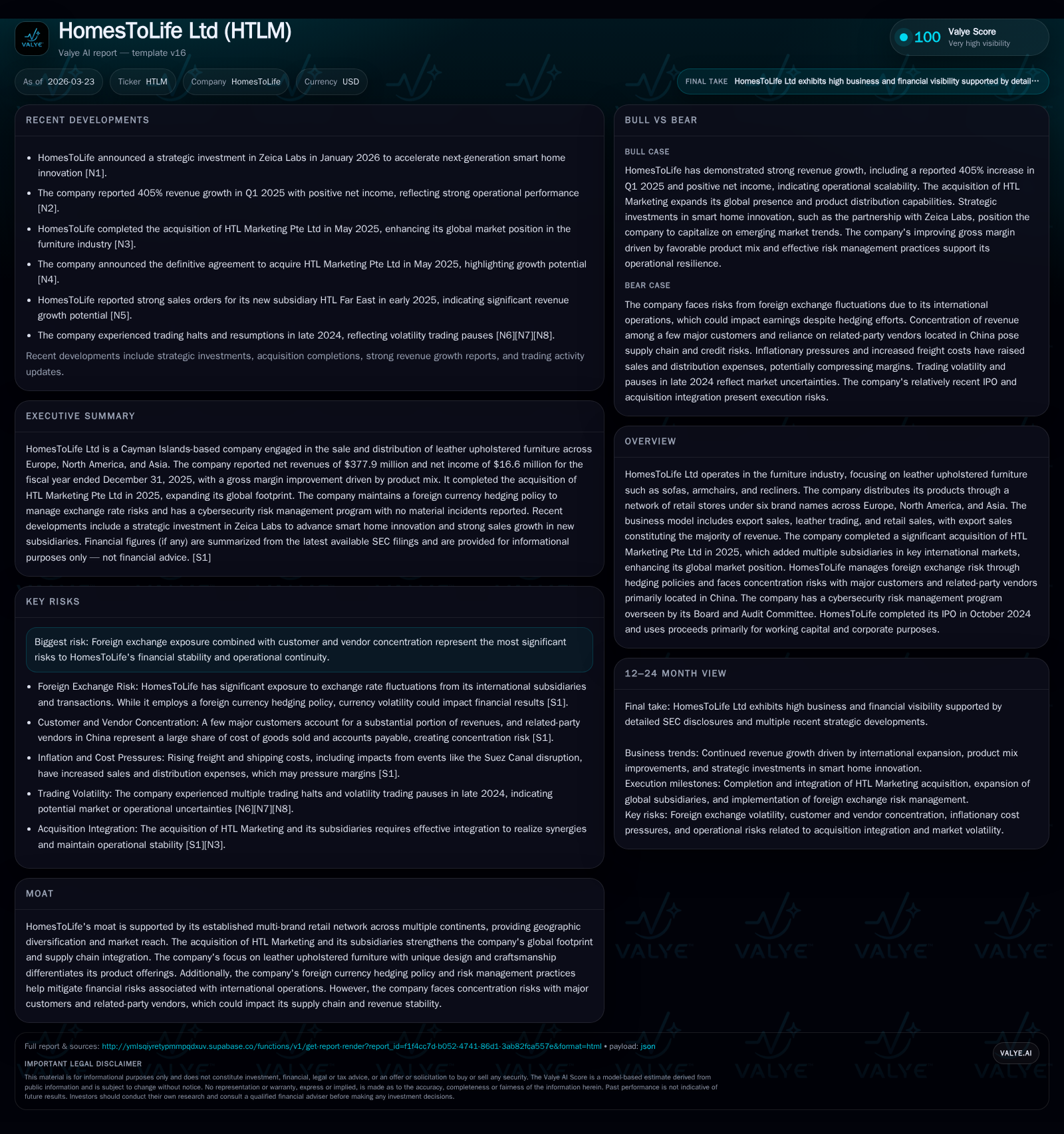
HomesToLife Ltd, a leather upholstered furniture manufacturer, achieved solid revenue growth and sharply improved profitability in 2025 following the acquisition of HTL Marketing Pte Ltd. Revenue grew 12.8% year-over-year to $377.9 million, driven by export sales and the expanded global footprint. Gross margin increased by 3.1 percentage points due to a favorable product mix shift toward higher-margin fabric sofas. Operating income rebounded from a loss in 2024 to nearly $19.4 million in 2025, supported by cost controls despite rising freight costs linked to global shipping disruptions. The company carries risks from high reliance on a few large customers and related-party vendors concentrated in China, alongside foreign exchange exposure mitigated by active hedging. Liquidity improved substantially with positive operating cash flow of $13.5 million, supporting capital expenditures and reducing short-term borrowings.
Company Overview
HomesToLife Ltd was incorporated in February 2024 in the Cayman Islands and publicly listed via IPO later that same year [S1]. The company specializes in furniture manufacturing focusing on leather upholstered products—sofas, armchairs, recliners—and related accessories marketed under six brand names across Europe, North America, and Asia [S1].
A transformative event for HomesToLife was its acquisition of HTL Marketing Pte Ltd in May 2025—a business with multiple subsidiaries spanning major markets including the UK, France, Australia/New Zealand, Korea, Japan, Taiwan, and Singapore [S1]. This acquisition expanded HomesToLife's geographic reach and created closer supply chain integration.
Historical Performance (2023–2025)
From SEC filings consolidated under ASC rules for common control entities, HomesToLife's historical income statement reflects moderate revenue growth followed by a step-up post-acquisition [S1], [F1]:
Historical performance (annual)
| FY | Net ($mm) | CFO ($mm) | OpInc ($mm) | Capex ($) | Net YoY |
|---|---|---|---|---|---|
| 2025 | 17 | 13 | 19 | 1136453 | +1093.5% |
| 2024 | -2 | -1 | -2 | 124243 |
Source: SEC companyfacts cache [F1].
Capital returns and efficiency (annual)
| FY | FCF ($mm) | ROE% |
|---|---|---|
| 2025 | 12 | 59.5 |
| 2024 | -1 | -48.4 |
Source: SEC companyfacts cache [F1].
The financials illustrate a dip into operating losses and net losses in the transition year of 2024 likely associated with costs related to new market investments and initial public offering expenses [S1], [S9]. Recovery was swift in 2025: revenues rose strongly prompted by the acquisition-driven scale; operating income reversed powerfully into positive territory with margin expansion; net income followed suit delivering healthy profitability.
Revenue Drivers
Export sales remain the major revenue source representing approximately two-thirds of total revenue [S14]. Growth was buoyed by expanding product lines that include more fabric sofas—a higher-margin category that enhanced overall gross profit margins by over three percentage points year-over-year [S14]. Leather trading continues as a smaller segment but contributes steady ancillary revenue.
Sales uplift came despite macroeconomic headwinds such as inflationary pressures affecting input costs including raw materials and shipping freight rates [S9]. The spike in ocean freight rates stemming partially from disruptions like the Suez Canal blockage contributed materially to increased distribution expenses (~22% rise), which management offset partly through selling price adjustments [S9].
Margin Analysis
Gross margins improved markedly from sub-25% levels in earlier years to nearly 28% in 2025 aided by product mix and operational efficiencies [F1], [S14]. Rising costs were controlled well enough that operating margins swung from negative (~-0.5%) to about +5% despite elevated logistical expenses [F1], [S9].
Expense Trends
Sales and distribution expenses increased significantly ($66M vs $54.7M), largely tracking volume growth but also freight cost spikes; general administrative expenses were relatively stable around $18 million reflecting controlled overheads with modest headcount increases [S9]. Listing expenses impacted results modestly during the IPO transition period.
Future Growth Prospects
The acquisition of HTL Marketing integrated eight key subsidiaries enhancing HomesToLife’s international scope across Europe and Asia-Pacific markets—this positions the company well for penetrating growing economies and diversified demand centers [S1]. The expanded retail network under six brands supports broad geographic diversification bolstering resilience against localized economic swings.
Growth drivers include:
- Increasing penetration in fabric upholstery segments which carry higher margins.
- Geographic expansion unlocking incremental customer bases especially in Asia-Pacific.
- Leveraging scale benefits for cost control particularly freight/logistics optimization post-global supply chain disruptions.
- Marketing initiatives planned for business development projects aiming at brand expansion leveraging new market subsidiaries established via HTL Marketing.
Constraints likely include:
- Macroeconomic uncertainties such as inflation potentially curbing consumer discretionary spending on home furnishings.
- Exposure to currency fluctuations tied to diversified international operations despite existing hedging frameworks [S6], [S11].
- Concentration risk given reliance on two major customers representing one-third of revenues and three related-party vendors accounting for ~80% of COGS—all predominantly based in China—which could create supplier or customer dependency vulnerabilities if disrupted or renegotiated unfavorably [S6], [S17], [S18].
Capital Allocation / Returns / Liquidity
HomesToLife reported robust cash flow improvements with operating cash flow turning positive at $13.5 million following prior negative CFO performance—this supports ongoing capital expenditure growth (planned property & equipment investments totaling $1.1 million) aligned with business expansion strategies [F1], [S15], [S21].
Working capital improved significantly from about $4.9 million at end-2024 to roughly $20.4 million as of end-2025 driven by elevated current assets growth outpacing liabilities expansion including accounts receivable collection focus [F1], [S18]. Short-term borrowings decreased modestly from $15.3 million down to around $10.4 million reflecting prudent debt management supported by strong cash flows [F1], [S18]. Banking facilities securing trade finance up to $33 million are guaranteed by a major shareholder Golden Hill Capital Pte Ltd., enhancing financing flexibility though this introduces counterparty risk should defaults occur impacting HomesToLife given HTL Marketing’s contribution (~95%) to export sales revenues [S3], [S7], [S10].
The company paid dividends during previous years but no dividend data is available for latest periods; shares issued during IPO reached about 1.44 million shares at a price near $4 per share with lock-up provisions affecting liquidity until expiry mid-2027 [S16]. Return on equity approximated near 59.5% driven primarily by strong net income against equity base build-up in trailing year-end financials evidences efficient capital utilization post-reorganization/acquisition integration effects but may reflect transient returns tied to accounting structure shifts post-common control combination treatment under ASC accounting standards [F1].
Risk Profile
Key risks pertain heavily to concentration across customers and vendors as detailed above—the top two customers contribute up to one-third of total revenue while vendor concentration is even more pronounced among three related party entities based primarily in China affecting about four-fifths of cost structures thus influencing gross margin sustainability directly if relationships disrupt or prices increase unexpectedly [S6], [S17], [S18]. Foreign currency exposures inherent due to multinational operations pose translation/transactional risks that HomesToLife actively manages using forwards and hedging contracts although residual volatility may persist that could impact financial results especially given complex multiple currencies handled worldwide ranging between U.S., Eurozone currencies and various Asian currencies including Chinese Yuan linked operational elements [S11], . Inflationary pressures while easing globally remain above historical averages requiring continued vigilance over input cost inflation pass-through capability impacting margin stability longer term.
Cybersecurity risks are addressed robustly via board oversight involving audit committee supervision complemented by experienced IT management instituting comprehensive threat assessments/testing/training programs aligned closely with business strategy mitigating critical information system vulnerabilities; importantly no material cybersecurity incidents occurred historically up through latest filings denoting effective controls implemented enhancing operational continuity assurances nonetheless vigilance must continue given rising cyber threat environment worldwide especially for global consumer brands maintaining digital sales channels and complex enterprise IT ecosystems [S23].
What To Watch (Analysis)
Monitoring HomesToLife involves evaluating how effectively it manages its major customer/vendor concentration without compromising supply chain or pricing power amidst evolving geopolitical tensions impacting China-based suppliers; also worth watching will be successful execution on expanding fabric sofa sales penetration as well as profitability trends amid shifting global economic conditions influencing discretionary consumer spending on home furnishings sectors. Liquidity maintenance through continued positive operating cash flow generation plus timely debt repayments combined with strategic capital investments supporting scalable retail footprint expansions will be critical drivers underpinning sustainable earnings growth beyond immediate post-acquisition recovery period. Foreign exchange volatility management effectiveness amidst rising FX rate uncertainties could materially swing quarterly outcomes requiring consistent hedging policy adherence adapting dynamically as needed. Lastly any material changes or developments concerning corporate governance practices distinct from Nasdaq domestic issuer standards due to Cayman Islands incorporation environment may register investor attention regarding alignment on shareholder protections relative to broader U.S.-listed peers over time.
Disclaimer: This document is an independent analysis intended solely for informational purposes based on available public disclosures including SEC filings up through March 23, 2026. It does not constitute investment advice or recommendations regarding any securities mentioned herein.
Disclaimer: This is research-only, informational analysis and not investment advice. It may include AI-generated interpretation and general industry context. Always verify important details using primary sources.

Comments