
EGH Acquisition’s Deal with Hecate Energy Signals Ambition in Modernizing Energy Infrastructure
EGH Acquisition leverages seasoned management and a focused SPAC approach to propel energy transition through its merger with Hecate Energy.
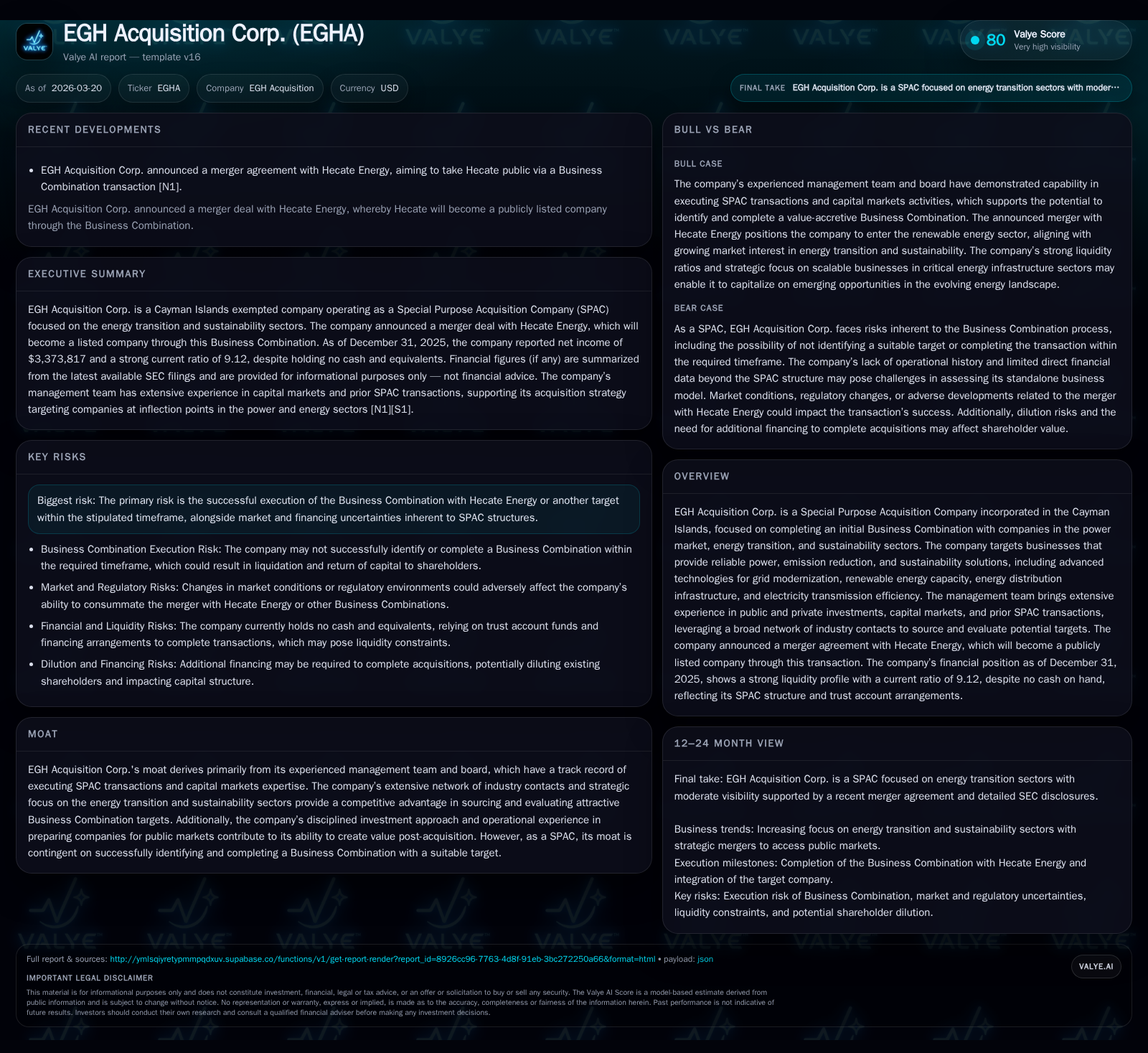
EGH Acquisition Corp., a Cayman Islands-based SPAC, focuses on the power market and sustainability sectors, aiming to drive growth by merging with companies that modernize energy infrastructure. The pending merger with Hecate Energy exemplifies this strategy, targeting grid modernization and renewable capacity expansion amid rising demand for efficient electricity transmission. While operating income remained negative pre-merger, net income showed positive results likely due to transaction effects. Capital allocation discipline and the experienced management team are positioned to capitalize on sector tailwinds, though execution risks typical of SPACs remain salient.
SPAC Origins and Evolution: Foundation for Growth
EGH Acquisition Corp. was established on January 9, 2025, incorporated as an exempted company in the Cayman Islands expressly for the purpose of effecting a Business Combination with one or more target companies [S24]. The entity conducted its Initial Public Offering (IPO) on May 12, 2025, raising gross proceeds of $150 million through the sale of 15 million Public Units priced at $10 each [S24]. In addition to these public units, the company completed a private placement of 500,000 units generating an additional $5 million from its Sponsor and representatives [S24]. This foundational capital lays the groundwork for acquisition activity.
Focused explicitly on power market entities involved in energy transition and sustainability solutions, EGH's mandate includes advanced technologies for grid modernization, renewable energy buildout, energy distribution infrastructure upgrades, and enhancing electricity transmission efficiency [S7]. Such specialization distinguishes EGH from generalist blank-check companies by aligning it with broad secular tailwinds driven by regulatory support and infrastructural necessity.
The management team's pedigree is a crucial asset: extensive capital markets know-how combined with demonstrated experience overseeing prior SPACs affords EGH an operational edge in sourcing quality targets while navigating complex transaction mechanics [S5; S17]. This expertise mitigates some typical SPAC risks such as deal execution delays or inadequate diligence.
Merging Into the Future: The Hecate Energy Business Combination
In January 2026, EGH entered into a definitive Business Combination Agreement (BCA) with Hecate Energy, a developer of clean energy infrastructure solutions [S16]. This strategic merger aims to take Hecate public via EGH's existing Nasdaq listing under ticker EGHA [S3]. The transaction carries customary covenants typical to SPAC mergers including representations and warranties that do not survive closing, reflecting negotiated risk allocations tailored to this deal type [S4].
Key structural elements include conversion mechanisms transforming founder shares into Class A ordinary shares concurrent with closing, redemption rights allowing public investors opting out of the merger to redeem shares, and domestication from Cayman Islands exempted company status to Delaware corporate law jurisdiction post-merger [S16; S19; S20]. Post-closing governance arrangements will feature seven directors with six designated by Hecate, ensuring operational control alignment [S4].
Financially, the consideration involves an estimated enterprise value of approximately $1.2 billion less net indebtedness adjustments at closing [S8]. Ancillary legal frameworks such as an up-C structure facilitate tax-efficient ownership dynamics alongside a Tax Receivable Agreement that stipulates payment obligations based on realized tax benefits after certain equity exchanges by shareholders [S20]. Lock-up and support agreements constrain initial insider share sales to preserve market stability following listing [S17; S18].
Market Dynamics and Sector Drivers in Energy Transition
EGH’s sector focus taps into critical infrastructure needs heightened by technological evolution and environmental imperatives. Notably, over 70% of U.S. transmission and distribution transformers have service lives exceeding 25 years — signaling extensive replacement demand in coming years [S7]. Furthermore, government forecasts anticipate a roughly 60% increase in electricity transmission requirements by 2030 driven largely by renewable energy integration targets across states.
Advances in artificial intelligence (AI) are also digitizing grid operations enabling predictive maintenance and real-time load balancing that improve overall electricity transmission efficiency [S7]. Fresh capital investment flows into data centers supporting AI workloads augment overall power demand alongside rising electric vehicle adoption and climatically induced increases in residential cooling needs.
Such macro trends coalesce to position Hecate — post-merger — as a scalable platform servicing emergent challenges in energy distribution infrastructure modernization with technologies that enhance reliability while reducing emissions.
Financial Footprint Before Merger
As of December 31, 2025, EGH reported an operating loss of $653 thousand but posted net income of approximately $3.37 million [F1], likely reflective of non-operating components or transaction-related adjustments typical for shell companies preparing for combination deals. Current assets stood at $868,906 against current liabilities near $95,288 yielding a strong current ratio of approximately 9.12 — indicating solid short-term liquidity positioning despite zero reported cash equivalents earlier in the year [F1; S1].
Given the nature of SPAC accounting, these figures should be interpreted cautiously. The operating loss reflects pre-revenue status while positive net income may arise from mark-to-market adjustments or financing transactions relating to initial capitalization events rather than core operations.
Historical performance (annual)
| FY |
|---|
| 2025 |
Source: SEC companyfacts cache [F1].
Capital Strategy: Allocation and Governance
EGH prioritizes capital discipline focused on deploying proceeds efficiently through its targeted Business Combination criteria emphasizing companies driving improved operating margins via innovative business practices [S5]. Its management’s prior involvement with various SPACs underscores an emphasis on sound financial structuring including participation in PIPE financings post-announcement when necessary.
Dividend distributions remain non-existent given the infancy stage pre-business combination typical for SPACs. The company has not engaged in share repurchases nor declared returns beyond transactional activities involving sponsor conversions and redemptions [S7; S11]. Governance covenants impose lock-up periods restricting sponsor share sales aimed at protecting long-term shareholder value post-merger [S17; S18].
Return on equity is negative (-64.9% based on trailing net income versus equity), reflecting initial losses inclusive of expenses before revenue-generating operations commence [F1]. Future returns will hinge critically on successful integration post-Hecate merger and subsequent execution toward operational scaling.
Risk Management and Execution Challenges
Execution risk remains foremost given statutory deadlines inherent to SPAC structures requiring business combination consummation within prescribed timeframes—typically around two years from IPO—though specific timelines depend on individual charters [S2]. Failure to close results in liquidation triggering investor capital return but no upside participation.
Market risk also permeates financing conditions surrounding redemptions where high shareholder opt-outs could necessitate supplemental funding rounds diluting existing investors [S6; S22]. Dilution further arises from founder shares’ anti-dilution protective provisions that may convert into additional Class A shares beyond one-for-one ratios during combinations [S14; S25].
The deal structure addresses certain risk allocations via non-survival clauses on representations post-closing plus operating covenants controlling both pre-closure conduct and board composition aimed at mitigating transitional uncertainties specifically tied to Hecate’s existing management consistency [S4; S16].
Outlook: The Path Forward
Analysts should monitor progress toward regulatory approvals required for shareholder vote enabling completion of the Hecate merger anticipated in Q3 2026 [S20]. Additional capital raises could be forthcoming depending on redemption volumes or working capital needs preceding deal close as disclosed under potential financing contingencies [S6; S22].
Post-merger integration will warrant scrutiny around realizing projected operational synergies highlighted by improved efficiencies in grid modernization deployments aligned with rising renewables penetration. Developments in related governmental policies supporting clean energy investments are also relevant.
Sponsor vesting conditions linked to equity price performance post-listing provide insight into management incentives aligned with shareholder value creation milestones extending several years beyond closing date [S26; S18].
This report synthesizes publicly available SEC filings and factual disclosures on EGH Acquisition Corp.’s SPAC operations and pending business combination without providing investment advice or price guidance. Readers should consider all risks inherent to SPAC structures alongside sectoral fundamentals when evaluating future performance prospects.
Disclaimer: This is research-only, informational analysis and not investment advice. It may include AI-generated interpretation and general industry context. Always verify important details using primary sources.

Comments