
Abundia Global Impact Group’s Transition to Low-Carbon Fuels Confronts Capital and Commercialization Hurdles
The company's pivot from legacy oil and gas to renewable fuels is challenged by ongoing losses, licensing dependencies, and nascent market dynamics.
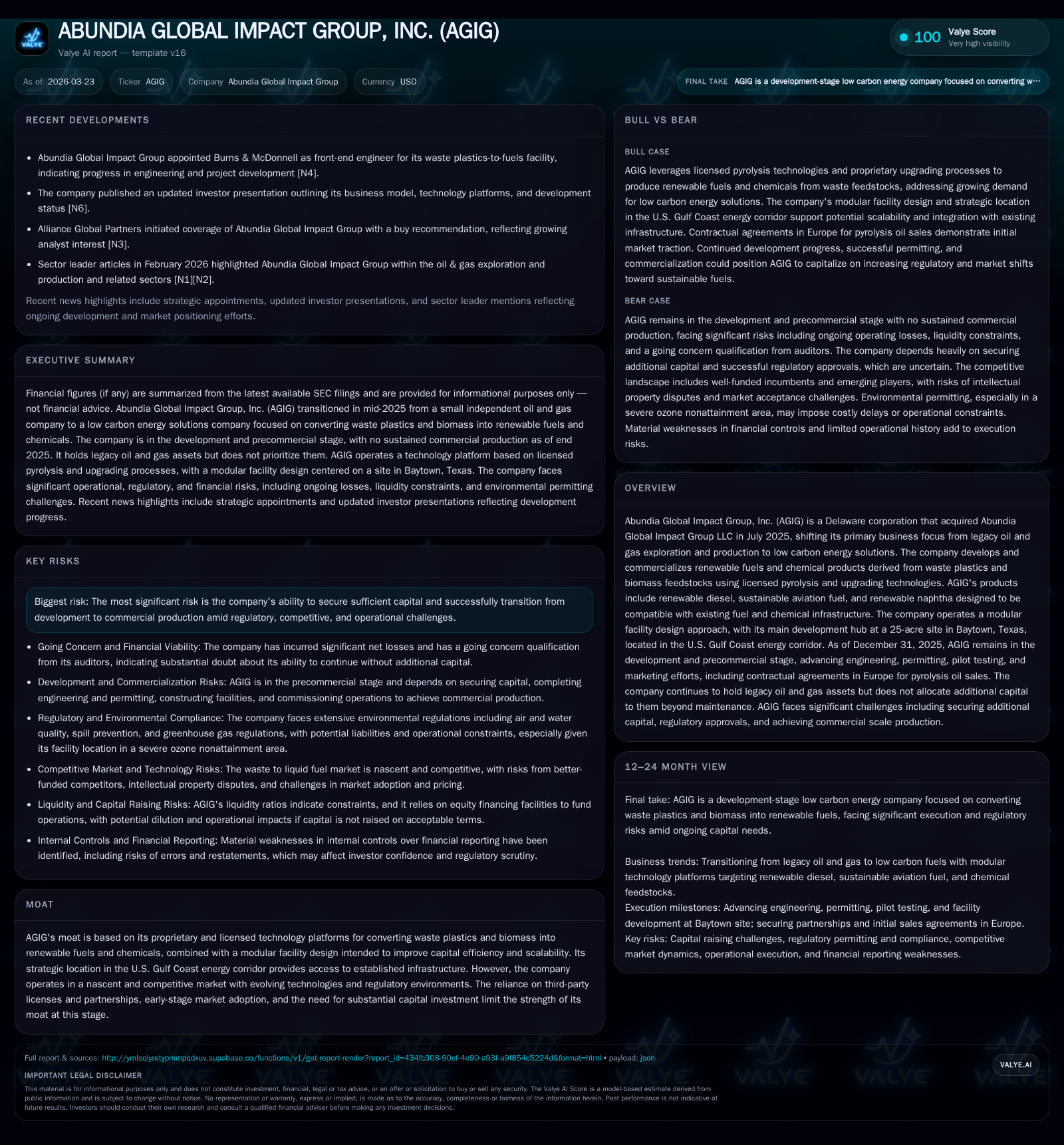
Abundia Global Impact Group, Inc. (AGIG) redefined its business in mid-2025, shifting from oil and gas production to producing renewable fuels derived from waste plastics and biomass. Despite promising proprietary technologies and strategic location advantages, AGIG remains in the developmental phase, burdened by consecutive net losses and a dependency on capital raises. Regulatory complexities, competitor presence, and operational risks underscore the company's cautious path toward commercial scale. Monitoring successful project commissioning and capital adequacy will be critical to assessing AGIG's future trajectory.
Company Historical Performance
Abundia Global Impact Group underwent significant change when it acquired Abundia Global Impact Group LLC in July 2025 through a reverse acquisition that reframed its principal focus from oil & gas exploration to low carbon energy solutions [S1]. Historically, revenues have contracted year-over-year from $1.64 million in 2022 down to approximately $410k in fiscal 2025 [F1]. This decline primarily reflects the scaled-down legacy oil & gas operations which AGIG no longer prioritizes.
Operating losses accelerated materially from a modest $778k loss in 2022 to an eye-catching $28.7 million loss in 2025 [F1]. Similarly, net income deteriorated by nearly fourfold compared to the prior year, culminating at a $29.5 million deficit [F1]. The broadening loss scale reflects intensified investment in research & development (R&D), pilot plant construction expenses, as well as operational overhead during this early scaling stage.
Operating cash flow has been negative since 2024 and worsened significantly to a negative $8.05 million outflow in FY25 driven by increasing operational burn alongside heavy capital expenditures of over $8.66 million in the same period [F1]. This capex surge represents expenditures related to facility development at the Baytown site as AGIG advances its engineering and permitting activities aimed at transitioning to commercial production.
Historical performance (annual)
| FY | Rev ($) | Net ($mm) | CFO ($mm) | OpInc ($mm) | Rev YoY | Net YoY |
|---|---|---|---|---|---|---|
| 2025 | 410632 | -29 | -8 | -29 | -26.7% | -258.5% |
| 2024 | 560180 | -8 | -2 | -9 | -29.5% | -155.9% |
| 2023 | 794027 | -3 | 0 | -5 | -51.5% | -331.5% |
| 2022 | 1638841 | -1 | 0 | -1 |
Source: SEC companyfacts cache [F1].
Capital returns and efficiency (annual)
| FY | ROE% |
|---|---|
| 2025 | |
| 2024 | -195.3 |
| 2023 | -32.1 |
| 2022 | -6.6 |
Source: SEC companyfacts cache [F1].
Despite such losses, dividend payments ceased after prior years reflecting strategy to conserve capital given developmental stage [F1]. No share buybacks have been reported recently amidst tight liquidity.
Business Model and Technology Platform
AGIG operates principally through licensed pyrolysis technologies combined with proprietary upgrades that chemically convert waste plastics (a key environmental pollutant) alongside biomass feedstocks into renewable hydrocarbon fuels including renewable diesel, sustainable aviation fuel (SAF), and renewable naphtha usable as chemical feedstock [S1]. These "drop-in" fuels are designed for seamless integration into existing refining pipelines, distribution channels, and end-use engines subject to regulatory qualification—significantly reducing infrastructure replacement costs for customers.
The company adopts modular facility designs intended to enhance scalability while controlling capital intensity across construction phases [S1]. Its primary development site spans approximately 25 acres within the U.S Gulf Coast energy corridor near Baytown, Texas—a hub providing proximity to robust energy logistics infrastructure and feedstock supply chains.
Currently AGIG remains at a precommercial stage advancing engineering design work for production plants, securing permits with relevant environmental agencies (e.g., EPA), conducting pilot runs for process validation, and negotiating strategic partnerships for feedstock sourcing [S1][S20]. The firm continues to operate legacy oil & gas assets managed as discrete reporting units but does not expect further capital injections into this segment beyond essential operational maintenance [S1].
Future Growth Prospects
Growth catalysts for AGIG hinge on successful execution of key milestones: ramping up feedstock availability agreements especially for recycled plastics; receiving environmental permitting; completing engineering design; commissioning modular plants; achieving product certifications; cultivating customer relationships within transportation sectors reliant on renewable diesel and SAF; scaling production volume towards capturing share of evolving decarbonization markets [N3][S20].
However, multiple constraints temper growth outlook:
- Regulatory uncertainty looms large given repeated adjustments to greenhouse gas regulations including recent rescission of EPA's greenhouse gas endangerment finding that underpinned past federal climate policies [S25]. This may delay incentive schemes or impose shifting compliance costs.
- Capital scarcity is acute as evidenced by ongoing operating cash burn exceeding revenue generation by magnitudes—a challenge compounded by material weaknesses disclosed regarding financial controls signaling governance risk that may affect investor confidence [S1][S20].
- Competitive pressure intensifies as numerous international players pursue biomass-to-liquid fuel solutions often backed by more substantial funding or integrated supply networks [S12][S14][S17]. Differentiation depends heavily on proprietary technology license arrangements but also risks being constrained by reliance on third-party licensors such as Alterra Energy LLC [S21].
- Operational risks including permitting delays or facility commissioning setbacks could derail timelines materially given complex multi-jurisdictional environmental requirements involving CAA, CWA, TSCA laws among others [S4][S5][S6][S11][S26].
- Feedstock price volatility or supply shortages may impact input economics crucial for margin realization.
Future growth levers also envision geographic expansion beyond U.S., notably into Europe where policy frameworks endorse mandates for sustainable aviation fuel consumption—a segment projected for accelerated demand growth despite nascent market formation challenges [S18].
Financial Forecasts and Milestones to Watch
AGIG's filings do not provide explicit formal guidance due to current developmental status but identify prospective markers worth monitoring:
- Completion of pilot testing phases leading into construction breakthroughs at Baytown plant;
- Receipt of major air emission and water discharge permits necessary for startup operations;
- Strategic partnership announcements cementing long-term feedstock contracts or off-take agreements;
- Progression beyond proof-of-concept into initial commercial product sales generating meaningful recurring revenue streams;
- Further capital raise success reflecting investor appetite amid heightened risk profile. All such milestones collectively inform the transition trajectory towards commercial scale fuel production expected over next two years absent unforeseen delays [N3][S20].
Returns Profile and Capital Allocation
Due to its pre-commercial position with negligible revenues relative to escalating operating expenses, AGIG exhibits a deeply negative return profile with an approximate return on equity of minus 700% (net income divided by equity base) as of fiscal year-end 2025 [F1]. Cash flow analysis confirms persistent negative free cash flow estimated around negative $16.7 million driven by rising capex commitments alongside operational cash deficits reflecting investment-heavy early phase build-out costs.
The absence of dividends or buybacks aligns with typical capital preservation stance expected during transformative repositionings away from legacy hydrocarbons towards renewables [F1]. The company's balance sheet reflects constrained liquidity evidenced by current liabilities exceeding current assets (current ratio under 1), reinforcing dependence on timely access to external financing sources highlighted through recent institutional investor placements documented in February 2026 transactions [S3][N3].
Material weaknesses identified around internal control environment particularly relating to significant non-standard transactions flag potential financial reporting risks that management is attempting remediation via enhanced controls—a necessary focus area considering investor sensitivity given continual capital need amidst steep operating losses [S1][S20].
Industry Context Analysis
The low-carbon fuels industry represents a fast-evolving space characterized by amplified policy attention toward climate change mitigation globally paired with substantial technical innovation across biofuels production platforms like pyrolysis-based chemical recycling applied here by AGIG . Early market participants confront steep hurdles synthesizing scalable processes that can reliably operate economically under stringent environmental standards while managing feedstock heterogeneity presenting both logistical and quality assurance challenges.
Within this incubatory stage of market maturity roughly paralleling developments seen historically in first-generation biodiesel or ethanol value chains decades prior—the balance between incentives provided by governments versus capital intensity required sets high entry barriers despite theoretically large addressable markets particularly in decarbonizing aviation fuels currently underserved compared with terrestrial transport segments .
Intellectual property protection represents a vital competitive moat element but incurs litigation exposure risks inherent among early-stage tech developers sharing patent portfolios with licensors or co-developers—as reported conflicts could cause operational disruptions if unresolved amicably or contractual terms altered unexpectedly [S7][S15]. Partnering success thus emerges as another critical determinant enabling integrated feedstock sourcing capabilities alongside customer network access important within biofuel supply ecosystems typically characterized by multi-party collaborations including regulatory stakeholders.
Risks Summary Highlights
- Capital Dependency: Persistence of negative cash flows demands multiple future funding rounds potentially diluting shareholders or diluting control;
- Regulatory Environment: Fluid policy landscape in clean energy mandates directly impacts economics; failure/ delays acquiring permits could stall pioneering initiatives;
- Competitive Pressures: Well-resourced competitors advancing parallel technologies may capture market share faster;
- Technology Licensing: Reliance on third-party IP licenses exposes exposure if arrangements terminate or litigation ensues;
- Operational Execution: Transitioning from pilot phase to full-scale modular plants is complex requiring precision scheduling;
- Internal Controls: Prior material weaknesses in financial reporting elevate risk of errors affecting transparency.
Conclusion
Abundia Global Impact Group’s repositioning towards renewable hydrocarbon fuels derived from waste plastics and biomass feeds promising alignment with broader decarbonization trends yet embodies distinct strategic challenges. While proprietary pyrolysis technology deployment coupled with Gulf Coast location advantage underline potential relevance within growing sustainable aviation fuel markets, the company must overcome acute liquidity pressure amidst escalating expenses during facility development phases compounded by intensified competition and regulatory uncertainties.
Investors observing AGIG should prioritize milestones around permitting progress, feedstock partnerships formation along with clarity on financing plans that underpin path-to-profitability assumptions outlined by management disclosures. As the firm pioneers modular facility builds intended for scalability within complex energy infrastructure ecosystems, execution discipline will drive whether technology promise translates into enduring commercial viability.
Disclaimer: This report is prepared solely for informational purposes without offering any investment advice or recommendations.
Disclaimer: This is research-only, informational analysis and not investment advice. It may include AI-generated interpretation and general industry context. Always verify important details using primary sources.

Comments