
Cabaletta Bio’s Early-Stage CAR T Platform Faces Clinical and Financial Hurdles Amid Autoimmune Therapy Development
Cabaletta Bio advances proprietary engineered T cell therapies targeting autoimmune diseases while navigating intensifying clinical, manufacturing, and regulatory pressures.
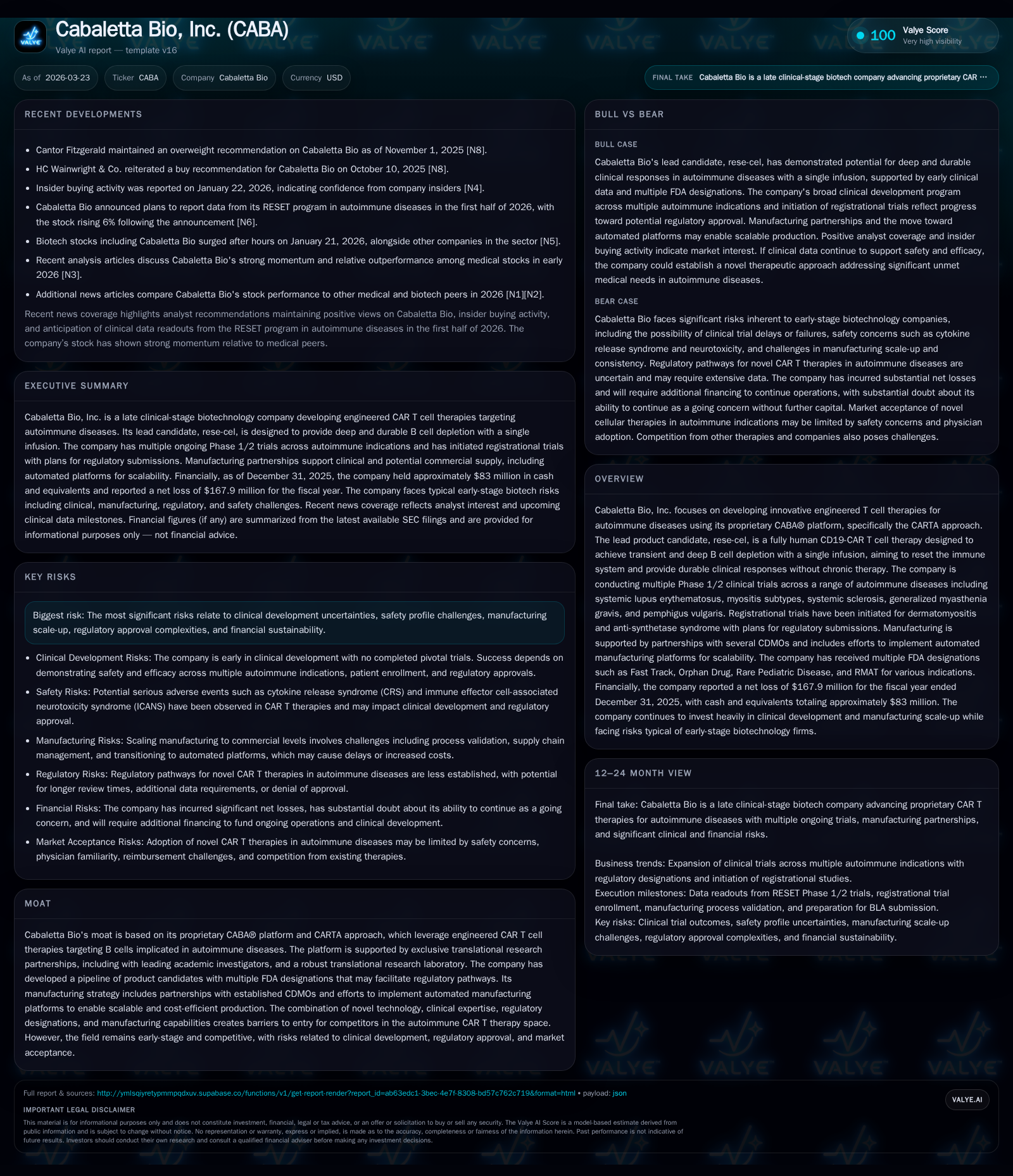
Cabaletta Bio specializes in engineered CD19-CAR T cell therapies aimed at resetting the immune system in autoimmune disorders. Its lead candidate, rese-cel, is progressing through multiple Phase 1/2 trials and recently initiated registrational studies. The company reported growing operating losses with no commercial revenues as of fiscal 2025. Manufacturing scalability is being addressed via automation partnerships, but significant clinical development risks, regulatory complexities, and ongoing cash burn persist. Upcoming clinical readouts and automated manufacturing data will be critical for assessing early validation of Cabaletta’s novel CARTA platform.
Company Overview
Cabaletta Bio is a late clinical-stage biotechnology company focused on developing engineered T cell therapies utilizing its proprietary CABA® (Chimeric Antigen Receptor T cells for Autoimmunity) platform. The company’s CARTA approach aims to provide deep and durable immune system reset through one-time administration targeting pathogenic B cells implicated in autoimmune diseases [S1].
The lead asset, rese-cel (formerly CABA-201), is a fully human CD19-directed CAR T therapy incorporating the 4-1BB co-stimulatory domain designed for profound B cell depletion via a single infusion that allows healthy B cell repopulation—intended to induce long-lasting remission without chronic immunosuppressive therapy [S1].
Historical Performance Drivers
Cabaletta has concentrated on clinical development without product sales revenue to date [F1]. Operating losses have grown substantially due to intensified R&D supporting multiple active Phase 1/2 studies across several autoimmune indications.
Historical performance (annual)
| FY | Net ($mm) | CFO ($mm) | OpInc ($mm) | Capex ($mm) | Net YoY |
|---|---|---|---|---|---|
| 2025 | -168 | -131 | -172 | 1 | -44.9% |
| 2024 | -116 | -88 | -125 | 2 | -71.2% |
| 2023 | -68 | -54 | -75 | 1 | -27.7% |
| 2022 | -53 | -46 | -54 | 2 |
Source: SEC companyfacts cache [F1].
Capital returns and efficiency (annual)
| FY | FCF ($mm) | ROE% |
|---|---|---|
| 2025 | -132 | -149.8 |
| 2024 | -90 | -76.1 |
| 2023 | -54 | -28.7 |
| 2022 | -49 | -50.7 |
Source: SEC companyfacts cache [F1].
Operating losses increased approximately 38% year-over-year from 2024 to 2025 attributable to expanded clinical programs and manufacturing investments [F1]. Net income and operating cash flow trends similarly reflect escalating research activities. Capital expenditures remain small relative to operating expenses.
Equity declined between FY23 and FY25 reflecting cumulative net losses despite any capital raises during that period [F1]. The current ratio near 2.77 at end-2025 indicates solid short-term liquidity management; however sustained cash burn necessitates further funding [F1].
Pipeline Progress and Growth Prospects
Growth depends on validating the CABA® platform’s therapeutic potential across autoimmune disorders where treatments are currently limited. Multiple Phase 1/2 trials target systemic lupus erythematosus (SLE), including lupus nephritis (LN), systemic sclerosis (SSc), generalized myasthenia gravis (gMG), pemphigus vulgaris (PV), dermatomyositis and anti-synthetase syndrome [S1]. Key developments include:
- Initiation of registrational trials in December 2025 for dermatomyositis and anti-synthetase syndrome representing important regulatory milestones.
- Ongoing evaluation of fludarabine/cyclophosphamide preconditioning regimens versus no preconditioning approaches informed by early positive Phase 1/2 data in PV [S1].
- IND clearance in January 2026 for automated manufacturing of rese-cel using Cellares’ Cell Shuttle™ platform enabling scalable production potentially serving thousands annually with minimal capital investment [S1]. Early clinical data from this process expected in H1 2026.
Clinical benefit durability and safety will be pivotal for commercial viability given the nascent status of CAR T therapies in autoimmunity.
Constraints on Growth
Challenges include:
- Uncertain clinical trial outcomes regarding durability and safety profiles.
- Manufacturing scale-up complexities inherent to autologous cellular therapies with associated cost implications.
- Complex regulatory pathways balancing innovation risks against unmet medical needs.
- Uncertain reimbursement landscapes for high-cost one-time therapies treating chronic diseases .
Financial Outlook and Operational Milestones
Near-term focus centers on clinical data readouts from no-preconditioning cohorts and automated manufacturing patients expected in H1 CY2026 [N1][S3]. Registrational trial progress frames longer-term approval timelines extending beyond near term.
With no product revenues or licensing income reported through December 31, 2025 [F1], continued operations rely heavily on capital injections or partnership agreements yet to be publicly disclosed.
Key indicators for investors include:
- Efficacy/safety signals from automated manufacturing batches,
- Regulatory feedback on registrational designs,
- Competitive positioning among emerging autoimmune CAR T developers,
- Cash runway aligned with burn rates,
- Potential strategic partnerships enhancing commercialization prospects.
Capital Allocation and Returns Profile
Cabaletta exhibits substantial negative returns with an approximate -150% return on equity calculated from FY25 net loss relative to shareholders’ equity [F1]. Free cash flow remains deeply negative at approximately -$132 million considering operating cash outflows less capex [F1].
Capital allocation prioritizes:
- Clinical trial advancement,
- Manufacturing capacity expansion including automation technology licensing,
- Translational research collaborations within the CABA platform.
No dividends or share repurchases are indicated as the company remains pre-commercial [F1]. Liquidity concerns were noted with substantial doubt expressed about continuation absent additional funding availability [S27], implying ongoing capital raising needs that may dilute shareholders.
Industry Context & Strategic Moat Assessment
Autoimmune diseases represent a large unmet market characterized by heterogeneous etiologies inadequately managed by chronic immunosuppression or biologics. Cabaletta’s targeted B cell depletion via CAR T offers a potential paradigm shift toward curative one-time treatments contingent on demonstrating durable safety and efficacy.
While oncology dominates current CAR T approvals globally, autoimmune applications represent emerging high-growth potential if technical hurdles are overcome. Cabaletta’s proprietary constructs combined with academic collaborations provide intellectual property barriers alongside translational expertise.
Manufacturing bottlenecks common across cell therapy industry underscore importance of automating vein-to-vein processes; Cabaletta’s partnership with Cellares reflects proactive operational strategy distinguishing it from peers reliant solely on external CDMOs.
Risks Summary
Principal risks encompass:
- Clinical outcome uncertainty with respect to efficacy durability and safety,
- Manufacturing scale-up complexities limiting supply reliability,
- Regulatory challenges amid evolving frameworks for novel biologics,
- Financial sustainability given prolonged cash burn amidst volatile biotech markets,
- Compliance risks related to extensive U.S. healthcare fraud laws including Anti-Kickback Statute/False Claims Act plus global privacy laws such as GDPR requiring robust governance .
Conclusion
Cabaletta Bio operates at the forefront of innovative autoimmune disease treatment leveraging engineered CAR T technologies aimed at durable B cell depletion through limited dosing. While scientific rationale and early data provide optimism as registrational phases commence late 2025/early 2026 [S1], considerable clinical development challenges remain.
Financially the company continues wide losses aligned with exploratory early-to-mid development stages without revenues but supported by solid liquidity balanced against anticipated capital raising needs beyond immediate horizons [F1][S27]. Its forward-looking manufacturing strategy embracing automation positions it distinctly within this emerging therapeutic niche where success depends critically on proving durable safety/efficacy alongside scalable cost-efficient production under rigorous regulation.
Monitoring upcoming clinical durability datasets especially from automation-manufactured batches alongside key regulatory interactions will be essential barometers for Cabaletta’s ability to translate cutting-edge science into commercial reality.
Disclaimer: This is research-only, informational analysis and not investment advice. It may include AI-generated interpretation and general industry context. Always verify important details using primary sources.

Comments